



ESO Update 50 is set to make June 2026 one of the most important months for The Elder Scrolls Online this year. The patch is not just another maintenance beat with a few balance notes attached to it. It brings Challenge Difficulty, Class Mastery, PvP Veterancy, the permanent Vengeance Campaign, Werewolf updates, Guild Mail, player experience improvements, and a stronger reward structure around Golden Pursuits.
The timing gives the update extra weight. ESO joins PC Game Pass and Xbox Play Anywhere on June 2, the Xbox Games Showcase gives players another look at the next seasonal step on June 7, and Update 50 follows on June 8. That sequence creates a cleaner story than another broad 2026 roadmap article. Roadmaps are useful, but they are still promises. Update 50 is where ZeniMax Online Studios has to put those promises into live systems players can test, praise, break, or complain about with the efficiency only MMO players can achieve.
The strongest angle is simple: June is the first real pressure test for ESO's new seasonal model. Season Zero has already started moving the game away from the old annual chapter rhythm, but Update 50 is where the base-game systems begin to carry more of the year. If Challenge Difficulty makes old zones more engaging, if Class Mastery gives pure class builds a reason to exist beside Subclassing, and if PvP Veterancy gives competitive players a lasting reward track, June can make ESO's 2026 direction feel much more credible.
TESO Update 50 Release Date Gives June a Clear Center
ESO Update 50 is scheduled to launch on June 8, 2026, with its main systems arriving as part of Season Zero. The patch matters because it is not built around one feature. It touches overland difficulty, class identity, PvP progression, Cyrodiil rulesets, Werewolf gameplay, guild communication, and broader player experience improvements. That makes it a base-game systems patch rather than a narrow content drop.
The June schedule also gives ESO a better activity curve than a single patch date. PC Game Pass arrives first, then the Xbox Games Showcase points toward Season One, then Update 50 lands, and then PvP events, Golden Pursuits, and Zeal of Zenithar keep the month active. For an MMO, that matters more than it sounds. One announcement creates noise. A month with several playable beats creates reasons to return.
| ESO June 2026 beat | Date | Player impact |
|---|---|---|
| PC Game Pass launch | June 2 | ESO joins PC Game Pass and Xbox Play Anywhere, giving Xbox account players access through the Xbox app on PC and supported handheld devices. |
| Xbox Games Showcase | June 7 | ESO gets a Season One look before Update 50 arrives, connecting the patch to the next seasonal step. |
| Update 50 launch | June 8 | Challenge Difficulty, Class Mastery, PvP Veterancy, Vengeance Campaign, Werewolf updates, Guild Mail, and player experience changes arrive. |
| Three-Sided Chaosball Battlegrounds Spotlight | June 9-17 | PvP players get an immediate event window to test the new reward environment after Update 50. |
| Night Market and Golden Pursuits | Until June 17 | Short-term goals and rewards continue around the patch launch window. |
| Challenge Difficulty Golden Pursuits | Starts June 18 | The new difficulty system gets a reward push instead of being left as a menu option players may ignore. |
| Zeal of Zenithar | June 24-July 8 | The back half of the month keeps the economy and event loop active before Season One becomes the larger focus. |
This is why June is a stronger article angle than a generic ESO 2026 roadmap. The roadmap says where the game wants to go. June shows whether that direction can create actual play patterns. Update 50 has to make the new seasonal structure feel like a working cadence, not just a new label on the same waiting room.
ESO Challenge Difficulty Targets the Overland Problem Directly
Challenge Difficulty is the most important long-term system in ESO Update 50 because it addresses one of the game's oldest complaints: overland content is often too easy for experienced players. ESO has a huge world full of quests, delves, public spaces, story bosses, cults, monsters, Daedric threats, and all the usual disasters that should probably feel more dangerous than a mildly annoyed mudcrab. For veteran characters, many enemies die so quickly that the world loses tension.
The important detail is that Challenge Difficulty is optional. It does not force every player into harder overland combat. Adventurer keeps the current baseline intact, while Seasoned, Master, and Vestige apply stronger personal modifiers to players who want more pressure and better monster rewards. That is the correct design direction for ESO because the game has very different audiences: story players, new players, returning players, solo veterans, alt levelers, completionists, and players who want the open world to bite back.
| Challenge Difficulty tier | Damage taken from monsters | Damage dealt | Reward bonus from monsters |
|---|---|---|---|
| Adventurer | Default | Default | Default rewards |
| Seasoned | 100% more damage taken | 50% less damage dealt | 50% more gold and 20% more experience |
| Master | 300% more damage taken | 65% less damage dealt | 100% more gold and 75% more experience |
| Vestige | 600% more damage taken | 80% less damage dealt | 200% more gold and 100% more experience |
The reward balance is the part that will decide whether the system lasts beyond launch curiosity. If rewards feel too weak, Challenge Difficulty becomes a novelty for players who want screenshots of self-inflicted suffering. If rewards feel too strong, the higher tiers become mandatory for efficient farming. ESO needs the middle ground: enough incentive to make harder overland worth using, but not so much that casual players feel punished for staying on Adventurer.
The system also has one obvious limitation. Challenge Difficulty changes the pressure on the player, but it does not turn every overland enemy into a redesigned encounter with new mechanics. That means the system may improve danger and pacing without fully solving the deeper issue of old enemy behavior. Still, as a base-game lever for making the world less harmless, it is one of the most meaningful Update 50 additions.
ESO Class Mastery Gives Pure Class Builds a Real Counterweight to Subclassing
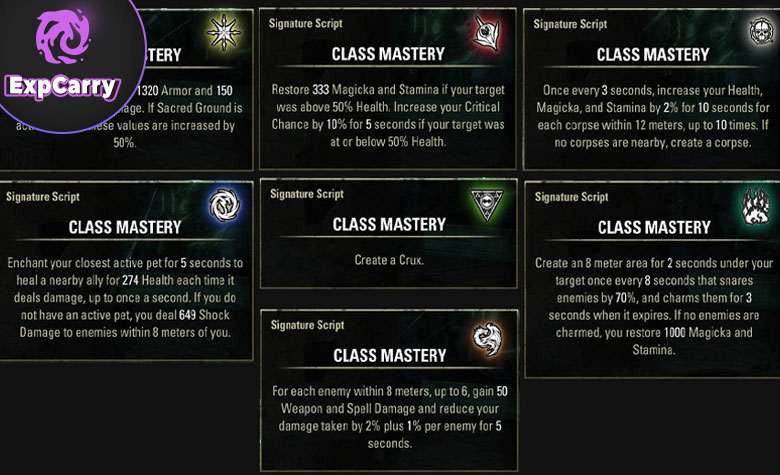
Class Mastery arrives at a useful moment because ESO's build system has been pulled between freedom and identity for years. Subclassing made that tension even stronger. Players can build strange and powerful combinations across class lines, weapons, guild skills, mythics, gear sets, Champion Points, consumables, and other systems. That freedom is one of ESO's best traits. It is also why class identity can get blurry when too much power comes from shared or borrowed tools.
Update 50's Class Mastery system is designed to reward characters that stay committed to their native class. To unlock it, a character needs level 50 in all three of their own class skill lines and cannot actively use Subclassing. Once unlocked, Class Mastery gives each class five passive options, with players able to choose two. These choices do not use normal skill points, which keeps the system from competing directly with the rest of a build's basic skill budget.
The system gives Dragonknight, Nightblade, Sorcerer, Templar, Warden, Necromancer, and Arcanist players a reason to ask whether pure class identity is worth keeping. That question matters because Subclassing can easily dominate the build conversation if pure classes do not receive a meaningful reason to stay pure. Class Mastery is ZeniMax's first clear answer to that problem in the 2026 seasonal structure.
The risk is tuning. If Class Mastery passives are weak, players will treat them as a consolation prize for not using stronger Subclassing setups. If they are too strong, they can create a new meta problem in high-end PvE and PvP. ESO players will find broken interactions quickly, because apparently no passive can exist for more than five minutes before someone turns it into a spreadsheet with hostile intent. The best version of Class Mastery strengthens class flavor without shrinking buildcraft.
ESO PvP Veterancy Gives Competitive Players a Longer Reward Track
PvP Veterancy gives Update 50 a stronger competitive hook than a normal Battlegrounds spotlight or limited event. It is a free PvP progression system tied to Alliance Points and experience earned through Cyrodiil, Imperial City, and Battlegrounds. The system is account-wide, so progress is not locked to one character. That is important in a game where PvP players often swap builds, classes, and roles depending on campaign conditions or balance changes.
The reward track includes ranks, milestone rewards, temporary titles, currencies, collectibles, Trade Bars, and Vengeance-related perks. It is also built around a PvP season structure that lasts roughly six months. That gives competitive players a clearer long-term loop: fight, earn progress, unlock rewards, reach the cap, and continue into repeatable rewards instead of relying only on event windows or old campaign habits.
This does not fix every PvP issue by itself. Cyrodiil performance, population habits, faction balance, campaign identity, reward value, and combat balance are bigger than one track. But Veterancy gives ESO PvP something it has needed for a long time: a more visible reward spine. Players are much more likely to keep engaging with PvP when the game clearly recognizes that time with ranks and seasonal rewards, not just another pile of battlefield fatigue and repair bills.
ESO Vengeance Campaign Tests Normalized PvP on a Permanent Ruleset
The Vengeance Campaign is the sharper PvP experiment in Update 50. Unlike standard Cyrodiil campaigns, Vengeance uses normalized stats and gear, pushing the mode toward fairer competition and away from raw gear advantage. That makes it easier to understand as a separate PvP space: less about who has the most optimized setup built across years of grinding, and more about skill, timing, ruleset knowledge, and the choices allowed within the mode.
Making Vengeance permanent is the real commitment. Temporary special campaigns can vanish if they fail. A permanent campaign has to survive population shifts, reward debates, balance complaints, and the usual PvP talent for detecting unfairness with the sensitivity of a smoke alarm in a toaster factory. If the mode keeps enough players after launch curiosity fades, it could become one of ESO's more important PvP additions in 2026.
The early Vengeance perks tied to Veterancy are worth watching because they can shape how fair the campaign feels. If the perks create a small sense of progression without overwhelming the normalized structure, they help the mode. If they become mandatory pressure points, the campaign risks recreating the same advantage problem it is trying to avoid. That balance will decide whether Vengeance feels like a fair alternative or just another ruleset players optimize until it squeals.
Three-Sided Chaosball Gives Update 50 an Immediate PvP Push
The Three-Sided Chaosball Battlegrounds Spotlight runs from June 9 to June 17, directly after Update 50. The timing is useful because it gives PvP players a reason to test the new systems immediately instead of waiting for the patch discussion to cool off. PvP systems need active populations at launch, and a focused event window can help create that early concentration.
The event itself is not the foundation of the PvP update. It is support structure. PvP Veterancy and Vengeance have to carry the long-term value, while Chaosball gives the first week a sharper activity point. If the new progression track feels rewarding, the event becomes a launch accelerator. If the track feels thin, the event becomes another short spike with a scoreboard attached.
ESO PC Game Pass Launch Opens the Door, but Not for Every PC Account
ESO's PC Game Pass launch on June 2 is well timed because it arrives just before Update 50. The game joins Xbox Play Anywhere through PC Game Pass, letting players use an Xbox account through the Xbox app on PC or supported handheld devices. That gives ESO a wider access point right before a major base-game patch, which is much stronger than dropping into a subscription library during a quiet month.
The key detail is that this is still tied to the Xbox ecosystem. ESO's support page notes that the Xbox app for PC version uses Xbox servers, even when played on PC or on the ROG Ally. Players who already own or access the Xbox version can use their ESO Xbox account through that route. That distinction matters because this should not be framed as a full merge between the traditional PC/Mac account environment and Xbox servers.
That makes the Game Pass launch useful but not magical. It can bring more players to ESO through a convenient access point, especially on PC handhelds and Xbox-linked setups. It does not erase the game's onboarding problem. New players still have to understand zones, DLC, chapters, classes, Subclassing, Champion Points, crafting, events, currencies, companions, guilds, PvP, dungeons-service">dungeons-services">dungeons, and whichever menu decided to become a second job. Update 50 gives them a better reason to arrive, but ESO still has to explain itself once they are inside.
ESO Golden Pursuits Turn New Systems Into Actual Player Behavior
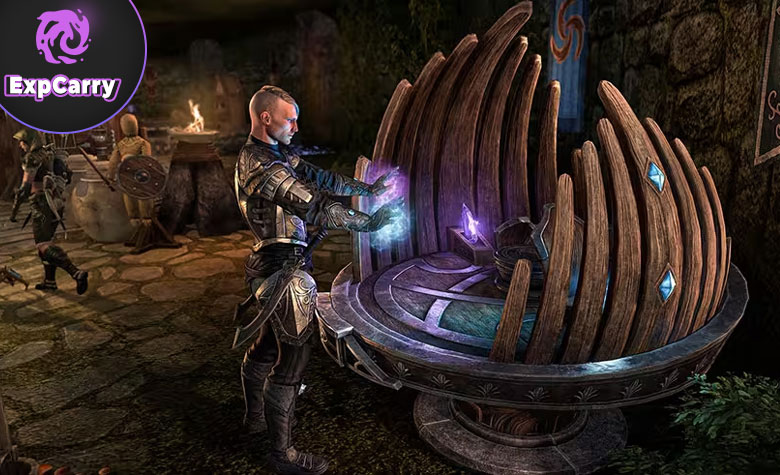
Golden Pursuits matter in June because they give Update 50's systems a reward framework. The Night Market and its related Golden Pursuits campaign continue into the month, while a new Challenge Difficulty Golden Pursuits campaign starts on June 18. That second campaign is especially important because it pushes players toward the new difficulty system soon after launch.
This is the kind of structure ESO needs if the seasonal model is going to work. A feature can be well designed and still be ignored if players are not nudged toward it. Golden Pursuits give short-term goals, currencies, Crown Crates, and other rewards that turn "this system exists" into "players are actually testing this system." MMO players like choice, but they also like being paid for their curiosity. Civilization remains tragic, but at least predictable.
The same logic applies to the wider June calendar. Update 50 cannot carry the month alone. Events, reward campaigns, and Season One previews help turn a patch into a live rhythm. That rhythm is what ESO needs more than another broad promise about the future. The new model will only work if each month gives players something concrete to do, earn, and judge.
ESO Update 50 Still Has Execution Risks
Update 50 has the right targets, but that does not mean every system is guaranteed to land cleanly. Challenge Difficulty has to feel rewarding without becoming mandatory. Class Mastery has to support pure classes without punishing creative builds. PvP Veterancy has to make PvP feel more rewarding without becoming a mechanical grind. Vengeance has to stay fair after players discover the strongest choices inside its normalized ruleset.
The patch also arrives while ESO is asking players to accept a broader structural change. The move toward seasons, base-game updates, and recurring system improvements can work, but only if those updates feel substantial. Players are not going to judge the model by the name "Season Zero." They will judge it by whether Update 50 makes the game better to play in June.
That is why the June angle is stronger than a simple feature list. The story is not only that ESO is adding difficulty settings, class passives, PvP progression, and Game Pass access. The story is that all of these changes arrive together at a moment when ESO needs to prove its new yearly rhythm can create momentum without leaning entirely on the old chapter structure.
ESO Update 50 Makes June 2026 a Trust Check for the New Model
ESO Update 50 is ultimately a trust check. Players have heard enough MMO promises to know that a roadmap is cheap until it survives contact with the live game. Challenge Difficulty has to make overland content feel less harmless for players who want pressure. Class Mastery has to make pure class builds feel like a real choice. PvP Veterancy has to give competitive players a reward track worth repeating. Vengeance has to prove normalized PvP can hold a stable audience. PC Game Pass has to bring new access without making the game's complexity feel like a wall.
The patch does not need to solve every ESO problem. No single update can do that, and pretending otherwise would be fantasy in the least useful sense of the word. What Update 50 needs to prove is simpler: ESO's base game can still evolve in ways players feel immediately. If June delivers that, the 2026 seasonal structure starts to look like a real shift rather than a new wrapper for old habits.
If the systems launch weakly, the month will expose that quickly. Difficulty rewards that feel wrong, Class Mastery passives that fail to compete, PvP progression that feels too thin, or a Vengeance Campaign that cannot keep players would all damage the larger seasonal pitch. But if the systems land well, Update 50 gives ESO exactly what it needs in June: a concrete reason for players to stop talking about the roadmap and start judging the game itself.
Conclusion
ESO Update 50 gives June 2026 a stronger hook than another broad roadmap discussion. The patch brings Challenge Difficulty, Class Mastery, PvP Veterancy, the permanent Vengeance Campaign, Werewolf updates, Guild Mail, and player experience improvements, while PC Game Pass and Xbox Play Anywhere add a wider access point at the start of the month.
The best part of June is the sequence. PC Game Pass arrives on June 2, the Xbox Games Showcase follows on June 7, Update 50 launches on June 8, Three-Sided Chaosball begins on June 9, Golden Pursuits push players toward new rewards, and Zeal of Zenithar carries the back half of the month into July. That gives ESO a real activity curve instead of one patch note dump and a polite hope that players will entertain themselves.
The harder part is execution. Challenge Difficulty needs rewards that respect player effort without turning higher tiers into mandatory farming. Class Mastery needs to strengthen class identity without making Subclassing feel like the only serious path or pure classes feel like a decorative compromise. PvP Veterancy needs to reward long-term participation without becoming another grind bar players fill out of obligation. Vengeance needs to make normalized PvP feel fair after the first wave of curiosity fades.
June will not decide ESO's entire future, because no single update can carry a game this large by itself. But Update 50 will shape how players judge the new 2026 structure. If the systems land well, ESO looks like an older MMO using its base game as an advantage instead of dragging it around like legacy baggage. If they land weakly, the roadmap will look cleaner than the live game, which is one of the most familiar MMO problems ever invented.