



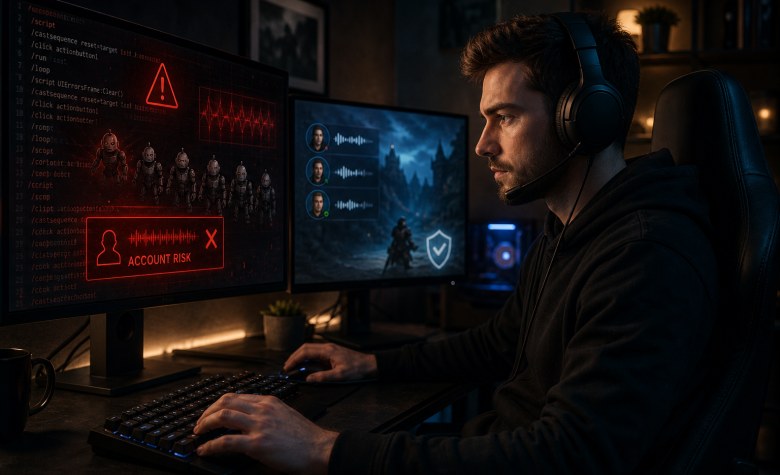
You've probably seen it a hundred times. A " boosting service " promises you Mythic+ gear, a Gladiator title, or a max-level character—all at a price that sounds almost too good to be true. Spoiler alert: Most of the time, it is. Because behind this suspiciously cheap offer, there's a high probability of a script, not a real player. And this small detail can end up costing you significantly more than the amount you initially saved.
The bot problem that nobody talks about
Here's the uncomfortable truth: A large part of the boosting market is based on automation. Predefined farming routes, macro-controlled rotations, and auto-clickers sold as "premium services"—all of this is widespread, and most customers don't even know what they're actually paying for.
Why is this important for you? Because game developers have become very good at detecting bot behavior. Movement patterns that are too perfect. Reaction times that no human can consistently achieve. Actions performed at intervals that a real player couldn't physically reproduce. If the detection is triggered, it's not the boosting service that gets banned, but your account.
Think about it for a moment. You're handing over your login credentials, years of game progress, rare mounts, and achievements to a service that might be using the very software explicitly prohibited by its terms of service. And when the ban hammer falls, there's no refund that can bring back a level 80 character with a ten-year history.
What manual execution really means
At this point, the distinction ceases to be merely a marketing buzzword and becomes genuinely important. In an industry saturated with generic advertising promises, irrelevant entertainment recommendation , and automated offers, it can be difficult to discern what a service truly delivers.
In manual execution, a real, experienced player sits at the keyboard and makes decisions in real time. They observe enemy cooldowns in PvP, spontaneously adjust their rotation during a Mythic+ pull, and react to a raid mechanic that may have been changed via hotfix just yesterday.
Bots can't do that. A script follows a predetermined sequence. It can't improvise if the tank pulls an additional group of enemies, provoke a trinket use in the arena, or recognize that the meta has changed after last week's patch.
Manual boosting isn't just safer. It's the only method that can actually deliver the results you're paying for. Because a real player brings genuine game understanding, not just automated repetitions.
The ban waves are real.
Every few months, major MMOs conduct comprehensive detection campaigns, and the results are devastating. Thousands of accounts are banned overnight. Many of these belong to players who never used automation software themselves—they simply paid someone else to do it.
Publishers don't differentiate between "I didn't know about it" and "I did it myself." The penalty is applied to the account. Period.
That's why trustworthy boosting services clearly and specifically explain how they work: exclusively manual execution. No bots, no scripts, and no shortcuts that could land your account on a watchlist.
In a service description, this might seem like a small detail, but it is precisely this that differentiates between normally leveling up your character and risking ending their story for good.
This is how you can really tell the difference
You don't need to be a security expert to protect yourself. A few practical tests are enough.
A price that seems impossibly low. Human labor costs money. If a service charges only a fraction of what competitors charge for the same result, you should ask yourself where costs are being cut. Often the answer is: automation.
Unclear or missing information about how the process works. Reputable providers explain their procedures: pilot mode or self-play, streaming options for real-time account monitoring, and direct communication with the booster. If a website doesn't reveal who is actually playing, that's a red flag.
No live support and no visible community. Real gaming teams usually have recognizable support channels – live chat, Discord communities, and transparent order tracking. An anonymous provider with no way to contact a human should make you suspicious.
Look for reviews that explicitly mention account security. Pay attention to feedback that talks about account suspensions, security, and communication – and not just that an order was completed quickly.
The conclusion
Speed and price certainly play a role. However, the real purpose of a boost is to save time without jeopardizing your account. If the chosen method puts everything you've built up at risk, it's not a shortcut, but a gamble where your account is the stake.
The gaming industry is constantly gaining new players. New titles build their own communities and boosting ecosystems, where trust and a good reputation still need to be earned through hard work.
Regardless of which game you are playing or which service you are considering, the same rule applies: ask who or what is actually at the keyboard before you give out your login details.
Because boosting is just like the game itself: the players who understand the mechanics are almost always the ones who end up in the lead.