



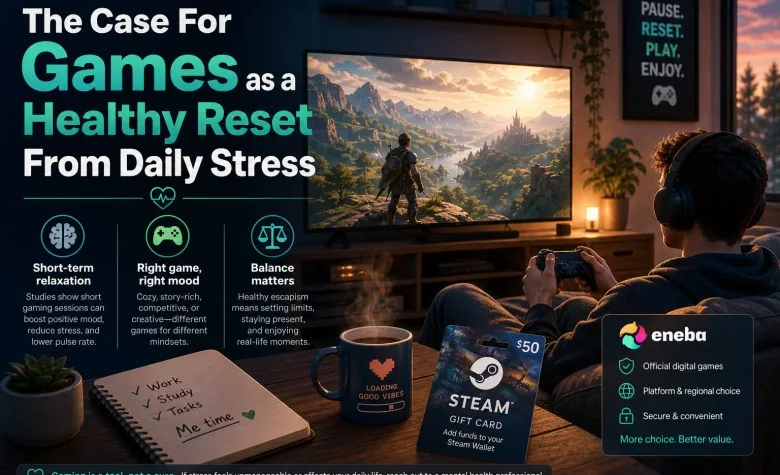
Daily pressure rarely ends the moment work, school, or household tasks stop. A well-chosen game can mark a deliberate transition into personal time. In a 2024 study of 40 university students, a short gaming session was followed by increased positive affect, decreased negative affect, and a lower pulse rate. A 2009 survey of 1,614 participants also found that people commonly used video and computer games after stressful or exhausting situations. That supports a brief reset, not treatment for persistent stress or impaired functioning.
Players can buy digital games through official platform stores or digital marketplaces. gift cards for Steam games can provide Steam Wallet credit for a later choice, and Eneba presents platform and regional categories that help shoppers browse across platforms and regions. Clear region tags also support selecting an option that suits the intended account.
Four practical picks for a calmer break
Genre fit and the reason for playing shape the experience. Each pick can fit a planned stopping point.
1. A short-session casual game is a strong pick for an overloaded evening. Its contained objective gives attention one clear place to go, then lets the player stop at a natural endpoint.
2. An open-world exploration game suits someone who wants autonomy instead of another fixed demand. Research with postgraduate students examined exploration, relaxation, cognitive escapism, and well-being in this setting, though it does not promise the same response for every player.
3. A creative building game can suit a player who wants a small, self-directed project. Choosing what to make and working at a personal pace can turn the session into a quieter form of engagement.
4. A cooperative game is a good pick when shared time feels restorative. Reviews describe social gaming as a potential source of recovery and connection, while the tone and quality of interaction remain important.
A player who wants a clear task may find a casual session more helpful than an expansive world, while another may prefer the freedom to explore. Personal motivation and context guide the fit.
Escapism works best as a return trip
Healthy escapism is temporary psychological distance, not a solution to the source of pressure. A game can briefly redirect attention toward a focused puzzle or a quiet stretch of exploration. The benefit lies in returning to daily life refreshed enough to re-engage with it.
That return trip keeps the reset in proportion. Reviews link escapist motivation with problematic gaming and poorer mental-health outcomes in some research, though much of that evidence is correlational and self-reported. Persistent anxiety, depression, severe stress, or impaired functioning deserves qualified professional support rather than gaming alone.
Balance protects the value of play
Choose the reset that matches the moment. Calm exploration or creative play may suit overstimulation, while a short structured session can fit a player seeking a defined break. Set an endpoint before starting and keep space for sleep, meals, movement, responsibilities, and offline relationships.
Pew found that 41% of U.S. teen players said gaming had hurt the sleep they got. The World Health Organization describes gaming disorder as impaired control, priority over other activities, and continued play despite negative consequences. Digital marketplaces like Eneba offer deals on digital products and can help players choose games or gift-card credit that fits intentional leisure.