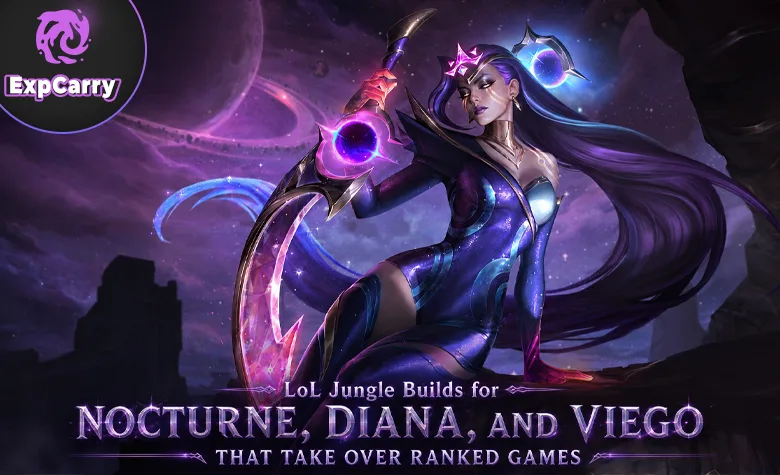
Choosing the right LoL jungle build in Patch 26.21 means understanding what your champion needs to accomplish before the first teamfight. Nocturne, Diana, and Viego offer three very different ways to carry ranked games. Nocturne threatens isolated enemies with Paranoia, Diana brings magic damage and powerful grouped engages, and Viego turns the first takedown into a potential chain of possessions. All three can win games, but none can ignore lane priority, jungle tempo, or the enemy team's tools for stopping an engage.
This guide covers current jungle builds for Nocturne, Diana, and Viego in live Summoner's Rift, including runes, items, skill order, first clears, recalls, matchups, bans, objectives, and teamfight plans. The biggest change from the older Patch 26.9 recommendations is Nocturne's popular move toward a Hail of Blades lethality build, while Diana's AP bruiser setup and Viego's Kraken Slayer core remain recognizable. The aim is to give you a plan you can use in solo queue, with clear reasons to change it when the match demands something different.
Short answer: Use Hail of Blades with Profane Hydra on Nocturne for pick damage, Conqueror with Dusk and Dawn on Diana for AP engage, and Conqueror with Kraken Slayer on Viego for sustained skirmishing and resets.
LoL Patch 26.21 Jungle Builds for Ranked
Nocturne is the direct pick jungler: he farms toward level six, then looks for enemies who have pushed too far or used their escape tools. Diana is the AP engage choice when your composition needs magic damage and a champion who can punish grouped opponents. Viego is the skirmish carry who becomes more threatening after the first enemy falls. These roles have not disappeared in Patch 26.21, but their strength still depends on the draft and on whether your team can support the first engage.
Current ranked data makes it important not to call Nocturne the strongest statistical pick of these three. His clear game plan is appealing, but the champion has a less comfortable matchup spread than the old guide suggested, and the popular build has shifted toward burst and lethality. Diana and Viego remain viable for different reasons, with Diana offering AP pressure and Viego rewarding well-timed fights. Riot's Patch 26.21 notes also include jungle balance changes, so older assumptions about opponents such as Rammus and Nidalee should not be treated as permanent facts.
| Champion | Draft role | Main rune | Core item | Best use case |
|---|---|---|---|---|
| Nocturne | Level-six ganker and backline assassin | Hail of Blades | Profane Hydra | Picking off isolated carries and punishing exposed side lanes |
| Diana | AP jungler and teamfight engager | Conqueror | Dusk and Dawn | Adding magic damage and threatening grouped opponents |
| Viego | Skirmish carry and reset jungler | Conqueror | Kraken Slayer | Finishing a vulnerable target and chaining possessions |
LoL Nocturne Jungle Build for Patch 26.21
Nocturne still offers one of the clearest level-six game plans in the jungle, but that does not automatically make him the strongest blind pick in the current meta. He clears camps efficiently, threatens lanes with Paranoia, and punishes carries that position without respecting his ultimate range. His basic abilities support this playstyle: Duskbringer helps him chase, Shroud of Darkness can block an important spell, and Unspeakable Horror can fear a target that fails to break the tether. Riot's official Nocturne champion page provides the ability overview behind this approach.
The more common Patch 26.21 Nocturne setup uses Hail of Blades, Profane Hydra, Axiom Arc, and Voltaic Cyclosword for fast damage after he reaches a target. Conqueror with Experimental Hexplate remains a bruiser alternative when fights are likely to continue after the initial engage, but it should no longer be presented as his only standard build. The important tradeoff is straightforward: a lethality Nocturne kills exposed carries more quickly, while a bruiser setup gives him more room to survive prolonged fights. Choose based on whether the enemy team can protect its damage dealers after you press R.
Nocturne runes for jungle
Hail of Blades supports Nocturne's current burst-oriented setup by accelerating his opening attacks once he reaches an enemy. Sudden Impact improves offensive follow-up after his ultimate, while Grisly Mementos and Ultimate Hunter reward takedowns and frequent map pressure. Triumph and Legend: Alacrity make a useful secondary Precision combination for fights and clearing. The rune page is strongest when you choose targets carefully rather than turning every available ultimate into an automatic dive.
| Tree | Rune | Reason |
|---|---|---|
| Domination | Hail of Blades | Fast opening attacks after an engage |
| Domination | Sudden Impact | Extra offensive value when closing distance |
| Domination | Grisly Mementos | Rewards takedowns and aggressive map pressure |
| Domination | Ultimate Hunter | More frequent Paranoia opportunities |
| Precision | Triumph | Survival value after takedowns |
| Precision | Legend: Alacrity | Attack speed for camps and fights |
| Shards | Attack Speed / Adaptive Force / Scaling Health | Clear speed, damage, and durability |
Conqueror is still playable when you commit to an extended-fight bruiser build, especially if the enemy team has several durable melee champions. In that setup, Triumph, Legend: Alacrity, Last Stand, Grisly Mementos, and Ultimate Hunter remain a coherent page. The current Hail of Blades setup is better aligned with the popular lethality item path, however, and using the old rune page with a new burst build without thinking through the tradeoff can undermine both plans.
Nocturne items and full build path
Profane Hydra is the main first-item damage spike in the popular Patch 26.21 lethality build. Axiom Arc supports repeated ultimate-based plays, while Voltaic Cyclosword helps threaten vulnerable targets after closing the distance. Armor penetration and defensive options become more important as the enemy team adapts. Nocturne can deal impressive opening damage, but an item build is unsuccessful if he reaches the target and immediately dies before the fight is decided.
| Order | Item | Purpose |
|---|---|---|
| Jungle companion | Gustwalker Hatchling or Mosstomper Seedling | Map movement or extra protection |
| First item | Profane Hydra | Damage, clearing, and burst follow-up |
| Boots | Plated Steelcaps | Protection against physical damage and basic attacks |
| Second item | Axiom Arc | Lethality and ultimate-focused fight tempo |
| Third item | Voltaic Cyclosword | Extra pressure when reaching a target |
| Fourth item | Lord Dominik's Regards | Armor penetration when targets become harder to kill |
| Fifth item | Edge of Night or Guardian Angel | Protection against key spells or late-game death risk |
Mercury's Treads become more attractive against important crowd control and magic damage, while Maw of Malmortius can protect against threatening AP burst. Edge of Night is useful when blocking one spell lets you reach an otherwise protected carry, and Guardian Angel can help when a late death would decide the match. If you prefer the bruiser route, Experimental Hexplate into Stridebreaker, Black Cleaver, and defensive items remains a situational alternative with Conqueror. The goal is to match the build to the fight you expect, not to combine unrelated items because they all looked good on different screenshots.
Nocturne first clear, first recall, and ban priority
Nocturne usually benefits from a full clear toward level four, with a Scuttle contest or gank afterward if the lane state allows it. You can start at either buff and clear through the nearby camps toward the opposite side, but your destination matters more than memorizing one permanent route. Path toward the lane that can set up a reliable play or toward the side where you need to cover an expected enemy move. His level-six ultimate is a major spike, so sacrificing several camps for a low-probability early gank often makes the next few minutes harder than they need to be.
On the first recall, prioritize useful damage components toward Profane Hydra while staying healthy enough to resume clearing and contesting the map. Early defensive boots can be justified if the opposing jungler and lanes threaten repeated physical-damage fights, but buying them automatically delays your first damage spike. Rammus remains a relevant anti-auto-attack opponent despite the nerf to Defensive Ball Curl in Patch 26.21, while Udyr, Rek'Sai, and Poppy can challenge Nocturne through early pressure or anti-dive tools. Pick bans based on matchups you actually encounter, and use individual LoL coaching as a natural place to review whether your first clear and recall decisions are costing you more games than your champion choice.
Nocturne skill order and jungle pathing
Nocturne normally maxes Q first, E second, and W last, taking R whenever it is available. Duskbringer supplies clear damage and movement on its trail, Unspeakable Horror adds fear for ganks, and Shroud of Darkness rewards precise timing against enemy spells. You should not treat the spell shield as permission to dive into several available crowd-control abilities. The strength of the kit comes from reaching one important target under favorable conditions.
| Skill priority | Ability | Use |
|---|---|---|
| Max first | Q — Duskbringer | Clearing, damage, chasing, and movement trail |
| Max second | E — Unspeakable Horror | Fear and stronger gank lockdown |
| Max third | W — Shroud of Darkness | Blocking a decisive enemy ability |
| Take whenever possible | R — Paranoia | Vision denial, targeted engage, and map pressure |
The best Nocturne games come from efficient farming, timely level-six pressure, and choosing targets who cannot easily escape or receive immediate protection. Before committing Paranoia, look at the minion wave, nearby enemies, and the target's defensive cooldowns. If the dive is unlikely to earn a kill, summoner spell, or objective, keeping your ultimate for a better window may be the smarter play. Missing two camps for a failed gank is not the end of the world, but repeating that mistake can erase the advantage your champion was supposed to create.
Nocturne counters and good matchups
Nocturne dislikes champions who can withstand his opening damage, prevent access to a carry, or force fights before he reaches his ultimate spike. The matchups below describe practical threats rather than promising a particular win rate at every rank. Their difficulty also changes with lane priority: a strong early enemy jungler becomes much more dangerous when both nearby lanes can move first. Plan your route around those conditions instead of assuming the champion names alone determine the outcome.
| Opponent | Why it is difficult | Nocturne response |
|---|---|---|
| Shyvana | Fast farming and scaling can punish wasted Nocturne tempo | Track her route, pressure exposed lanes, and trade objectives intelligently |
| Udyr | Strong clear speed, dueling, and prolonged fights | Avoid needless early duels and create pressure where he is absent |
| Rammus | Taunt, armor, and anti-basic-attack pressure | Avoid committing onto him and prioritize vulnerable targets |
| Rek'Sai | Early skirmishes and invasions can delay level six | Ward entrances and trade camps rather than accept unfavorable fights |
| Poppy | Disengage and protection against direct approaches | Wait for key cooldowns and approach isolated enemies |
| Opponent | Opportunity | Best plan |
|---|---|---|
| Naafiri | Can be punished after committing to an approach | Time W around important damage and fight with fear available |
| Qiyana | Paranoia can threaten her side-lane plays | Track terrain approaches and avoid fighting blindly in her preferred areas |
| Dr. Mundo | Pressure the map before his durability becomes overwhelming | Play through lanes and avoid wasting burst on the frontline |
| Master Yi | Fear can interrupt his attack pattern after Alpha Strike | Time E around his engage and avoid feeding him free farm |
Nocturne teamfight and objective plan
Nocturne should not automatically use Paranoia on the enemy ADC the moment it becomes available. A carry protected by several crowd-control abilities is often a terrible first target, especially with a lethality build that offers less room for error than a bruiser setup. Look for isolated targets, enemies who have spent mobility, or opportunities created by a teammate's engage. Sometimes casting the ultimate to disrupt enemy vision before a coordinated fight is more useful than immediately diving into the center of the opposing team.
At objectives, Nocturne can punish enemies who separate from their teammates while trying to establish vision. His ultimate reduces the opposing team's access to shared information and creates an opportunity to collapse onto a vulnerable champion. Use the surrounding terrain, available wards, and your team's position before choosing a target near dragon or Baron. His job is to make the objective setup dangerous for isolated enemies, not to win every front-to-back five-on-five by himself.
LoL Diana Jungle Build for Patch 26.21
Diana provides the magic-damage option in this champion pool. She clears jungle camps quickly, benefits from repeated spell-and-attack combinations, and threatens grouped enemies with Moonfall. This makes her useful when the rest of your team deals mostly physical damage or lacks a reliable way to engage a clustered fight. Riot's official Diana ability overview explains her passive attack pattern, which is an important reason attack speed and well-timed basic attacks matter between spells.
Diana should still be viewed as a deliberate AP draft choice rather than a completely safe blind pick. Her common Patch 26.21 build uses Conqueror, Dusk and Dawn, Riftmaker, and Zhonya's Hourglass, combining sustained damage with enough protection to survive an aggressive entry. She becomes much harder to use when opponents can interrupt Lunar Rush, disengage from Moonfall, or invade before her first item spike. Pick her when your teammates can follow the engage, not simply because you need someone with an AP icon on the champion select screen.
Diana runes for jungle
Conqueror works well for Diana because she often continues attacking and casting after entering a fight. Triumph helps her survive takedowns, Legend: Alacrity supports her passive attack rhythm, and Coup de Grace improves finishing damage. Magical Footwear and Cosmic Insight are efficient secondary options when the game allows you to reach your core purchases without early boots. This page supports the AP bruiser approach rather than relying entirely on one perfect burst combo.
| Tree | Rune | Reason |
|---|---|---|
| Precision | Conqueror | Damage during extended fights |
| Precision | Triumph | Survival after takedowns |
| Precision | Legend: Alacrity | Faster attacks, clearing, and passive activations |
| Precision | Coup de Grace | Finishing damaged targets |
| Inspiration | Magical Footwear | Saving gold for the AP core when early boots are unnecessary |
| Inspiration | Cosmic Insight | Useful summoner and item cooldown benefits |
| Shards | Attack Speed / Adaptive Force / Scaling Health | Clear speed, damage, and safety |
Electrocute remains an alternative for burst-oriented Diana builds, but it changes how you expect to win fights. Conqueror makes more sense when you can stay near targets long enough to benefit from repeated attacks, shields, and abilities. If the opposing team can disengage every time you enter, neither rune will solve the problem by itself. Your approach angle and teammate follow-up still determine whether Diana's engage achieves anything.
Diana items and full build path
Dusk and Dawn is a popular first purchase for Diana because it fits her combination of spells and empowered attacks. Riftmaker strengthens her performance in longer fights, while Zhonya's Hourglass offers protection after she dives into danger. Rabadon's Deathcap and a final damage or penetration item round out the standard AP setup. The core is recognizable from earlier patches, but item timing should still change when the enemy composition makes an aggressive entry particularly risky.
| Order | Item | Purpose |
|---|---|---|
| Jungle companion | Scorchclaw Pup or Gustwalker Hatchling | Extra offensive pressure or map movement |
| First item | Dusk and Dawn | AP damage and repeated spell-and-attack value |
| Boots | Sorcerer's Shoes | Magic penetration for offensive pressure |
| Second item | Riftmaker | Improved damage and durability in extended fights |
| Third item | Zhonya's Hourglass | Safety after diving into the enemy team |
| Fourth item | Rabadon's Deathcap | Major AP scaling |
| Fifth item | Shadowflame or Void Staff | Burst against fragile targets or penetration against magic resistance |
Nashor's Tooth remains an option when repeated basic attacks and objective damage matter, while Hextech Rocketbelt can help against teams that are difficult to reach. Banshee's Veil is useful when an important spell might stop the engage before Diana gets into position. Zhonya's Hourglass is particularly valuable when she needs to survive in the middle of several opponents, but it cannot repair an engage that starts too far away from her teammates. Build for the fight that is likely to happen, not the one where every enemy conveniently stands still.
Diana first clear, first recall, and ban priority
Diana usually wants an efficient full clear, using her spells and passive attacks to keep camps moving without unnecessary delays. Choose the starting side based on which lane will offer useful priority or an early objective opportunity after your clear. A pre-six gank can work when an ally has crowd control or the target is clearly overextended, but repeated low-probability ganks delay the items that make Diana threatening. Protect your farming tempo and do not start a river fight merely because Scuttle is available.
On your first recall, work toward Dusk and Dawn with practical AP and component purchases, or prioritize boots if movement and early survival demand them. Sorcerer's Shoes increase offensive pressure, but buying them should not automatically delay a stronger first-item timing. Jarvan IV, Shyvana, Lillia, Rek'Sai, and Poppy are examples of opponents worth considering in champion select because of their ability to contest early movement, outpace Diana, or disrupt her engage. The best ban depends on which of those problems your own team composition is least equipped to solve.
Diana skill order and jungle pathing
Diana normally maxes Q first, W second, and E last, taking R whenever it is available. Crescent Strike provides clear damage and marks targets for Lunar Rush, Pale Cascade adds shielding and damage at close range, and Lunar Rush can reward correctly timed use on marked enemies. Her early power comes from combining these abilities efficiently rather than maximizing the dash first. When deciding whether to fight, remember that using Lunar Rush without a reliable follow-up can leave Diana standing in a very dangerous place.
| Skill priority | Ability | Use |
|---|---|---|
| Max first | Q — Crescent Strike | Clearing, poke, and marked-target setup |
| Max second | W — Pale Cascade | Shields, camp durability, and close-range damage |
| Max third | E — Lunar Rush | Mobility and follow-up after landing Q |
| Take whenever possible | R — Moonfall | Grouped engage and teamfight control |
Diana benefits from a full clear because staying ahead on levels and item components makes her later objective fights more threatening. Track the enemy jungler, take Scuttle when nearby lanes can help, and trade camps across the map when the opponent has stronger early skirmishing. After level six, look for angles where Moonfall can catch multiple enemies without forcing you to engage alone. A failed fight that costs camps, an objective, and your ultimate is far more damaging than quietly giving up one crab.
Diana counters and good matchups
Diana struggles most when an opponent can challenge her early clearing route or prevent her from reaching high-value targets. Against these champions, the answer is often to avoid giving them their preferred fight rather than attempting to prove you can win every duel. More comfortable matchups still require vision, lane priority, and sensible timing. The following table focuses on practical interaction patterns, since matchup numbers can move between ranks and regions.
| Opponent | Why it is difficult | Diana response |
|---|---|---|
| Viego | Can punish a committed engage and start resets afterward | Do not dive first without follow-up and prevent the opening takedown |
| Rek'Sai | Early pressure can interrupt Diana's farming plan | Track her route, protect entrances, and trade camps when necessary |
| Xin Zhao | Strong early dueling and tools against direct engages | Avoid isolated early fights and aim for coordinated level-six plays |
| Lee Sin | Can force early fights and invade before Diana is ready | Read his first route and punish wasted ganks by taking camps |
| Poppy | Can interrupt Diana's dash and disengage from fights | Wait for defensive cooldowns before committing Lunar Rush |
| Opponent | Opportunity | Best plan |
|---|---|---|
| Dr. Mundo | Can pressure lanes before his durability becomes overwhelming | Clear efficiently and use early tempo rather than fighting him endlessly |
| Volibear | Can contribute strong grouped damage after avoiding early duels | Track early ganks and look for coordinated fights later |
| Amumu | Can match farming tempo when early lanes provide help | Contest with priority and avoid stacking into his crowd control |
| Brand | Can reach him after his important spells are unavailable | Approach with vision and avoid losing too much health before engaging |
Diana teamfight and objective plan
Diana's best engages begin from an angle that forces opponents to react too late. Use Crescent Strike to prepare Lunar Rush, then look for a Moonfall that pulls several enemies into follow-up damage from your team. Zhonya's Hourglass can protect Diana after she commits, but only if teammates are close enough to capitalize on the opportunity. Entering alone may produce an impressive animation without producing a winning fight.
Dragon and Baron entrances reward Diana when opponents crowd into narrow areas. She can threaten several champions at once, making her especially useful when your team has additional area damage or crowd control. Against compositions with strong disengage, wait for a teammate to draw out key abilities or find a flank rather than repeatedly approaching from the front. Reviewing those engage decisions over a series of ranked matches is often more useful than changing her core items after every defeat.
Explore services related to this guide, selected from our League of Legends catalog.
View All League of Legends Services


LoL Viego Jungle Build for Patch 26.21
Viego is the reset carry of this jungle pool, and his best fights can change direction after a single takedown. He uses Blade of the Ruined King for consistent damage, Spectral Maw to threaten a stun, and Harrowed Path to create space for positioning and attacks. His passive lets him possess fallen enemies he helped defeat, turning one elimination into access to another champion's basic abilities. Riot's official Viego champion page provides the core ability descriptions behind this playstyle.
For Patch 26.21, Conqueror with Kraken Slayer remains a solid standard build, followed by The Collector and Immortal Shieldbow. This route gives Viego the damage needed to secure the first takedown while adding some protection for the fight that follows. Hail of Blades alternatives exist and are popular in some regions, but they are a different burst-oriented approach rather than proof that the standard Conqueror setup has stopped working. The key is still choosing fights where an early reset is realistic.
Viego runes for jungle
Conqueror supports the extended skirmishes that Viego often needs to win before his first possession. Triumph complements his takedown-focused pattern, Legend: Alacrity improves attack speed, and Coup de Grace helps finish weakened targets. Magical Footwear and Cosmic Insight form a common secondary combination, saving gold while supporting important cooldowns. If your game requires earlier boots, revisit that choice instead of waiting for free footwear while losing every early movement contest.
| Tree | Rune | Reason |
|---|---|---|
| Precision | Conqueror | Consistent damage in longer skirmishes |
| Precision | Triumph | Supports the takedown and reset pattern |
| Precision | Legend: Alacrity | Attack speed for clearing and dueling |
| Precision | Coup de Grace | Finishing targets to start possessions |
| Inspiration | Magical Footwear | Saving gold toward important damage items |
| Inspiration | Cosmic Insight | Summoner and item cooldown benefits |
| Shards | Attack Speed / Adaptive Force / Scaling Health | Clear speed, dueling, and durability |
Cash Back is another Inspiration option when you value purchase tempo differently, while Hail of Blades can support a faster burst-oriented opening. Neither choice eliminates Viego's dependence on selecting the right first target. If you arrive after your team has already lost the fight, the best rune page in the world will not create a safe possession for you. Learn to recognize when teammates can actually help finish an enemy before committing.
Viego items and full build path
Kraken Slayer is the most recognizable opening item for Viego's current damage build, supporting repeated hits and strong skirmishing. The Collector helps turn damage into finishing pressure, while Immortal Shieldbow adds survivability once the fight becomes dangerous. Lord Dominik's Regards is useful when opponents build armor, and a final defensive item can protect against losing an entire late-game fight before the first reset. This setup is aggressive, so positioning and target selection matter just as much as the completed items.
| Order | Item | Purpose |
|---|---|---|
| Jungle companion | Gustwalker Hatchling or Mosstomper Seedling | Map movement or added protection |
| First item | Kraken Slayer | Repeated-hit damage and dueling |
| Boots | Plated Steelcaps | Protection against physical damage and basic attacks |
| Second item | The Collector | Finishing pressure for the first takedown |
| Third item | Immortal Shieldbow | Damage and a defensive shield |
| Fourth item | Lord Dominik's Regards | Armor penetration against sturdier opponents |
| Fifth item | Guardian Angel or Death's Dance | Late-game protection or physical-damage defense |
Bruiser variations with Trinity Force or Sundered Sky can still make sense when fights demand more durability than the standard damage route provides. Wit's End is useful in sustained fights involving magic damage, while Maw of Malmortius addresses threatening AP burst. Guardian Angel is valuable when surviving one final engage matters more than adding another damage purchase. Viego's impressive late-game possessions are only possible if he stays alive long enough for the first enemy to fall.
Viego first clear, first recall, and ban priority
Viego can full clear effectively, but he also has meaningful early skirmish opportunities when nearby lanes can move first. Start by identifying which side of the map offers allied crowd control, favorable lane priority, or a useful countergank. If mid and the nearby side lane are losing control of their waves, forcing a Scuttle fight can hand the opponent an easy numbers advantage. When support is unavailable, clearing camps and preparing for the next objective is a legitimate decision, not a failure to be proactive.
On the first recall, aim for components toward Kraken Slayer without sacrificing the ability to move safely around the map. Early boots can help when skirmish positioning is the main problem, but delaying your core damage too long can make the first takedown harder to secure. Rammus, Poppy, Elise, Rek'Sai, and Kindred remain useful ban considerations because they threaten Viego through armor, anti-dash tools, early pressure, or ultimate timing. None is a universal ban; prioritize the threat your team is least likely to handle.
Viego skill order and jungle pathing
Viego usually maxes Q first, E second, and W last, taking R whenever available. Blade of the Ruined King supplies his main clearing and sustained damage, while Harrowed Path improves access and attack speed during skirmishes. Spectral Maw is important for catching a target, but it does not need to be maximized early to serve that purpose. Understanding when to enter a fight is more important than trying to maximize every source of damage before your first possession.
| Skill priority | Ability | Use |
|---|---|---|
| Max first | Q — Blade of the Ruined King | Clearing and sustained damage |
| Max second | E — Harrowed Path | Attack speed, movement, and fight access |
| Max third | W — Spectral Maw | Stun and opening control |
| Take whenever possible | R — Heartbreaker | Execution, repositioning, and reset follow-up |
Viego's best early decisions usually involve tracking the enemy jungler and moving toward lanes that can actually help win a skirmish. If a nearby opponent is already low and your allies have crowd control available, contesting river can be worth the risk. If the enemy controls both entrances and your teammates are stuck under tower, step back and take the safe resources instead. Viego does not need to turn every early encounter into an attempted montage clip.
Viego counters and good matchups
Viego struggles against opponents who prevent him from attacking freely or deny the finishing window that starts his reset chain. Some threaten him directly during early jungle fights, while others can make the first possession impossible during later teamfights. The more favorable matchups are usually those where Viego can survive the opening engage and punish important cooldowns afterward. Treat the following as interaction guides, since actual outcomes still depend on team composition and lane movement.
| Opponent | Why it is difficult | Viego response |
|---|---|---|
| Rammus | Armor, taunt, and punishment for repeated attacks | Avoid isolated duels and play around vulnerable teammates instead |
| Rek'Sai | Early pressure can disrupt farming and skirmish preparation | Protect entrances and trade map resources when necessary |
| Elise | Early catches and dives can prevent Viego from scaling | Track her movement and countergank with lane support |
| Poppy | Anti-dash control and strong protection for carries | Wait for defensive cooldowns before committing |
| Kindred | Range, invasions, and Lamb's Respite delaying executions | Contest marks with priority and time R after the protection ends |
| Opponent | Opportunity | Best plan |
|---|---|---|
| Diana | Can punish her once she commits and important spells are spent | Avoid free multi-target engage and look for the first low-health target afterward |
| Dr. Mundo | Can pressure the map before he becomes difficult to finish | Use early skirmishes and buy enough damage for prolonged fights |
| Volibear | Can recover and contribute strongly after avoiding early pressure | Track initial ganks and fight after reaching item spikes |
| Amumu | Can punish exposed targets before grouped crowd control decides fights | Move with lane priority and avoid entering objectives without vision |
Viego teamfight and objective plan
Viego usually performs better when someone else starts the fight and creates the first vulnerable target. Let your frontline or engage support absorb key crowd control, then enter once an enemy can realistically be finished. A successful possession can change the fight quickly, but attempting to force one against five healthy opponents usually ends badly. The right timing often matters more than the amount of damage shown in your inventory.
At objectives, Viego thrives in uneven skirmishes where enemies become separated or low enough to finish. Use nearby terrain and vision to avoid entering from the most obvious direction, and treat Heartbreaker as both an offensive tool and a way to reposition. After a takedown, possession can give you new abilities and another opportunity to influence the fight, but it should still be used with awareness of the remaining enemies. A reset is a chance to make the next good decision, not permission to stop making decisions entirely.
Jungle Draft Guide for Nocturne, Diana, and Viego
The easiest way to choose between these junglers is to identify what your composition lacks and what the enemy composition allows. Nocturne is the clearest specialist for punishing isolated carries, Diana supplies AP damage and grouped engage, and Viego rewards teams that can prepare the first takedown. Nocturne's predictable playstyle should not be mistaken for guaranteed blind-pick strength in Patch 26.21, especially when the enemy has strong anti-dive tools. Pick a champion who can realistically execute the team plan rather than one whose highlight clips happen to look best.
| Draft situation | Best pick | Reason |
|---|---|---|
| You want a clear level-six jungle game plan | Nocturne | Efficient farming and direct ultimate pressure |
| Your team needs magic damage | Diana | AP damage and dangerous grouped engage |
| Your lanes can set up early skirmishes | Viego | Can convert the first takedown into resets |
| Enemy carries have limited mobility | Nocturne | Paranoia can punish isolated backline targets |
| Enemy champions tend to group tightly | Diana | Moonfall punishes clustered positioning |
| Fights often leave several low-health targets | Viego | Possessions can extend a successful skirmish |
| Your team lacks engage | Diana or Nocturne | Diana starts grouped fights; Nocturne creates picks |
| You must pick without seeing the full draft | Choose by comfort | Nocturne is mechanically direct, but no pick is universally safe |
When to Pick and Avoid Each Jungle Champion
Pick Nocturne when you want to farm efficiently toward level six and your team can capitalize on pressure against isolated enemies. Avoid making him your automatic answer to compositions with several tanks, reliable peel, and protected carries, especially if you are using the current lethality setup. His damage matters only if he can reach the correct target and survive long enough to finish the job. A Paranoia engage into five prepared opponents is still a mistake, regardless of how impressive the animation looks.
Pick Diana when your team needs magic damage, a dependable teamfight threat, and someone who can punish opponents standing too close together. Be more cautious when the enemy has Poppy, strong disengage, or early jungle pressure that can deny your first-item tempo. Diana also needs her team to react when Moonfall connects, because even a good engage can fail without follow-up. The best selection is one that fits the other four champions on your side, not simply one that fills a damage-type checkbox.
Pick Viego when your lanes provide enough control or early pressure to help secure the first takedown. Avoid him in drafts where your team has no frontline, little crowd control, and no reliable way to lower an enemy's health before he enters. Viego can take over chaotic fights, but he needs an opening to start the chain. If every opponent is healthy and waiting for him, his passive will have very little opportunity to matter.
Summoner Spells for Nocturne, Diana, and Viego
Smite is the necessary jungle summoner spell for all three champions, and Flash is the usual second choice. Flash provides an extra way to reach a target, avoid danger, or correct positioning during an objective fight. Ghost is a situational alternative on Nocturne when sustained chasing is particularly valuable, but it gives up Flash's immediate repositioning. Diana and Viego generally benefit enough from Flash that replacing it should not be treated as a standard part of these builds.
| Champion | Standard spells | Alternative | Use case |
|---|---|---|---|
| Nocturne | Flash + Smite | Ghost + Smite | Flash for immediate repositioning; Ghost for sustained chasing |
| Diana | Flash + Smite | No standard replacement | Flash improves Moonfall angles and escape options |
| Viego | Flash + Smite | No standard replacement | Flash helps secure or survive the opening takedown |
Situational Jungle Items for Nocturne, Diana, and Viego
After the first items, your next purchase should solve the problem preventing your champion from doing its job. Nocturne's lethality build may need protection against one decisive spell or penetration against armor, while his bruiser alternative can invest more heavily in durability. Diana needs a balance between AP damage and surviving her engage, and Viego needs enough protection to reach his first possession. The same six-item inventory will not be optimal against every enemy composition.
| Enemy problem | Nocturne answer | Diana answer | Viego answer |
|---|---|---|---|
| Heavy physical damage | Plated Steelcaps, Death's Dance, or Guardian Angel | Zhonya's Hourglass | Plated Steelcaps, Death's Dance, or Guardian Angel |
| Heavy magic damage | Maw of Malmortius or an appropriate defensive item | Banshee's Veil or defensive boots | Wit's End or Maw of Malmortius |
| High crowd control | Mercury's Treads or Edge of Night | Mercury's Treads, Banshee's Veil, or Zhonya's | Mercury's Treads or Guardian Angel |
| Armor stacking | Lord Dominik's Regards or Black Cleaver in bruiser builds | Void Staff if enemies also stack magic resistance | Lord Dominik's Regards |
| Fragile enemy carries | Profane Hydra and lethality follow-up | Shadowflame when burst is valuable | Kraken Slayer and The Collector |
| One late death could lose the game | Guardian Angel | Zhonya's Hourglass or Banshee's Veil | Guardian Angel |
Jungle Pathing in Patch 26.21: Full Clear, Tempo, and Objective Windows
These champions should not follow the same route regardless of lane state. Nocturne generally wants efficient farming toward level six, Diana benefits from fast full clears and useful fights after her item spikes, and Viego can contest early skirmishes when nearby teammates have priority. Before the first camp spawns, decide which lane is likely to provide help and where the enemy jungler may appear. A route is useful only if it leads you toward a realistic next decision.
Objectives are decided by more than their spawn timers. Nocturne can use Paranoia to threaten separated enemies during setup, Diana can punish champions grouped at narrow entrances, and Viego wants fights where he can secure a first takedown. If your mid and side lane cannot move, walking into the enemy team at dragon is usually a poor trade even when the objective is available. Learning to give up one contested area and take resources elsewhere can be an important part of climbing through ranked progression, because efficient decisions accumulate across many games.
| Game phase | Nocturne plan | Diana plan | Viego plan |
|---|---|---|---|
| First clear | Full clear efficiently and reach level four in good condition | Clear quickly and protect farming tempo | Full clear or fight only with realistic lane support |
| Before level six | Gank clear overextensions or lanes with setup | Farm, countergank, and fight with allied control | Seek skirmishes when nearby lanes can move |
| Level six | Use Paranoia on exposed lanes and vulnerable carries | Look for Moonfall opportunities near fights and objectives | Fight when an opening takedown is realistic |
| Mid game | Threaten isolated targets and side-lane picks | Prepare grouped dragon, Herald, and Baron fights | Enter after the opening engage and look for possessions |
| Late game | Target isolated carries or follow teammate engage | Find flanks and multi-target Moonfall angles | Wait for vulnerable targets, then chain resets carefully |
Best LoL Jungle Champion Pool for Ranked
Nocturne, Diana, and Viego make a useful three-champion pool because each teaches a different way to win from the jungle. Nocturne emphasizes farming toward an ultimate spike and punishing isolated players, Diana rewards efficient AP farming and coordinated teamfight engages, and Viego teaches patience around skirmishes and resets. You do not need to play all three equally often. Choose one main champion, then use the others when their strengths directly solve a draft problem.
A practical approach is to keep Nocturne as an option for accessible pick-focused gameplay, Diana as your magic-damage engage choice, and Viego as the reset carry when allied lanes can help fight. That gives you physical burst, AP damage, crowd control, and sustained skirmish potential without constantly relearning the role. However, current Patch 26.21 data does not justify calling Nocturne an automatic statistically superior blind pick. Your best main is the champion whose clear timings, matchups, and decisions you can execute consistently.
LoL Jungle Builds Final Setup for Patch 26.21
Nocturne's popular Patch 26.21 jungle build uses Hail of Blades with Sudden Impact, Grisly Mementos, Ultimate Hunter, Triumph, and Legend: Alacrity. Build Profane Hydra, Plated Steelcaps, Axiom Arc, Voltaic Cyclosword, Lord Dominik's Regards, and a situational defensive final item. Max Q first, E second, and W last, and use Paranoia to pressure exposed enemies rather than diving every available target. Conqueror with Experimental Hexplate remains a separate bruiser option when longer fights and durability matter more.
Diana's standard jungle setup uses Conqueror with Triumph, Legend: Alacrity, Coup de Grace, Magical Footwear, and Cosmic Insight. Build Dusk and Dawn, Sorcerer's Shoes, Riftmaker, Zhonya's Hourglass, Rabadon's Deathcap, and Shadowflame or Void Staff depending on enemy resistance. Max Q first, W second, and E last, and look for Moonfall angles that teammates can follow. She is the AP engage option, not a guaranteed safe pick into every jungle opponent.
Viego's standard setup uses Conqueror with Triumph, Legend: Alacrity, Coup de Grace, Magical Footwear, and Cosmic Insight. Build Kraken Slayer, Plated Steelcaps, The Collector, Immortal Shieldbow, Lord Dominik's Regards, and Guardian Angel or Death's Dance. Max Q first, E second, and W last, and enter fights when a first takedown can start the possession chain. His strongest moments come from patience and execution, not from rushing into five healthy enemies.
Nocturne, Diana, and Viego remain three distinct jungle choices in Patch 26.21. Nocturne punishes isolation, Diana punishes grouped positioning, and Viego punishes the first fallen target. Choose the game plan that fits your team, keep your first clear efficient, and adapt itemization to the enemy threats. Those fundamentals will win more games than treating any build as a permanent six-item recipe.