



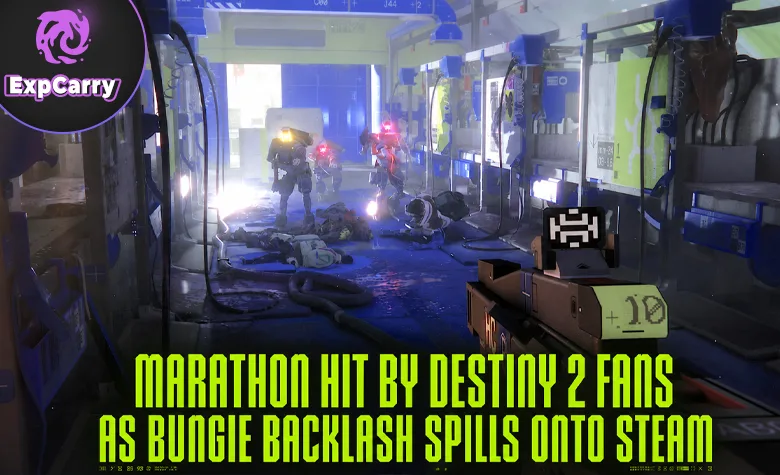
Marathon Hit by Destiny 2 Fan Backlash is not just another Steam review drama. It is a clear example of what happens when a studio tries to move toward a new project while its old audience feels abandoned. After Bungie said Destiny 2 will receive its final live-service content update on June 9, 2026, part of the Destiny community redirected its frustration toward Marathon, Bungie's extraction shooter.
The important detail is that Destiny 2 is not being shut down. Bungie said the game will remain playable, much like the original Destiny, even after active live-service development concludes. But for a community built around years of expansions, raids, seasons, builds, loot resets, and weekly rituals, "playable" is not the same as "alive." That gap is where Marathon got pulled into the blast radius.
The reaction on Steam was not only about Marathon's own design, balance, content, or technical state. Some negative reviews treated Marathon as the game Destiny 2 supposedly died for. Kotaku reported that more than 250 negative Steam reviews arrived across three days, pushing Marathon's recent review rating from 86% positive to 77%. Other players then pushed back with more than 500 positive reviews, turning the page into a visible tug-of-war between angry Destiny fans and Marathon defenders.
That distinction matters. A review page is supposed to judge the game in front of the player. In this case, it also became a complaint box for a different game, a different wound, and a much older relationship between Bungie and its audience. Not every negative Marathon review is automatically unfair, but the timing and wording of the backlash show that many players were not only reviewing Marathon. They were punishing Bungie.
Marathon Backlash Started With Destiny 2, Not Marathon
The anger did not begin with a new Marathon patch, a broken extraction system, or one specific design change. It surged after Bungie announced the end of Destiny 2's active live-service content pipeline. For long-time players, that news landed like the end of an era. Destiny 2 was not just a shooter for many of them. It was a weekly routine, a raid calendar, a social hub, a buildcrafting obsession, and a shared language built over almost nine years.
That emotional attachment explains why Marathon became an easy target. To some Destiny 2 players, Marathon is not merely Bungie's next major live-service bet. It is the most visible symbol of a studio moving away from the game they spent years supporting. The logic is messy, but it is easy to understand: if Bungie is winding down Destiny 2 while pushing Marathon forward, then Marathon becomes the object people can hit.
The problem is that symbolic punishment rarely produces clear criticism. Some players have fair reasons to dislike Marathon as an extraction shooter, from genre fatigue to concerns about progression, matchmaking, content cadence, or long-term support. Those are valid review topics. But "Destiny 2 is losing active development" is not a clean review of Marathon. It is grief filed under the wrong product, because apparently the internet needed one more way to turn disappointment into administrative work.
Destiny 2 Final Update Turned Marathon Steam Reviews Into a Battlefield
The Steam reaction around Marathon became visible because the reviews were not all focused on Marathon itself. Some negative posts framed it as the project Bungie chose over Destiny 2. Others used the review system to protest Bungie's broader direction. Then Marathon defenders responded with positive reviews, arguing that the game should be judged on its own terms instead of being used as a stand-in for years of Destiny frustration.
| Flashpoint | What happened | Why it matters |
|---|---|---|
| Destiny 2 final live-service update | Bungie set June 9, 2026 as the date for Destiny 2's final live-service content update. | The game remains playable, but active content development is ending, which many players see as the end of Destiny 2's live-service era. |
| Marathon targeted on Steam | More than 250 negative reviews hit Marathon across three days after the Destiny 2 news. | The backlash was tied heavily to anger at Bungie, not only direct criticism of Marathon's gameplay. |
| Recent rating dropped | Marathon's recent Steam rating reportedly fell from 86% positive to 77% positive. | The shift was visible enough to turn the game's store page into a public argument over Bungie's future. |
| Counter-reaction followed | More than 500 positive reviews appeared after Destiny 2's end-of-live-service announcement. | Marathon players and Bungie defenders pushed back against review bombing and tried to separate the two games. |
| Bigger Bungie anxiety | Players connected the news to layoffs, Sony's ownership, Marathon's role, and the lack of a clear Destiny 3 path. | The backlash became less about one Steam rating and more about trust in Bungie's direction. |
This is why the Marathon backlash is more useful as a story than a simple "fans are angry" headline. The Steam page became a public pressure point because players believe reviews are one of the few tools they can use against a studio. That does not mean the tool is being used well. Review bombing often blurs the line between feedback and punishment, and Marathon is now dealing with both at the same time.
Destiny 2 Fans Are Mourning a Live-Service Home

Calling the reaction childish is easy. It is also incomplete. Destiny 2 trained players to expect continuity: another season, another expansion, another raid, another artifact, another reason to return. When that loop ends, the reaction is not the same as leaving a single-player campaign behind. Players feel like a shared place is being moved into maintenance mode.
That emotional weight does not excuse bad targeting. Marathon did not personally cancel anyone's raid night, delete anyone's vault, or announce Destiny 2's final update from behind an extraction timer. It is simply the new Bungie game standing closest to the impact zone. For frustrated players, that has been enough. The modern fan economy often works like that: find the nearest visible object, attach every unresolved complaint to it, then call the result feedback.
The deeper issue is that Bungie built one of the most attached communities in online shooters, then asked that audience to accept a very different future. Marathon is not Destiny with a new logo. It has a different structure, a harsher PvPvE identity, a different social rhythm, and a different promise to players. The final Destiny 2 update news made that difference feel less like creative variety and more like replacement.
Marathon Is Being Judged as Bungie's Future, Not Just a Game
Marathon has a difficult position because it is not only competing with other extraction shooters. It is competing with the memory of Bungie's past. Long-time fans still connect Bungie with Halo, Destiny, raids, gun feel, sci-fi mystery, and large communities built around shared worlds. Marathon carries the Bungie name, but it asks players to buy into a different kind of tension: extraction pressure, risk-heavy runs, PvPvE conflict, shorter loops, and a more competitive identity.
That shift would be difficult even without Destiny 2's final live-service update hanging over it. With the Destiny news, Marathon now looks to some players like the studio's chosen replacement. That perception is powerful, even if the reality is more complicated. Studios do not move one magical bucket of developers from "beloved old game" to "new hated game" with a cartoon label on it. But community anger rarely waits for organizational nuance. It prefers a villain, a symbol, and a Steam review button.
The unfair part for Marathon is that many players now read it through Bungie's corporate situation. If Marathon struggles, it becomes proof that Bungie abandoned Destiny for the wrong project. If Marathon succeeds, some Destiny fans may see that success as validation of a shift they never wanted. Either way, the game is carrying baggage that no extraction shooter system can fully solve.
Marathon Steam Reviews Became Protest Notes With Star Ratings
Steam reviews are useful when they describe performance, matchmaking, content quality, pricing, progression, balance, or whether the game delivers what it sells. They become less useful when they are used as a public punishment system for related but indirect studio decisions. In the Marathon case, the line became blurry because some negative reviews were not really about the game. They were about resentment, anxiety, and the belief that Bungie chose Marathon over Destiny 2.
That does not mean Marathon should be shielded from criticism. If players dislike its extraction loop, technical state, economy, progression systems, season model, or long-term direction, those are fair review topics. The issue is not that players are angry. The issue is that some of that anger is being filed under the wrong product. That makes the Steam score less useful for new players who are trying to decide whether Marathon itself is worth playing.
Bungie's Trust Problem Is Bigger Than One Steam Score
The backlash also reflects a trust problem that Bungie cannot solve with one statement. Destiny 2 players have watched years of controversial decisions pile up: content vaulting, monetization complaints, expansion fatigue, shifting seasonal structures, layoffs, and uncertainty around the future of the franchise. When the final live-service update was announced, many players did not treat it as an isolated decision. They treated it as the last confirmation of a direction they already feared.
That is why Marathon took damage even though Destiny 2 was the trigger. Players are reading Bungie's recent history through the new game. Marathon is no longer just Marathon in the public argument. It is a referendum on whether Bungie still understands its audience, whether the studio still has a clear future for Destiny, and whether its next live-service bet deserves trust from players who already feel burned.
Marathon's Real Problem Is the Audience Bungie Brought With It
Every studio with a beloved legacy faces the same trap: the old audience wants continuity, while the studio wants room to build something else. Bungie has lived inside that tension for years. Halo fans once judged Destiny through the shadow of Halo. Now Destiny fans are judging Marathon through the shadow of Destiny. The names change. The ritual stays the same. Fans build a shrine, then get furious when the studio opens a different door.
For Marathon, this means the first battle is not only about gameplay design. It is about permission. Bungie has to convince players that Marathon deserves to exist without being treated as the thing that killed Destiny 2. That is a brutal marketing problem because it cannot be fixed with a trailer. It requires time, content, stability, transparency, and a game strong enough to create its own defenders instead of relying on Bungie's old reputation.
The risk is that Marathon gets trapped between two hostile expectations. Extraction shooter fans may judge it against the strongest games in the genre. Destiny fans may judge it against years of raids, characters, lore, social memories, and weekly rituals. That is not a fair comparison, but it is the comparison Bungie now has to survive.
Destiny 2 Backlash Shows the Toxic Link Between Old Fans and New Games

The Marathon backlash is part of a wider pattern in gaming. When a studio changes direction, the old community often treats the new project as betrayal. It happens across genres, franchises, and live-service pivots because players do not always separate creative decisions from emotional ownership. They supported the studio, bought expansions, defended weak seasons, recruited friends, watched reveal streams, and built habits around the game. Eventually, some begin to act as if that history gives them voting rights over the studio's future.
This is where fandom becomes toxic. Passion turns into entitlement, and entitlement turns into punishment. A player can be sad that Destiny 2 is winding down active development. A player can criticize Bungie for years of decisions. A player can refuse to buy Marathon. All of that is normal. But bombing Marathon because Destiny 2's live-service era is ending is not analysis. It is emotional spill damage.
The awkward truth is that Bungie needs new projects, but it also trained players to expect long-term emotional investment. Marathon is now paying the price for that contradiction. The same studio that built one of the most attached communities in online shooters is trying to sell that community a different future. Naturally, some players are responding with the grace of a vending machine that ate a bank card.
Conclusion
Marathon getting hit by Destiny 2 fan backlash shows how fragile studio loyalty becomes when a live-service game reaches the end of active development. The anger around Destiny 2 is real, and for many players it comes from years of investment, frustration, and uncertainty. But moving that anger onto Marathon's Steam page turns a legitimate community wound into messy review warfare. It makes the score less useful, the debate less honest, and the future of Bungie's audience even more divided.
The more important story is not that Marathon received negative reviews. The important story is that Bungie's next game is now carrying the emotional debt of Destiny 2. That is dangerous for Marathon because every update, every season, every player-count dip, and every design choice can be interpreted through a larger argument about what Bungie should have done with Destiny. Even good Marathon changes may struggle to break through if the loudest part of the conversation is still mourning a different game.
Bungie's challenge is now bigger than defending Marathon from a review bomb. The studio has to rebuild trust with players who feel that one of gaming's defining live-service worlds is being moved out of active development while a new project takes center stage. Marathon can still earn its own audience, but it will need more than Bungie's name. It needs a clear identity, strong updates, and enough distance from Destiny 2's final live-service update to stop looking like the replacement players never asked for.