
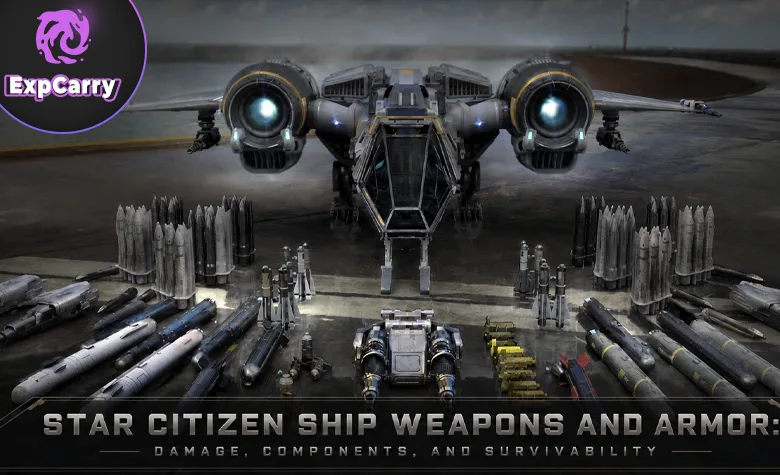
Ship combat in Star Citizen stops looking random once you stop treating every weapon like a simple DPS stick. Different weapon families do not just deal different numbers. They interact with shields, armor, penetration, and components in different ways, and that changes the job each loadout can do in a fight. The current combat model pushes ships toward layered damage rather than a single race to an invisible health bar. First you pressure shields and outer protection, then you weaken armor, then you start reaching the systems that keep the target alive and dangerous.
That is the key logic behind modern ship combat. Energy weapons are generally the most reliable tools for shield pressure and sustained damage. Ballistic weapons become much more valuable when penetration starts mattering and you want to damage internal systems. Distortion weapons are built for disruption rather than raw destruction. Missiles and torpedoes create burst windows and punish targets that fail to defend against ordnance. Armor sits over all of this as the damage filter that changes how quickly each weapon type becomes effective.
Ship Weapon Types in Star Citizen
At the broadest level, Star Citizen ship weapons fall into four main groups: ballistic weapons, energy weapons, distortion weapons, and explosive ordnance such as missiles and torpedoes. On top of that, ships also divide offensive systems by mounting type. A ship may rely on fixed guns, gimbaled guns, turret weapons, or separate ordnance hardpoints. Those are not cosmetic differences. They change tracking, firing angles, engagement discipline, and the kind of pressure a ship can apply.
Inside the gun categories, behavior matters just as much as damage type. Repeaters favor a faster stream of fire and generally feel more forgiving in dynamic dogfights. Cannons hit harder per shot and reward cleaner aim, especially when you are trying to land meaningful bursts instead of spraying space like a nervous idiot. Scatterguns are close-range pressure weapons that trade range and precision for brutal damage inside tight engagement windows. This is why comparing weapons by raw DPS alone is lazy and usually wrong. The important question is not just how much damage a weapon can produce in theory, but where that damage lands and what stage of the fight it helps you win.
Ballistic Weapons vs Energy Weapons

Ballistic and energy weapons are the core decision in most ship loadouts. Energy weapons are the more stable and forgiving option for sustained combat. They are strong at shield pressure and remain useful throughout long engagements because they do not rely on armor already being weakened to feel relevant. Ballistics are different. Their real value rises when penetration begins to matter and when the goal shifts from wearing the target down to breaking what is inside it.
This does not mean one family is simply better than the other. It means they solve different problems. If you want steady pressure and consistent performance across the early and middle phases of a fight, energy is usually the safer pick. If you want to exploit weakened protection and force subsystem failures, ballistics become much more dangerous.
Energy weapons in shield pressure and sustained fights
Energy weapons are usually the cleanest answer against shields and the easiest option for sustained pressure. That is one of the reasons laser-based loadouts remain popular in general dogfighting. They are dependable, straightforward to use, and less dependent on the target already being compromised. When a fight starts at full defenses, energy weapons usually feel more useful earlier.
That does not make energy weapons magical armor erasers, and this is where a lot of bad writeups drift into fiction. The safer way to describe them is simple: energy weapons are excellent in the outer fight. They pressure shields well, keep damage flowing, and help push the target toward a more vulnerable state. They are not automatically the best tools for deep subsystem kills once armor has been degraded and penetration becomes the deciding factor.
Ballistics as penetration and subsystem weapons
Ballistics are defined by penetration. In the current damage model, they become more valuable as armor weakens and more internal damage becomes possible. They are also described as mostly bypassing shields, though that does not mean shields are irrelevant against them. It means ballistic pressure interacts with the target differently, especially once the fight moves beyond the first defensive layer.
In practice, ballistics reward timing and target state. They are not just strong because of spreadsheet damage. They become strong because they can start reaching the systems that matter: power plants, coolers, relays, shield generators, weapon groups, and other internals tied to the ship's combat capability. That is why ballistic loadouts can feel merely decent at the start of a fight and then suddenly vicious once a hull is opened up.
Repeaters, Cannons, and Scatterguns in Real Fights
Choosing between repeaters, cannons, and scatterguns changes how your ship performs long before damage type enters the argument. Repeaters are the most forgiving in fast-moving engagements because they give you more shot volume and more chances to convert shaky tracking into real hits. They fit ships that rely on constant contact time and pilots who want a smoother damage curve rather than a few big moments.
Cannons lean in the other direction. They are more punishing when you miss, but more rewarding when you land clean shots. Ships that create good firing windows, nose authority, or strong opening passes can get more value from cannon-style weapons than from repeaters, especially against tougher targets where hit quality matters more than just spraying rounds into a shield face.
Scatterguns are far more specialized. They can be savage at short range, but they demand a ship and pilot combination that can force those ranges consistently. If your platform cannot stay close, or if the target can control distance well, scatterguns turn from menace to dead weight very quickly. They are not bad weapons. They are narrow weapons, which is a more important distinction.
Explore services related to this guide, selected from our Star Citizen catalog.
View All Star Citizen Services

Fixed Weapons, Gimbals, and Turret Pressure
Weapon mounting matters because accuracy is not theoretical in Star Citizen. Fixed weapons reward good piloting, disciplined aim, and ships that can hold a stable attack line. They often make the most sense when you trust your tracking and want to maximize direct offensive value. Gimbaled weapons give up some of that purity in exchange for easier target tracking and a more forgiving hit rate against agile opponents.
This is one of the most common places where players sabotage their own loadouts. A paper-optimal fixed setup that barely lands in real fights is worse than a slightly weaker arrangement that actually keeps damage on target. Hit consistency is part of real DPS, whether people enjoy that fact or not.
Turrets add another layer. A turret is not just extra firepower. It changes coverage, pressure angles, and crew value. Multi-crew ships in particular benefit from turret pressure because sustained tracking from independent firing positions can keep damage uptime high even when the pilot is busy managing movement, shield exposure, or positioning around larger targets.
Distortion Weapons and Disable-Oriented Combat
Distortion weapons live in a different lane from classic hull-killing weapons. Their job is not to win by raw structural damage. Their job is to disrupt systems and apply pressure to components around the impact point. In the engineering-era combat model, that matters far more than it used to. A ship does not have to explode to become combat-ineffective.
That makes distortion especially useful in disable-focused play. If your goal is to reduce the enemy's ability to fight, escape, or keep shields and power stable, distortion can do real work before the target is structurally finished. It is not the universal best answer, and it is not a substitute for direct damage. It is a specialist tool for players who understand where system disruption matters and how to convert that disruption into control or a kill.
Missiles, Torpedoes, and Explosive Damage
Missiles and torpedoes are not just side buttons for free damage. They are explosive ordnance with their own logic, timing, and counterplay. Missiles are the more flexible option for pressure, distraction, burst damage, and forcing defensive reactions. Torpedoes are larger, slower, and much more dangerous, making them better suited to larger or less mobile targets that cannot simply outmaneuver or screen them away.
Explosive damage also has its own role in the armor-and-components model. It is especially relevant for damaging armor and external components, which gives ordnance real value beyond simple alpha damage. A missile salvo can create a defensive mistake, strip external effectiveness, or open a timing window. A torpedo can threaten a dramatic state change if it lands on the right target. Neither replaces gun pressure, but both can shift the flow of an engagement fast.
Missile defense, countermeasures, and target choice
Ordnance is only as good as the firing solution behind it. Smaller, agile ships are often much harder to punish with torpedoes than players want to admit. Larger ships, slower targets, distracted crews, and ships already under pressure are much better ordnance targets. Countermeasures, evasive movement, point defense, and target awareness all affect whether a missile or torpedo is a threat or just an expensive tantrum.
That is why smart pilots do not throw missiles at random. They use them to punish a committed turn, force shield management mistakes, disrupt a chase, or stack pressure with gunfire. Torpedoes are even more conditional. They are most valuable when a large target is already occupied, unsupported, slow to react, or unable to screen incoming threats effectively.
Armor, Shields, and Penetration Work Together

The current Star Citizen damage model is built around layered defense. Shields are the first obvious barrier. Armor then reduces incoming damage and suppresses weapon penetration. As armor weakens, penetration rises and internal systems become more vulnerable. That is why a target can feel sturdy at the start of a fight and then suddenly begin collapsing once enough outer protection has been degraded.
This is the part many players miss. Armor is not just extra hull points. It is a gate that changes whether damage stays on the outside of the ship or starts reaching the systems inside it. Because of that, the same weapon can feel very different at different stages of the same engagement. Early hits may mostly pressure protection. Later hits may start breaking the ship from within.
Armor as damage reduction and penetration control
Armor does two jobs at once. First, it reduces incoming damage. Second, it limits penetration. That means armor protects survivability directly while also protecting the components that keep the ship functioning. When armor is healthy, subsystem damage is harder to deliver. When armor deteriorates, both forms of protection weaken together.
This is exactly why weapon family choice matters. Energy pressure can remain useful through the shield and outer-defense phase. Ballistics become more lethal when armor no longer suppresses their penetration as effectively. Distortion threatens systems around impact zones. Explosives batter armor and external equipment. Armor is the layer that decides when each of those plans starts paying off.
Component damage after penetration starts
Once penetration becomes meaningful, the fight changes. At that point the target is no longer just losing generic durability. It may lose cooling stability, power routing, shield uptime, weapon reliability, or maneuvering capability depending on what gets hit and how badly those internals degrade. This is why subsystem warfare matters more now than simple hull attrition.
A ship that still has visible hull left can already be losing the fight if its internals are compromised. That is not a niche edge case anymore. It is one of the central design ideas behind the newer engineering model. Players who keep thinking only in terms of total hull damage are reading half the fight and then wondering why outcomes feel strange.
Ship Armor Types in Star Citizen Right Now
This is the part where bad guides usually start inventing a clean public taxonomy that the game does not actually present. Star Citizen currently has meaningful armor differences across ships and archetypes, but it does not hand players a neat universal in-game list of official armor classes with detailed public rules for every hull. Talking loosely about light, medium, and heavy protection can be useful shorthand, but it is still shorthand.
The more accurate way to describe the current system is this: ships have armor values and armor behavior that differ by hull and archetype, and those differences matter more than they used to. Recent updates have pushed armor values further apart across ship roles, which means protection is more bespoke than before. That gives players real practical differences between targets without pretending the game already exposes a polished encyclopedia of armor categories.
Light, medium, and heavy protection in practice
In practical terms, lighter ships usually feel easier to pressure through the full damage chain. They rely more on agility, profile, and not getting hit cleanly for extended periods. Heavier ships usually gain more value from stronger protection, but that does not make them invulnerable. It changes the rhythm of how damage arrives and which weapons feel efficient against them.
This means "armor type" is better understood today as a combat behavior pattern rather than a simple labeled class. A lighter hull may punish missed shots and reward speed. A heavier hull may absorb outer damage longer and delay meaningful penetration. That difference is real even when the game does not package it in the neat category system some players keep pretending already exists.
How Armor Protects the Ship in Actual Combat
Armor protects ships in three ways. It lowers raw incoming damage, it delays penetration into components, and it changes which offensive plans are efficient against the target. That third part is easy to ignore and crucial to understand. Armor does not merely make every weapon worse by the same amount. It changes the relative value of different weapon families and loadout philosophies.
A fresh armored target often feels resistant to quick subsystem pressure because the outer defense layers are still doing their job. The same target can become dramatically more fragile once armor has been degraded enough for penetration to increase. That is why a fight can seem stable for a while and then unravel very quickly. Armor controls tempo as much as survivability.
Projectile Velocity, Hit Quality, and Real Damage Output
Real weapon performance is not only about damage family and penetration. Projectile velocity, spread behavior, firing rhythm, and the ability to stay on target all shape practical output. A theoretically strong weapon that misses in ordinary combat is a worse choice than a less glamorous weapon that keeps connecting. This sounds obvious, yet people still ruin good ships by chasing idealized numbers and ignoring whether they can actually land the shots.
That matters even more when comparing anti-fighter and anti-large-target loadouts. Fast, agile ships punish poor shot consistency. Larger ships punish weapons that fail to create meaningful penetration or burst when a good window appears. Matching the weapon not just to the target, but to the quality of hits you can realistically produce, is one of the most underrated parts of loadout building.
Loadout Logic Against Fighters, Gunships, and Large Ships
Against fighters and other agile targets, consistency matters more than fantasy damage. Energy repeaters or similarly forgiving weapons often make the most sense because they keep contact time useful and help maintain shield pressure during fast movement. Weapons that require perfect firing windows can still work, but only if the ship and pilot can reliably create those windows.
Against tougher ships, mixed logic starts making more sense. Sustained pressure that helps weaken defenses can pair well with weapons or tactics that capitalize once penetration becomes available. Larger targets also make missiles and torpedoes more relevant, especially when they are distracted, committed to a line, or unable to defend properly against incoming ordnance.
Against gunships and heavy targets, the question is rarely "what has the highest listed DPS." The better question is which combination can keep pressure on the target, survive return fire, and turn weakened armor into real subsystem damage. That usually separates thoughtful builds from nonsense much faster than any spreadsheet ever will.
Best Weapon Logic for Practical Ship Builds
If you want the clean practical answer, it works like this. Energy setups are usually the safest all-purpose choice for steady shield pressure and general reliability. Ballistics are at their most dangerous when the target is already vulnerable and you want to force internal damage. Distortion belongs in disable-oriented plans and in crews that understand system pressure. Missiles and torpedoes are best used as timing tools, punish windows, and force multipliers rather than mindless opening spam.
That does not mean every good ship must run a mixed loadout. Some platforms are stronger when they commit to one role fully. But it does mean the correct question is always tied to combat phase and ship role. Are you stripping shields, softening armor, breaching internals, disabling systems, or forcing a burst kill window? The best loadout is the one built for that sequence, not the one with the prettiest number on a component screen.
Final Thoughts
Star Citizen ship combat is much easier to understand once you stop flattening every weapon into the same role. Energy weapons excel as dependable pressure tools. Ballistics become much more threatening when penetration and subsystem damage matter. Distortion rewards disable-focused play. Missiles and torpedoes punish weak defense and create burst opportunities. Armor ties the whole system together by reducing incoming damage, suppressing penetration, and shaping when each offensive plan becomes effective.
The most honest conclusion is that there is no universally best weapon family. The right answer depends on target size, target state, range control, hit quality, crew support, and what part of the enemy ship you are trying to break first. Once you understand that layered logic, ship combat starts making sense. It stops feeling like random noise and starts looking like what it actually is: a fight over shields, armor, penetration, and system failure.