



In games, AI can create challenging enemies, and the balance of specializations in games can be changed quickly based on player data. However, most players are not aware of how artificial intelligence is being used in modern online games. This guide will give you an overview of AI in gaming in 2026 and where improvements can be made.
AI in gaming in 2026: key insights for MMO and shooter gamers
- Some enemies in ARC Raiders use machine learning to move (damaged enemies try to balance themselves).
- FACEIT reported that 40% of cheating bans in May 2026 were due to AI and DMA cheating.
- In World of Warcraft, tuning passes are scheduled based on in-game player data, meaning balance in specs can change quickly.
- In GDC's November 2026 survey, 40% of industry professionals use GenAI tools; however, 55% believe it to be a negative.
The impact of machine learning on NPC behavior in modern games
Using machine learning allows developers to teach enemies how to behave without hard-coding every possible scenario. Once trained, the AI can have movement or strategies based on thousands of trials. This means that enemies can react to damage and player positioning in dynamic ways that may not have been coded in manually. This makes encounters less predictable. For raiders, this is the most noticeable AI in gaming.
ARC Raiders enemies with adaptive movement instead of following animations
Currently, the most noticeable AI in this category is in ARC Raiders. As the game's CCO Stefan Strandberg noted in November 2025, some of the robots in the game have movement created using machine learning. If a robot loses a limb, the robot will attempt to balance itself and continue fighting. This feature was put to the test in October 2026, with over 30 million rounds in PvE mode against these enemies.
Procedural generation vs. generative AI: what's the difference?
- Procedural generation creates game environments and loot tables using rules and random seeds. This has been a common practice in games for many years.
- Generative AI creates new assets (visual/audio) based on models trained on large data sets.
These two terms are often confused, leading to many confusing discussions in player reviews.
Voice acting in ARC Raiders using AI and why the community pushed back
In October 2025, ARC Raiders launched with many lines of voice acting in NPCs generated using text-to-speech AI. These models were trained using voices from contracted actors. However, players heavily criticized the flat tone of the voice acting. In March 2026, the CEO of Embark confirmed that some lines of voice acting had been re-recorded with professional actors.
However, AI voice acting didn't completely disappear. The game still uses licensed text-to-speech for less important lines to maintain immersion (such as pings). The studio pays actors for this.
How AI-based anti-cheat systems catch cheaters in online games
Modern anti-cheat systems rely on more than finding cheat files. AI models detect cheating by analyzing aiming and inputs. If patterns of cheating appear to be inhuman, then a player is flagged. Usually, evidence of cheating is confirmed via additional evidence or human moderation. In ranked play, this is the part of AI in gaming that can determine whether a player is kept in the lobby.
In May 2026, 40% of cheating bans in FACEIT were due to AI and DMA cheating. Their Human Input Detection system went live on the 5th August 2026. Similarly, in Call of Duty, the RICOCHET team uses algorithms to detect cheaters and then manually verify them.
| Detection approach | What it checks | Weak spot |
|---|---|---|
| Signature-based | Known cheat files and processes | Misses new or external hardware cheats |
| Behavioral | Aim and input patterns over time | Needs large datasets and careful review |
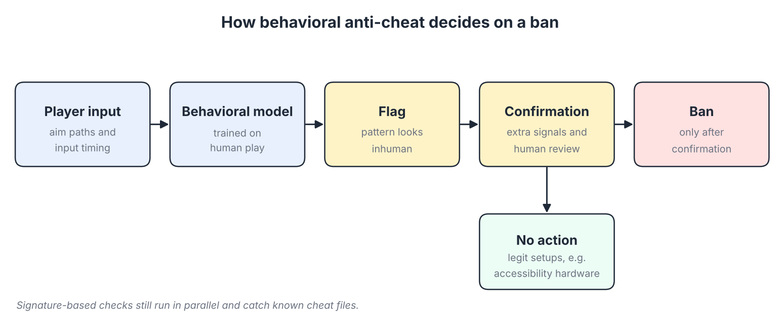
How behavioral anti-cheat decides on a ban. Signature-based checks still run in parallel and catch known cheat files.
Player analytics and game balancing in World of Warcraft raids
Damage dealt and completion rates in Mythic+ show which specializations are performing well (or poorly) far earlier than in forums. This player data is used to make balance changes.
How Blizzard uses player performance data to balance classes in World of Warcraft
The plan for class tuning in Midnight Season 1 was to make changes based on performance in Heroic Raids. These changes went live on March 24, 2026 (when Mythic Raids and Mythic+ opened). Therefore, tier lists and class guides in World of Warcraft can become outdated very quickly. Well-balanced games are due to many frequent small passes.
Data for AI in games: where studios learn what gamers think
Although player actions can be seen using telemetry data, it is harder to tell what players are feeling in games. Reading those feelings is a part of AI in gaming that has a large influence on many patches. Companies and studios gather public feedback, forum posts, and game ratings. They can use this to train models and understand their audience better. Often, teams use proxy residential connections to ensure a consistent flow of public data. Once models are trained, they can highlight issues in games, such as unpopular economic changes, before they begin to affect player retention.
Why the industry debate over generative AI in gaming keeps heating up
Despite the backlash, the use of AI in gaming industry workflows is increasing. According to Totally Human Media (covered by Tom's Hardware), 7,818 titles on Steam use generative AI, around 7% of the total. In games released in 2025, around 1 in 5 games disclose using generative AI.
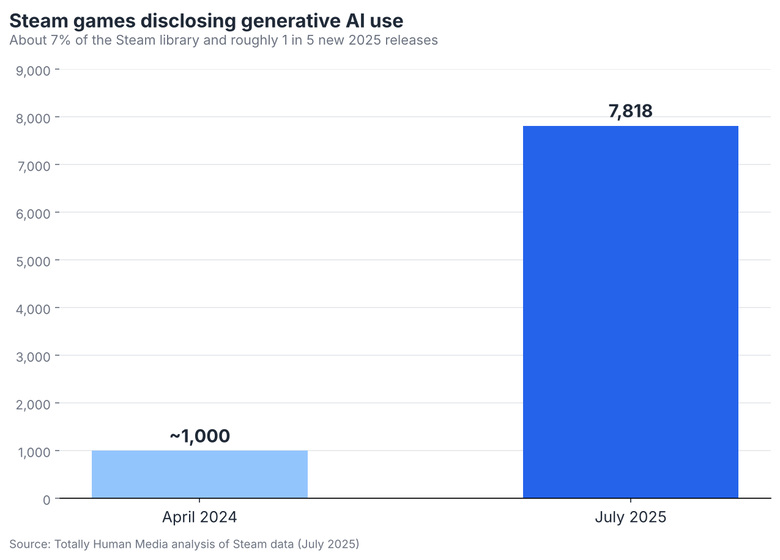
Steam games disclosing generative AI use. Source: Totally Human Media analysis of Steam data (July 2025).
Opinions are divided in the industry. In the GDC survey cited by TechPowerUp of over 2,600 professionals in November 2026, 40% use these tools. However, 55% believe it to be negative for the industry. Those who are critical of generative AI in games are concerned with job losses and loss of creativity. Those who support it believe it speeds up prototyping.
Players and studios' considerations regarding smarter enemies and fairer matches
Players should check the content disclosure section on Steam pages before purchasing. If a player suspects someone is cheating, they should include match IDs when reporting. This helps improve the accuracy of behavioral detection models. Embark's experience shows that AI-trained enemies can be a useful addition to games where players want a challenge. However, human actors are still required in scenes requiring emotional expression.
Common questions that MMO and shooter gamers frequently ask
These answers cover popular questions about these systems in online gaming.
Does AI in gaming make NPCs more intelligent or just harder to predict?
Generally, it makes them less predictable. Enemies can react to damage and cover in unpredictable ways. However, in most games, the AI is trained before release and will act according to a set policy. This means that fighting the enemy multiple times will not make them more difficult. This also means that behavior can be tested to make sure it is balanced.
Can innocent players be unfairly banned using behavioral anti-cheat?
Yes. Therefore, major competitive platforms have put measures in place to prevent this. FACEIT takes into consideration multiple factors in addition to Human Input Detection, and players will not be banned based on one trigger. In Activision's RICOCHET, automated flags are sent to staff members for verification. If a player believes they have been unfairly banned, they should contact official support. If players have unusual hardware (such as accessibility controllers), they should also include this in their appeal.
How is generative AI in gaming different from traditional scripted NPC systems?
Traditional NPC logic uses scripting and decision trees written by developers. Generative AI creates new content (textures, dialogue, etc.) using models trained on large data sets. In a decision tree, a guard would be given instructions for what to do next. The dialogue spoken by the guard may be generated by text or voice models. The latter is the cause of most controversy in generative AI in games.
Will AI replace voice actors and developers in big publishing companies?
Not entirely. In ARC Raiders, some text-to-speech lines were changed to studio recordings after release. Now, synthetic voices are mainly used for low-priority lines. Many developers use AI tools to help research and prototype games but leave creative aspects of games (voice acting/art) to humans.