



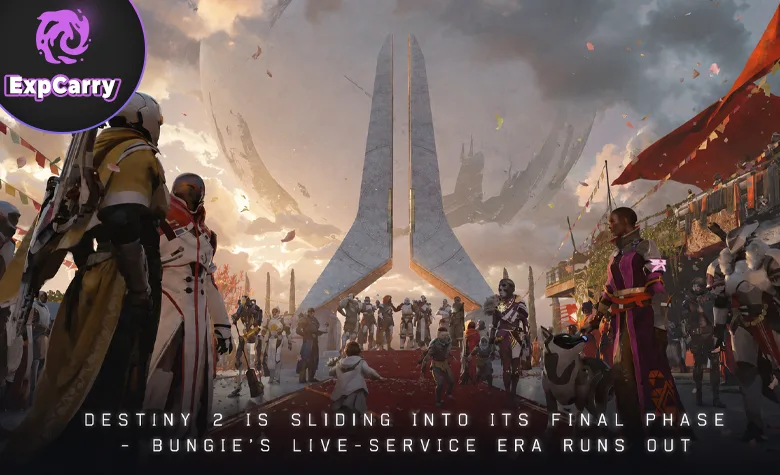
Destiny 2 is not being shut down overnight, but the game is entering its final active live-service phase. Bungie has announced that Destiny 2: Monument of Triumph will launch on June 9, 2026 as the final live-service content update for Destiny 2. The game will remain playable after active development concludes, similar to the original Destiny, but the regular update model that defined Destiny 2 for years is coming to an end.
That distinction matters. This is not a server shutdown, and it is not a simple cancellation. Players will still be able to log in, revisit activities, chase rewards, play PvP, run raids and dungeons, and use Destiny 2 as a playable product. What changes is the promise around the game. Destiny 2 is no longer being positioned as Bungie's central expanding live-service platform. It is being prepared as a legacy version of itself: still available, still full of playable content, but no longer built around the next expansion, next season, next roadmap beat, and next round of community hope.
The sharper way to describe the moment is this: Destiny 2 is not dead, but its live-service era is ending. Bungie is using Monument of Triumph to leave the game in a more complete and accessible state before stepping away from active development. For a series built around constant resets, new loot, evolving stories, raids, dungeons, balance patches, seasonal rituals, and long-term player routine, that is not a minor shift. It is the game moving from future-facing service to maintained archive.
Destiny 2 Monument of Triumph Ends the Live-Service Era
The key date is June 9, 2026. Bungie has confirmed that Destiny 2: Monument of Triumph will be available to all players on that date and will serve as the final live-service content update for Destiny 2. The update is not being framed as one more seasonal patch. It is a broad farewell package designed to celebrate Destiny 2's history, refresh major parts of the game, and make the remaining experience easier to revisit after active development concludes.
Monument of Triumph also gives the ending a clearer identity. Earlier discussion around Destiny 2's future could easily drift into vague phrases like "maintenance mode" or "final phase." Those terms still fit the direction, but the official update has a more specific purpose. Bungie is not only stopping the treadmill. It is bundling together long-requested changes, reward updates, activity refreshes, sandbox additions, and preservation-focused systems so the game can function better as a long-term destination.
Final live-service update does not mean server shutdown
A final live-service content update is not the same thing as the game going offline. Players should still be able to log in after June 9, run activities, return to old content, experiment with builds, earn rewards, and keep Destiny 2 in their rotation if they still enjoy the core game. The change is in development direction, not immediate access. That is the first point any article on this topic needs to make clearly, because "Destiny 2 is shutting down" is a cleaner headline and a worse explanation.
What ends is the old expectation that Destiny 2 will keep reinventing itself through expansions, seasonal updates, new systems, weekly communication, and long-term roadmap promises. Once active development concludes, there is no longer a major next reset for players to project hope onto. Destiny 2 becomes a game to return to, not a game that keeps dragging the whole community toward the next announced future.
That is why "legacy live-service game" is the most accurate description. Destiny 2 should remain playable, but the live-service machine that made the game feel permanently unfinished is being wound down. For players who liked the constant movement, that is a real loss. For players tired of seasonal churn, confusing systems, and never-ending grind loops, the final update may actually create a cleaner version of the game than the one they left behind.
Destiny 2 Final Update Adds More Than a Farewell Screen
Monument of Triumph is not just a symbolic goodbye. Bungie has outlined a large update touching story, rewards, activities, Dungeons, destinations, PvP, Gambit, Eververse, cosmetics, and core navigation. That is the part missing from many surface-level reactions to the announcement. The story is not only "Bungie is done." The practical question is what kind of Destiny 2 players will be left with after the final update lands.
Monument of Triumph brings one last account-wide celebration
The Monument of Triumph system expands the old Moments of Triumph idea into a broader celebration of Destiny 2's full history. Players will earn Legendary Marks through a game-wide array of Triumphs, then use them to unlock free armor ornaments, accessories, weapon engrams, and other rewards. Bungie is also adding an additional Title and armor ornament set for players who engage widely across the game.
This is a smart final-update structure because it gives returning players a reason to move through the whole game instead of logging in, staring at the map, and leaving because the UI looks like a committee argument. Destiny 2 has always had a strong activity catalog buried under layers of ownership rules, seasonal systems, currencies, and unclear progression. The final version still gives Raids a place in the activity loop. A broad Triumph-driven reward path gives the final version of the game a better reason to revisit old spaces.
The Director returns as the center of Destiny 2
One of the biggest practical changes is the return of a refreshed Director. Bungie says it has responded to player feedback about the Director and Portal, with the Director returning to its place as the center of Destiny 2 activities. Portal activities will still exist, but they will be accessible through nodes at the bottom of the Director rather than dominating the experience.
This matters because navigation has been one of Destiny 2's long-running problems, especially for returning players. The game often had strong content hidden behind awkward presentation. A clearer Director can make the final version of Destiny 2 easier to understand, which is exactly what a legacy live-service game needs. If the goal is to make the game welcoming after active development ends, players should not need a research fellowship just to find the thing they want to play.
Pantheon 2.0 gives endgame players a permanent challenge
Pantheon 2.0 is coming as a permanent addition with a fresh slate of bosses. Bungie plans to open the first boss slates on June 9, add a full gauntlet on June 13, and begin encounter rotations on June 16. This gives veteran players a structured endgame challenge after the final update instead of leaving the endgame purely dependent on old raid and dungeon habits.
That is important because Destiny 2's strongest identity has always lived in its combat encounters, boss fights, raid design, and buildcraft. A final version of the game without a serious endgame anchor would feel hollow. Pantheon 2.0 gives the legacy version of Destiny 2 a more durable reason for skilled players to keep returning.
Raid, Dungeon, Destination, and Sandbox Updates Make the Final Patch Matter
The strongest part of Monument of Triumph is that it touches the parts of Destiny 2 players actually care about: loot, builds, activities, difficulty, and rewards. A farewell update built only around cosmetics and nostalgia would have been thin. Bungie is instead using the final update to modernize a large amount of older content, which could make Destiny 2 more coherent after the live-service era ends.
Raid and dungeon loot gets brought up to modern standards
Bungie says all raid and dungeon weapons and armor have been revisited to bring them to modern standards. That includes full Tier parity, set bonuses, new perks, and an upgrade path for crafted weapons through Tiers 1-5. Weekly Featured Raids and Dungeons are also returning, giving players additional opportunities to chase high-tier rewards.
This is one of the most important changes in the whole update. Destiny 2 has years of excellent raids and dungeons, but old loot often becomes irrelevant when the reward economy moves on. Updating those rewards gives older content a stronger reason to exist in the final version of the game. It also helps Destiny 2 avoid becoming a museum where the best encounters are still playable but their rewards feel outdated.
Destinations get modern rewards and new Distortions
Destination weapons and armor are also being updated with modern standards, including Tier parity, set bonuses, new perks, and reward refreshes. Bungie is also adding Distortions to some destinations, introducing extra challenge and unique rewards for players spending time planetside.
This is not as flashy as a new raid, but it is useful for a game entering long-term preservation. Destiny 2 has many destinations that look expensive, atmospheric, and underused. Giving them modern rewards and new wrinkles helps make the final game feel less like a list of abandoned spaces. The better Destiny 2's patrol zones and destination loops become, the more useful the legacy version is for casual sessions rather than only endgame farming.
New abilities and Exotic updates keep builds alive
Monument of Triumph also includes sandbox updates. Bungie has named new Aspects for Solar Hunter, Void Warlock, and Solar Titan, a new Void Hunter melee, new Strand and Stasis grenades for all classes, and broader class-specific ability changes. Exotic armor and weapons are also getting attention, with Exotic armor earned since The Edge of Fate automatically upgraded to Tier 5 stats and various Exotic weapons receiving tuning passes and Catalysts.
That matters because buildcraft is one of the main reasons people still come back to Destiny 2. If the final update left the sandbox untouched, the game would feel frozen in a less satisfying way. New ability options and Exotic tuning give players something meaningful to test in the final version, even if there is no next season waiting behind it.
Portal, PvP, Gambit, and SRL Give Destiny 2 a Broader Afterlife
Destiny 2's final state cannot depend only on raids and nostalgia. A playable legacy version needs variety, because different players return for different reasons. Some want PvP. Some want Gambit. Some want old destination rewards. Some want casual activities. Some want to race Sparrows because apparently even the end of a decade-long live-service saga needs vehicle chaos.
Portal Overhaul aims to reduce friction
The Portal is being reworked so players can approach activity categories more easily and find fun faster. Bungie specifically wants to reduce choice paralysis, simplify difficulty pressure, and make rewards feel better across Solo Ops, Fireteam Ops, Arena Ops, Pinnacle Ops, Crucible Ops, and Gambit Ops. Onslaught, Contest of Elders, and The Coil are also receiving balance passes focused on difficulty, length, and pacing.
This is exactly the kind of change Destiny 2 needed before becoming a legacy product. The game has often buried good content under too many modifiers, reward rules, and progression layers. If the Portal Overhaul succeeds, the final version of Destiny 2 could become easier to play casually without losing the reward chase that keeps people engaged.
Crucible and Gambit are not being left untouched
Crucible is receiving new modes, private match additions, Iron Banner timing, Trials scheduling, new armor sets, tiered loot, and the return of Heavy Metal with a third vehicle type and a new map. Gambit is being upgraded to an Ops category with refreshed rewards, new armor, a unique set bonus, and reprised iconic weapons as tiered gear with new perks.
This does not automatically fix years of PvP and Gambit frustration. Nobody should pretend one final update magically solves every old argument, because that is how live-service denial becomes a lifestyle. Still, it gives those modes a cleaner place in the final version of Destiny 2. That is better than leaving them as half-maintained side rooms in a game that used to promise everything would matter eventually.
Sparrow Racing League returns permanently
Sparrow Racing League is returning as a permanent addition. Bungie says SRL will reopen tracks from the original Destiny experience and add a new space to race opponents. It will also include a new weapon set, returning armor sets with a new set bonus, cosmetics, and horns.
This is one of the smartest nostalgia moves in Monument of Triumph. SRL is not the core of Destiny 2, but it represents the kind of strange, memorable side content that helped Destiny become more than a loot treadmill. Bringing it back permanently gives the final version of the game a stronger sense of celebration and variety. It also gives returning players something instantly understandable to try, which is useful in a game that often explains itself like a tax form written by space wizards.
Seasonal Events, Eververse, and Destiny 2: The Collection Change the Player Deal
The final update also changes the business and reward structure around Destiny 2. These details matter because players deciding whether to return need more than emotional closure. They need to know what happens to event rewards, cosmetics, paid content, Bright Dust, Silver, and access to old expansions.
| Area | Monument of Triumph change | Player impact |
|---|---|---|
| Final update | Destiny 2: Monument of Triumph launches June 9, 2026 as the final live-service content update | Destiny 2 remains playable, but active development concludes |
| Director | A refreshed Director returns as the center of activities | Returning players should have a clearer way to find content |
| Pantheon 2.0 | Permanent boss challenge with staged rollout and rotations | Endgame players get a durable final challenge structure |
| Raids and dungeons | Weapons and armor updated with Tier parity, set bonuses, new perks, and crafted weapon upgrade paths | Older endgame content becomes more rewarding again |
| Seasonal events | Festival of the Lost, The Dawning, Guardian Games, and Solstice are being retired as seasonal events | Selected event rewards move to a Monument of Triumph vendor and engram systems |
| Eververse | Bright Dust remains earnable, Silver remains available, Bright Dust rotation changes to daily, and Bright Engram Focusing is added | Cosmetic access becomes more direct, though monetization does not disappear |
| Destiny 2: The Collection | All content packs are bundled into one purchase, with permanent markdowns for individual packs and expansions | New and returning players get a simpler buying path |
| SRL | Sparrow Racing League returns permanently with tracks, rewards, armor, cosmetics, and horns | Destiny 2 gets a stronger casual and nostalgia-driven activity after the final update |
Seasonal events are being retired, but rewards are not simply vanishing
Bungie says seasonal events are being retired. That means Festival of the Lost, The Dawning, Guardian Games, and Solstice will no longer function as recurring seasonal live-service events in the old way. However, a collection of event weapon rewards will be available through engrams on a Monument of Triumph vendor. Armor ornament sets that were previously available for Bright Dust will also be available through direct exchange and Bright Engram Focusing.
This is a clean example of the whole Destiny 2 transition. The old calendar rhythm goes away, but Bungie is trying to preserve access to rewards inside the final version. That is the right direction for a game leaving active development. A legacy game should not depend on annual event windows if the studio is no longer treating it as an active seasonal platform.
Eververse stays, but cosmetic access changes
Eververse is not disappearing. Silver will continue to be available for purchase and exchange, while Bright Dust will remain earnable through gameplay objectives. Bungie is also changing the Bright Dust rotation from weekly to daily and adding Bright Engram Focusing, letting players spend an Engram and some Bright Dust to target item categories without duplicates.
That is not the same as removing monetization, and the article should not pretend it is. Destiny 2's final version still includes Eververse. The more useful point is that Bungie is making cosmetic acquisition less dependent on old weekly rotation frustration. For players returning after June 9, that could make collection chasing less miserable, which is a small mercy in a game that has historically treated cosmetic timing like a hostage negotiation.
Destiny 2: The Collection simplifies buying old content
Bungie is bundling all Destiny 2 content packs into Destiny 2: The Collection on June 9. That bundle includes campaigns, Dungeon Keys, the 30th Anniversary Pack, and more. Individual content packs and expansions will also receive permanent markdowns in June.
This is one of the most important practical details for returning players. Destiny 2's purchase structure has been confusing for years, especially for anyone trying to understand which expansion, dungeon, campaign, or pack they actually need. A single collection and permanent markdowns make the game easier to recommend after active development ends. That does not undo years of messy access rules, but it gives the final version a cleaner entry point.
The Final Shape Gave Destiny 2 Its Peak Before the Wind-Down
The Final Shape gave Destiny 2 the ending it had been building toward for years. It closed the Light and Darkness saga, gave the game a real narrative summit, and briefly restored the feeling that Bungie could still land the big emotional moment when it mattered. The problem is that a strong ending also creates a brutal question for a live-service game: what is left after the story that held everything together is finished?
The saga ended better than the next era could replace it
The Final Shape worked because it had weight behind it. Players were not just buying another content drop. They were entering the conclusion of a long-running conflict that had defined Destiny's identity since the first game. That kind of finale gives a live-service game rare momentum, but it also removes the central engine once the credits roll. After that, Destiny 2 needed a new reason to feel essential, not merely available.
The post-Final Shape era struggled with that burden. The Edge of Fate and the wider Year of Prophecy plans tried to open a new direction, but the player conversation had already shifted toward fatigue, distrust, and uncertainty. Destiny 2 had survived bad seasons, weak systems, content vaulting anger, economy complaints, and balance disasters before. This time, the problem was deeper. The game needed a new core promise after finishing its biggest saga, and that promise never fully reset the mood around the game.
That is the quiet damage of a live-service climax. A finale can be strong and still leave the product weaker afterward. The Final Shape gave Destiny 2 a satisfying peak, but the game never fully proved that its next era could justify the same level of commitment. Once Bungie announced the final live-service update, that uncertainty stopped being a debate and became a company decision.
Destiny 2 Player Fatigue Made the Ending Easier to Understand
Destiny 2 did not reach this moment because of one bad patch. It reached it through years of accumulated pressure. Content vaulting damaged trust. Seasonal repetition wore players down. Expansion quality varied. New player onboarding remained messy. Economy changes often felt more punishing than meaningful. PvP went through long periods of frustration. Monetization stayed present even when goodwill was thin. Then The Final Shape delivered a strong ending, and the game still had to answer the question live-service games hate most: why keep going?
Player activity showed pressure, even if Steam never told the whole story
Steam numbers never show the entire Destiny 2 population because the game also exists on consoles and other PC storefronts. Still, Steam trends are useful public signals because they show visible momentum. When average player counts sit far below historic highs, it becomes harder to argue that the game still has the same live-service force it once had.
The key point is not that Destiny 2 suddenly had no players. It still had a community, veterans, returning players, raid groups, PvP regulars, collectors, and people willing to argue over every system as if a perk change personally insulted their bloodline. The problem is that a major live-service model needs more than loyalty. It needs enough recurring engagement to justify content production, technical support, balance work, community communication, monetization upkeep, and long-term roadmap investment.
A smaller audience can keep a legacy game alive, but it cannot always justify the same machine that powered a major expansion era. That is where Destiny 2 appears to have crossed the line. The game remained culturally important, but its future as a constantly expanding live-service platform became harder to defend.
Community fatigue became part of Destiny 2 itself
Destiny 2 has always had a strange relationship with its own players. The same people who criticized the game most brutally often played it for thousands of hours. That kind of loyalty can carry a game for a long time, but it also creates a permanently exhausted community. When every season arrives with hope, irritation, fixes, nerfs, economy complaints, and another round of "Bungie needs to communicate better," the loop eventually becomes part of the product itself.
By the time Bungie reached this final phase, Destiny 2 was not only competing with other games. It was competing with player exhaustion. The game asked for time, grinding, vault management, build updates, currency tracking, expansion purchases, dungeon access, event repetition, and constant adaptation. For veterans, that could still be satisfying. For returning or new players, it often looked like homework with better gun sound design.
Monument of Triumph is partly a response to that fatigue. Bungie can preserve and streamline Destiny 2 more cleanly than it can keep asking players to believe in another major reinvention. That is not a heroic ending, but it is a realistic one.
Destiny 2 After Active Development: Worth Returning or Letting Go?
The practical answer depends on the player. Destiny 2 after June 9 will not be the same kind of game it was during its expansion-driven years. It will still have strong combat, deep builds, raids, dungeons, PvP, Gambit, destinations, cosmetics, Triumphs, and years of accumulated history. But it will no longer carry the same expectation that a new season, expansion, or roadmap will keep pushing the game forward.
Returning players may get the cleanest version of Destiny 2
For returning players, Monument of Triumph could be the best time to come back if they want a more stable version of Destiny 2 without needing to chase a long future roadmap. The refreshed Director, updated rewards, Destiny 2: The Collection, modernized raids and dungeons, Portal changes, and permanent SRL all make the game easier to approach than it has often been.
That does not mean every old problem disappears. Destiny 2 still has removed content in its history, years of fragmented ownership, complicated systems, and a reputation for confusing new or returning players. A final update cannot rewrite all of that. But it can make the remaining game more coherent. If Bungie lands Monument of Triumph well, Destiny 2 could become more comfortable as a legacy product than it often was as a live-service treadmill.
Veterans face a different kind of ending
For veteran players, the end of active development hits differently. Destiny 2 was not just a game they finished. It was a routine, a social space, a loot chase, a weekly reset ritual, and sometimes a very expensive argument with balance patches. When that rhythm stops, players lose more than future content. They lose the shared expectation that everyone is moving toward the same next thing.
Some veterans will keep playing because the core feel of Destiny 2 remains excellent. Bungie's weapon feel, movement, raid design, ability fantasy, and cooperative combat are still hard to replace. Others will leave because the reason to keep investing is gone. Both reactions make sense. A maintained Destiny 2 can still be enjoyable, but it cannot recreate the tension of a game with an active future.
That is the emotional split at the center of this transition. Destiny 2 can remain playable and still feel over. For live-service games, both statements can be true because the game is not only the software. It is the promise around the software.
Bungie's Destiny Problem After the Final Update
Bungie now has to solve a problem bigger than Destiny 2. The studio built its modern identity around Destiny as an evolving platform. Ending that platform's active development leaves Bungie needing to prove that it can create its next major era without simply living off Destiny's past. That is a difficult position for any studio, and especially exposed after layoffs, project uncertainty, and years of community pressure.
No announced Destiny 3 keeps the franchise future unclear
The end of Destiny 2's live-service updates would feel different if Bungie had already announced Destiny 3 or a clear successor. Without that, the move creates a gap. Destiny 2 is ending its active development era, but the next major Destiny product has not been publicly positioned as the obvious replacement.
That uncertainty is why the announcement feels heavier than a normal content sunset. Players are not simply moving from one Destiny game to the next. They are being told that the current game will remain accessible while Bungie incubates future projects. Maybe Destiny returns in another form later. Maybe Bungie rethinks the franchise completely. Maybe the studio moves its energy into other games first. The public message leaves room for possibility, but not enough certainty for fans who expected a clean handoff.
This is the part that makes the wind-down feel real. A franchise can survive a finished game when the next step is visible. Destiny's next step is not visible in the same way. That turns Monument of Triumph into more than the end of one content plan. It becomes a pause in the public identity of Bungie's post-Halo era.
Destiny still has value, but value is not direction
Destiny still has powerful ingredients. The universe has visual identity, faction history, iconic classes, strong combat feel, memorable raids, deep lore, and years of player attachment. Those assets do not vanish because Destiny 2's live-service updates end. The franchise still has value, but value is not the same as direction.
The obvious question is whether Bungie eventually returns to Destiny with a new game, a rebooted model, a different format, or a smaller preservation-focused approach. At the moment, players do not have a clean public answer. That uncertainty makes the final Destiny 2 update feel less like a handoff and more like a closing chapter with a blank page after it.
That blank page may eventually become something interesting. But for now, Destiny 2 is the game players have, and Bungie is stepping away from the live-service structure that kept it central. The franchise may continue later. Destiny 2's main era is ending now.
Final Thoughts
Destiny 2 is not being erased, but it is entering its final active phase. Bungie's June 9, 2026 Monument of Triumph update marks the end of live-service content updates while keeping the game playable for returning players and veterans. That makes the situation more specific than simple shutdown drama. Destiny 2 is becoming a legacy game: available, preserved, and still meaningful, but no longer the center of an expanding live-service future.
The update itself is more substantial than a farewell banner. Monument of Triumph brings a refreshed Director, Pantheon 2.0, raid and dungeon loot updates, destination reward updates, new abilities, Exotic tuning, Portal changes, PvP and Gambit updates, retired seasonal events with preserved reward paths, Eververse changes, Destiny 2: The Collection, and the permanent return of Sparrow Racing League. Those details matter because they show Bungie trying to leave behind a playable final version rather than simply walking away from a cluttered service.
The reason this feels so significant is that Destiny 2 was built around continuation. The next expansion, the next season, the next raid, the next balance pass, the next loot chase, the next promise that Bungie had learned the right lesson this time. Ending active development cuts through that entire cycle. It does not remove the game's history, but it changes the way players relate to it. Destiny 2 becomes something to revisit rather than something to follow.
The cleanest way to describe this moment is not "Destiny 2 is dead." That is too blunt and too lazy. The better line is harsher because it is more accurate: Destiny 2's live-service era is over, and Bungie is trying to leave the game standing while it walks toward whatever comes next. For players, that means one final major update, one last stabilization push, and then a long afterlife for a game that spent almost a decade teaching people to expect another reset.