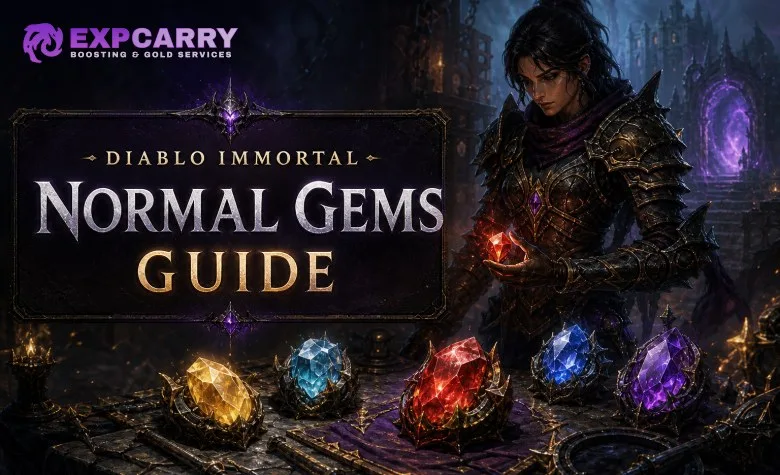
Normal Gems are Diablo Immortal’s secondary-attribute gems. You socket them into secondary equipment, upgrade them with duplicate gems, and use them to improve damage, life, Armor, Armor Penetration, Potency, or All Resistances. For most accounts, the best long-term plan is to farm Normal Gems consistently, prioritize the attributes that match your build and activity, and avoid spending Platinum on upgrades that do not improve your immediate secondary-stat targets.
What Normal Gems Do in Diablo Immortal
Normal Gems are different from Legendary Gems. Legendary Gems occupy Legendary Gem slots and provide Resonance, Combat Rating, and unique effects. Normal Gems are placed in the sockets of secondary equipment and directly increase secondary attributes.
The six Normal Gem types are divided into red, blue, and yellow socket categories:
| Gem | Socket Color | Primary Attribute | Most Useful For |
|---|---|---|---|
| Tourmaline | Red | Damage | PvE damage, farming, raids, and most general builds |
| Ruby | Red | Life | Survivability, PvP, and difficult content |
| Sapphire | Blue | Armor Penetration | PvE damage and offensive PvP builds |
| Aquamarine | Blue | Armor | Defensive PvP builds and damage reduction |
| Topaz | Yellow | All Resistances | Defensive builds and PvP survivability |
| Citrine | Yellow | Potency | Control, harmful effects, and builds that rely on debuffs |
Socket colors matter because a Normal Gem can only be placed in a matching socket. A high-rank Tourmaline cannot replace a Sapphire in a blue socket, so do not evaluate your gem collection only by total rank. You also need a balanced supply of red, blue, and yellow gems for your available sockets.
Which Normal Gems Should You Upgrade First?
For general PvE progression, Tourmaline is usually the safest first priority because Damage improves clear speed across open-world farming, dungeons, Elder Rifts, raids, and other combat activities. Sapphire is the usual offensive blue-gem priority because Armor Penetration improves damage against targets whose Armor reduces your attacks.
Defensive gems become more valuable when you are dying, pushing difficult content, or playing Battlegrounds. Ruby increases Life, Aquamarine increases Armor, and Topaz increases All Resistances. Citrine is more specialized: Potency is useful when your build applies crowd control or other harmful effects, but it is less attractive for a straightforward damage build that does not rely on those effects.
| Account Goal | Red Gems | Blue Gems | Yellow Gems |
|---|---|---|---|
| General PvE | Tourmaline | Sapphire | Citrine or Topaz, depending on build |
| Open-world farming | Tourmaline | Sapphire | Usually offensive or balanced |
| Dungeons and raids | Tourmaline | Sapphire | Build-dependent |
| Battlegrounds | Ruby or Tourmaline | Aquamarine or Sapphire | Topaz or Citrine |
| Survivability bottleneck | Ruby | Aquamarine | Topaz |
Do not replace every gem with an offensive option automatically. If your character already clears content comfortably but dies during boss mechanics or PvP engagements, defensive Normal Gems can produce a larger practical improvement than a small increase in damage.
Tourmaline versus Ruby
Tourmaline is the default red-gem choice for PvE because Damage improves how quickly you kill enemies. Ruby is more valuable when additional Life prevents deaths, allows you to survive burst damage, or helps you remain active during a dungeon or raid encounter.
For Battlegrounds, the choice depends on your role. Damage-focused ranged characters may continue using Tourmaline, while frontline characters and builds that need to survive long enough to deliver crowd control often gain more from Ruby.
Sapphire versus Aquamarine
Sapphire is the offensive blue gem and is normally preferred for PvE damage. Aquamarine is defensive and becomes more attractive in PvP or when incoming damage is the main reason you cannot complete content.
Armor Penetration and Armor are not interchangeable. Sapphire does not make your character tougher, and Aquamarine does not improve your damage in the same way. Choose between them according to the problem your account is actually experiencing.
Citrine versus Topaz
Citrine increases Potency, which matters most for builds that depend on crowd control, damage-over-time effects, or other harmful effects. Topaz increases All Resistances and is the more direct defensive choice.
If your build does not meaningfully benefit from Potency, Topaz is often easier to justify. If your build regularly applies control effects and your Potency is not already sufficient for the content you play, Citrine can be useful.
How to Farm Normal Gems
The most efficient Normal Gem strategy combines guaranteed or capped activities with repeatable group farming. Hidden Lairs, four-player activity bonuses, the Market, Bounties, Battle Pass rewards, and selected PvP rewards all contribute, but they do not offer the same type of gem or the same level of control.
1. Complete Hidden Lairs
Hidden Lairs are one of the most important free sources of Normal Gems. When a Hidden Lair opens, complete its events and defeat the lair boss rather than leaving after the first room. Hidden Lairs can provide Normal Gems and additional materials, making them useful even when the gem color is not exactly what you wanted.
Hidden Lair rewards are subject to current game limits and availability rules. The game may distinguish between bound gems and unbound gems, so inspect the reward and inventory status before planning to sell a gem on the Market.
When several players are farming, communicate the lair location and finish the full activity. Splitting up can increase the number of lairs found, but abandoning partially completed lairs wastes the opportunity for their completion rewards.
2. Farm in a Full Party
A full four-player party is the core method for repeatable unbound Normal Gem farming. The party gem-find benefit can apply to eligible open-world and group activities, including dungeon farming and other supported content. The exact daily or weekly allowance is tracked by the current game interface, so check the Normal Gem or buff display rather than relying on an old guide’s reset assumptions.
For efficient farming, use a fast open-world route or a dungeon that your party can clear quickly. The best location is not necessarily the activity with the highest reward per run; it is the activity that gives your group the highest number of eligible kills or completions per hour without frequent deaths or downtime.
- Form a party of four before beginning a dedicated gem-farming session.
- Stay close enough for the party bonus and shared activity progress to function.
- Use movement, area damage, and cooldown-reset tools to reduce travel time.
- Stop or change activities when your current gem allowance has been reached.
- Keep unbound gems for Market sales or upgrade them only after deciding how the Platinum value will be used.
3. Run Dungeons Efficiently
Dungeons are useful when you need both Normal Gems and set-item progress. A coordinated four-player group can combine gem farming with equipment farming instead of spending every session on open-world monsters.
Choose dungeons according to your current objective. If you need a particular set item, farm the relevant dungeon during its featured-drop period when available. If your only goal is Normal Gems, prioritize speed, reliable matchmaking, and minimal downtime over a dungeon with a longer boss sequence.
Do not repeatedly farm a dungeon that your party cannot clear smoothly. Failed runs, long waits, and frequent deaths reduce the value of the session even if the theoretical reward is attractive.
4. Use Battleground Rewards
Current Battleground reward adjustments include Normal Gems as participation rewards. Battlegrounds can therefore contribute to your gem income while also providing PvP progress, but they should not replace dedicated group farming if your primary goal is to maximize Normal Gems.
Play Battlegrounds when you also want PvP rewards, activity progress, or practice. Do not enter solely for gems if the mode causes repeated losses, long queue times, or frustration. Participation rewards are useful, but Battleground performance cannot compensate for missing PvP survivability, Resonance, secondary attributes, or coordinated teammates.
5. Complete Bounties and Battle Pass Activities
Bounties and Battle Pass progression can provide Normal Gems or related rewards depending on the current reward track. Bounties are particularly valuable for new and developing characters because they also provide experience, gold, and activity progress.
Do not treat Bounties as the only Normal Gem farm. Use them as part of your daily routine, then move to Hidden Lairs, dungeons, or group open-world farming when you have time for a longer session.
6. Buy Gems from the Market
The Market is the fastest way to obtain additional unbound Normal Gems when listings are available and your Platinum budget allows it. You can also access Market purchasing from the Normal Gem upgrade interface when you lack enough copies for an upgrade.
Market prices and supply vary by server. Compare the cost of buying the required lower-rank gems with the cost of an available higher-rank listing, and do not spend all of your Platinum on Normal Gems if you still need Platinum for Legendary Gem upgrades, skill Stones, or other account priorities.
Market purchases are most useful for completing an upgrade, correcting a socket-color shortage, or converting surplus Platinum into a meaningful secondary-stat improvement. They are less attractive when the same gems can be earned through your remaining weekly activities.
Explore services related to this guide, selected from our Diablo Immortal catalog.
View All Diablo Immortal Services


How Normal Gem Upgrades Work
Normal Gems are upgraded at the Apprentice Jeweler by combining three gems of the same type and rank. For example, three Rank 1 Tourmalines become one Rank 2 Tourmaline. The same pattern continues through the lower ranks.
Higher-rank upgrades also require Echo Crystals. The required Echo Crystal cost increases as the gem rank rises, so high-rank upgrades are limited by both duplicate gems and the additional upgrade material.
| Upgrade Stage | Required Gem Copies | Additional Requirement | Practical Advice |
|---|---|---|---|
| Lower-rank upgrades | Three gems of the same type and rank | None beyond the normal upgrade cost | Upgrade freely when the attribute is useful |
| Rank 5 to Rank 6 | Three Rank 5 gems | Echo Crystals | Begin planning material costs |
| Rank 6 and higher | Three gems of the previous rank | Increasing Echo Crystal requirements | Prioritize your main gem colors and avoid scattered upgrades |
Because every rank requires three copies of the previous rank, the number of Rank 1 gems needed grows rapidly. A single high-rank gem consumes a large stock of lower-rank copies, so spreading upgrades across every gem type can leave your character with many partially developed gems and no meaningful improvement.
Upgrade Main Attributes Before Niche Attributes
Upgrade the Normal Gems that directly support your main build first. A damage-oriented PvE character will normally gain more from raising Tourmaline and Sapphire than from upgrading all six gem types evenly.
After your primary offensive gems reach a comfortable rank, improve defensive gems to address the content that is killing you. A balanced secondary-stat setup is usually better than pursuing one perfect color while leaving the rest of your sockets filled with very low-rank gems.
Use Gem Splitting Carefully
The current system allows Normal Gems to be broken down into multiple lower-rank gems of the same type. Gem splitting is useful when you need to redistribute a high-rank gem, correct an upgrade mistake, or prepare copies for another rank combination.
Use splitting only when you have a clear plan. Breaking down a high-rank gem does not create free value; it reverses an earlier investment. Confirm the result before accepting the operation, especially when Echo Crystals or valuable unbound gems are involved.
Bound and Unbound Normal Gems
Bound Normal Gems are tied to your character and cannot be sold on the Market. Unbound Normal Gems can generally be listed, subject to the Market’s rules and current supply restrictions.
For a F2P account, unbound gems have two possible uses: upgrade your own secondary attributes or sell them for Platinum. Upgrading improves your character directly, while selling can fund Legendary Gem upgrades or other purchases. There is no universal answer because the correct choice depends on your current bottleneck.
- Upgrade unbound gems when the gem matches an important socket and provides an immediate power increase.
- Sell unbound gems when your key Normal Gems are already well developed and you need Platinum for a higher-priority account upgrade.
- Keep the gem when the Market price is poor and you expect to need that color for a future socket or build change.
Do not sell every unbound gem automatically. A temporary Platinum gain can be less valuable than completing a major Normal Gem rank, particularly when your secondary attributes are limiting your performance in higher difficulty content.
Normal Gems for F2P, Low-Spender, and Developed Accounts
F2P progression
F2P players should focus on consistent activity completion rather than trying to match the gem ranks of heavily invested accounts. Complete available Hidden Lairs, maintain a four-player farming group when possible, claim Battle Pass rewards, complete Bounties, and use Battleground participation rewards when PvP is part of your routine.
Spend Platinum selectively. Tourmaline and Sapphire are strong general-purpose targets for PvE, but buying every available listing can delay more important Legendary Gem progression. Keep a reserve for an upgrade that you can complete immediately rather than purchasing random gems without a rank plan.
Low-spender progression
Low-spenders can combine regular farming with targeted Market purchases. The most efficient use of Platinum is usually to finish a meaningful rank upgrade, fill a missing socket color, or buy a listing that is cheaper than assembling the same rank from individual gems.
Do not assume that spending on Legendary Gems makes Normal Gems irrelevant. Normal Gems improve secondary attributes, and weak secondary stats can remain a noticeable problem even when your Resonance is higher.
Developed accounts
Developed accounts should optimize around activity rather than simply chasing the highest possible rank. Keep separate PvE and PvP loadouts when your socket colors and gem supply allow it. PvE normally favors Damage and Armor Penetration, while PvP often rewards a greater investment in Life, Armor, and All Resistances.
If you frequently change classes, avoid destroying every defensive or utility gem for a single class setup. Normal Gems are broadly useful across classes, and preserving a flexible collection reduces the cost of future class changes.
Normal Gems in PvE and PvP
PvE enemies are generally defeated more efficiently with offensive secondary attributes. Tourmaline and Sapphire are common priorities because they improve damage output, while Citrine can support builds that rely on Potency and harmful effects.
PvP is less straightforward. A damage increase is valuable only if your character survives long enough to attack, so Ruby, Aquamarine, and Topaz can outperform offensive choices in practice for frontline or fragile builds. PvP performance also depends on Resonance, Legendary Gems, class mechanics, positioning, team composition, and matchmaking, so Normal Gems alone cannot guarantee wins.
| Activity | First Priority | Secondary Priority | Adjustment |
|---|---|---|---|
| Open-world farming | Tourmaline | Sapphire | Use movement and area-damage builds |
| Dungeons | Tourmaline | Sapphire or Citrine | Add defense if deaths slow the group |
| Helliquary raids | Tourmaline | Sapphire | Use Ruby if survivability is the limiting factor |
| Battlegrounds | Build-dependent | Ruby, Aquamarine, or Topaz | Prioritize survival and role execution |
Efficient Normal Gem Farming Routine
For a short session, complete the most accessible daily activities that contribute to Battle Pass progress, Bounties, or current Normal Gem rewards. For a longer session, join a four-player party and combine open-world farming or dungeon runs with Hidden Lair completion whenever a lair appears.
- Check your current Normal Gem ranks and identify the next upgrade you can realistically complete.
- Choose one or two priority gem colors instead of upgrading every color at once.
- Complete available Hidden Lairs and collect their full rewards.
- Join a full party for eligible open-world or dungeon farming.
- Use Bounties and Battle Pass activities to fill gaps in your routine.
- Play Battlegrounds when you also want PvP progression or participation rewards.
- Return to the Apprentice Jeweler only after checking whether Echo Crystals are needed.
- Sell surplus unbound gems only after comparing their Platinum value with your next upgrade.
Track progress by gem rank, not by the number of gems in your inventory. Three Rank 4 gems are not merely three items; they are part of a planned Rank 5 or higher upgrade. Keeping a written or mental target for each color prevents accidental sales and unnecessary conversions.
Common Normal Gem Farming Mistakes
- Farming alone when a full party bonus is available: solo play can be comfortable, but it is usually less efficient for dedicated group-gem farming.
- Upgrading every color evenly: broad upgrades can leave your most important attributes too low to matter.
- Ignoring socket colors: a large supply of one color does not solve a shortage in another color.
- Selling all unbound gems: Platinum is useful, but a completed Normal Gem rank can provide more immediate account power.
- Buying without checking the upgrade screen: compare the required copies and Echo Crystal cost before spending Platinum.
- Using PvE priorities in Battlegrounds: maximum damage is not always better than enough Life and defensive attributes to survive.
- Leaving Hidden Lairs unfinished: complete the events and boss encounter whenever possible.
- Trusting old farming caps: Normal Gem rewards and activity rules have changed over time, so use the current in-game tracker and reward panels.
- Confusing Normal Gems with Legendary Gems: Normal Gems improve secondary attributes; they do not provide Legendary Gem effects or Resonance.
Practical Upgrade Priorities
If your character is still progressing through difficulty levels, prioritize the Normal Gems that improve clear speed and then add defensive ranks when survivability becomes a problem. For a typical PvE account, begin with Tourmaline, develop Sapphire alongside it, and choose Citrine, Topaz, Ruby, or Aquamarine according to your build and activity.
If Battlegrounds are your main goal, test whether you are losing because enemies survive your attacks or because you die before contributing. Choose offensive gems for the first problem and defensive gems for the second. If your performance varies by mode, maintain separate loadouts instead of forcing one Normal Gem setup to handle every activity.
Normal Gems are a long-term progression system. Farming them efficiently means combining capped rewards, full-party activity, Hidden Lairs, dungeons, Bounties, Battle Pass progress, current PvP rewards, and carefully selected Market purchases. The best results come from upgrading a small number of relevant gem types consistently while preserving enough flexibility to adapt to new gear, class changes, and PvE or PvP requirements.