



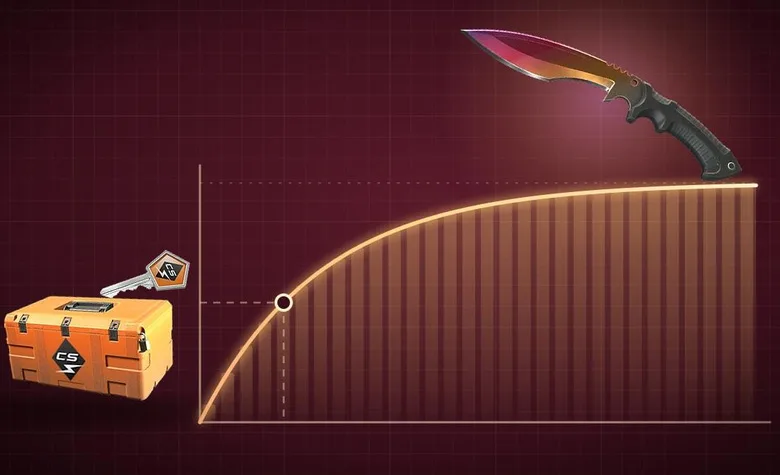
On average, 391 cases. If you only want a coin-flip chance at a knife or gloves, plan on 271, and at today's prices even the cheaper of those two numbers costs you more than $700. Here's where those numbers come from and what they cost in 2026.
Cases are cheap right now. A Kilowatt Case sold for a median $0.12 on the Steam Market on November 14, and CSMarketCap's October recap had its case index down 10.72% for the month, the steepest drop of any category it covered. The key didn't move. It still costs $2.49, which means the key is about 95% of what you pay to open a Kilowatt. A cheaper box barely changes the math.
Where the 0.26% comes from
The numbers every odds guide quotes come from China, where Perfect World, Valve's local partner, had to publish them in 2017 under rules that force games with loot boxes to disclose drop chances. PCGamesN covered it at the time: the odds Perfect World released were ratios between tiers, and a player turned them into percentages.
The ratios are 100 blue, 20 purple, 4 pink, 0.8 red and 0.32 gold. Add them up and you get 125.12, so the gold tier (a knife or gloves, depending on the case) works out to 0.32 / 125.12 = 0.2558%. Everyone rounds that to 0.26%, which gives the familiar "1 in 385". The unrounded figure is 1 in 391.
StatTrak sits on top of that. Perfect World said any grade has a 10% chance to come as StatTrak, so a StatTrak knife is roughly 1 in 3,910 cases.
How many cases you really need
The average hides how streaky this is. Each case is its own roll: the published table describes odds per case, and nothing in it builds up during a dry run. Case 300 has the same 0.2558% as case one.
So the useful question is how many cases give you a given chance of at least one gold. Here's that table, with the cost per opening at $2.61 for a Kilowatt Case plus key and $3.57 for a Dreams & Nightmares Case ($1.08 median) plus key, Steam Market prices on November 14:
| Chance of at least one knife or gloves | Cases needed | Cost with Kilowatt ($2.61) | Cost with Dreams & Nightmares ($3.57) |
|---|---|---|---|
| 10% | 42 | $109.62 | $149.94 |
| 25% | 113 | $294.93 | $403.41 |
| 50% | 271 | $707.31 | $967.47 |
| 75% | 542 | $1,414.62 | $1,934.94 |
| 90% | 900 | $2,349.00 | $3,213.00 |
| 99% | 1,799 | $4,695.39 | $6,422.43 |
Two things in that math surprise people. After 391 cases, the "average" count, about 37% of players still haven't seen gold. And going from 50% to 90% takes more than three times as many cases. The tail is long, and a lot of players live in it.
Gold is also a specific item, not "a knife" in general. In a Kilowatt Case it's always a Kukri, and the cheapest Kukri on the Steam Market on November 14 was a Safari Mesh in Well-Worn at $44.67. An average run of 391 Kilowatts costs about $1,020 in keys and cases. That's a lot of money for a knife whose floor price is under $45, even if your pull lands a better finish.
You do get something back from every case, but 79.92% of the time it's a blue Mil-Spec, and most of those sell for well under a dollar. The table only counts what you put in and leaves resale out, since the drops that would change the result are the rare ones.
The trade-up route
Since Valve's October 22, 2025 update, there's a second way to a knife that skips the 0.26% entirely. The patch notes extended the Trade Up Contract to Covert items. Five regular Coverts now turn into one knife or one pair of gloves, and five StatTrak Coverts into a StatTrak knife, taken from the collection of one of the items you put in. The StatTrak route only gives knives, since gloves never come in StatTrak.
It isn't free. Covert prices climbed right after the update, which is why the market panicked the night the patch landed, and you still don't pick the finish. You get a random knife or gloves from that collection, so a contract built from cheap Coverts can hand you a Safari Mesh as easily as something you'd keep. What it does give you is a known price for the attempt instead of an open-ended number of keys.
Cases outside Steam
Steam isn't the only place players open cases. Case-opening sites don't use Valve's drop table at all: they assemble their own cases from CS2 skins and set the price and the odds together, so 0.26% stops being the rule. On Skin.Club, every item in a case is listed with its own drop chance and the range of roll numbers it covers, and the Provably Fair system lets you check a finished roll afterwards.
That changes what the math is about. When a site builds a case entirely out of knives, getting a knife stops being the question and which knife becomes the whole game. In the knife-only case we checked, a vanilla Navaja carried a 7% chance and an Emerald Gamma Doppler Bayonet 0.01%. Per-item odds let you work that out before you open anything, the same way the table above works out a Steam case.
What buying a knife costs instead
The cheapest knife on the Steam Market on November 14 was a Navaja Knife | Safari Mesh in Field-Tested at $41.40. Shadow Daggers in Bright Water and Black Laminate sat just above it, around $43. Knives also lost 4.52% in October by CSMarketCap's count, less than cases, but still down.
Put that next to the table: $41.40 buys 15 Kilowatt openings with keys, and 15 cases give you about a 3.8% chance at gold. With Dreams & Nightmares it's 11 openings and roughly 2.8%.
None of that makes opening cases pointless. People open them for the moment the reel slows down and for the clip afterwards, and a key is the price of that moment. If the knife itself is the goal, buy it. If you keep opening anyway, budget for 271 keys before a knife becomes a coin flip.