




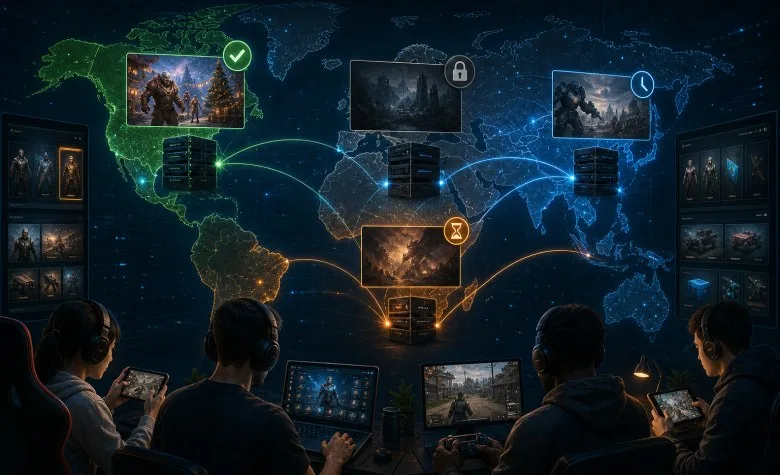
Live-service games depend on continuous updates, seasonal events, and active communities. However, many players barely notice that not every piece of content reaches every region at the same time—or becomes available there at all. Publishers now control regional availability more precisely than ever for legal, commercial, and infrastructural reasons.
This development no longer affects only niche titles. It determines which builds, items, or game modes players can access in a particular country. Anyone creating meta analyses or tier lists increasingly needs to account for these regional differences.
How Licensing Determines Game Rollouts
Age-rating requirements and licensing regulations have long been important tools that publishers use to release content differently across territories. In Germany, for example, games without a valid age rating may face restrictions on public advertising or presentation—a requirement that can have direct technical consequences.
Store operators enforce these rules through server-side filtering that uses account information and IP addresses to determine which content is visible. For live-service games, this means that an update or event may technically exist while remaining completely invisible to certain players. Rollout schedules therefore become a strategic tool rather than merely an administrative necessity.
Server Infrastructure and Country-Specific Availability
The technical side of this control is particularly visible in recent market developments. In April 2026, approximately 900 titles were reportedly removed from the German Steam store or blocked from new purchases as a direct result of stricter regional access requirements.
These mechanisms are not exclusive to the gaming industry. The online gambling sector has also developed a highly segmented landscape of regional services, with access models varying from one market to another. Information about platforms operating without a German licence provides another example of how availability and access conditions can differ significantly depending on the user’s region.
This comparison shows that regional segmentation has become a cross-industry principle of digital entertainment rather than a phenomenon limited to individual gaming platforms.
Accounts are usually connected to regions through several factors at the same time. IP address, payment country, and purchase history may all be used to determine which products and content a player can view or purchase. This is not an accidental side effect. It is a deliberate system designed to prevent price arbitrage and technically enforce regulatory requirements.
Parallels with Other Digital Entertainment Markets
Streaming services face very similar issues. The European Consumer Centre Germany has noted that geoblocking remains noticeable despite existing portability rules. A television series may be available in one EU country while remaining restricted in a neighbouring market.
This practice also continues to receive political support. Discussions surrounding the possible extension of the EU Geoblocking Regulation to audiovisual content indicate that regional access restrictions for copyrighted works are likely to remain in place.
For live-service publishers that frequently use licensed intellectual property or audiovisual event content, the message is clear: regional content restrictions are not a temporary problem. They are a permanent feature of the digital entertainment market.
What This Means for Players Worldwide
For players who optimise builds, follow meta trends, or create progression guides, regional availability is becoming a permanent part of the planning process. An item, game mode, or balance patch available in one region may function differently elsewhere—or may not be available at all.
Players who participate internationally or use boosting services should therefore pay close attention to regional differences. Server selection and store region are no longer minor technical details. They are structural features of modern live-service games, and their importance is likely to increase in the coming years.