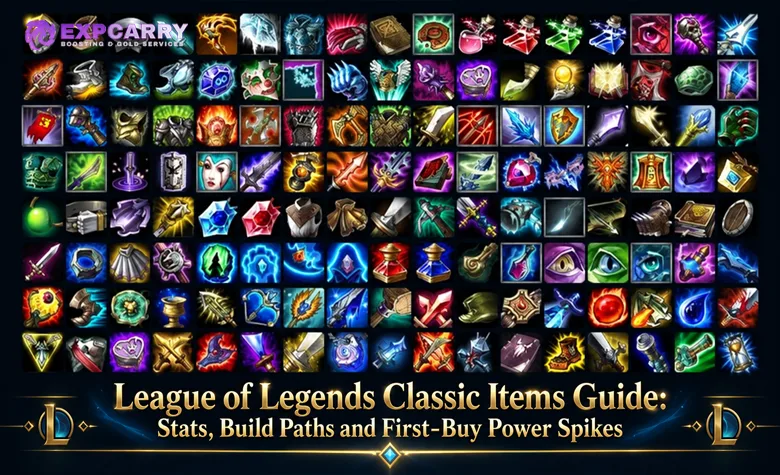
League of Legends Classic items reward a different kind of shopping discipline than modern League. A completed item can be a huge spike, but the path to that item is often uneven: one recall gives a perfect component, another leaves you choosing between movement, sustain, a cheap stat stick, or saving several hundred more gold. The strongest build is therefore not always the fastest route to six finished items. It is the sequence of purchases that gives your champion the most useful power at each recall.
This League of Legends Classic items guide focuses on that decision process. It covers starting items, first-buy power spikes, important components, classic build paths, defensive pivots, support and jungle purchases, and the current item changes that make archived Season 3 guides unreliable. Riot describes Classic as a "greatest hits" version of early League rather than a frozen copy of one historical patch, so the live Classic shop and current patch notes remain more important than memory.
How League Classic Itemization Differs From Modern League
Classic itemization is less standardized around equal-price first items. Some powerful components are cheap enough to buy on an ordinary recall, while other builds ask you to hold gold for expensive pieces such as B. F. Sword or Needlessly Large Rod. Finished item prices also vary much more. Morellonomicon sits at 2,200 gold, while Infinity Edge costs 3,800 gold and Trinity Force costs 3,628 gold in the current Classic item set.
That price spread changes the meaning of tempo. Completing a cheaper item can create a fight-winning window before an opponent reaches a more expensive scaling purchase. On the other hand, spending 800 to 1,300 gold on a component that directly solves lane pressure can be better than forcing a weak recall just to keep the theoretical full-item route clean.
Riot's League Classic developer overview makes the broader design clear: Classic restores old-school items, Runes, Masteries, champion identities, and strategic tradeoffs while retaining selected modern quality-of-life improvements. The item shop should therefore be read as its own live system, not as a museum copy of Season 3.
If the difficult part is deciding which recall actually converts a lane lead into a kill window, League of Legends coaching is one relevant option for reviewing item timing and matchup decisions. The same principle still applies without coaching: every recall should answer the next problem in the match.
Starting Items: Win the First Lane Problem
The three classic Doran's items remain the cleanest examples of how Classic shopping works. They are not interchangeable placeholders. Doran's Blade buys physical trading power, Doran's Ring supports AP lane pressure, and Doran's Shield gives up some aggression for a larger defensive health package. Choosing correctly can matter more than copying the eventual six-item build.
| Starting Item | Cost | Core Stats | Best Use |
|---|---|---|---|
| Doran's Blade | 475g | 80 Health, 10 Attack Damage, basic attacks restore 5 Health on hit | Physical lanes that want stronger last-hits, trades, and basic-attack sustain immediately |
| Doran's Ring | 400g | 60 Health, 15 Ability Power, 3 Mana Regen per 5 seconds, restores 4 Mana on unit kills | AP champions that want early spell pressure, mana sustain, and a cheap offensive start |
| Doran's Shield | 440g | 100 Health, 10 Health Regen per 5 seconds, blocks 8 damage from champion basic attacks | Poke or basic-attack-heavy lanes where surviving the first levels matters more than forcing trades |
Crystalline Flask and consumable-heavy openings can also be correct, especially for champions that spend both health and mana to create repeated lane pressure. The tradeoff is immediate combat strength. If the opponent starts a Doran's item and you start sustain, do not take the first trade as if both inventories provide the same stats.
First-Buy Power Spikes: Components Matter More Than Perfect Recipes
The first recall is where many Classic lanes are decided. A player who returns with a component that changes damage, sustain, cooldowns, or durability can pressure the next wave immediately. A player who returns with scattered pieces that only look good on a final build screenshot may have spent the same gold for much less lane power.
The table below is intentionally limited to high-impact first-buy components rather than every item in the shop. These are useful because each purchase creates a clear breakpoint and leads into several common finished items.
| Item | Cost | Current Stats or Effect | Why It Is a Power Spike |
|---|---|---|---|
| Pickaxe | 875g | 25 Attack Damage | Large raw AD injection for a moderate recall and a component in several carry items |
| B. F. Sword | 1,550g | 45 Attack Damage | Expensive but immediately changes last-hitting, trades, and crit carry damage |
| Vampiric Scepter | 800g | 10 Attack Damage, 10% Life Steal | Turns repeated basic attacks into lane sustain while preserving an AD build path |
| The Brutalizer | 1,337g | 25 Attack Damage, 10% Cooldown Reduction, 10 Lethality | Combines damage, spell frequency, and early physical penetration in one recall |
| Fiendish Codex | 820g | 30 Ability Power, 10% Cooldown Reduction | Cheap AP plus cooldown value that builds into multiple mage and support options |
| Catalyst the Protector | 1,200g | 200 Health, 300 Mana, level-up restoration | Stabilizes mana-heavy lanes while building toward Rod of Ages and other durable AP routes |
| Heart of Gold | 825g | 200 Health, 5 gold per 10 seconds | Immediate health plus long-term income for champions that can delay a full combat item |
The first-buy rule is simple: buy the strongest component you can actually use now. A B. F. Sword is a huge purchase on a marksman who can afford 1,550 gold cleanly. If you are forced back on 875 gold, Pickaxe is not a failed recall; it is a real damage spike that keeps the Infinity Edge path alive. If you are losing trades because you cannot stay healthy, Vampiric Scepter may outperform a greedier damage component even if the final build is identical.
Explore services related to this guide, selected from our League of Legends catalog.
View All League of Legends Services

Why Saving for a Full Item Can Lose Lane Tempo
Classic has more awkward recipe gaps than modern League, so refusing to buy until the exact full-item path is available can be expensive. Gold sitting in your inventory does nothing. If the next fight happens before you complete the item, a useful component can be worth more than theoretical efficiency.
This is especially important when an opponent has already hit a component spike. If an AD lane opponent returns with Brutalizer, walking back with only Boots while holding 900 unused gold creates a real combat gap. If an AP opponent buys Catalyst and can now survive repeated exchanges, continuing to play for short poke as if their sustain profile did not change is a mistake.
There are exceptions. Rod of Ages gains value from being completed earlier because its stacking begins after purchase. Infinity Edge becomes dramatically stronger only when its complete crit package is online. The decision is therefore not "always buy components" or "always save." It is whether the next 60 to 120 seconds of the match are more important than the completion timing you are delaying.
Classic Build Paths for Major Carry Items
Classic build paths are worth memorizing because components often have independent value. A good route lets you adapt without abandoning the final item. The examples below use current Classic costs and recipes, not modern League recipes.
| Finished Item | Total Cost | Build Path | Primary Power Spike |
|---|---|---|---|
| Infinity Edge | 3,800g | B. F. Sword + Pickaxe + Cloak of Agility + 645g combine | 70 Attack Damage, 25% Critical Strike Chance, critical strikes deal 250% damage instead of 200% |
| Deathfire Grasp | 3,100g | Needlessly Large Rod + Fiendish Codex + 680g combine | 120 Ability Power, 10% Cooldown Reduction, active deals 15% of the target's maximum Health as magic damage and increases subsequent magic damage taken by 20% for 4 seconds |
| Rod of Ages | 2,800g | Catalyst the Protector + Blasting Wand + 740g combine | Health, mana, AP, and ten minutes of stacking after completion |
| Trinity Force | 3,628g | Zeal + Sheen + Phage + 3g combine | Broad mixed stats plus Spellblade and movement value for repeated ability-attack patterns |
| Wriggle's Lantern | 2,000g | Madred's Razors + Recurve Bow in Patch 26.17 | 30% Attack Speed, 25 Armor, 15% Life Steal, jungle damage, ward utility, and eventual Feral Flare transformation |
These paths illustrate why one generic purchase rule does not work. Infinity Edge is expensive and asks the marksman to accumulate large raw-damage pieces. Deathfire Grasp gives mages two very different component timings: a 1,600g Needlessly Large Rod recall and an 820g Fiendish Codex recall. Rod of Ages rewards finishing the item earlier because the scaling clock starts after completion. Trinity Force is expensive, but each of Zeal, Sheen, and Phage can solve a different mid-game problem before the combine.
ADC First Buys: B. F. Sword, Pickaxe, Sustain, or Attack Speed
Traditional crit carries often want Infinity Edge early, but the correct first recall depends on gold and lane state. B. F. Sword is the strongest raw AD checkpoint when you can afford it without destroying your recall timing. Pickaxe is the natural lower-cost damage option. Vampiric Scepter is the sustain pivot when staying in lane and surviving poke matters more than maximum burst per attack.
Attack speed components become more attractive when the champion already has enough base damage, relies on repeated on-hit effects, or is moving toward a different first item. The important mistake to avoid is buying attack speed simply because it appears later in the full build. If your current trades are one or two attacks plus a spell, raw AD may create the larger immediate power spike.
Infinity Edge itself is not a universal first item for every marksman or crit champion. League Classic contains older on-hit, lifesteal, and mixed-stat routes that can be correct for specific kits and matchups. Use the final build as a destination, then use the lane to decide the order.
AD Bruiser and Assassin Components: Brutalizer, Phage, and Defensive Pivots
The Brutalizer is one of the clearest Classic first-buy spikes because it compresses three useful offensive properties into 1,337 gold. Champions that trade through repeated physical spells benefit from the Attack Damage, Cooldown Reduction, and penetration at the same time. It also builds into The Black Cleaver and Youmuu's Ghostblade, so the first buy does not lock you into only one final item.
Phage is the opposite type of component. It trades some burst efficiency for a more mixed combat profile and fits Trinity Force or durable physical routes. If the lane is decided by whether you survive long enough to finish a second rotation, Phage can be more valuable than a pure damage purchase.
Do not delay defensive components until the fifth item if the matchup already demands them. Hexdrinker can be the correct mid-build response into threatening magic burst, while Chain Vest or Negatron Cloak can buy enough effective health to keep a lead alive. A damage item that you never get to use is not a power spike.
AP First Buys: Codex, Catalyst, Needlessly Large Rod, or Early Boots
Mage shopping has one of the widest Classic price ranges. Fiendish Codex costs only 820 gold and supplies 30 AP plus 10% Cooldown Reduction. Needlessly Large Rod costs 1,600 gold and delivers a much larger raw AP commitment. Catalyst costs 1,200 gold but buys health, mana, and level-up restoration rather than maximum damage.
The right choice depends on what stops the champion from winning the lane. If cooldowns limit pressure, Codex can be excellent. If mana and survivability are the problem, Catalyst may create more usable spell casts than another AP component. If you are already ahead and can afford Needlessly Large Rod cleanly, the raw damage can accelerate a Deathfire Grasp or Rabadon's Deathcap timing.
Sorcerer's Shoes can also be a first major spike rather than a cleanup purchase. Movement speed changes dodge windows, roam timing, and target access, while magic penetration improves real damage against low-resistance targets. Do not automatically sit on basic Boots until after the first legendary item.
Rod of Ages and Other Scaling Purchases Should Be Completed Early
Rod of Ages is different from a normal stat bundle because it grows after completion. The current Classic version begins at 450 Health, 450 Mana, and 60 Ability Power, then gains 20 Health, 20 Mana, and 2 Ability Power each minute for ten stacks. Delaying the completion therefore delays both the current stats and the time at which the fully stacked item arrives.
That creates a practical rule: once you have committed to Rod of Ages and the game still supports that plan, prioritize finishing it over unnecessary side purchases. Catalyst is a strong lane component, but sitting on Catalyst for ten more minutes removes the main reason to choose Rod of Ages in the first place.
The exception is survival. If completing Rod means refusing Mercury's Treads into a crowd-control-heavy lane or skipping a necessary resistance component before an objective fight, the theoretical stacking curve may not matter. Scaling is only valuable if the character reaches the later game in a playable state.
Deathfire Grasp and Burst Builds: Active Items Are Part of the Combo
Deathfire Grasp is not valuable only because it gives 120 Ability Power. Its active deals magic damage equal to 15% of the target champion's maximum Health and increases subsequent magic damage taken by 20% for 4 seconds. That means the item must be used at the correct point in the spell sequence; buying it and forgetting the active removes a large part of the purchase value.
The component path also creates two different recall plans. Fiendish Codex is the cheap tempo option with AP and cooldown value. Needlessly Large Rod is the expensive damage checkpoint. If you cannot afford the Rod without missing several waves or a major fight, Codex first can keep the lane functional while preserving the final DFG route.
Players practicing a single champion's classic combo and item timings may also find a League of Legends Champion Mastery route relevant as a separate account goal. It does not determine the correct Classic build, so item decisions still need to be made from the current matchup and live Classic values.
Support Items: Gold Generation, Sightstone, and Cheap Team Power
Classic supports operate on a much tighter personal economy than modern supports. Gold-generation items and purchased vision matter more because there is no modern support-item progression system solving the entire economy and warding loop for you automatically.
Heart of Gold is a classic example: 825 gold buys 200 Health and 5 gold per 10 seconds. That can be strong when the champion can use the health immediately and expects the income to pay back over a long game. Philosopher's Stone and Lucky Pick serve similar economic ideas for different stat profiles.
Vision investment remains central even though Classic includes trinkets. Players still need to think about ward inventory, ward timing, and the opportunity cost of spending gold on information instead of combat stats. A support who rushes a flashy AP item while the team has no reliable vision around Dragon can create more total risk than the extra damage solves.
Patch 26.17 also made Innervating Locket much more attractive by cutting its total cost to 2,250 gold, increasing its Health to 500, adding 10% Cooldown Reduction, and increasing Innervation's restoration to 60 Health and 25 Mana. That is exactly why an old item list cannot be treated as current without checking the live patch.
Gold-Per-10 Items: When Greed Is Actually Efficient
Gold-generation items are strongest when they provide a stat you already want and the game will last long enough for the passive income to matter. Heart of Gold is useful because its 200 Health is not dead combat value while you wait for the income. A support or tank can therefore buy immediate durability and future gold in the same slot.
The downside is tempo. If the enemy completes a major combat item while you stack economy pieces, the gold-per-10 advantage may never have time to pay back. Do not buy multiple income items automatically just because old League allowed it. Compare the expected game length, your role, and whether the next objective demands real combat stats now.
Jungle Items Changed in Patch 26.17
Jungle itemization is one of the clearest examples of Classic being a live remix rather than one historical snapshot. Riot acknowledged that the mode combines 2013 jungle tuning with Feral Flare from a later period, which created overlapping item identities. Patch 26.17 reshaped Wriggle's Lantern and Feral Flare to separate them more clearly from Spirit of the Elder Lizard.
The current Patch 26.17 notes changed Wriggle's build path from Madred's Razors plus Vampiric Scepter to Madred's Razors plus Recurve Bow. The 2,000g total price stayed the same, but the item lost 25 Attack Damage and gained 30% Attack Speed. Feral Flare also lost 25 Attack Damage and gained 30% Attack Speed after the transformation.
That means any current jungle guide telling you to plan a Vampiric Scepter specifically for Wriggle's is outdated. The first-buy logic now favors junglers that convert attack speed into faster clearing or on-hit pressure, while Spirit of the Elder Lizard remains the more natural offensive route for champions that value Attack Damage.
Defensive First Buys Can Be Offensive Power Spikes
A defensive component can increase your real damage output by keeping you in range long enough to cast again. This is especially true in Classic, where hard crowd control and targeted burst are more common and many champion kits have fewer modern escape tools.
- Mercury's Treads: prioritize when magic damage and crowd control are the reason you cannot participate in fights.
- Ninja Tabi: useful when repeated physical basic attacks are the main lane or teamfight threat.
- Chain Vest: a direct armor checkpoint that can stop an AD snowball before you finish the larger defensive item.
- Negatron Cloak: the equivalent magic-resistance pivot when AP burst is forcing bad recalls.
- Hexdrinker: a hybrid offensive-defensive answer for AD champions that still need damage while surviving magic burst.
The correct timing is before the damage becomes unplayable, not after. If an enemy mage can already remove most of your health in one rotation, finishing another pure offensive component may give you no realistic chance to use it.
When to Finish Boots Before Your First Legendary Item
Boots are a real power purchase in Classic because movement affects more than roaming. It changes whether you can dodge skillshots, reach a target before a stun expires, escape older point-and-click engage patterns, and return to lane before losing another wave.
Finish boots early when movement or resistance directly solves the matchup. Sorcerer's Shoes can be a damage spike for AP champions. Mercury's Treads can turn an impossible crowd-control chain into a survivable one. Boots of Mobility can create map pressure on roaming champions and supports. The mistake is treating upgraded boots as mandatory first item or mandatory second item regardless of the game.
How to Build When You Are Ahead, Even, or Behind
The same champion should not always follow the same six purchases. Your gold state changes which risks are acceptable and which component timings matter most.
- When ahead: convert the lead into a component or finished item that creates immediate kill pressure. Do not sit on 1,500 unused gold trying to make the next recall prettier.
- When even: buy the component that improves the lane pattern you are already playing. Sustain, cooldowns, movement, and resistance can be more valuable than theoretical maximum damage.
- When behind: reduce the enemy's strongest win condition. A cheap defensive component, wave-clear item, or safer boots can preserve enough time for the next major purchase.
Classic is intentionally more punishing when early leads turn into item advantages, so poor shopping decisions can compound quickly. The practical response is to evaluate the inventory gap before the next fight rather than following the same purchase order regardless of the scoreboard.
Current Classic Item Changes You Should Not Miss
League Classic has already received live item balance changes, which makes old Season 3 reference sheets useful only as historical context. Patch 26.17 is the latest live Classic patch and is especially important for itemization because it changed both a support item and the Wriggle's Lantern/Feral Flare jungle path.
- Innervating Locket: total cost is now 2,250g, Health is 500, Cooldown Reduction is 10%, and Innervation now restores 60 Health and 25 Mana.
- Wriggle's Lantern: still costs 2,000g, but now builds from Madred's Razors plus Recurve Bow and provides 30% Attack Speed instead of 25 Attack Damage.
- Feral Flare: likewise provides 30% Attack Speed instead of 25 Attack Damage after the transformation.
- Classic item behavior: Riot continues fixing interactions such as Statikk Shiv timing and Tear stacking bugs, so tooltips and patch notes matter even when the item name looks familiar.
The League Classic launch patch notes are also useful for understanding which systems entered the mode at release, but current item values should always be checked against later Classic patches.
The existing ExpCarry League Classic Patch 2 guide covers the full 26.17 Classic update, including these item changes, Rune progression, champions, and system fixes. This items guide stays focused on purchase logic and build paths instead of repeating the patch overview.
Common League Classic Itemization Mistakes
Most bad builds are not bad because the final six items are absurd. They fail because the purchases arrive in the wrong order for the game that is actually happening.
- Saving too long for one expensive component: a useful 800g or 900g buy can win the next fight while 1,400 unspent gold cannot.
- Copying historical Season 3 recipes: Classic already has current-only changes such as the new Wriggle's Lantern path.
- Ignoring item actives: Deathfire Grasp, Shurelya's Reverie, Quicksilver Sash, and similar items lose major value when their actives are not used deliberately.
- Finishing damage into an unwinnable matchup: defensive boots or a resistance component can create more real DPS by keeping you alive.
- Delaying Rod of Ages after committing to it: every delayed minute delays its stacking curve.
- Buying gold-generation items without a timing plan: future income does not help if the next two objectives are lost because the inventory has no combat power.
- Treating support vision as someone else's job: Classic asks the team to spend inventory space and gold on vision more deliberately.
The best way to audit a build is to look at each recall separately. Ask what changed after the purchase. If the answer is "nothing until I buy two more components," the route may be too greedy for the current game.
League of Legends Classic Items FAQ
These questions cover the purchase decisions that most often cause confusion for players returning from modern League or using old Season 3 guides.
Is League Classic using the exact Season 3 item set?
No. Riot describes Classic as a curated mix from early League, and current patches already include item combinations and balance changes that did not exist together historically.
What is the best first buy for an ADC in League Classic?
There is no universal answer. B. F. Sword is a major raw AD spike at 1,550g, Pickaxe gives 25 AD for 875g, and Vampiric Scepter trades some damage for sustain. Choose based on recall gold and lane pressure.
How much does Infinity Edge cost in League Classic?
Infinity Edge costs 3,800g and builds from B. F. Sword, Pickaxe, and Cloak of Agility plus a 645g combine cost.
What does The Brutalizer give in League Classic?
The Brutalizer costs 1,337g and gives 25 Attack Damage, 10% Cooldown Reduction, and 10 Lethality. It builds into The Black Cleaver and Youmuu's Ghostblade.
Should Rod of Ages be rushed?
If the build has committed to Rod of Ages, early completion is valuable because the item gains one stack per minute for ten minutes. Delay it only when survival or a critical matchup purchase matters more.
Is Wriggle's Lantern still an Attack Damage item?
No. Patch 26.17 removed its 25 Attack Damage, added 30% Attack Speed, and changed the recipe to Madred's Razors plus Recurve Bow while keeping the 2,000g total cost.
Should supports buy gold-per-10 items?
They can be efficient when the stats are already useful and the game will last long enough for the income to matter. Do not sacrifice every early combat or vision purchase just to stack future gold.
Can I use old Season 3 build guides for League Classic?
Use them for ideas, not exact current values. Verify recipes, costs, and interactions in the live Classic shop because Riot is actively balancing the mode.
Conclusion
League of Legends Classic itemization is strongest when you stop thinking only in six-item screenshots. Doran's choices determine the first lane pattern, components such as Pickaxe, Brutalizer, Fiendish Codex, Catalyst, and Vampiric Scepter create real first-buy breakpoints, and the expensive completed items reward different timing plans. Infinity Edge wants raw damage and crit completion, Rod of Ages wants an early stacking clock, Deathfire Grasp wants an active burst window, and Trinity Force gives several useful component checkpoints before the final combine.
Use the live Classic shop as the authority, especially after Patch 26.17 changed Wriggle's Lantern, Feral Flare, and Innervating Locket. Buy for the next fight rather than the final screenshot, finish boots or resistance when they solve the matchup, and treat archived Season 3 builds as context instead of current rules. The best first-buy power spike is the purchase that changes what your champion can safely do before the next recall.