
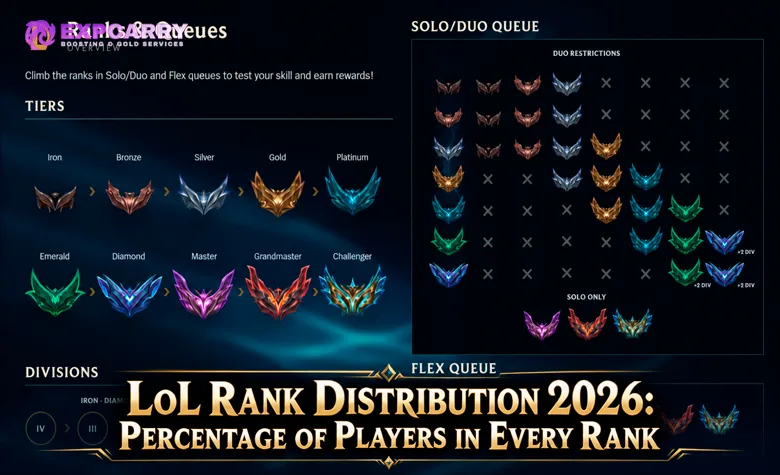
LoL rank distribution in 2026 looks different from the old picture of a ladder packed with Bronze and Silver players. In the global Ranked Solo/Duo data counted on October 27, Gold is the most populated rank at 23.3%, followed by Silver at 20.6% and Platinum at 18.4%. Approximately 4.7% of ranked players are Diamond or higher, while Master, Grandmaster, and Challenger together account for around 0.74%. The median player sits in Gold III, which makes Gold a more useful reference point than its reputation from older seasons might suggest. These are third-party figures compiled from Riot's ranked ladders, not an official distribution table published by Riot. The numbers also reflect important changes to how visible ranks correspond to MMR in 2026.
If you have ever reached Emerald and wondered whether that makes you a good player, or climbed into Diamond only to discover that the competition suddenly feels much tougher, rank percentages help put those experiences into perspective. They show how many ranked players occupy each part of the ladder and how uncommon your current position really is. But the distribution is not fixed: Riot can change how hidden matchmaking rating maps to visible ranks, players move between divisions, and new Ranked participants enter the population. Let's examine the October numbers, what they mean, and why comparing your 2026 rank with an older season can be misleading.
Short answer: In October 2026, Gold is the most common League of Legends rank at approximately 23.3% of Ranked Solo/Duo players, while Gold III contains the median player. Emerald IV or higher represents roughly the top 18.2%, Diamond IV or higher the top 4.7%, and Master or higher about the top 0.74%, based on LoLValue's October 27 dataset.
LoL Rank Distribution 2026: Every Rank and Player Percentage
The global snapshot used here comes from the LoLValue rank distribution tracker, which reports 16,886,712 Ranked Solo/Duo players across 15 regions as of October 27, 2026. The data reflects the live Ranked Season 3 ladder during Patch 26.21. It counts accounts with an established Solo/Duo rank rather than every League account ever created, so unranked accounts and other queues are outside this comparison. Riot's official Ranked tiers guide confirms that League has ten ranks, with four divisions each from Iron through Diamond and a separate Apex ladder for Master, Grandmaster, and Challenger.
| Rank | Share of Ranked Players | Top Percentage at This Rank or Higher |
|---|---|---|
| Iron | 3.7% | 100.0% |
| Bronze | 15.7% | 96.3% |
| Silver | 20.6% | 80.5% |
| Gold | 23.3% | 59.9% |
| Platinum | 18.4% | 36.6% |
| Emerald | 13.5% | 18.2% |
| Diamond | 3.9% | 4.7% |
| Master | Approximately 0.68% | Approximately 0.74% |
| Grandmaster | 0.041% | 0.058% |
| Challenger | 0.017% | 0.017% |
The first percentage tells you how many ranked players currently occupy that tier. The second shows the proportion at that tier or above it, starting from its lowest division. For example, Gold contains 23.3% of ranked accounts, but Gold IV or higher includes approximately 59.9% of the entire Ranked Solo/Duo population. The figures are rounded and represent a dated snapshot, not permanent thresholds. Master is particularly difficult to count because Riot's ranked API returns at most 10,000 Master entries per regional ladder. LoLValue estimates players beyond that limit, so its Master+ percentage is less certain than the lower-tier counts.
LoL Rank Percentiles: Where the Top 1%, 5%, and 10% Begin
Percentiles can sound more impressive or more disappointing than they should, depending on how you read them. When someone says they are in the top 5% of League players, they usually mean that about 5% of ranked accounts occupy their position or a higher one. It does not mean they have a 95% chance of defeating a random opponent, and it says nothing about the total number of people playing League without entering Ranked. A percentile simply locates an account within a particular competitive population.
For the October 27 global Solo/Duo snapshot, these are useful reference points:
- Top 50%: The median lies within Gold III. Gold II or higher is entirely above the midpoint, while Gold IV is below it.
- Top 20%: Emerald IV or higher, approximately 18.2% of ranked players.
- Top 10%: Emerald II or higher is approximately the top 10.0% at the displayed precision. Emerald I or higher is clearly inside the top 10%, at about 8.0%.
- Top 5%: Diamond IV or higher, approximately 4.7% of ranked players.
- Top 1%: The exact cutoff lies within Diamond I. Diamond I or higher covers about 1.3%, while Master or higher is safely inside the top 1%, at approximately 0.74%.
- Top 0.1%: Grandmaster and Challenger together represent approximately 0.058%.
One detail stands out: positions can vary substantially inside a single tier. Gold IV is the most common individual division, accounting for about 8.3% of ranked players, yet Gold III contains the midpoint of the entire ladder. The same Gold badge can therefore describe quite different competitive positions. If you are evaluating a LoL rank climb from Platinum into Emerald, the percentile change tells you more about the distance between those milestones than the tier names alone.
Gold IV and the Most Populated Ranks in League of Legends
Gold holds the largest share of the 2026 Solo/Duo ladder, but that does not mean every Gold player has suddenly become equally skilled. League's distribution is shaped by the relationship between hidden MMR and visible rank, where the system places players, and how accounts move through divisions. Gold now occupies the central portion of the competitive population rather than representing a relatively small group well above the midpoint. That matters when someone dismisses Gold as universally low based on memories of a much older Ranked system.
The distribution is also uneven within each tier. Gold IV accounts for approximately 8.3% of all Ranked Solo/Duo players, while Platinum IV is the second-largest individual division at around 7.4%. Division IV is generally where players enter a tier after promotion, and tier-boundary demotion protection can influence how long accounts remain there. Those mechanics help explain why a tier's bottom division can become crowded, although a single snapshot cannot establish precisely how much each mechanic contributes.
Consider two players with the same Gold badge. One has just reached Gold IV, while the other is sitting near Gold I and trying to enter Platinum. They belong to the same tier in a basic distribution table, but their positions on the ladder are not interchangeable. That is also why counting ranked wins alone cannot tell you the exact number of games needed to cross a percentile threshold. LP gains, losses, and the account's underlying matchmaking rating all matter. For a fuller explanation of progression, see the existing LoL ranks guide.
Explore services related to this guide, selected from our League of Legends catalog.
View All League of Legends Services


The 2026 MMR Changes Behind League's New Rank Distribution
The current percentages make more sense once you understand that Riot deliberately adjusted how MMR translates into visible ranks during 2026. This was not simply the result of players gradually improving over another season. In its March 2026 development update, Riot explained that the Ranked ladder had become uneven in the skill differences represented by certain tiers. The team focused particularly on Iron and the upper end of Diamond, where different problems had developed.
Iron and Bronze Rank Distribution After Riot's 2026 Adjustment
Riot said Iron had historically contained around 14% of players globally, including many people who had been playing for years. The problem was not that everyone in Iron lacked experience. Some players understood champions and game mechanics reasonably well but struggled to apply that knowledge consistently, meaning the same tier contained players with very different levels of familiarity with League. Riot adjusted the relationship between MMR and visible rank to move more experienced players from Iron into Bronze, leaving Iron better suited to those still learning the game.
In the October 27 tracker data, Iron represents approximately 3.7% of Ranked Solo/Duo players and Bronze about 15.7%. Those figures are consistent with the direction of Riot's adjustment, but they should not be presented as a controlled before-and-after comparison. Riot's historical 14% figure and the October third-party snapshot come from different dates and reporting contexts. We can confidently say Riot changed the mapping and that current trackers show a much smaller Iron population; we cannot attribute every percentage point of the difference to that adjustment alone.
Diamond to Master: The 2026 Shift in High-Elo Ranks
At the other end, Riot found that the skill gap between Diamond IV and Diamond I had become unusually large. Instead of treating that entire range as one coherent level of play, it shifted the higher-performing portion of Diamond into Master by changing the MMR-to-rank mapping. This made Master cover a wider skill range, from newly promoted players to competitors much closer to Grandmaster. Riot also explained that this widening raised the LP requirements for reaching the limited Grandmaster and Challenger positions.
That change makes historical comparisons particularly tricky. A player reaching Master in 2026 may be entering a tier that represents a different MMR range than Master did in an older season. It does not make the achievement meaningless, and it certainly does not mean all Master players are equally skilled. It means the label alone is no longer enough to compare accounts from different years. Current tracker figures put Master and above below 1% of the Ranked Solo/Duo population, but interpreting that group requires accounting for Riot's revised mapping and the limitations of public data.
Ranked Season 3 and the Percentiles That Keep Moving
Even without another major rank redistribution, the numbers change as players complete placements, climb, stop playing, and return. Riot began Ranked Season 3 on July 29, 2026, creating another milestone in the competitive calendar around which player activity could shift. New ranked participation can change the population measured by public trackers, while LP movement and inactivity affect where established accounts sit. Ordinary balance patches do not automatically redistribute every player or reset the ladder.
For that reason, I would avoid judging the whole year from a single screenshot labeled "2026 rank distribution." Riot's MMR adjustment, the snapshot date, and the changing Ranked population all matter. To compare one month with another, use the same provider, region, and queue, then check whether its counting method changed. Otherwise, an apparent rise in Diamond or decline in Silver may partly reflect a measurement difference rather than a genuine competitive trend.
Solo/Duo vs. Flex: How LoL Rank Percentages Differ by Queue and Region
One of the easiest mistakes is comparing two charts that are not measuring the same ladder. Ranked Solo/Duo and Ranked Flex have separate ranks and matchmaking histories. Riot's official MMR, Rank, and LP explanation describes how hidden rating relates to visible progression, while its Ranked queues guide confirms that Solo/Duo and Flex ranks are independent. Someone can be Emerald in Solo/Duo and Gold in Flex without anything being wrong with their account. The percentages in this article refer only to Solo/Duo.
Region matters too. A worldwide chart combines servers with different population sizes, activity patterns, and competitive environments. A rank that represents a certain percentage globally may be more or less common on EUW, NA, Korea, or another individual server. That alone does not prove one region is universally easier or harder. For a meaningful comparison, use the same rank, queue, and date across the regions involved.
When two websites disagree about rank distribution, check these details before trusting either number:
- Measurement date: A recent daily count and a chart from an earlier 2026 season are not equivalent.
- Queue: Solo/Duo and Flex populations must not be mixed.
- Region: Worldwide percentages and single-server distributions answer different questions.
- Player coverage: Unranked accounts, incomplete placements, missing regions, and API limits can affect the denominator.
- Apex coverage: Riot's accessible Master lists are capped on large servers, so tools that only count visible entries can understate Master+.
The final point deserves attention because small percentages at the top are easy to misread. A separate October tracker reports a directly observed Master+ share near 0.61%, while LoLValue estimates approximately 0.74% after accounting for Master players beyond the public list limit. Both figures can be informative when their counting methods are understood, but they are not identical measurements. For reliable comparisons, always keep the source date and Apex estimation method attached to the percentages.
Setting Realistic Ranked Goals with LoL Percentiles
A rank distribution chart can be motivating, but it becomes less useful when players treat every percentile as a judgment about their worth. I would use it as a map instead. If you are currently Gold IV, reaching Platinum represents a meaningful move through the ranked population, but it is a different journey from breaking into Diamond's top few percent. Both goals can be worthwhile. The important thing is choosing a target that gives your games direction rather than turning every loss into a personal crisis.
A practical way to use the numbers is:
- Start with the correct ladder. Check your current Solo/Duo rank and use a distribution chart filtered to the same region whenever possible.
- Choose a percentile milestone. Emerald IV places you around the top 18.2% globally, Diamond IV around the top 4.7%, and Master or higher around the top 0.74% in this snapshot.
- Separate the badge from your progress. Compare recent LP gains and losses with the concepts explained in the LoL MMR guide. A visible rank alone cannot reveal your exact hidden rating.
- Work on repeatable improvements. Focus on frequent mistakes, champion consistency, laning decisions, and objective timing rather than treating a brief winning streak as proof that you belong several tiers higher.
- Recheck the distribution later. Percentile thresholds can move, particularly after major Ranked changes or shifts in the active player population.
If your goal is improvement rather than collecting another badge, reviewing your gameplay is usually more useful than staring at the distribution every day. Some players prefer analyzing replays themselves, while others use League of Legends coaching to identify weaknesses they might overlook. Either way, a percentile measures where you stand; it does not explain everything about how you play. If you are still learning Ranked, the LoL placement matches guide explains how an account receives its initial position.
LoL Rank Distribution 2026: Common Questions
These answers cover important details that a simple percentage chart may miss, particularly when comparing ranks with friends or checking older League of Legends statistics.
Are Unranked Accounts Included in LoL Rank Distribution?
No. The distribution used here covers accounts with a recorded Ranked Solo/Duo position, not everyone who plays League of Legends. Players without an established rank in that queue are excluded, so these figures should never be described as percentages of every League player worldwide.
What Is the Average LoL Rank in 2026?
Gold is the most common tier, and Gold III contains the median player in the October 27 global Solo/Duo snapshot. However, Gold IV and Gold I occupy noticeably different positions, so calling every Gold player exactly average would oversimplify the results. Strictly speaking, Gold III is the median division, not a calculated mathematical mean or an official skill rating assigned by Riot.
Can Your LoL Rank Percentile Change Without Playing?
Yes. Your percentile compares your rank with the current ranked population, so it can shift as other players move between divisions or new accounts enter the ladder. At higher ranks, inactivity and LP decay rules can also affect visible position. Even if your badge stays unchanged, its standing within the wider population may move.
Does Riot Publish Official Rank Distribution Percentages?
Riot publishes Ranked rules and explains major system adjustments, but the full tier-by-tier percentages in this article come from a third-party tracker using Riot's ranked ladder data. They are approximate, date-specific, and subject to collection limits. Riot's support documentation also contains a general historical statement about Master representing the top 0.2%; that statement should not be substituted for a dated October 2026 Solo/Duo count after Riot changed the rank-to-MMR mapping. For trustworthy comparisons, keep the source, date, queue, region, and measurement method attached to each percentage.
What the 2026 LoL Ranked Numbers Tell Us
The 2026 League of Legends Ranked Solo/Duo ladder is centered around Gold, with Emerald occupying a smaller upper portion of the population and Diamond beginning around the top 5%. Master and the ranks above it are rarer still, although their exact shares are harder to measure. Riot's 2026 adjustments also make older distribution charts unreliable shortcuts for judging today's players. Use the percentages to understand your position and choose sensible goals, then let your actual matches show you what needs to improve.