
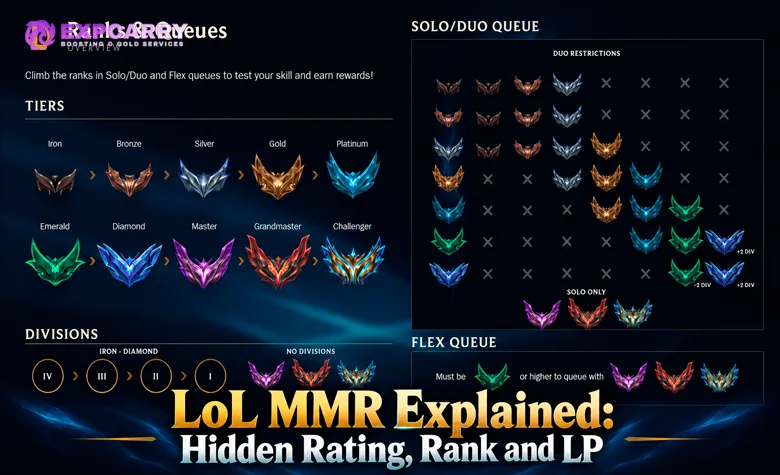
LoL MMR (Matchmaking Rating) is the hidden rating Riot Games uses to match League of Legends players with opponents of comparable skill. It is different from your visible rank and League Points (LP), which is why a Gold player can encounter Platinum opponents, receive unusually large LP gains, or lose more LP than a victory awards. In the 2026 Ranked system, Riot also provides a Climb Indicator when a player's visible rank is lower than their matchmaking level. However, Riot does not reveal exact MMR values, and third-party calculators cannot retrieve the real number. The most reliable ways to assess your position are your recent LP gain/loss pattern, the strength of your matchmaking lobbies, and the indicators available in the game client. This guide explains those signals, the limits of MMR checkers, and how to improve your ranked progression.
Short answer: Your MMR determines the skill level of your matchmaking, while your visible rank and LP track ranked progression. If you consistently gain more LP than you lose, your MMR is generally above your rank; if you lose more than you gain, it is generally below. Riot keeps the exact rating hidden, so any numerical MMR estimate from a third-party website is unofficial.
What Is MMR in League of Legends?
MMR stands for Matchmaking Rating. It is an internal rating Riot uses to estimate where a player belongs in the matchmaking system and to assemble games between players of roughly similar ability. Winning a match raises your MMR, while losing lowers it. The precise calculation and numerical scale are not made public.
Riot's official MMR, Rank, and LP explanation confirms that MMR is deliberately hidden because its numerical value is designed for internal matchmaking rather than direct player comparison. The system translates competitive progress into visible ranks, divisions, and LP instead.
MMR does not operate as a separate reward currency that players can spend or collect. Its purpose is to evaluate matchmaking strength and support ranked progression. This distinction matters because two players can display the same rank while playing against noticeably different opponents.
MMR vs Visible Rank: What Is the Difference?
Your visible rank is the tier and division shown on your profile, such as Silver II, Gold IV, or Emerald I. It represents your position on the ranked ladder and changes through LP progression. MMR is the hidden rating the system uses when evaluating appropriate matches.
These two measurements generally move in the same direction over time, but not necessarily at the same speed. A player returning after a ranked reset may display a lower tier than the one suggested by their matchmaking results. Conversely, a player protected from an immediate tier demotion may retain a visible rank that is higher than their current MMR.
| System | What It Represents | Visible to Players? | Main Function |
|---|---|---|---|
| MMR | Internal matchmaking rating | No exact numerical value | Matching players of similar skill and informing LP progression |
| Rank | Competitive tier and division | Yes | Showing ladder progression |
| LP | League Points earned or lost in Ranked | Yes | Moving between divisions and tiers |
| Climb Indicator | A signal that visible rank is behind matchmaking level | Yes, when applicable | Explaining certain apparent rank mismatches |
MMR and rank are related, but one is not simply a publicly hidden version of the other. An Emerald player does not automatically have one fixed MMR value, and an external website cannot convert every division into an exact official rating. The relationship depends on the current matchmaking environment and Riot's internal rank distribution.
How MMR Affects LP Gains and Losses
LP is the main visible signal of the relationship between your MMR and rank. Riot uses LP gains and losses to help your visible rank move toward the level indicated by matchmaking results. This is why players in the same division may receive different amounts of LP after winning or losing a game.
Riot describes three general situations: MMR above rank, MMR approximately aligned with rank, and MMR below rank. These patterns are useful for diagnosis, but none provides a formula for calculating the hidden number.
| Observed LP Pattern | Likely Relationship | Interpretation |
|---|---|---|
| Wins award more LP than losses remove | MMR above visible rank | Rank is generally catching up with matchmaking level |
| Wins and losses have similar LP values | MMR approximately aligned with rank | Visible position is relatively consistent with matchmaking results |
| Losses remove more LP than wins award | MMR below visible rank | Rank is generally ahead of the current matchmaking level |
| LP values change sharply in isolated games | Not enough information | Check bonuses, penalties, matchmaking conditions, and additional matches |
MMR Higher Than Your Rank: Larger LP Gains
When your MMR is substantially higher than your displayed rank, Riot attempts to move your visible progression upward more quickly. Wins generally award more LP, while defeats remove less. This commonly occurs when a returning player begins the season below their previous competitive position or when matchmaking strength rises faster than the visible rank.
For example, gaining 26 LP after a win and losing 18 LP after a defeat would produce a net gain of 8 LP across those two games. These figures are illustrative, not fixed Riot thresholds. What matters is the repeated relationship between comparable victories and defeats.
MMR Approximately Equal to Your Rank
When the two systems are reasonably aligned, LP gains and losses tend to be similar. If a player receives approximately equal amounts for wins and defeats, Riot considers the visible rank relatively consistent with current matchmaking strength. Further climbing then requires sustaining a positive win rate against the opposition being provided.
A player with a strong lifetime or season-wide win rate can still have balanced current LP gains. If most of those wins happened at lower ranks, the older results do not necessarily describe the player's performance against current opponents. Riot specifically warns against interpreting an overall win rate without considering where those games occurred.
MMR Lower Than Your Rank: Smaller LP Gains
When matchmaking results fall below the level represented by a player's displayed tier, wins can award less LP than defeats remove. Losing streaks, changes in performance, and rank protection can contribute to this situation. The system is attempting to bring visible progression and matchmaking strength closer together.
For example, a player gaining 17 LP per victory and losing 25 LP per defeat would lose a net 8 LP across one win and one loss. That does not prove the account has a specific hidden MMR or that the next match will have the same adjustment. It indicates a negative LP balance worth monitoring across additional matches.
Recovering from this pattern requires consistently winning against the opponents the matchmaker provides. There is no confirmed fixed number of victories that automatically restores normal LP gains, because the system continues updating matchmaking ratings as games are played.
Why Are Your LoL Opponents Higher or Lower Rank Than You?
The matchmaker primarily evaluates internal ratings and attempts to assemble teams with similar expected strength. Riot's matchmaking documentation describes a target near an even chance of victory for both sides, while also accounting for position preferences and queue times. It does not simply select ten players whose visible rank badges match.
A Silver player appearing in a Platinum lobby can therefore be the result of a higher hidden matchmaking level rather than a matchmaking error. The opposite can happen when a player's displayed rank remains high but recent matchmaking results place them against lower-rated opposition.
Why You Face Players Above Your Current Tier
Higher-ranked opponents can indicate that your MMR is already above your visible rank, particularly when the pattern persists over several games. A player who has recently started climbing, returned after a reset, or performed substantially above expectations may be placed into stronger lobbies before their displayed rank catches up.
However, the average visible rank of one lobby is not a direct measurement of MMR. Other players may have their own rank-to-MMR differences, and matchmaking must account for factors beyond the badges on the loading screen.
Why You Face Lower-Ranked Players
Facing lower-ranked opponents repeatedly can suggest that your current matchmaking strength is below your visible rank. It can also reflect another player's unusually high MMR, differences within premade groups, or a shortage of appropriate players in the queue.
Riot also identifies off-peak hours, role availability, and queue duration as factors that complicate matchmaking. These conditions make individual lobbies less useful for diagnosing your own rating. Look for consistent trends instead of drawing a conclusion from one unusual match.
Does Duo Queue Affect Your MMR and Opponents?
Playing with a premade partner changes matchmaking conditions because the system must account for both players and the advantages of coordination. Riot states that premade groups can encounter somewhat more difficult opposition or reduced LP gains. A duo with a significant rank difference can also create lobbies that look less balanced when judged only by visible badges.
This does not mean every duo receives one permanent LP penalty or a different published MMR formula. Ranked duo eligibility also depends on tier and region: Patch 26.15 allowed qualifying Master players to duo while restricting Grandmaster, Challenger, and players with MMR at those levels. Evaluate your own results and queue conditions. If your goal is understanding personal Solo/Duo progression, avoid comparing isolated duo games against a separate sample of solo matches without accounting for the difference.
Explore services related to this guide, selected from our League of Legends catalog.
View All League of Legends Services


LoL Climb Indicator: The Official 2026 MMR Signal
Riot introduced the Climb Indicator in Patch 26.3 to help explain situations where a player's displayed rank is lower than their matchmaking level. The indicator appears during the loading screen when applicable, providing useful context for a player who seems unusually low-ranked compared with the rest of the lobby.
The feature was confirmed in the official Patch 26.3 notes and is documented as part of Riot's 2026 matchmaking changes. It is especially relevant to players whose rank is catching up with their current MMR.
What the Climb Indicator Tells You
The indicator provides evidence of a particular direction of rank mismatch: the player's visible rank is lagging behind their matchmaking level. This can help explain why someone with a relatively low rank appears in a higher-ranked lobby. It is an official client-side signal, unlike a third-party estimate built from public profile data.
However, the indicator does not show the numerical MMR value or quantify the difference between MMR and rank. It also should not be used as a complete rating diagnostic in situations where the rank is ahead of MMR. Its absence alone is insufficient to establish that the two values are exactly equal.
How to Check Your LoL MMR Without an Exact Number
Riot does not publish exact individual MMR values. The most practical alternative is to evaluate observable signals that are connected to matchmaking and ranked progression. LP history is the clearest starting point, while the Climb Indicator and opponents' visible ranks provide additional context.
A useful diagnosis should remain within one queue and consider several games. A single LP gain, unusually strong opponent, or temporary bonus is not enough to calculate a hidden rating.
Step-by-Step MMR Diagnosis
Use the following procedure to determine whether your visible rank is probably ahead of, behind, or relatively close to your matchmaking level. It provides a qualitative assessment rather than an exact MMR score.
- Select the correct queue: Review Ranked Solo/Duo or Ranked Flex separately rather than combining results.
- Record recent LP changes: Track LP gained after wins and removed after defeats across several completed matches.
- Identify unusual adjustments: Note Aegis of Valor bonuses, AFK-related adjustments, loss prevention, or other special cases.
- Compare normal gains and losses: Determine whether wins generally award more, about the same, or less LP than defeats remove.
- Check the Climb Indicator: Use it as additional evidence when it appears, not as an exact numerical measurement.
- Review multiple matchmaking lobbies: Look for recurring differences between your rank and the visible ranks of opponents.
- Check current performance: Separate your recent results at the current rank from your overall seasonal win rate.
- Repeat after more matches: Reassess whether LP gains and opponent strength are changing in a consistent direction.
For example, reviewing ten or more recent matches can be more useful than reacting to a single game, provided there are enough wins and defeats to compare. Ten matches is a practical observation window, not an official Riot threshold for MMR stabilization. If results are unusual or bonuses are common, a larger sample may be necessary.
| Signal | What It Can Tell You | What It Cannot Prove |
|---|---|---|
| Recent LP gains and losses | Whether MMR is probably above, near, or below displayed rank | Your exact hidden MMR number |
| Climb Indicator | Visible rank is behind matchmaking level when shown | The size of the rating gap |
| Opponent ranks | The approximate competitive environment of recent lobbies | Exact MMR values of you or your opponents |
| Recent win rate | Whether you are consistently winning at your current matchmaking level | A direct numerical conversion to MMR |
| Third-party MMR calculator | An estimate based on its available data and assumptions | Direct access to Riot's internal rating |
Are LoL MMR Checkers and Calculators Accurate?
Third-party MMR checkers estimate matchmaking strength using public or otherwise accessible information such as ranked position, match history, and visible lobby ranks. Different services use different models, reference scales, and data coverage, so the same account can receive different numerical estimates.
These tools do not expose Riot's exact hidden rating. A website presenting a number such as 1,750 MMR is displaying its own estimate, not a verified value from Riot's internal matchmaking system. Treat that number as a rough indicator only if the website clearly explains its methodology and limitations.
A trustworthy checker should identify which queue it evaluates, state when the data was collected, explain its estimation method, and avoid promising precise accuracy. It should not require your account password to perform a public-data estimate. The official client remains the authoritative source for visible rank, LP, and supported matchmaking indicators.
Important: Riot does not provide a public exact-MMR lookup for ordinary players. Avoid websites claiming guaranteed access to the hidden number, fixed MMR thresholds for every rank, or a precise number of wins needed to repair your account. Such claims are not established by Riot's published matchmaking rules.
Separate MMR for Ranked Solo/Duo, Flex, and Normal Games
League of Legends does not use one universal MMR value for every queue. Riot confirms separate matchmaking ratings for Normal, Ranked Solo/Duo, and Ranked Flex. Your results in one queue therefore cannot be interpreted as direct changes to the matchmaking rating in another.
This is important when diagnosing apparently inconsistent games. A player who performs well in Flex may still have a different Solo/Duo rating, and a strong Ranked Solo/Duo player can encounter unexpected opponents in Normal games because the queues evaluate separate matchmaking histories.
Does Ranked Flex Affect Solo/Duo MMR?
Riot's official explanation states that a losing streak in Flex does not directly lower your Solo/Duo MMR. The two queues have separate ratings, even though matchmaking rules and initial calibration can involve information from other game modes in certain circumstances.
For an established account, evaluate LP gains in the specific ranked queue you are trying to climb. Combining Flex wins with Solo/Duo losses into a single percentage does not provide a reliable diagnosis of either queue's MMR.
Do Normal Games Affect Ranked MMR?
Riot states that Normal matchmaking is separate from Ranked matchmaking. However, the initial placement of an account entering Ranked for the first time can take Normal Draft and Swiftplay MMR into account. This is a starting-calibration relationship, not a rule that ordinary Normal wins directly raise the Solo/Duo rating of an established ranked player.
The distinction explains why a new account's early Ranked opponents may not correspond to an arbitrary beginner rating. Riot uses available information to estimate suitable placement and reduce the likelihood of placing experienced players into clearly inappropriate matches.
Placements, Ranked Resets, and Demotion Protection
Placements and rank resets can create temporary differences between displayed rank and hidden matchmaking strength. Riot's current placement rules require five placement matches per ranked queue when a player is unranked, such as during the initial ranked placement or after the new-year reset. Starting position depends on match results, opponent difficulty, and relevant previous progression. First-time ranked players may also have their Normal Draft and Swiftplay MMR considered, and placement cannot exceed Diamond III under the published rules.
During placement matches, defeats do not remove visible LP, but match results still matter to the rating and placement process. A player can therefore see limited visible movement while the system continues determining an appropriate matchmaking position.
Does a Ranked Reset Erase Your MMR?
A visible rank reset does not necessarily erase the matchmaking history represented by MMR. Riot's general explanation describes players starting a season at a lower visible rank while retaining their underlying matchmaking level, allowing stronger early LP gains as the rank catches up. The exact treatment depends on the applicable reset rules.
The 2026 season also included specific changes to how MMR maps onto visible ranks. Riot adjusted the distribution at parts of the lower ladder and around the upper Diamond/Master boundary, meaning that historical comparisons between an MMR estimate and a rank from an older season are especially unreliable.
There was also a targeted Master+ ranked reset in Patch 26.9 for NA, EUW, EUN, LAN, BR, and TR, where affected players were reset to Master 0 LP. This was separate from an ordinary universal ladder reset. These events are reasons to check the applicable official patch notes before assuming a sudden visible rank change reflects an equally large change in hidden skill.
How Demotion Protection Can Create an MMR Gap
Visible rank protection can temporarily soften the effects of a losing streak on the displayed tier. Matchmaking results continue to matter, however, so a protected rank can end up above the level suggested by recent games. That can contribute to smaller LP gains and larger losses as the systems move back toward alignment. Separately, inactivity-related LP decay in Diamond and higher ranks should not be treated as direct evidence of an equivalent MMR decrease.
Current Riot support documentation states that demotion between tiers can place players at 25, 50, or 75 LP depending on the assessed gap. These are current demotion rules rather than universal MMR values. The official placements and demotions guide provides the applicable progression details.
Other Reasons Your LP Gains May Look Unusual
Not every unexpected LP result is caused solely by the difference between hidden MMR and visible rank. Riot documents additional systems that modify the LP awarded or removed in certain circumstances. These exceptions should be identified before using a match as evidence that your MMR has suddenly improved or deteriorated.
Aegis of Valor and Bonus LP
Aegis of Valor is a Ranked feature introduced in 2026 that rewards eligible players in autofilled or priority-role situations. Under the rules updated in Patch 26.15, eligible victories award double LP without requiring a minimum champion mastery grade. Aegis no longer reduces LP losses after defeats. These bonuses affect visible LP progression and should not be interpreted as evidence of an equivalent sudden MMR increase.
Earlier in 2026, Patch 26.3 raised the required mastery grade from C to B, but Patch 26.15 removed that minimum grade requirement and ended Aegis loss protection. When diagnosing normal LP gains, distinguish an Aegis-affected victory from an ordinary match. Do not use the earlier mastery threshold or loss-protection rules to describe the current system.
LP Compensation, Penalties, and Loss Prevention
Riot may also adjust visible LP because of verified disruptive behavior, cheating-related compensation, loss prevention, or AFK/leaver penalties. Under the disruptive-behavior match termination system introduced in Patch 26.10, a successful termination vote protects the affected team from losing LP or MMR. Other verified disruptive-behavior cases can also trigger protection or compensation under the applicable rules.
The important distinction is between the visible adjustment and what can actually be established about hidden MMR. Some protection systems explicitly prevent MMR loss, but Riot does not provide a public conversion allowing players to calculate MMR changes from every compensation or penalty. Exclude unusual LP events when evaluating your normal gain/loss trend.
How to Improve Your MMR in League of Legends
The confirmed way to improve your MMR is to win matches consistently at your current matchmaking level. Riot states that victories increase the rating and defeats decrease it. There is no supported shortcut that directly repairs an account's hidden number independently of competitive results.
Improving MMR therefore means improving the probability of winning more games over time. Concentrating on repeatable gameplay improvements is more useful than looking for an undisclosed reset mechanism or assuming a specific win streak guarantees better LP gains.
Prioritize Consistent Wins Over Short Streaks
A short winning streak can improve recent results, but it does not guarantee permanent LP increases. As a player climbs, matchmaking generally becomes more demanding, and earlier results against weaker opponents become less representative of current performance. Evaluate whether you continue winning at the new level rather than judging progress only by the total season win rate.
Focus on the decisions that repeatedly affect match outcomes: farming efficiently, avoiding unnecessary deaths, controlling objectives, coordinating with teammates, and recognizing favorable fights. These improvements influence MMR through wins rather than awarding separate hidden points for individual statistics.
Use a Small, Reliable Champion Pool
Playing familiar champions reduces the number of mechanical and matchup mistakes made during Ranked games. A small pool also makes it easier to recognize recurring problems in lane, itemization, teamfighting, and map decisions. The goal is not to avoid learning new champions altogether, but to avoid treating important ranked matches as repeated first-time experiments.
Choose champions suited to your role and skill level, then review why matches are being won or lost. If a particular champion consistently produces poor results at the current rating, practicing it outside Ranked or switching to a more reliable alternative may improve competitive consistency.
Review Losses Instead of Chasing a Fixed MMR Number
A useful review identifies decisions that you can control: missed waves, poor recalls, deaths before major objectives, weak vision decisions, unnecessary fights, or failure to adapt to enemy threats. Correcting repeatable mistakes matters more than interpreting every defeat as evidence that matchmaking has become unfair.
Track your performance at the current rank and compare results across enough matches to identify a pattern. If LP gains gradually improve while opponents become stronger, that can be consistent with successful progression. However, the exact internal MMR remains unknown throughout the process.
MMR Shortcuts and Myths to Avoid
Several popular strategies confuse visible LP mechanics with hidden matchmaking progression. The following claims should not be treated as reliable ways to repair MMR:
- Winning Normal games to repair an established Solo/Duo rating: The queues use separate matchmaking ratings.
- Using a third-party checker as proof of exact MMR: Such tools provide estimates, not Riot's internal value.
- Maintaining a high KDA while losing: Riot's published MMR explanation emphasizes match results, not a guaranteed bonus for personal statistics.
- Dodging until a favorable lobby appears: Dodging carries its own penalties and restrictions, including stronger consequences in high-tier Ranked.
- Assuming one fixed win streak resets LP gains: Riot has not published a universal number of wins required to restore an account's MMR.
The practical objective is to improve the quality and consistency of competitive results. There is no need to know the exact hidden number to determine whether your matches are becoming more successful.
LoL MMR FAQ
These additional answers address common questions about hidden ratings and the limits of available diagnostic tools.
Can you see another player's exact MMR? No. Riot does not publish exact individual MMR values for ordinary player lookup. A visible rank, loading-screen indicator, or external estimate cannot reveal the precise internal value.
Does reaching a higher rank mean your MMR immediately matches it? Not necessarily. Rank and MMR can move at different speeds, particularly during placements, rapid climbs, and periods affected by demotion protection. Recent LP patterns provide a better indication of whether the two systems are approaching alignment.
Can an MMR calculator predict how many games you need to climb? It can provide a hypothetical projection using assumptions about win rate and LP changes, but it cannot guarantee the result. Actual matchmaking strength, LP adjustments, and future wins or losses remain variable.
Conclusion
MMR explains why visible rank, opponent strength, and LP changes do not always agree. Riot keeps the exact value hidden, but consistent LP patterns, matchmaking history, and the 2026 Climb Indicator offer useful evidence of the relationship. Evaluate your results within one queue, account for current Aegis of Valor rules and special LP adjustments, and focus on winning consistently rather than relying on an unofficial numerical MMR estimate.