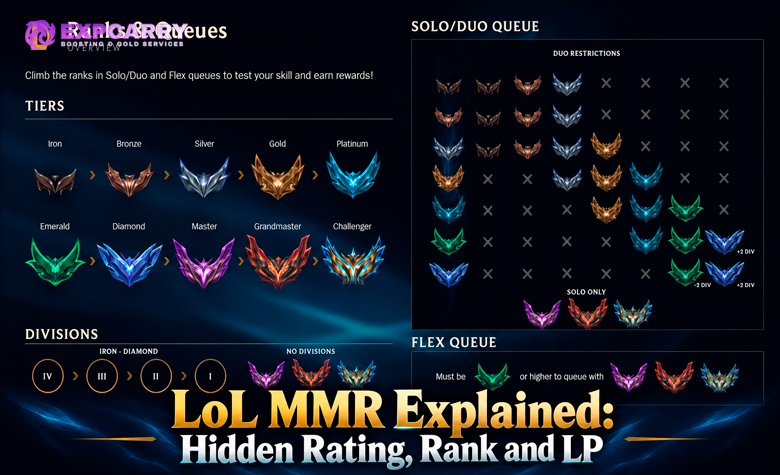

League of Legends placement matches determine your starting Ranked tier and division before you begin the regular climb. In 2026, you must complete five placement games in Ranked Solo/Duo and another five if you also want a rank in Flex. Riot considers your match results, the strength of your opponents and your previous year's rank. For accounts entering Ranked for the first time, Normal Draft and Swiftplay MMR also contribute to initial placement. Losses award zero LP during placements, but they still affect hidden matchmaking rating, so every match matters. The highest possible standard placement is Diamond III, regardless of your previous rank or a perfect five-win record. These rules remain the relevant official placement framework as of Patch 26.20. This guide explains how your first rank is assigned, what to expect from each match and how to prepare without relying on misleading win-to-rank calculators.
Short answer: Standard LoL placement matches consist of five games per Ranked Solo/Duo or Flex queue, with your final starting rank determined by results, opponent difficulty and previous ranking information. You cannot lose visible LP during placements, but defeats still affect MMR, and even winning all five games does not guarantee a specific starting tier. The experimental Ranked 5s mode also has five placements on a separate ladder.
How Do LoL Placement Matches Work in 2026?
Placement matches are the provisional games used to assign a starting rank in League of Legends. Riot requires them when an account is unranked in a standard Ranked queue, including players entering Ranked for the first time and players beginning a new ranked year after the annual reset. Once the required games are completed, the account receives its starting tier and division for that queue.
The 2026 ranked year began on January 8 with a rank reset and five provisional games. Riot's current support documentation confirms the same five-game requirement for each standard Ranked queue. This replaces older versions of League of Legends that required ten placement matches, so guides describing ten games as the current standard are outdated.
| Rule | Current Requirement |
|---|---|
| Placement matches | 5 games per standard Ranked queue |
| Ranked Solo/Duo | Separate placement series and starting rank |
| Ranked Flex | Separate placement series and starting rank |
| Maximum starting rank | Diamond III in standard placements |
| LP after a placement win | Positive progression based on the account's placement conditions |
| LP after a placement loss | 0 LP gained; no visible LP deducted |
| MMR after a placement loss | Still affected by the defeat |
| Final rank | Established after the required five games |
These rules are documented in Riot's Placements, Promotions, Series, Demotions, and Decay support article. They describe standard Summoner's Rift Ranked Solo/Duo and Flex. The experimental Ranked 5s queue has its own five-game placement process and separate progression, while League Classic uses a different competitive system.
Why Are There Five Placement Matches Instead of Ten?
Riot reduced the placement series from ten games to five and retained the shorter format in later ranked seasons. The system uses existing matchmaking information alongside the placement results, allowing it to establish a starting position without requiring ten separate provisional games.
Older guides may still contain ten-game tables, including advice about winning seven or eight placements. Those calculations should not be used for the 2026 ranked system. Players now complete five qualifying games in each standard queue they want ranked.
When Do You Need to Play Placements?
Placements are required when you enter a standard Ranked queue without an established rank for the current ranked year. This includes a new player who has just unlocked Ranked and a returning player whose visible rank was reset at the start of the year. An established player does not repeat five placements merely because a regular balance patch arrives.
Riot's current description ties standard placements to being unranked and to the new-year reset. Seasonal content updates and ordinary champion balance changes do not automatically trigger another placement series. An exceptional mid-year reset occurred in Patch 26.9, when Master, Grandmaster and Challenger players in NA, EUW, EUNE, BR, LAN and TR were reset to Master at 0 LP. That intervention was not a general five-game placement reset.
How to Unlock Your First Ranked Placement Matches
New League of Legends accounts must meet the Ranked entry requirements before beginning placements. Reaching the appropriate summoner level alone is not enough. Riot also requires an adequate champion collection and experience in ordinary Summoner's Rift matches.
| Requirement | Minimum | Purpose |
|---|---|---|
| Summoner Level | 30 | Unlock eligibility for Ranked queues |
| Champion Collection | 20 champions | Meet the minimum champion availability requirement |
| Normal Match Experience | 10 Swiftplay or Normal Draft games | Complete the required preliminary PvP experience |
These requirements are confirmed by Riot's Unlocking Game Modes page. Once they are satisfied, Ranked Solo/Duo and Ranked Flex become available, subject to the normal queue restrictions and availability in the player's region.
Playing the required ten Normal games is not the same as completing placements. Those matches unlock Ranked eligibility and can provide information for initial matchmaking. The actual five-game placement series begins after the account enters a Ranked queue.
What Happens If You Have Never Played Ranked Before?
Riot uses available Normal Draft and Swiftplay MMR when preparing a new player's initial Ranked placement. This helps the system estimate suitable opposition instead of treating every first-time Ranked account as having identical prior experience. A player who performs well in Normal games may therefore encounter stronger competition during their first Ranked matches than another new player with different matchmaking results.
Normal-game MMR is not a direct conversion into a guaranteed Ranked tier. Riot also evaluates the actual placement results and opponent difficulty. You cannot reliably predict your first rank from Normal win rate alone, and Riot does not publish a numerical formula for calculating it.
What Happens If You Played Ranked Last Year?
Returning players begin with existing ranking information. Riot specifically identifies the previous year's rank as one of the factors used to determine the new starting position. This means a returning player with an established competitive history is not evaluated in exactly the same way as an account entering Ranked for the first time.
A previous high rank does not guarantee returning to that tier immediately. Riot can assign a lower visible starting rank even when the player's matchmaking level remains comparatively high. In that situation, subsequent LP gains can help the visible rank catch up as the player continues competing.
How Is Your First Rank Calculated After Placements?
Riot's placement calculation uses several inputs rather than a fixed win-count table. The officially identified factors are placement results, the strength of opponents faced and previous ranking information. First-time Ranked players also have Normal Draft and Swiftplay MMR considered during their initial calibration.
As a result, two accounts can finish placements with identical win-loss records and receive different starting ranks. One may have entered the series with a stronger established matchmaking history, while the other may be facing a different level of opposition.
Placement Wins and Losses
Winning placement games improves the account's competitive results and contributes to a stronger starting position. Defeats affect matchmaking rating, even though the visible LP system does not subtract points for them during placements. Every game therefore matters beyond its immediate displayed LP result.
However, Riot does not publish a fixed mapping such as three wins equals Silver, four wins equals Gold or five wins equals Platinum. Any table that promises a tier based only on the number of placement victories ignores the other variables involved.
How Hidden MMR Influences Your Starting Rank
MMR, or Matchmaking Rating, is Riot's hidden rating used to create matches between players of comparable skill. Your placement matches update this rating while the visible rank is being established. The matchmaker considers the competitive level of the opposition you face, not simply the rank icons displayed in a lobby.
That is why two players with a 4–1 placement record may not start in the same division. Their previous matchmaking histories and the difficulty of their respective games can differ. The detailed mathematical weighting is not publicly disclosed, so third-party calculators cannot guarantee an exact first rank.
The broader explanation of hidden rating belongs to the MMR topic. For placement decisions, the essential point is that matchmaking information and the five game results work together instead of forming two unrelated systems.
Why the Strength of Your Opponents Matters
Riot explicitly includes opponent difficulty when determining placements. A win against stronger matchmaking opposition does not occur in the same competitive context as a win against weaker opponents. This helps explain why an account's initial rank cannot be reconstructed from its five match outcomes alone.
Visible opponent ranks can provide context, but they are not a precise record of matchmaking difficulty. Opponents may themselves have recently completed placements, be returning after a reset or have a visible rank that differs from their MMR.
Explore services related to this guide, selected from our League of Legends catalog.
View All League of Legends Services


What Rank Will You Get With 5–0, 4–1 or 0–5 Placements?
A perfect placement record is valuable, but it does not guarantee a particular rank. Riot sets Diamond III as the highest possible standard starting position and does not publish separate guaranteed placements for each win-loss combination. The same results can lead to different ranks depending on the account's matchmaking history and opponents.
The following table describes what each record means without assigning fabricated rank ranges.
| Placement Record | General Interpretation | Guaranteed Rank? |
|---|---|---|
| 5–0 | Five wins provide the strongest possible result from the series, but initial MMR and opponent difficulty still matter | No |
| 4–1 | Strong positive results with one defeat affecting MMR | No |
| 3–2 | Positive win-loss record; final placement still depends on other factors | No |
| 2–3 | More losses than wins, with no visible LP deducted during the series | No |
| 1–4 | Limited wins and several defeats affecting matchmaking strength | No |
| 0–5 | No placement victories, but previous ranking information still contributes to the final calculation for returning players | No |
Even a 5–0 finish cannot exceed the Diamond III standard placement cap. Conversely, an established player losing all five matches is not automatically assigned Iron IV. Riot evaluates more information than the record alone, and neither outcome has a universal guaranteed tier.
Can You Place Directly Into Diamond in 2026?
Yes. Riot's current support documentation allows standard placements as high as Diamond III. This is a maximum, not an expected result for new accounts or a reward granted for winning all five games. Reaching it depends on the full placement assessment.
Players who previously competed in Master, Grandmaster or Challenger are still subject to this standard placement ceiling. Starting below a previous high rank does not automatically mean that their hidden matchmaking rating has fallen to the same level as the displayed placement.
Does Winning All Five Placements Guarantee a High Rank?
No. Winning all five is the best available match record, but the starting position also depends on the account's previous ranking information and the opponents faced. Riot does not provide a guaranteed Gold, Platinum, Emerald or Diamond outcome for a 5–0 record.
Players should focus on maximizing their chance of winning each game rather than following websites that promise an exact division from five results. A fixed win-to-rank table cannot represent the full placement calculation.
Do You Lose LP During Placement Matches?
Riot confirms that standard placement losses do not subtract visible LP. After a defeat, the placement LP result is zero gained rather than a negative amount. This protection applies to the provisional series and differs from ordinary Ranked progression after the starting rank is finalized.
Importantly, zero visible LP loss does not mean that the defeat is ignored. Losing still affects MMR, which contributes to matchmaking and the starting rank calculation. Players should therefore distinguish visible LP protection from the consequences of the match result.
How Much LP Do You Gain for a Placement Win?
There is no single guaranteed LP gain that applies to every placement victory in 2026. The result depends on the account's ranking and matchmaking conditions, and the amount shown in the client can differ between players. Riot's official support documentation does not establish a universal 40, 60 or 80 LP reward for each provisional win.
Do not calculate your expected final rank by multiplying five victories by an assumed LP value. Placement is an assessment of both the current series and existing matchmaking information, not a standard five-match LP farming event.
Do Losses Still Count When LP Cannot Decrease?
Yes. Riot states that wins and losses affect MMR, including during placements. A defeat changes the matchmaking information even when the provisional LP display awards zero points. This is why losing a placement game can influence the final result despite the absence of a visible LP deduction.
Going AFK is also treated as a loss during placements according to Riot's support documentation. Maintaining a stable connection and completing matches normally is therefore important even when the LP loss protection is active.
Ranked Solo/Duo vs Flex Placement Matches
Ranked Solo/Duo and Ranked Flex are the two standard competitive queues. Each requires its own five placement games and produces an independent rank. Completing placements in one does not automatically give the account a finalized rank in the other.
For example, a player can finish all five Solo/Duo placements and remain unranked in Flex until that queue's provisional series is completed. Results in one queue should not be added to the other queue's placement record.
| Feature | Ranked Solo/Duo | Ranked Flex |
|---|---|---|
| Required placements | 5 | 5 |
| Starting rank | Independent Solo/Duo tier and division | Independent Flex tier and division |
| Matchmaking rating | Separate Solo/Duo MMR | Separate Flex MMR |
| Rank from the other queue | Does not become the Solo/Duo rank | Does not become the Flex rank |
| After placements | Normal Solo/Duo ranked progression | Normal Flex ranked progression |
Riot confirms the independent ranks in its Ranked Tiers, Divisions, and Queues article. The experimental Ranked 5s queue is another distinct option in 2026: it requires a premade team of five, has its own five placements and uses separate MMR and LP progression after those games. Its second experiment runs from September 11, 2026, to January 7, 2027, with availability limited to specified weekend hours. Its results do not replace Solo/Duo or Flex placements.
How to Prepare for Your First Five Placement Matches
Preparation is more useful than trying to manipulate an undisclosed placement formula. Your immediate objective is to complete five competitive games in which you can perform consistently. Familiar champions, stable connection quality and a clear understanding of your preferred role give you better control over the decisions that lead to wins.
The purpose of preparation is not to guarantee a particular starting rank. It is to reduce preventable mistakes that could affect the limited five-game series.
Choose a Small Champion Pool
Use champions you already understand rather than experimenting with unfamiliar mechanics during calibration. A main pick and a backup for your primary role are generally more practical than switching between several champions because of one difficult matchup. Familiarity improves farming consistency, ability timing and decisions under pressure.
Prepare at least one comfortable option for your secondary role as well. Ranked matchmaking asks players to select role preferences but does not guarantee that the primary role will be assigned in every game. Being able to play a secondary position competently reduces the risk of entering an important match without a workable game plan.
Checklist Before Starting Placement Games
Before queuing, confirm that your account is eligible, your connection is stable and you have enough time to finish the match. Since AFK results count as losses, starting a game when you expect to disconnect or leave creates an avoidable risk to the placement outcome.
- Check eligibility: Confirm Level 30, 20 champions and the required ten Normal matches if you are new to Ranked.
- Choose your queue: Decide whether the immediate objective is Solo/Duo or Flex.
- Prepare familiar champions: Select reliable options for your preferred positions.
- Review the current patch: Ensure your champion's runes, items and abilities match the live version.
- Check connection stability: Avoid queuing during known connection problems.
- Reserve sufficient time: Start only when you can finish the match without interruption.
- Focus on the game result: Prioritize decisions that help your team win rather than chasing personal statistics.
- Record progress: Monitor which placement games are complete and whether the intended queue has received its final rank.
Do not treat the first defeat as a reason to abandon the entire placement series. Four remaining matches still contribute to the result, and no individual game provides enough information to predict the final tier.
Common Placement Mistakes to Avoid
Several common mistakes can make placements more difficult without improving the final result. Most involve misunderstanding which factors Riot confirms and which are only speculation from players or third-party websites.
- Playing unfamiliar champions: A strong meta pick is not necessarily better than a familiar champion you can use reliably.
- Expecting a rank from a win-count calculator: Riot does not publish a fixed five-game placement table.
- Ignoring opponent difficulty: The same win-loss record can occur in different matchmaking environments.
- Assuming zero LP loss means no consequence: Defeats still affect hidden MMR.
- Mixing Solo/Duo and Flex results: Each queue has independent placements and ranking.
- Leaving or going AFK: Riot counts AFK results as losses during placements.
Improving the outcome comes from playing the five games as consistently as possible. Unverified strategies promising placement bonuses for individual KDA, damage or vision-score thresholds should not be treated as established ranked rules.
What Happens After You Finish All Five Placement Matches?
After completing the fifth placement game in a queue, your starting tier and division become established. You can then continue playing Ranked under the ordinary LP progression rules. Wins and losses affect your visible progress, while MMR continues informing matchmaking and LP adjustments.
There is no requirement to complete another placement series before continuing the same queue's regular climb. A lower starting rank is not a permanent limit on how high the account can reach later in the year.
Why Is Your Starting Rank Lower Than Last Year?
Riot's annual ranked reset can place returning players below their previous visible rank. This is consistent with the intended relationship between MMR and the ranked ladder: the player may retain stronger matchmaking information while restarting from a lower visible tier. Subsequent games allow the new displayed rank to move toward the player's competitive level.
That means an apparently low initial placement does not necessarily indicate that the account is now matched exclusively with players at that displayed rank. Judge progression through the actual opponents and LP changes after the provisional series, not only by comparing the first rank badge with last year's highest result.
How to Start Climbing After Placement
Continue using the same reliable champion pool and focus on maintaining positive results against the current matchmaking opposition. Track your normal LP gains and losses once the placement series is complete. Those values can help indicate whether visible rank and hidden matchmaking rating are relatively close or still adjusting.
The League of Legends Guides hub covers broader Ranked progression topics, including MMR, LP and champion selection. The placement process itself ends after the required five games; subsequent climbing is a separate stage of Ranked progression.
LoL Placement Matches FAQ
These answers address the most common remaining questions about the five-game placement process and the first rank you receive.
Can you be placed above Diamond III? No. Riot lists Diamond III as the highest possible initial rank after standard placements, even for players who previously competed in higher tiers.
Do you need placements at every split or balance patch? Not under the standard current rule. Riot requires placements when you are unranked, including first-time Ranked participation and the start of a new ranked year. A normal balance update or a new season within the same year does not automatically start a new five-game series.
Can a 0–5 placement record still produce a rank above Iron? Yes, depending on the account's other placement factors. Riot uses previous ranking information and opponent difficulty as well as the five results, so no loss record automatically guarantees one specific tier.
Do kills, KDA and CS directly determine your first rank? Riot's published placement explanation lists match results, opponent difficulty and previous ranking information, with Normal MMR considered for first-time Ranked players. It does not establish a separate guaranteed placement bonus for reaching a specific KDA, kill count or CS total.
Conclusion
Standard League of Legends placements require five games in Solo/Duo and another five in Flex, with the starting position determined by results, opponent difficulty and relevant previous ranking information. Losses do not subtract visible LP but still affect MMR, and Diamond III is the highest possible standard initial rank. The experimental Ranked 5s mode uses its own five-game placements and separate ladder. Enter the series with familiar champions, complete every match and evaluate the starting rank only after all five games are finished.