
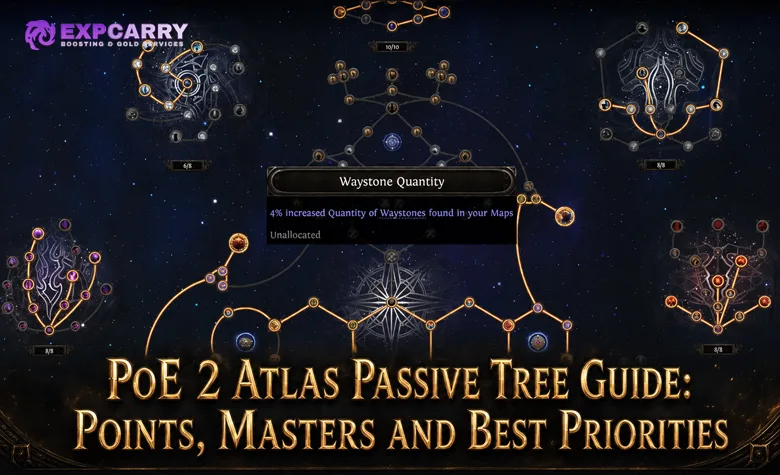
The PoE 2 Atlas Passive Tree should be treated as a progression system first and a farming system second. Early points need to keep Waystones available, help the character complete objectives consistently, and open a short route toward useful global bonuses. Specialization becomes valuable only after the map pool, character, and chosen content can support it.
The current endgame also includes Masters of the Atlas as a separate layer. Doryani, Hilda, and Jado each offer a configurable set of bonuses, and the active Master can be changed between maps. This guide explains how Atlas points are earned, how the main tree differs from mechanic trees and Masters, which priorities make sense at each stage, and how to specialize without following one rigid farming build.
How the PoE 2 Atlas Progression Systems Fit Together
PoE 2 uses several related endgame progression systems. They appear around the same map interface, but they do not use the same points or solve the same problem. Understanding that separation prevents players from searching for a missing refund option or expecting a Breach objective to award a point for the main Atlas tree.
| System | What it changes | How it progresses |
|---|---|---|
| Main Atlas Passive Tree | Global mapping rules, rewards, monsters, Waystones, Tablets, biomes, and broad content interactions | Complete qualifying locations and objectives inside the Precursor Fortress |
| Mechanic Atlas Trees | One endgame mechanic such as Breach, Ritual, Delirium, or another dedicated system | Advance that mechanic's own questline, region, or encounter chain |
| Masters of the Atlas | Map-by-map specialization through Doryani, Hilda, or Jado | Complete each Master's missions to unlock rows and Master points |
| Atlas exploration | Available routes, Towers, points of interest, Fortress access, and boss paths | Open Maps with Waystones and complete their objectives |
The main Atlas tree is unusually large because it is designed to be fully allocated over time. Early pathing still matters because the first points determine what helps during progression, but a late-game character is not permanently locked out of the branches it did not take first.
Global bonuses and map-specific choices
Allocated main-tree passives apply broadly wherever their conditions are met. A Master is selected for the map being opened, so the Master layer can respond to a specific objective, layout, boss, or reward plan. Dedicated mechanic trees are narrower and reward repeated commitment to their matching content.
A coherent setup makes all three layers support the same run. For example, the global tree can support Waystones and Tablets, a mechanic tree can improve one chosen encounter, and a Master can add bonuses suited to the map. Splitting investment across unrelated goals produces weaker results even when every individual node looks useful.
How to Unlock the Main Atlas Passive Tree
The main Atlas Passive Tree is connected to the Precursor Fortress and the Origins of Divinity storyline. Random map completion outside that structure advances exploration and can reveal objectives, but it does not replace the Fortress-based method of earning the main tree's passive points.
Complete the campaign and Interludes, enter the Atlas, and use Waystones to clear manageable Maps. Reaching and completing the first Precursor Tower causes the Fortress to rise. Maps and major locations inside that Fortress then become the source of Atlas Passive Skill Points. This system replaced the older point-award method, as described in the official Content Update 0.5.0 notes.
The practical unlock sequence
Treat the unlock as a chain of visible objectives rather than a reason to clear every available branch. Ordinary Maps establish the route and Waystone supply, the first Tower reveals the Fortress, and qualifying Fortress content supplies the main passive points.
- Establish a small reserve of Waystones that the character can complete reliably.
- Clear a route to the first Precursor Tower and finish its objective.
- Locate the Fortress after it rises and follow the Origins of Divinity objectives.
- Use a Waystone that meets the requirement shown for each qualifying Fortress location.
- Complete the location's required objective and allocate the awarded points immediately.
- Continue through Fortress Maps, Gateways, Halls, Enigma Chambers, and the main boss route.
The interface is the authority for a location's current Waystone requirement. Entering with a lower tier may allow a Map to run without satisfying the Atlas-point condition. Check the displayed requirement before spending the Waystone, especially when a route crosses into a harder Fortress section.
Fortress completion and the boss alternative
Qualifying Fortress locations award one or more points depending on the location. The endgame storyline also provides an alternative progression path: repeated Arbiter of Divinity victories can automatically complete different Fortress sections in sequence, awarding the Atlas progress associated with them. Under the current official system, this alternative covers five victories.
Manual Fortress clearing and boss repetition therefore lead toward the same long-term goal through different workloads. Manual clearing favors players who want steady exploration and lower individual risk. Repeating the boss can accelerate large sections for a character that already handles the encounter consistently, but forcing that route on an unstable build wastes time and access attempts.
How Atlas Points and Respecs Work
Ordinary choices on the main Atlas Passive Tree cannot be refunded. This is intentional because enough points exist to allocate the entire tree eventually. Early allocation order is permanent for the current progression window, but it is not a permanent exclusion from the rest of the tree.
Multi-choice nodes are the exception. Their available options can be changed, allowing the player to adapt the selected effect without refunding the path that reached the node. Master selections are also configurable and can be changed independently of the main Atlas tree.
Why fixed total-point claims are not evergreen
The size of the tree and the rewards from major Atlas locations can change while the endgame is expanded. Content Update 0.5.1 added more Atlas passives and increased points from Fortress Towers, Gateways, Enigma Chambers, and Halls. Those changes are recorded in the official 0.5.1 patch notes.
For that reason, track completion through the live Atlas interface instead of relying on an old total from a planner or video. The stable rule is that Fortress progression supplies the main points and ultimately permits full allocation. A precise total is less useful than knowing which unfinished locations still display an available point reward.
Plan the order even when the tree becomes complete
No refund does not mean the first route must be perfect. It means the early route should prioritize bonuses that solve current constraints. A player short on usable Waystones gains little from an isolated premium-reward branch, while a character failing dangerous rare monsters should not rush modifiers that make those enemies stronger.
Before allocating, identify the next twenty or thirty points as one connected route. Count travel nodes, confirm that each destination contributes during current content, and avoid spending points merely because a nearby cluster looks interesting. Later point income can fill side branches after the progression engine is stable.
Explore services related to this guide, selected from our Path of Exile 2 catalog.
View All Path of Exile 2 Services


Masters of the Atlas Explained
Masters function like an Atlas-level specialization layer alongside the main tree. Doryani, Hilda, and Jado each have twelve node options arranged in four rows. Four options can be active for a Master, and additional rows become available through that Master's mission progression.
All three Masters can be developed and their selections saved. Before opening a map, use the quick-select control to activate the Master whose bonuses match the run. The official Return of the Ancients overview summarizes their identities as cleansing corruption with Doryani, hunting dangerous monsters with Hilda, and uncovering artefacts with Jado.
| Master | Initial unlock | General identity | Good fit |
|---|---|---|---|
| Doryani's Science | Cleanse a Corruption Nexus | Atlas manipulation, modified maps, corruption, constructs, and broad infrastructure interactions | Players who want flexible map rules, traversal value, or bonuses tied to prepared map inputs |
| Hilda's Hunting | Visit Hilda's Campsite south-west of the Atlas start and complete her hunt | Rare and Unique monsters, Powerful Map Bosses, spirits, and combat-driven rewards | Builds that can handle harder targets and want boss or monster-focused returns |
| Jado's Spycraft | Complete an Anomaly Map near the starting region | Artefacts, Strongboxes, rare chests, Anomalies, extra content, and exceptional rewards | Players emphasizing chest interaction, special items, or broad map reward opportunities |
These identities are decision guides, not a substitute for reading the live node text. Balance changes can alter values or redesign individual options while leaving the Master's overall theme intact. Choose the effect that matches the map being opened rather than copying a permanent four-node setup.
How Master points are earned
Completing the first qualifying encounter starts a Master's questline and unlocks the first selection row. Further missions unlock later rows and additional Master points. Hilda sends the player after increasingly demanding hunts, Jado continues through Anomaly objectives, and Doryani advances through Corruption Nexuses before a final related boss objective.
Master points do not come from ordinary character levels or main Atlas points. If a row remains locked, follow that Master's quest tracker and locate the marked or required encounter. Completing unrelated maps can reveal the route, but it does not substitute for the mission itself.
There is no single best Master
The best Master is the one that improves the planned run without pushing its failure chance too high. Hilda can be attractive when bosses and empowered monsters are the goal, Jado when chest or exceptional-item opportunities matter, and Doryani when map preparation or Atlas manipulation is central. The exact answer changes with the node options, map, build, and available inputs.
An early character should prefer effects that add reliable value without requiring expensive Tablets, extreme modifiers, or a difficult boss. Once the character and input supply improve, switch Masters map by map. Leaving one Master permanently active ignores the main advantage of the system.
Best Starting Atlas Passive Priorities
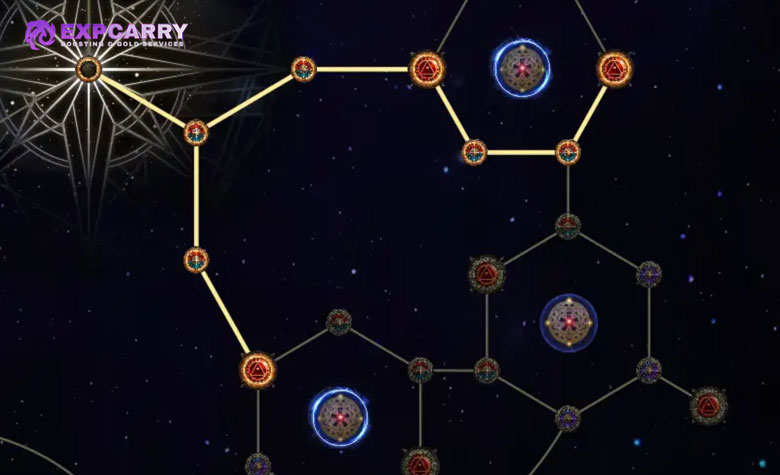
The safest starting priority is not maximum currency per map. It is a loop that replaces consumed Waystones, completes objectives, and earns the next points without repeated failures. Reward specialization becomes more profitable after the loop is stable.
| Priority | Why it comes early | Move on when |
|---|---|---|
| Waystone access and sustain | Progress stops when the character lacks usable Maps at the required tier | The reserve grows while normal progression continues |
| Reliable completion | A failed Map loses time, inputs, objectives, and potential drops | Rare monsters and bosses at the current tier die consistently |
| Efficient point pathing | Connected routes reduce travel cost and make each early point useful | The next major destination is reached without dead investment |
| Magic and Rare monster value | More rewarding enemies can improve drops and experience during normal Maps | The build handles the added density and modifier pressure safely |
| Tablet supply and effect | Tablets turn surrounding Maps into a repeatable content package | The player has useful Tablets and enough worthwhile Maps to affect |
| One specialized mechanic | Concentrated investment produces more value than shallow investment everywhere | The mechanic's inputs, tree, and Master choice support one another |
Priority one: protect Waystone progression
Search the live tree for effects that improve Waystone access, useful tier progression, or the reward conditions that help Maps replace themselves. Exact node names and positions can change, but the goal is stable: the stash should contain several Waystones the character can complete, not one highest-tier Waystone surrounded by unusable risks.
Run Maps with enough modifiers to support drops without creating a likely failure. If the reserve shrinks, lower the difficulty, review the filter, complete Powerful Map Boss opportunities that support progression, and allocate the next points toward sustain before buying deeper reward specialization.
Priority two: add monsters only when they remain profitable
Magic packs, Rare monsters, pack size, and related reward bonuses can improve experience and item flow. They also increase combat time and may create dangerous modifier combinations. A node that adds nominal rewards is a loss when the character dies, abandons the boss, or spends twice as long on every Map.
Use completion time as the check. If added monster pressure barely changes the run and produces more useful drops, keep scaling it. If flask charges, recovery, or boss damage fail, repair the character before allocating more difficulty. A player needing a complete map-ready foundation can consider a contextual PoE 2 starter build setup, but the Atlas still needs to match what that character can clear.
Priority three: make Tablets and one mechanic work together
Tablet investment has little value when no useful Tablets are available or the surrounding Maps are not worth modifying. Build a reserve first, reveal a group of viable Maps, and then choose passives that improve the Tablet types the player can actually use. The goal is repeated benefit across several Maps rather than one isolated high-roll run.
After the global foundation, select one mechanic whose pace, difficulty, and rewards match the character. Develop its dedicated tree, use the relevant Tablets, and select a compatible Master. Do not split the first specialized points across every mechanic just to make all of them slightly better.
A Practical Atlas Priority by Progression Stage
Atlas priorities should change when the current bottleneck changes. The following stage model works across builds because it responds to completion, input supply, and risk rather than assuming one permanent farming strategy.
| Stage | Main objective | Tree and Master approach |
|---|---|---|
| First Maps | Reach the first Tower and preserve usable Waystones | Take connected sustain and low-risk value; unlock any convenient Master without forcing difficult missions |
| Early Fortress | Earn main Atlas points and satisfy displayed Waystone requirements | Prioritize completion support, efficient pathing, and a Master effect that does not jeopardize the objective |
| Stable tier progression | Grow the map pool and improve reward density | Add Magic or Rare monster value, Tablet infrastructure, and the first focused mechanic |
| Established Atlas | Repeat a chosen strategy with predictable inputs | Align the main tree, mechanic tree, Tablets, Master, map layout, and character strength |
| Late completion | Fill remaining branches and compare mature strategies | Complete the global tree, switch multi-choice nodes, and rotate Masters per run |
Do not specialize before the inputs exist
A specialized node has four requirements: matching content must appear, the build must complete it, the necessary Tablet or Waystone inputs must be available, and the reward must justify the added time. Missing any one of these turns the node into delayed value.
Early generic bonuses are useful because they apply during the work already required for Fortress progression. When a stash contains enough inputs for a meaningful sample, specialization can be tested over multiple Maps. Players who want help with repeated map completion or a tailored farming objective can use a PoE 2 hourly farming service without changing how the Atlas systems themselves function.
How to Build an Atlas Specialization
A good specialization is a chain of compatible decisions, not a copied tree screenshot. Start with the desired output, identify the content that produces it, then make the tree, Tablets, Master, Waystones, and character support the same loop.
Step one: choose the measurable goal
Use a concrete goal such as building a higher-tier Waystone reserve, farming a specific mechanic, hunting Unique bosses, finding exceptional items, or generating rewards that sell in bulk. A vague goal such as more loot cannot tell the player which nodes deserve priority.
Define how success will be measured before spending inputs. Useful measures include Maps completed per hour, net Waystones gained, average setup cost, deaths, sellable reward value, and time required to liquidate the drops. A strategy with a large headline drop can still be worse than a steady loop with lower failure and setup costs.
Step two: match content, Master, and character
Select a mechanic whose combat pattern suits the build. Fast clearing helps dense timed content, strong single-target damage helps boss-heavy routes, and durable recovery supports long encounters. Then choose the Master option that benefits that map without amplifying the build's weakest area.
Read every live tooltip before committing a premium Waystone. Some Atlas and Master options exchange difficulty for reward, change which content appears, or require a specific type of input. The modifier must apply to the planned Map and reward source; thematic similarity alone does not guarantee an interaction.
Step three: test before expanding
Run a small batch under comparable conditions. Use similar Waystone tiers, modifier strength, Tablets, and map layouts. Record total session time, not only combat time, and subtract the cost of inputs before judging the result.
If the loop works, expand the Atlas route and invest in the next supporting branch. If it fails, identify whether the problem is sustain, character power, setup cost, content access, or poor reward conversion. Players who need a different progression objective can compare broader PoE 2 progression services, but the correct tree still follows the chosen goal and available content.
Choosing a Master Before Each Map
The active Master should be part of map preparation alongside identifying the Waystone, reading modifiers, and selecting Tablets. A saved Master setup is useful, but it should not become an automatic choice for every map.
- Use Doryani when the selected options improve the map's preparation, corruption, constructs, traversal, or other Atlas infrastructure relevant to the run.
- Use Hilda when the character is prepared for stronger Rare or Unique enemies and the planned rewards come from those targets.
- Use Jado when the map supports Strongboxes, rare chests, Anomaly interactions, exceptional items, or compatible extra content.
- Choose the safer option when the Map carries an important Atlas-point objective that should not be risked for marginal rewards.
- Switch the Master when the Waystone, layout, Tablets, or objective changes.
A thirty-second pre-map decision
Ask five questions before opening the Map: What is the objective? Which reward source is being scaled? Does the Waystone disable or threaten the build? Which Tablets actually affect the area? Which Master's active nodes apply to that combination?
If the answers do not form one clear plan, remove an input or choose a simpler Master setup. Complexity is valuable only when the parts interact. A safe Fortress objective with modest rewards is better than losing the point opportunity to an unnecessary combination of difficulty modifiers.
Why Atlas Points Sometimes Do Not Appear
Most missing-point problems come from completing the wrong content, using an insufficient Waystone tier, or confusing the main tree with a mechanic or Master progression track. Check the map interface and quest state before assuming the character is bugged.
| Problem | Likely cause | What to check |
|---|---|---|
| The Fortress is not visible | The first required Precursor Tower has not been completed | Follow the early Atlas route and finish the Tower objective |
| A Fortress Map gave no point | The Waystone did not meet the displayed requirement or the point objective was incomplete | Reopen the location details and verify tier and completion conditions |
| A mechanic encounter gave no main point | It progresses a dedicated mechanic tree instead | Open the matching mechanic tree and quest tracker |
| A Master row remains locked | The next mission in that Master's questline is unfinished | Track the relevant hunt, Anomaly, Corruption Nexus, or boss objective |
| A normal Atlas node cannot be refunded | The main tree does not allow ordinary respecs | Continue earning points; only multi-choice effects can be switched |
| An old guide shows a different total or route | The tree and location rewards changed after the endgame overhaul | Use the current interface and official patch notes as the final reference |
Use the live interface as the completion ledger
Hover over unfinished Fortress locations and inspect their icons, Waystone requirement, and objective. Review the Origins of Divinity quest state, then check each Master's separate mission list. This isolates whether the missing progress belongs to the main tree, a mechanic, or a Master.
If every displayed requirement is complete and a reward is still missing, relog to refresh the state and consult the current known issues or bug-report forum with the exact location, Waystone tier, objective, and screenshots. Avoid repeating expensive content until the requirement and reward source are confirmed.
Common Atlas Passive Tree Mistakes
The main Atlas tree is forgiving in the long term because it can be completed, but inefficient early choices can still slow progression. Most problems come from scaling rewards before the character and input supply are ready.
- Expecting ordinary Maps outside the Fortress to award the main Atlas points.
- Opening a point location without meeting its displayed Waystone-tier requirement.
- Assuming normal main-tree passives can be refunded later.
- Copying an old total-point number after new passives and point rewards were added.
- Adding monster difficulty before the character can complete the current tier reliably.
- Investing in Tablets before building a supply and revealing a useful group of Maps.
- Spreading early specialization across several unrelated mechanics.
- Leaving one Master active for every Map regardless of the objective.
- Judging a strategy by one lucky drop instead of a repeatable sample.
Fix the bottleneck before adding reward multipliers
If Waystones are disappearing, invest in sustain and run safer modifiers. If Maps fail, improve the character or reduce difficulty. If specialized content rarely appears, secure its access and Tablet supply. If rewards do not sell, choose a different output or include liquidation time in the calculation.
Only add another reward multiplier after the current loop is stable. This order turns each new Atlas point into useful progression instead of increasing the cost of a system that is already failing.
Final Verdict
The PoE 2 Atlas Passive Tree rewards correct ordering more than one permanent best build. Unlock the Fortress through the first Precursor Tower, earn main points from qualifying Fortress locations, satisfy every displayed Waystone requirement, and remember that ordinary passives cannot be refunded even though the whole tree can eventually be allocated.
Begin with Waystone stability, reliable completion, and efficient connected pathing. Add Magic and Rare monster value only when the character can handle it, then develop Tablet support and one mechanic. Progress Doryani, Hilda, and Jado through their separate missions, save useful configurations, and switch the active Master to match each map. Specialize only when the tree, inputs, character, content, and measurable reward goal all support the same repeatable loop.