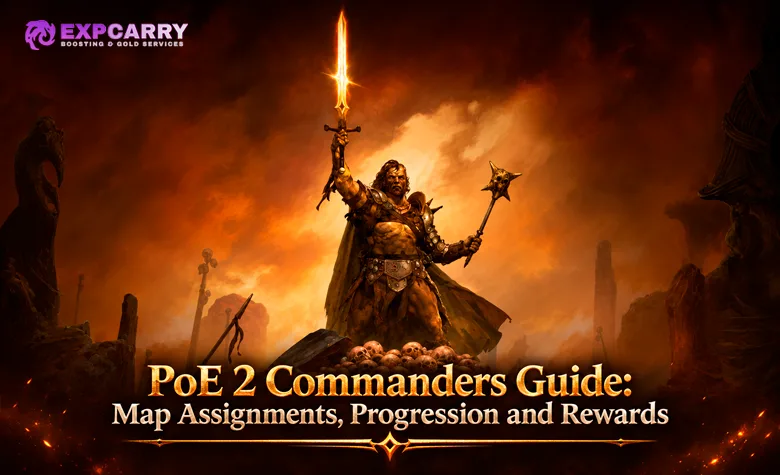
Path of Exile 2 Commanders introduce a new way to progress through the Atlas without personally clearing every map. In the Conquerors of Wraeclast Challenge League, players can assign soldiers and Waystones to commanders, queue expeditions, complete Towers, and use Tablets to pursue particular rewards. Up to three commanders can operate independently as stronghold progression advances. The system arrives with PoE 2 version 1.0 on December 11, 2026 (PST). As of November 13, the developer demonstrations establish the main expedition mechanics, but final mission costs, completion rates, reward quantities, and currency profitability remain untested on LIVE servers. This guide explains commander unlocks, map assignments, army management, available rewards, and how to evaluate automated farming once the system becomes playable.
Short answer: Unlock commanders through the Conquerors endgame storyline, supply them with troops and Waystones from your stronghold, and assign Atlas maps for real-time completion. You can eventually manage three commanders, queue several maps, and target Tablet-related rewards, but their actual net profit cannot be established before the December 11 release.
How Do Commanders Work in Path of Exile 2?
Commanders are independent military leaders who undertake Atlas expeditions using soldiers recruited through the Conquerors of Wraeclast army system. Instead of entering a map yourself, you provide the necessary resources, assign the destination, and allow the commander to complete the expedition over time. Successful assignments produce map rewards that can be collected afterward.
The important distinction is that commanders do not simply multiply the loot from maps your character already clears. They conduct separate expeditions, using their own assigned forces and Waystones. This creates an additional activity alongside ordinary mapping, character progression, and castle sieges.
Grinding Gear Games introduced the mechanic during the official ExileCon 2026 keynote. The demonstration showed commanders moving across the Atlas, handling map assignments, and bringing rewards back to the player. Unlike a conventional map run, completing an expedition requires real-world time.
| Feature | Announced functionality | Practical significance |
|---|---|---|
| Commander assignments | Send a commander with soldiers and Waystones. | Delegates Atlas map completion to an independent army. |
| Real-time expeditions | Maps require time to complete rather than finishing instantly. | Introduces planning around expedition duration. |
| Map queues | Several maps can be assigned in sequence. | Reduces the need to arrange every expedition separately. |
| Multiple commanders | Up to three commanders can become available. | Allows independent expedition assignments. |
| Towers | Commanders can complete Atlas Towers. | Provides an alternative way to handle certain Atlas objectives. |
| Tablets | Commanders can pursue specific reward types using Tablets. | Connects expeditions to targeted farming. |
| Map rewards | Completed expeditions return loot to the player. | Creates additional reward opportunities while the character pursues other activities. |
The system has similarities to resource-based expeditions from earlier Path of Exile content, but that does not mean its costs, failure mechanics, or rewards follow the same rules. In particular, the PoE 2 commander system should not be treated as a copy of Kingsmarch shipping from Path of Exile 1.
What Do You Need to Send a Commander?
The demonstrated assignment process revolves around three components: an unlocked commander, troops available from your stronghold, and Waystones for the selected Atlas destinations. All three matter because having a commander without soldiers or usable map resources does not create a productive expedition.
- Commander: The military leader who receives and executes the Atlas assignment.
- Troops: Soldiers recruited or maintained through your army and stronghold systems.
- Waystones: Map resources supplied for the destinations the commander will clear.
- Atlas destination: A selected map or supported objective, including certain Towers.
- Tablets: Optional reward-targeting resources for supported assignments.
Gold is another important part of the military economy because recruitment costs gold and the keynote described commanders retaining gold earned during expeditions. The exact financial treatment of every map assignment still needs confirmation in the released version.
Commander Expeditions vs. Normal Atlas Mapping
Manual mapping remains the activity where your own character enters an area, fights monsters, completes encounters, and collects drops directly. Commander expeditions handle a separate Atlas assignment through the army system. This allows your character to continue progressing elsewhere while a commander works on a map.
However, delegating a map does not automatically make that map more profitable. A strong character may clear a valuable map quickly, while a commander needs time and military resources to complete its assignment. The advantage of delegation is the possibility of obtaining additional rewards without spending the same period actively controlling your character inside that map.
How to Unlock Commanders in Conquerors of Wraeclast
Commanders belong to the league's endgame progression rather than its opening campaign encounters. Your first military activities begin with Varek, the mercenary captain who introduces troop recruitment and battlefield commands. After reaching the Atlas, the Conquerors storyline expands into stronghold development, major castle battles, and the commander system.
The official ExileCon 2026 announcement hosted by Steam confirms that players establish an endgame stronghold and later delegate Atlas progression to commanders. The full sequence of quest names, recruitment interactions, and interface requirements has not yet been published.
When Do You Get Your First Commander?
During a post-keynote developer interview, Grinding Gear Games described the first commander as becoming available after clearing the first major castle in the league's endgame storyline. This provides a more specific progression milestone than simply completing the campaign or entering the Atlas for the first time.
The gameplay demonstration featured High Adjudicator Atella as a commander. However, showing Atella during a demonstration does not establish the final recruitment dialogue, quest name, or whether every player receives commanders in exactly the same sequence. Those details require the released game.
A sensible progression goal is therefore to advance the Conquerors storyline toward its first major castle without assuming that every optional stronghold building must be completed beforehand. Characters struggling to reach the endgame can address normal campaign progression separately; existing PoE 2 campaign progression assistance concerns the campaign itself and does not guarantee completion of the unreleased commander questline.
How to Unlock All Three Commanders
GGG has announced a maximum of three independent commanders. According to the same developer interview, the other two commander unlocks are planned for later in the league's endgame progression, after its pinnacle encounter. That makes the complete commander roster a long-term objective rather than something expected immediately after constructing a basic stronghold.
The first commander offers an opportunity to learn the system before committing resources to several simultaneous expeditions. Expanding to three also increases the need for Waystones and replacement troops. A weak stronghold may have difficulty supporting the maximum number of assignments even after the additional commander slots become accessible.
These specific unlock milestones come from the developers' pre-release discussion, not from verified 1.0 quest completion. If the final storyline or unlock conditions change, follow the released quest objectives rather than treating the interview as an immutable walkthrough.
How to Assign Commanders to Atlas Maps
The ExileCon demonstration established the main assignment workflow, although the final interface labels and individual button interactions remain subject to the 1.0 release. The process begins with an available commander and ends with a completed expedition whose rewards can be collected.
- Unlock a commander. Advance the league's endgame storyline until the commander system becomes available.
- Prepare your stronghold. Recruit or maintain enough soldiers to supply the expedition without exhausting your army.
- Select the commander. Use the commander's assignment interface to allocate available troops.
- Choose an Atlas destination. Select a map or supported objective that the commander can reach.
- Provide the Waystone. Supply the map resource required for the assignment.
- Arrange additional maps if desired. Use the demonstrated queue system to plan subsequent expeditions.
- Start the assignment. The commander begins progressing through the selected expedition over real time.
- Collect completed rewards. Return to the relevant interface after the assignment finishes and claim the available loot.
This is the demonstrated workflow, not a verified sequence of exact menu clicks. The release interface will determine whether assignments require additional confirmation, how resources are committed, and which operations are permitted while an expedition is active.
Choosing Maps and Waystones for Commanders
Waystones are an essential expedition input. That means the decision to delegate a map should account for the Waystone's opportunity cost: using it for a commander may prevent your character from using the same resource for an ordinary run.
Before the system launches, there is no reliable evidence that the highest-tier Waystones always provide the best commander returns. More difficult maps may offer better rewards, but they can also require longer expedition times. The ideal assignment will depend on its actual reward output, resource requirements, and the value of other maps available to your character.
For early testing, use ordinary Waystones that you can afford to replace and compare different destinations under similar conditions. Keep particularly valuable or difficult maps for manual completion until there is enough evidence that delegating them is worthwhile. The existing PoE 2 Atlas Passive Tree guide covers ordinary Atlas progression but does not establish the optimal Waystones for commander assignments.
How Commander Map Queues Work
Players will be able to queue several Atlas maps for a commander rather than starting every expedition individually. The showcase demonstrated this feature as part of the real-time assignment system, allowing a commander to handle a sequence of destinations before the player collects accumulated rewards.
A useful queue should be assembled around the resources you can spare. Assigning every available Waystone may leave your character unable to continue ordinary mapping, while assigning too few may cause the commander to finish its work before you next manage the army.
GGG has not published the final maximum number of queued maps, whether the queue can be reordered after dispatch, or the rules for canceling an active assignment. There is also no confirmed refund policy for Waystones committed to an abandoned expedition. Until those rules are available, avoid treating queues as freely reversible assignments.
How Long Does a Commander Take to Complete a Map?
The demonstrated expedition system uses real-world time, with map difficulty and distance influencing completion duration. A harder or more distant destination can take longer than an easier or closer one. This introduces a different optimization problem from normal mapping, where clear speed depends primarily on your character and the encounters inside a map.
There are no verified universal mission-duration tables for version 1.0. Publishing a fixed number of minutes for a particular Waystone tier would be premature because the release may also account for commander progression, army composition, or other variables that have not been fully described.
Once the game launches, compare assignments using the actual displayed duration rather than the map tier alone. The fastest mission is not necessarily the most rewarding, but a high-reward expedition that occupies a commander for much longer may produce fewer total rewards over a complete farming session.
Explore services related to this guide, selected from our Path of Exile 2 catalog.
View All Path of Exile 2 Services

Stronghold and Troop Management for Commander Expeditions
Commanders depend on the army maintained at your stronghold. The Conquerors system begins with recruiting troops through Varek, then expands into an endgame base offering faction-specific soldiers, buildings, and upgrades. Stronghold development therefore matters to commander farming even though commanders operate on the Atlas rather than directly inside the fortress.
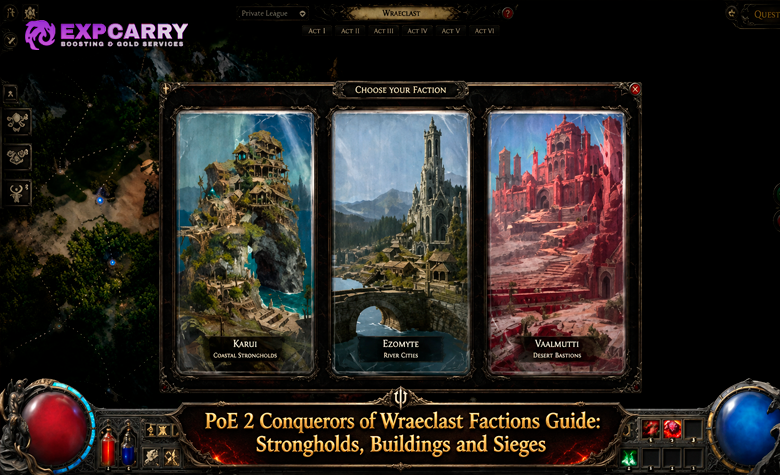
GGG has announced more than 20 buildings and upgrades for each of the Karui, Ezomyte, and Maraketh strongholds. The developers have also described strongholds producing additional troops over time, helping sustain the forces used by commanders. The exact production rates and final building prerequisites are not yet available.
How Many Troops Should You Assign?
The showcase confirms that commanders require troops, but it does not provide a complete, finalized formula for the minimum or optimal army size. A larger force may appear safer, yet assigning more soldiers than necessary can tie up resources that would otherwise support other expeditions or your next military battle.
Start by separating your available soldiers into a working expedition force and a reserve for personal Conquerors objectives. The size of those groups should reflect the actual mission requirements shown in the released interface. Do not assume that every commander needs the same number or type of soldiers regardless of destination.
At launch, pay attention to whether different troop types affect mission success, completion speed, or losses. Until those relationships are measured, a particular soldier should not be described as the best commander-farming unit merely because it performs well in a player-controlled siege.
Troop Production, Replacement, and Army Reserves
The stronghold's ability to generate additional troops is one of the most important connections between army progression and automated mapping. Sustained commander activity requires an available military force, and that force cannot be evaluated independently of recruitment and replacement costs.
The developers have not published a final universal production rate, offline production rule, or complete list of troop losses for different map difficulties. The safest early plan is to maintain a usable reserve rather than assuming that every soldier assigned to a commander will always return intact.
A commander who completes valuable maps but repeatedly requires costly troop replacements may produce less net value than one assigned to easier content. Stronghold improvements should therefore be evaluated according to the military resources they actually provide, not simply the number of available upgrade buttons.
Do Commanders Cost Gold?
Gold is already established as a recruitment resource in the Conquerors army system. The keynote also described commanders keeping gold earned during their expeditions, while some reporting characterized this as a share of the expedition's gold income. The precise final distribution has not been documented in a complete public ruleset.
This distinction matters for farming calculations. Players should not assume that a commander delivers all collected gold to the stronghold, or that a particular fixed percentage is deducted from every assignment. The value of returned items and the cost of maintaining the expedition force must be considered separately from any gold retained by the commander.
Gold should also not be confused with tradeable currency such as Divine Orbs. An expedition's gold economy supports army management, while tradeable drops determine much of its potential market value. Both can affect the usefulness of an assignment without being interchangeable resources.
Using Commanders for Towers and Tablet Rewards
Ordinary map completion is only part of the announced commander system. GGG also confirmed that commanders can complete Towers and pursue specific rewards through Tablets. These functions make assignment choices more interesting than sending every commander to the nearest available map.
The official Path of Exile 2 full-release overview introduces commanders as a way to delegate Atlas progression. The detailed interactions between 1.0 Towers, Tablets, and commander rewards have not yet been independently tested on LIVE servers.
Can Commanders Complete Atlas Towers?
Yes. Tower completion was specifically included in the announced commander capabilities. This gives players an alternative to personally clearing certain Atlas objectives while continuing their own mapping or character progression.
However, the announcement does not establish that commander-cleared Towers award every possible Atlas progression benefit in exactly the same way as a manual completion. It also does not confirm which Tower objectives, modifiers, or special conditions are eligible for delegation.
At release, check the Atlas interface after a commander finishes a Tower. Confirm what changed, whether the relevant objective is marked complete, and whether any expected progression reward was actually granted. A successful expedition and a particular passive-point unlock should not be treated as equivalent until the released game establishes that relationship.
How Tablets Affect Commander Rewards
Tablets are particularly important because GGG has described using them to direct commanders toward certain reward types. Instead of accepting only the general rewards available from ordinary maps, players can assign relevant Tablets to pursue content associated with particular Atlas mechanics.
The concept is straightforward: choose a reward category, prepare the appropriate Tablet resources, and send a commander on an eligible assignment. The actual 1.0 system will determine how Tablets are consumed, which effects apply, and whether commanders receive the same reward scaling as player-cleared encounters.
Do not automatically transfer Early Access Tablet rules into the new assignment interface. The existing PoE 2 Tablet Stacking guide explains current manual mapping interactions, but the released commander system needs separate verification before those setups can be recommended for automated expeditions.
Which Rewards Should Commanders Target?
Choose reward targets according to what your character or economy actually needs, not an assumed universal best Tablet. A character with limited crafting resources may value a consistent supply of useful materials, while a trade-focused character may prefer rewards with strong market demand and reliable liquidity.
There is no verified 1.0 commander reward tier list. GGG has not established that every Tablet mechanic is available for commanders, that all modifiers work identically, or that specific valuable drops can be guaranteed through a particular assignment.
Once the feature becomes playable, begin with one reward category and compare its outputs against ordinary commander maps. That makes it easier to identify whether the Tablet improves the assignment enough to justify consuming it.
PoE 2 Commander Rewards: What Can You Get?
The principal reward is loot collected from completed Atlas expeditions. Commanders have been demonstrated returning the results of map assignments, with Tablets providing a way to influence the type of rewards pursued. This establishes an additional source of items, but it does not establish a fixed quantity or value for any individual expedition.
Castle treasury rewards are a separate part of the Conquerors system. Materials associated with capturing fortifications and their treasuries should not automatically be included in commander map reward lists. There is no confirmed rule that delegating an ordinary Atlas map grants a castle's specialized crafting materials.
| Reward or result | What is established | What requires release testing |
|---|---|---|
| General map loot | Commanders collect and return rewards from completed maps. | Exact quantities, rarity scaling, and item distribution. |
| Tablet-related rewards | Tablets can direct expeditions toward particular reward types. | Eligible mechanics, reward scaling, and Tablet consumption. |
| Gold | Commanders retain gold earned during expeditions according to the showcase. | Final retained share and any additional gold costs. |
| Atlas exploration | Commanders can explore maps and complete Towers. | Which completion flags and progression benefits are granted. |
| Valuable currency | General map rewards create opportunities to obtain valuable items. | Specific drop rates, currency yields, and expected market value. |
| Castle treasury materials | Castle treasuries are an announced source of specialized crafting rewards. | Whether any commander assignment can access those rewards. |
Players should avoid interpreting broad promises of map loot as guarantees for Divine Orbs, specific Uniques, high-tier Waystones, or particular crafting materials. Those outcomes depend on reward pools that have not been fully documented for commander expeditions.
How Do You Claim Commander Rewards?
The presentation demonstrated collecting loot after commanders completed their assignments. Queued maps allow players to return after multiple expeditions and retrieve the accumulated results rather than personally entering every completed map.
The final reward-claiming interface, storage capacity, and any restrictions on leaving rewards unclaimed have not been established. It is also unclear whether rewards must be collected before a commander can continue every type of assignment.
At release, check whether completed rewards are held separately from your normal inventory and whether new assignments can continue while previous rewards are waiting. Do not assume that the system provides unlimited reward storage simply because several maps can be queued.
Do Commander Maps Count Toward Atlas Progression?
GGG explicitly describes the feature as delegating Atlas progression, and commander completion of maps and Towers is part of the announced system. That establishes a progression role beyond collecting ordinary loot.
However, not every Atlas objective necessarily follows the same completion rules. The precise treatment of Atlas Passive Skill Points, boss-specific rewards, quest milestones, and other completion conditions has not been fully documented for commander assignments.
Use the released Atlas interface to confirm whether each delegated objective awards its expected benefit. Until that is verified, do not plan an entire passive-point route around the assumption that commanders can replace every personally completed endgame objective.
Recommended Commander Progression and Assignment Priorities
The most practical progression plan is to secure commander access, establish a sustainable army, and then expand assignments as the stronghold becomes capable of maintaining them. Reaching the maximum commander count quickly has limited value if there are not enough soldiers or Waystones to keep the commanders active.
The following priorities are based on the announced unlock structure and resource dependencies. They are not a fixed in-game upgrade order or a tested optimal farming strategy.
| Stage | Main objective | What to prioritize |
|---|---|---|
| 1. Campaign army | Meet Varek and develop the basic troop system. | Recruitment, military encounters, gold, and supplies. |
| 2. Endgame stronghold | Establish your faction's base. | Available soldiers and recruitment infrastructure. |
| 3. First major castle | Advance toward the first planned commander unlock. | Storyline completion and a reserve of usable Waystones. |
| 4. Initial expeditions | Learn map assignments and queues. | Affordable maps, observed durations, and resource costs. |
| 5. Stable production | Maintain a reliable supply of soldiers. | Recruitment, replacement costs, and sustainable assignment frequency. |
| 6. Later commander unlocks | Complete the required pinnacle progression. | Additional commanders and independent map assignments. |
| 7. Specialized farming | Evaluate Tablet and Tower assignments. | Repeatable rewards, actual costs, and measured profitability. |
Do not spend every available resource chasing stronghold upgrades while the storyline remains blocked. Conversely, unlocking an additional commander should not encourage sending away troops required for your next military objective. The best investment is whichever one removes the current obstacle to maintaining successful expeditions.
Best Priorities for Your First Commander
The first commander should be treated as an opportunity to establish a working baseline. Send affordable maps, record their completion times, check returned rewards, and observe any costs associated with troop replenishment.
A reliable low-investment assignment may be more useful than an ambitious expedition that ties up your only commander for a long period. Once a set of ordinary missions becomes predictable, experiment with different destinations and Tablet resources rather than immediately committing every valuable Waystone.
Managing Three Commanders Efficiently
Three commanders offer the potential to run independent expeditions while your character continues mapping. That creates more opportunities to collect rewards, but the commanders still compete for your army's available resources.
A reasonable starting approach after unlocking all three is to compare different assignment goals: one commander handling straightforward maps, another completing supported Atlas objectives, and a third testing reward-focused Tablet expeditions. This is an experimental allocation, not a verified optimal configuration.
If the stronghold cannot maintain three working forces, fewer active commanders may be the more sustainable choice. Measure how often each commander completes assignments and how much preparation is needed before assuming that three commanders provide triple the rewards of one.
Are PoE 2 Commanders Good for Currency Farming?
Commanders have clear potential as an additional source of map rewards because they can operate independently while the player continues other activities. The ability to queue maps and eventually maintain three commanders makes the system especially interesting for players who already spend substantial time progressing through the Atlas.
That potential does not yet establish profitability. Version 1.0 has not launched, no representative LIVE reward sample exists, and the final costs of running and maintaining commander expeditions remain incomplete. Any claim of a guaranteed Divine Orb income per hour would therefore be speculative.
The important economic question is whether the value returned by an expedition exceeds the market value of the resources committed to it. A commander might generate useful loot while still consuming Waystones and military resources that could have been used elsewhere.
What Costs Should Be Included in Commander Farming?
A proper profitability comparison must include more than the visible gold fee or the quantity of currency returned. Waystones have value, troop recruitment consumes resources, and a commander occupies an assignment slot for real-world time.
- Waystone value: Count the opportunity cost of the Waystone used for the assignment, even if it was obtained through ordinary gameplay.
- Tablet value: Include any Tablet resources consumed to improve or direct rewards.
- Troop replacement: Measure the actual cost of replacing soldiers that are lost or otherwise consumed.
- Other expedition costs: Include any additional gold or supplies the final interface requires.
- Reward liquidity: Distinguish valuable sellable drops from items that have little practical market demand.
- Commander availability: Record how long the assignment prevents that commander from performing another expedition.
Do not count the same resource twice. If gold is retained by the commander from the expedition's own earnings, record that separately from gold you actually spend before dispatch. Likewise, the cost of constructing an entire stronghold should not automatically be charged in full to every map; persistent infrastructure and recurring expedition inputs are different expenses.
How to Measure Commander Profit After Release
Once version 1.0 launches, run repeatable batches of comparable assignments and record their results. For Trade leagues, evaluate sellable rewards using current market prices from the same league. For SSF, evaluate useful progression materials and replacement resources without assigning fictional trade prices.
The basic calculation is net reward value equals the conservative market value of returned loot minus consumed Waystones, Tablets, troop replacement, and other applicable expedition costs. Divide this net value by the relevant elapsed time to compare different assignment strategies.
Two measurements are especially useful: net reward value per commander-hour and net reward value per player-hour. Commander-hours show how efficiently an individual assignment slot is being used. Player-hours show the additional value you actually receive during a real play session, including the time spent preparing armies and collecting rewards.
| Metric | What to record | Why it matters |
|---|---|---|
| Completed maps | Successful assignments compared with all attempted assignments. | Measures the actual completion rate. |
| Expedition duration | Displayed and observed completion time for each map. | Shows how efficiently commander time is used. |
| Waystones consumed | Quantity, tier, and replacement value. | Identifies the cost of map access. |
| Tablets consumed | Type, uses spent, and relevant market value. | Measures the additional investment behind targeted rewards. |
| Troop expenditure | Soldiers lost or consumed and their replacement costs. | Shows the burden placed on the stronghold. |
| Gold balance | Gold spent, retained by commanders, and returned where applicable. | Tests whether the army economy is sustainable. |
| Sellable loot | Realistic market value of rewards in the correct league. | Measures potential economic return. |
| Preparation time | Time spent recruiting, configuring queues, and collecting rewards. | Prevents passive farming from appearing completely cost-free. |
Compare several batches rather than judging the system from one unusually valuable drop. A lucky Unique Item or rare currency drop can make a small sample look far more profitable than its normal outcome. The existing PoE 2 farming profit-per-hour guide explains market valuation and repeatable testing methods for ordinary farming; commander rewards will need their own 1.0 measurements.
Is Commander Farming Better Than Manual Mapping?
The two methods answer different questions. Manual mapping measures what your character can obtain through active gameplay. Commander farming measures the additional rewards generated from assigned resources while your character remains free to pursue other activities.
If a commander provides positive net value without significantly interrupting your normal mapping, the combined activity may outperform manual mapping alone. However, if maintaining the army consumes too much time, gold, or valuable Waystones, the additional rewards may not justify the investment.
Players who rely on ordinary mapping for most of their resources should preserve enough Waystones to sustain that activity. Existing PoE 2 manual farming assistance relates to conventional gameplay and does not imply that commander expeditions can deliver the same results without direct participation.
Best Commander Approach for Solo Players and Dedicated Farmers
Different players will benefit from commander expeditions in different ways. A casual solo player may prefer assignments that require little management, while someone already farming the Atlas extensively may want to evaluate more demanding Tablet setups. Both approaches depend on the actual released resource costs.
Commander Assignments for Solo Players
Solo players should prioritize reliability over the maximum number of simultaneous expeditions. Start with a manageable force, avoid spending the entire Waystone reserve, and use ordinary maps to understand how frequently soldiers need replacing.
The purpose is to establish a sustainable activity that complements normal play. If the commander requires constant attention or expensive replacement resources, simplify the assignments until the stronghold can support them more comfortably.
Commander Assignments for Established Atlas Farmers
Experienced endgame players can evaluate a wider range of assignments once they have spare Waystones, a developed stronghold, and sufficient military reserves. The most interesting comparison will be between ordinary commander maps, Tower objectives, and Tablet-focused expeditions.
Instead of choosing the most difficult available maps automatically, identify which assignment produces the strongest return for the resources spent. Keep your character focused on encounters that benefit from manual control, while assigning commanders objectives that can be completed efficiently through the army system.
Character preparation still matters because commander expeditions do not remove the need to progress through the storyline, defeat major enemies, and unlock additional commanders. Players struggling with their own endgame encounters can review PoE 2 character build preparation separately from the military economy; the service does not provide an automatic commander upgrade.
Common Commander Assignment and Farming Mistakes
The main risks are committing valuable resources before understanding expedition costs, expecting unsupported rewards, and treating the announced system as though every detail has already been tested. Commander farming may become an important endgame activity, but success will depend on managing the resources that keep expeditions running.
Expecting Commanders Immediately After the Campaign
Commanders are linked to the Conquerors endgame storyline and stronghold progression. The developers described the first commander becoming available after the first major story castle, with the other two arriving later. Simply entering the Atlas does not establish that all three commanders become available immediately.
Sending Every Valuable Waystone to Commanders
Waystones are needed for ordinary mapping as well as commander assignments. Committing the entire reserve to an untested expedition strategy may interfere with normal Atlas progression. Start with replaceable inputs until the actual reward-to-cost relationship is known.
Ignoring Troop Replacement Costs
Sending soldiers away is not economically free merely because the commander operates independently. Recruitment and stronghold production require resources, while troop losses and final expedition maintenance rules can affect how often assignments remain sustainable. Keep a military reserve instead of building a strategy around unlimited replacement troops.
Assuming Automated Maps Guarantee Passive Profit
The ability to collect rewards while doing other activities is valuable only when the returns justify their costs. An expedition that produces impressive loot can still have poor net value after accounting for expensive Waystones, Tablets, and troop replenishment. Measure actual outcomes rather than treating automation itself as a profit multiplier.
Using Old Tablet Rules Without Checking Version 1.0
Tablets already influence ordinary Atlas farming, but the new commander system introduces another context for using them. Do not assume that every existing modifier interaction, stacking method, or reward bonus automatically applies to commander-cleared maps. Verify the released interface and reward behavior before committing valuable Tablets.
Assuming Every Expedition Runs Forever While Offline
The showcase presented a real-time expedition system and the ability to return later for accumulated loot. However, complete offline progression rules, queue exhaustion behavior, and reward storage restrictions have not been documented in a final public specification. Do not base a farming schedule on unlimited unattended production before those conditions are tested.
PoE 2 Commanders FAQ
These answers address additional questions about commander access, expedition management, and the limits of the information revealed before version 1.0.
How many commanders can you have in PoE 2?
GGG has announced up to three independent commanders. The first is planned to unlock during the league's major castle storyline, while the additional commanders are associated with later endgame progression.
Can commanders complete Atlas Towers?
Yes. Tower completion is one of the announced commander functions. The exact progression benefits granted by individual Tower assignments still require verification after release.
Can you queue multiple maps for a commander?
Yes. Multiple-map queues were demonstrated at ExileCon. The final queue capacity, cancellation rules, and handling of unfinished assignments have not been established.
Do commanders keep farming while you are offline?
The announced system progresses in real time and supports collecting rewards later. However, the precise behavior while fully logged out, including any restrictions on continued assignments, has not yet been independently confirmed on LIVE servers.
Conclusion
PoE 2 commanders add a resource-based layer to Atlas progression, allowing players to delegate maps, complete supported Towers, and pursue Tablet-related rewards while continuing other activities. Focus first on unlocking your initial commander, developing a sustainable troop reserve, and learning the real costs of ordinary assignments before expanding to three commanders. Once version 1.0 launches, use repeatable reward and expense measurements to determine which maps are genuinely worth delegating instead of relying on unverified passive-income estimates.