
Crafting in Path of Exile is the process of changing an item's modifiers until it provides the stats your character needs. New players do not have to begin with expensive meta-crafting, influenced bases or high-risk Currency. Most useful campaign and early endgame items can be made by selecting the correct base, guaranteeing one important modifier and filling an open affix with the Crafting Bench.
The safest rule is to define the purpose of the item before spending anything. Decide whether the upgrade must provide maximum Life, Elemental Resistances, attributes, Movement Speed, weapon damage or another build requirement. Set a budget, check the possible modifiers and stop once the item performs its intended role.
How PoE Item Crafting Works
Every craft combines a base item with one or more modifiers. The base controls the equipment slot, attribute requirements, defensive values, weapon properties and implicit modifier, while the item's rarity and item level determine how many explicit modifiers it can have and which modifier tiers are available.
- Normal items: Have no regular explicit modifiers and provide a clean crafting base.
- Magic items: Can normally have one prefix and one suffix.
- Rare items: Can normally have three prefixes and three suffixes.
- Unique items: Have item-specific modifiers and usually cannot be crafted like ordinary Rare gear.
- Implicit modifiers: Come from the base and usually do not occupy a prefix or suffix slot.
- Explicit modifiers: Include the prefixes and suffixes generated through drops or crafting.
Choosing the Right Item Base
The base is the foundation of the finished item, so a strong modifier roll on the wrong base can still be useless. Armour users should check the defence type and attribute requirements, while attack builds must also compare weapon type, base damage, attack speed and critical strike chance. Jewellery should be selected around useful implicits, such as Resistances or attributes. Current base properties can be checked in the official Path of Exile item database.
| Item slot | Important base properties | Beginner priority |
|---|---|---|
| Weapon | Weapon type, base damage, attack speed and critical chance | Use a base compatible with the main skill |
| Body Armour | Defence type, attribute requirements, sockets and links | Secure the required links before investing heavily |
| Helmet and Gloves | Defence type, attributes and available implicits | Prioritise Life and Resistances during progression |
| Boots | Defence type and attribute requirements | Look for Movement Speed with useful defensive stats |
| Ring | Base implicit, Life, Resistances and attributes | Use the implicit to cover a missing requirement |
| Amulet | Attribute implicit and access to offensive modifiers | Confirm the desired modifier can roll on the base |
| Belt | Implicit modifier, Life and Flask-related options | Do not ignore the value provided by the implicit |
Item Level, Prefixes and Suffixes
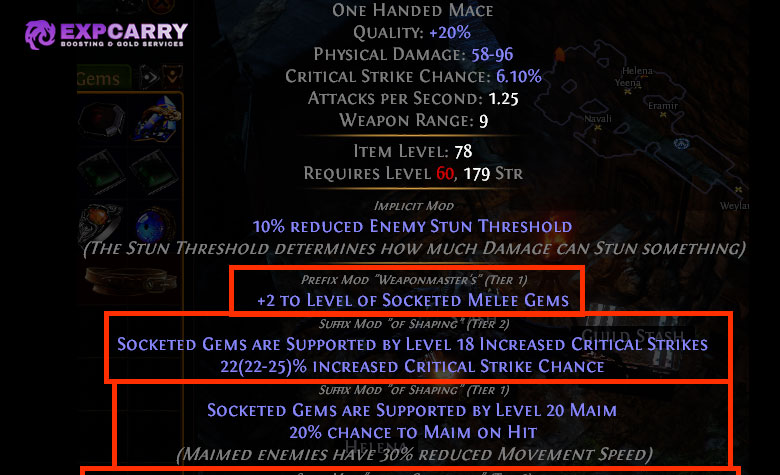
Item level controls which modifier tiers can appear. A low-level item cannot roll certain high-tier stats, even when valuable Currency is used, while a higher-level item may unlock both stronger and additional modifiers. Enable Advanced Mod Descriptions and hold Alt while hovering over an item to view its item level, modifier tiers, prefixes and suffixes before beginning a craft.
- Maximum Life, local defences and many damage modifiers are commonly prefixes.
- Elemental Resistances, attributes, Attack Speed and Critical Strike modifiers are commonly suffixes.
- An open prefix or suffix can be completed with a compatible Crafting Bench modifier.
- Two modifiers that belong to the same modifier group may block each other even when an affix slot appears open.
- The highest item level is not automatically required if a lower level already allows every desired modifier.
Explore services related to this guide, selected from our Path of Exile catalog.
View All Path of Exile Services

Implicit, Crafted and Fractured Modifiers
Modifiers are not all changed by the same crafting methods. Implicits belong to the base, crafted modifiers are added through the Crafting Bench, and Fractured Modifiers remain locked through most ordinary rerolls. Influenced, Veiled, Eldritch and corrupted modifiers introduce additional rules, but beginners can create effective gear without using those advanced systems.
| Modifier type | How it works | Beginner use |
|---|---|---|
| Implicit | Provided by the base and shown above explicit modifiers | Choose a base with an implicit that supports the build |
| Explicit | A prefix or suffix added through drops or crafting | Provides most of the item's Life, damage and utility |
| Crafted | Added at the Crafting Bench for a fixed cost | Fills a missing stat with a predictable result |
| Fractured | Locked and protected from most rerolling methods | Creates a safer starting point for Essence crafting |
| Corrupted | Created through corruption and normally prevents further ordinary crafting | Use only after the item is otherwise complete |
Essential Crafting Currency for Beginners
Currency items modify equipment directly and also function as trade resources. Low-value Currency can be used freely on replaceable campaign gear, but Chaos Orbs, Divine Orbs and other valuable materials should only be spent when the expected result justifies their current trade value.
| Currency | Main effect | Risk |
|---|---|---|
| Orb of Transmutation | Upgrades a Normal item to Magic | Low |
| Orb of Alteration | Rerolls the modifiers on a Magic item | Low on common bases |
| Orb of Augmentation | Adds a missing modifier to a Magic item | Low |
| Regal Orb | Upgrades a Magic item to Rare and adds a modifier | Medium |
| Orb of Alchemy | Upgrades a Normal item to Rare | Low on replaceable gear |
| Chaos Orb | Rerolls removable modifiers on a Rare item | Medium |
| Exalted Orb | Adds a random modifier to a Rare item with a compatible open affix | Medium to high |
| Orb of Scouring | Removes removable explicit modifiers | High when the current modifiers are valuable |
| Orb of Annulment | Removes one random removable modifier | High |
| Divine Orb | Rerolls numerical values within existing modifier ranges | High due to its trade value |
| Blessed Orb | Rerolls the value of a compatible implicit modifier | Low to medium |
| Vaal Orb | Corrupts an item and can produce an unpredictable result | Very high |
How to Use the Crafting Bench
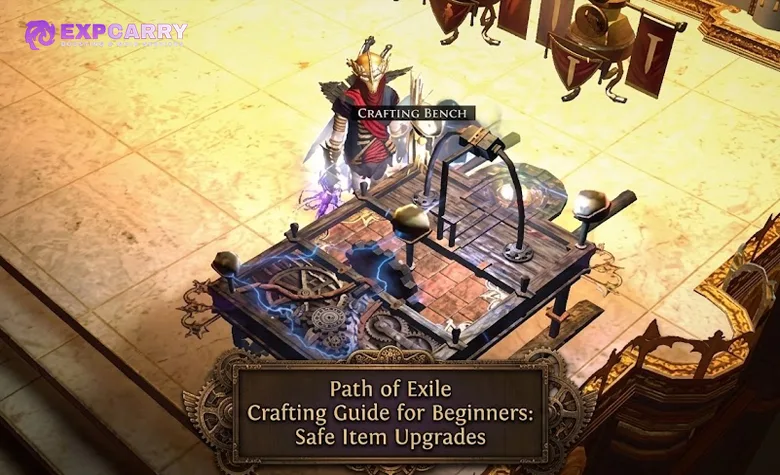
The Crafting Bench adds a chosen modifier for a displayed Currency cost, making it one of the most dependable tools available to beginners. An item normally supports one crafted modifier unless a special meta-craft changes that limit, and the selected option requires an open prefix or suffix of the correct type.
- Place the item in the Crafting Bench.
- Check every existing prefix and suffix.
- Search for the stat the build is missing.
- Confirm that the correct affix slot is available.
- Check whether an existing modifier blocks the selected craft.
- Review the Currency cost and apply the modifier.
PoE 3.29 places a Crafting Bench in every town from Act 2 onward and adds default options that reroll three modifiers on a Rare Item for 3 Chaos Orbs or one modifier for 8 Chaos Orbs. These and other current changes are listed in the official PoE 3.29 patch notes. Players who would rather spend their time on progression can use ExpCarry assistance instead of repeating long farming and gearing stages.
Best Crafting Bench Stats During Progression
The best Bench Craft is usually the modifier that removes the character's largest immediate weakness. Maximum Life and Elemental Resistances are reliable choices for campaign and mapping gear, while attributes help meet equipment and gem requirements. Movement Speed is valuable on Boots, and weapons should receive a modifier that directly scales the main damage source.
| Problem | Useful Bench Craft | Typical item slots |
|---|---|---|
| Low survivability | Maximum Life or a compatible defence modifier | Armour, Jewellery and Belts |
| Uncapped Resistances | Fire, Cold, Lightning or combined Resistance | Armour and Jewellery |
| Missing attributes | Strength, Dexterity or Intelligence | Amulets, Rings and selected armour pieces |
| Slow movement | Movement Speed when available | Boots |
| Weak attacks | A compatible local damage or Attack Speed modifier | Weapons |
| Mana problems | Mana or a compatible Mana Cost modifier | Jewellery and selected equipment |
Safe Crafting with Essences
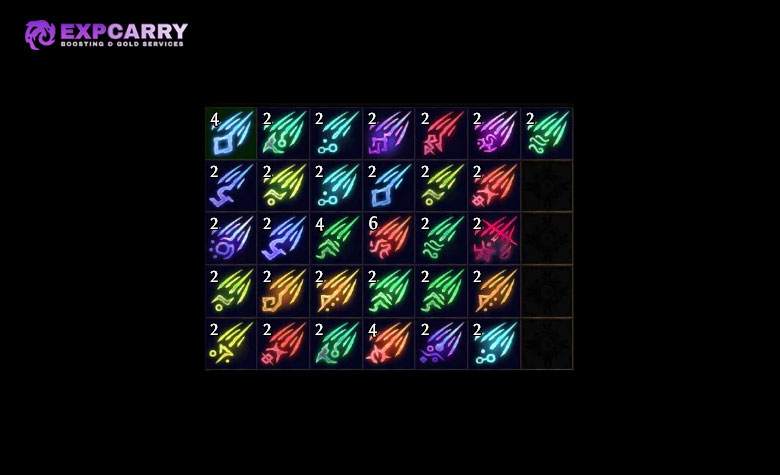
Essences are effective for beginner crafting because each Essence guarantees the modifier written on its tooltip while generating the remaining modifiers. This provides a clearer starting point than repeatedly using random Rare-item rerolls, especially when the item only needs one guaranteed Resistance, attribute, defensive stat or damage modifier.
- Select a base that matches the build and equipment slot.
- Check the item level and attribute requirements.
- Choose an Essence that guarantees a required modifier.
- Apply it to a compatible item.
- Keep a result with one or more useful additional modifiers.
- Complete the item with a Crafting Bench modifier if an affix remains open.
Safe Crafting with Fractured Items
A useful Fractured Modifier reduces randomness because it remains fixed while the other modifiers are rerolled. A practical beginner method is to buy or find a suitable base with Fractured maximum Life, Resistance, attribute or another essential stat, use an Essence to guarantee a second modifier and finish a successful result at the Crafting Bench.
- Choose a useful Fractured Modifier on the correct base.
- Verify that the item level supports the remaining desired modifiers.
- Apply an Essence that guarantees another important stat.
- Keep a roll with useful additional prefixes or suffixes.
- Add the most valuable missing modifier at the Crafting Bench.
Basic Magic and Rare Item Crafting
Magic-item crafting is suitable when one or two modifiers provide most of the value, while Rare-item crafting is required when the item needs several different stats. Beginners should avoid continuing a project automatically after every mediocre result and should decide in advance which outcomes are good enough to keep.
- Start with a Normal item and use an Orb of Transmutation.
- Use Orbs of Alteration until an important modifier appears.
- Add a second Magic modifier with an Orb of Augmentation when possible.
- Use a Regal Orb only when the existing Magic modifiers are worth preserving.
- Evaluate the added Rare modifier before investing further.
- Use the Crafting Bench when the item has a compatible open affix.
When Exalted, Divine and Annulment Orbs Are Worth Using
An Exalted Orb is reasonable only when the existing item is already strong, the open affix has been confirmed and a random addition cannot block an essential Bench Craft. A Divine Orb changes values inside the current modifier tiers rather than upgrading a weak tier, while an Orb of Annulment can remove either the unwanted modifier or the best modifier on the item. These currencies should therefore be reserved for valuable gear with a defined success condition and an acceptable failure outcome.
PoE 3.29 Socket Crafting Changes
Equipment sockets are White by default in PoE 3.29, and gems can be placed into any equipment socket regardless of colour. A Red, Green or Blue socket grants 10 percent additional Quality when it matches the socketed gem, while higher item level and item Quality improve the relevant chances for coloured or Non-White sockets. Chromatic Orbs force at least one socket to become Non-White, and Currency that adds sockets creates the new sockets as White.
| Crafting Bench option | Cost |
|---|---|
| At Least Two Non-White Sockets | 5 Chromatic Orbs |
| At Least Three Non-White Sockets | 20 Chromatic Orbs |
| At Least Four Non-White Sockets | 75 Chromatic Orbs |
Simple Beginner Crafting Examples
The following examples focus on affordable progression items rather than perfect endgame gear. The exact modifier tiers depend on the selected base and item level, but the same process can be used throughout the campaign and early mapping.
Campaign Resistance Ring
- Choose a Ring with a useful Resistance or attribute implicit.
- Use an Essence that guarantees another required Resistance.
- Keep a result with maximum Life or a useful attribute.
- Bench Craft the largest remaining defensive requirement.
Early Mapping Boots
- Select a defensive base that the character can equip.
- Use an Essence or a useful Fractured Modifier to secure one stat.
- Keep a result with Movement Speed, Life and at least one Resistance.
- Use the Crafting Bench to complete the missing affix.
Physical Attack Weapon
- Choose a weapon type supported by the main skill.
- Compare base Physical Damage and attack speed before crafting.
- Use an Essence that guarantees a relevant physical modifier.
- Look for increased Physical Damage, added Physical Damage and Attack Speed.
- Bench Craft the strongest compatible missing modifier.
Spellcaster Weapon
- Choose a Wand, Sceptre or Staff compatible with the build.
- Identify whether the build needs gem levels, Spell Damage, Cast Speed or critical stats.
- Use an Essence that guarantees a useful caster modifier.
- Keep a result with at least one additional relevant stat.
- Finish the item with a compatible Bench Craft.
Common Crafting Mistakes to Avoid
Most beginner losses come from spending Currency without checking the base, modifier pool or expected cost. A clear plan prevents valuable items from being damaged and makes it easier to recognise when a usable craft should be kept.
- Using Currency on an unsuitable base type.
- Ignoring the item's level and available modifier tiers.
- Filling the last affix before adding an essential Bench Craft.
- Using a Divine Orb to fix a low-tier modifier.
- Applying an Orb of Annulment without accepting the possible loss.
- Using an Exalted Orb without checking the open affix type.
- Corrupting an item before its modifiers, sockets and links are finished.
- Continuing to reroll after reaching the original crafting goal.
- Following an outdated crafting method without checking current changes.
- Spending more than an equivalent finished item would cost.
When Buying Gear Is Better Than Crafting
Crafting is not always the cheapest upgrade path. Common combinations of maximum Life, Resistances, attributes and Movement Speed are often available for less than the expected cost of producing the same result, so compare similar equipment on the official Path of Exile Trade site before committing valuable Currency.
- Buy the item when the required modifier combination is common and inexpensive.
- Craft when you already own a strong base or need an unusual combination.
- Avoid a project when one failed step would consume most of the available budget.
- Compare the full expected cost, including the base, Essences and finishing crafts.
Players who prefer to avoid trading, repeated crafting attempts or extended gearing can use ExpCarry services to move directly toward the campaign, mapping or endgame content they want to play.
Final Crafting Advice for New Players
Successful beginner crafting is not about creating a perfect six-modifier item. It is about choosing the right base, checking item level and affix space, guaranteeing one important modifier and using the Crafting Bench to complete the result. Essences and Fractured Items provide safer starting points, while expensive or destructive Currency should only be used when the item already has enough value to justify the risk. Compare every project with Trade, stop when the item solves its intended problem and save advanced crafting methods for endgame bases supported by a clear plan and sufficient budget.