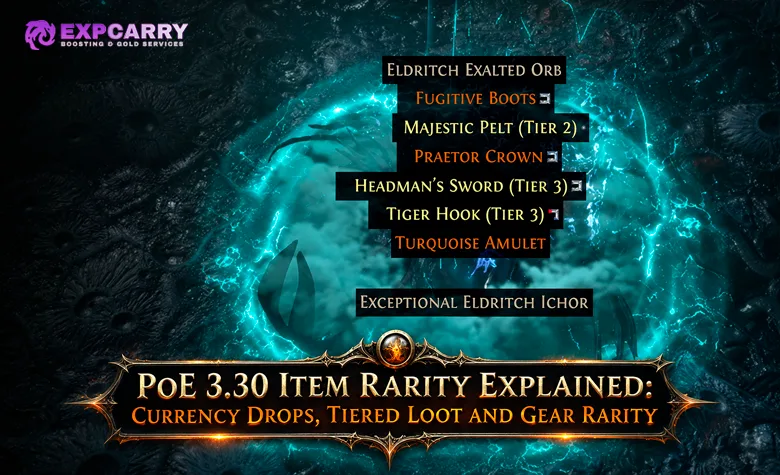
Item Rarity in Path of Exile 3.30 works differently depending on where the stat comes from. Rarity on your character's equipment no longer has the same farming value as rarity supplied by maps and monster modifiers. The biggest change is that monster Item Rarity now influences which currency drop pools can be selected, giving tougher monsters better chances of dropping valuable currency. Meanwhile, rarity on player gear has reduced effectiveness for finding Magic, Rare and Unique items, but can improve the chance of obtaining newly introduced tiered equipment. Item Quantity on map modifiers has also been replaced by Atlas Drops, separating currency quality from map sustain and league-specific resources. These rules are confirmed in GGG's official 3.30.0 patch notes. Covens of Umbra launches on November 13, 2026 (PST), so exact farming returns still require live testing.
Short answer: Item Rarity on your gear does not improve currency drops in PoE 3.30. For valuable currency and rarer loot, focus on rarity from maps and monsters; use gear rarity primarily when targeting tiered Magic and Rare equipment, and prioritize Atlas Drops when farming Maps, Threads and supported league resources.
How Item Rarity Works in PoE 3.30
Item Rarity is a loot-generation stat, but its source now determines which rewards it can influence. The 3.30 update separates player-equipment rarity from the rarity applied by maps, monsters and certain other sources. This is important because a character with substantial Item Rarity on equipped gear is not equivalent to a character running maps with strong rarity modifiers.
GGG redesigned the underlying item-generation system rather than simply increasing the effectiveness of a familiar stat. Monster rarity now influences which loot categories are eligible during item generation, including different currency pools. Player rarity remains relevant to equipment, particularly the new Item Tier system, but does not provide the same effect on currency. The official Covens of Umbra FAQ explicitly confirms this distinction and corrects an outdated statement distributed during ExileCon.
| Rarity source | Effect on currency | Effect on equipment and loot |
|---|---|---|
| Player equipment | Does not affect currency dropped by enemies. | Has reduced effectiveness for Magic, Rare and Unique drops; improves the chance of finding tiered Magic and Rare equipment. |
| Map modifiers | Can improve currency outcomes through the monster drop system. | Improves the rarity environment of the area, affecting eligible equipment and other drops. |
| Monster modifiers and inherent rarity | Influences the eligible currency drop pools, favoring more valuable currency at higher rarity. | Influences Item Tier chances, rarer Divination Cards and, at higher levels, the selection of rarer Unique items. |
| Chests and other non-player sources | Item Rarity on chests affects which drop pools can be selected; effects from other sources depend on their specific rules. | Chest rarity can influence eligible equipment drops, while fixed rewards and other sources do not necessarily scale in the same way. |
This distinction changes how players should evaluate Magic Find equipment. Adding Item Rarity to a character may still be worthwhile when valuable equipment is the target, but it should not be presented as a direct way to increase Divine Orb drops. Conversely, improving the rarity of monsters through suitable map modifiers can contribute to better currency outcomes without requiring the player to sacrifice equipment slots for rarity.
Does Item Rarity Increase Currency Drops in PoE 3.30?
Yes, but only when the rarity comes from eligible non-player-equipment sources, such as maps and monster modifiers. The distinction comes from the new currency generation system. In previous versions, a monster's item rarity could be wasted when the game selected a drop such as a Scroll of Wisdom, because that item could not become Magic, Rare or Unique equipment. Patch 3.30 changes this by connecting the initial rarity roll to the categories of items that can be generated.
The revised system separates currency into Magic Currency and Rare Currency pools. A Magic rarity roll can select the Magic Currency pool, while a Rare rarity roll can select the Rare Currency pool. Increasing a monster's Item Rarity therefore changes the relative opportunities for valuable currency to appear, rather than directly multiplying the total number of currency drops. These labels describe internal drop categories, not visible Magic- or Rare-quality versions of the currency items.
Magic Currency vs. Rare Currency Drop Pools
The official patch notes provide examples of which currencies belong to the two categories. The distinction helps explain why higher-rarity monsters can produce better currency results, but it does not establish a guaranteed drop or a fixed number of Chaos Orbs for a particular rarity percentage.
| Drop category | Examples confirmed by GGG | Generation rule |
|---|---|---|
| Normal-rarity scroll pools | Scrolls of Wisdom and Portal Scrolls | These pools can only be selected when the initial rarity roll is Normal. |
| Magic Currency | Orb of Transmutation, Orb of Alteration, Jeweller's Orb | Available when the generated rarity is Magic. |
| Rare Currency | Orb of Alchemy, Chaos Orb, Divine Orb, Mirror of Kalandra | Available when the generated rarity is Rare. |
High monster rarity makes ordinary scroll pools less likely while improving access to more valuable currency categories. However, selecting the Rare Currency pool does not guarantee that the result will be a Divine Orb or Mirror of Kalandra. The game still has to determine which item is generated within that category, and GGG has not published a complete probability table for individual currencies.
For players who primarily want currency for trading and crafting, the new rules make monster difficulty and map preparation more relevant than simply wearing more rarity gear. The actual value of currencies such as Chaos Orbs used for trading and map preparation still depends on the league economy, while the rarity system determines how those items can enter the drop pool.
Why Rare and Unique Monsters Matter More
Before 3.30, Magic monsters had a 50% reduced chance to drop items unaffected by rarity, while Rare and Unique monsters had an 80% reduction. These penalties included currency and Skill Gems. GGG removed the reductions because the redesigned system now uses monster rarity to influence the available drop categories instead.
This is a substantial change to the value of fighting dangerous enemies. Rare and Unique monsters have higher inherent Item Rarity, and their modifiers can increase it further. The update also raises the rarity provided by Magic and Rare monster modifiers, while Rare monsters receive slightly more inherent Item Quantity. As a result, GGG expects a much larger share of valuable currency to come from Rare and Unique monsters rather than ordinary enemies.
That does not mean every heavily modified Rare is worth several minutes of combat. A monster that takes too long to kill can still reduce your farming efficiency, especially if it threatens repeated deaths. The useful strategy is to farm challenging monsters that your character can defeat consistently, not to maximize difficulty without considering clear speed and survival.
Why Magic Find Gear Does Not Improve Currency Drops
One of the biggest sources of confusion after ExileCon was whether Item Rarity on player equipment would also improve currency drops. GGG clarified the answer directly: rarity on player gear does not affect currency items dropped by enemies. Only rarity from other sources, including map and monster modifiers, contributes to that part of the system.
This makes the opportunity cost of Magic Find gear much easier to evaluate. A ring with Item Rarity may help when hunting high-tier equipment, but replacing a powerful damage or defensive ring with it does not improve your currency drop pool. If the replacement lowers your clear speed, it can make a currency-farming strategy worse rather than better.
The practical rule is to separate your goals. Gear rarity is an equipment-farming consideration, while map and monster rarity are the relevant statistics for improving currency quality. Do not calculate an imaginary Divine Orb bonus from the Item Rarity displayed on your character sheet.
Tiered Loot Explained: Item Tiers 2–5
Path of Exile 3.30 introduces a new Item Tier system for Magic and Rare equipment. Starting in Act 6, eligible items can drop with an Item Tier from 2 to 5. Higher tiers influence several parts of item generation, improving the chances of stronger modifiers, better bases, quality, sockets and links. The tier is part of the item's drop generation, not a guarantee that every modifier will be valuable for your build. Items in Ruthless do not have Item Tiers.
The important benefit is that players can recognize potentially valuable equipment before committing time and resources to evaluating every ordinary Rare. A higher-tier item is more likely to be worth inspecting, particularly when it drops on a desirable base. However, an unsuitable modifier combination can still make a high-tier item less useful than a lower-tier piece with exactly the stats your character needs.
What Higher Item Tiers Actually Improve
Item Tiers influence multiple aspects of the generated item rather than adding one fixed bonus. This makes them relevant to both players searching for upgrades and crafters looking for promising starting items.
- Modifier Tier Rating: Higher Item Tiers improve the chances of stronger modifier tiers when the item is identified.
- Equipment bases: Higher tiers increase the chance of generating a higher-level weapon or armour base type.
- Item Quality: Higher tiers improve the chance of an item having Quality and the chance of receiving more of it.
- Sockets and links: Higher tiers improve the chance of generating additional sockets and socket links.
- Special Tier 5 outcomes: Tier 5 items can occasionally gain +1 to Item Level or drop as Fractured Magic items.
The redesigned Modifier Tier Rating system also changes how good modifiers are generated. GGG removed the old behavior where increasing the rating could disproportionately suppress certain modifier categories, such as high-tier Physical Damage on weapons. The revised system is designed to improve modifier tiers more consistently without relying on large rating breakpoints, making higher-quality item generation more predictable in principle.
Special Item Bases and Minimum Tier Requirements
Several valuable equipment bases now require a sufficiently high Item Tier when dropping through the normal item pool. This is particularly important for players hunting crafting bases, because finding a suitable monster is no longer the only relevant condition. The item must also generate at the required tier.
GGG gives two explicit examples: Steel Ring requires at least Item Tier 3, while Stygian Vise requires Item Tier 5. The update also adds previously specialized bases to the core drop pool, including Simplex Amulet, Helical Ring, Cogwork Ring, Geodesic Ring and others. These newly available core drops are restricted by Item Tier, while some of their previous specialist sources remain available at reduced drop chances. GGG still recommends Heist when specifically targeting a Simplex Amulet.
Do not confuse the minimum Item Tier with the area's map tier. A Tier 16 map is not the same thing as an Item Tier 5 drop, and running a high map tier does not guarantee a Stygian Vise. The new condition applies to the generated equipment item itself.
Item Tier vs. Item Level vs. Item Rarity
These three terms describe different properties. Item Rarity normally refers to whether an item is Normal, Magic, Rare or Unique, or to the stat that influences loot generation. Item Level determines which modifiers can be eligible on equipment. The new Item Tier adds another generation property that improves the chance of stronger outcomes.
For example, an unidentified Rare weapon can have a high Item Tier without necessarily having every modifier your build wants. Its Item Level still matters for modifier eligibility, while its Item Tier affects generation quality. A Tier 5 item also has a chance to receive +1 Item Level, but this is a possible outcome rather than a universal property of every Tier 5 drop.
The broader PoE crafting guide explains how to evaluate equipment bases, modifiers and crafting options after finding a promising item.
Explore services related to this guide, selected from our Path of Exile catalog.
View All Path of Exile Services

Map Item Rarity vs. Atlas Drops in PoE 3.30
Map preparation has changed alongside item generation. The previous Item Quantity modifiers on Maps have been replaced with Atlas Drops, while Item Rarity continues to influence eligible loot generation. These are different reward systems, and understanding the distinction is essential when deciding which map modifiers are worth investing in.
Atlas Drops is not simply a new name for all ordinary loot quantity. It specifically improves map and Thread drops and increases certain mechanic-specific rewards. Item Rarity, by contrast, affects which eligible loot categories are selected and how valuable the resulting drops can be. A map with strong Atlas Drops is therefore not automatically a map with a stronger chance of producing high-value currency through rarity.
| Stat | What it improves | What it does not guarantee |
|---|---|---|
| Map Item Rarity | Rarity-based item generation, including better currency pools and eligible equipment rewards. | A Divine Orb, valuable Unique or high-tier equipment from every map. |
| Monster Item Rarity | Currency pool selection, rarer Divination Cards, Item Tier chances and rarer Unique selection at higher levels. | That every dangerous monster drops a premium item. |
| Atlas Drops | Maps, Threads, specified monster drops and supported league resources. | A general increase to every currency drop or to the rarity of equipment. |
| Player Item Rarity | Tiered Magic and Rare equipment chances, with reduced effects on normal rarity categories. | Better currency drops from enemies. |
Each percentage point of increased Atlas Drops raises the quantity of Maps and Threads found in the area by 1%. It also improves certain additional drops, such as Conqueror's Exalted Orbs from eligible bosses, Legion Splinters, and league resources such as Breach Hiveblood and Harvest Lifeforce. Other confirmed interactions include scaling Blight chest counts, the average number of Essences on imprisoned monsters, Legion reward-icon drops and stackable Ultimatum rewards. These examples show why players farming a specific mechanic must examine its reward system rather than choosing every map modifier based on a single rarity number.
Important Map Rarity Changes in Patch 3.30
GGG adjusted several sources of map rarity to account for the stronger reward interactions of the new system. Some familiar methods remain available but provide smaller numbers than before. Players copying old high-rarity maps should check the new modifier ranges rather than assuming their 3.29 investment still works identically.
- Maven's Chisel of Procurement: Grants +25% Item Rarity at 20% Map Quality, down from 40%.
- Eldritch Altars: Can grant 10–20% increased Item Rarity in the area, reduced from 15–30%.
- Memory Trace Altars: Can grant 20–25% increased Item Rarity in future areas, reduced from 25–40%.
- Nightmare and Originator modifiers: Map modifiers specifically increasing Item Rarity have been reduced by approximately 40–50%.
- Corrupted Maps: The Item Rarity corruption implicit now grants 10–20% increased rarity, previously 8–12%.
- Unidentified Maps: Opening an unidentified Map grants +30% Atlas Drops instead of the previous +30% Item Quantity.
These changes show that GGG is not simply increasing every source of rarity to make loot more valuable. The system's underlying influence has changed, so some rarity values have been lowered. The most useful map modifier is now the one that supports the exact reward you are trying to farm without introducing difficulty your character cannot handle.
When Atlas Drops Is Better Than Item Rarity
Atlas Drops is particularly relevant when the goal is Map sustain, Threads, or league-specific resources whose rewards scale with the new stat. Harvest is a good example because Lifeforce is explicitly named among the resources affected by Atlas Drops. A Harvest-focused character should therefore evaluate the relevant Atlas modifiers and encounter-specific bonuses rather than assuming ordinary Item Rarity on gear will produce more Lifeforce.
For players still completing their Atlas, improving access to maps and earning passive points can be more important than investing heavily in rarity. The Atlas completion and passive-point progression system is a separate objective from loot rarity, but a developed Atlas provides more opportunities to specialize in the mechanics that produce your desired rewards.
The official Atlas Passive Tree is the reference for checking the available progression and specialization options. Because patch 3.30 reworks the tree and replaces Scarabs with Threads, earlier five-Scarab farming setups should not be carried into the new league unchanged.
How Item Rarity Affects Divination Cards and Unique Items
Currency is not the only reward category affected by monster rarity. The new system also increases the chance that high-rarity monsters drop rarer Divination Cards and, at higher levels, influences the rarity of the Unique item selected when a Unique drop occurs. This makes difficult monsters more interesting for players targeting valuable items beyond ordinary currency.
However, there are important limitations. A higher chance of selecting a rarer item is not the same as a guaranteed drop, and a high-rarity monster does not necessarily produce more total items. The rules increase the value of eligible outcomes, but the number of monsters killed, available drop opportunities, and the actual rarity of desirable items still matter.
Rarer Divination Cards from Monsters
GGG confirms that monsters with high Item Rarity have a higher chance to drop rarer Divination Cards. Some common cards are also restricted from dropping from monsters with extremely high rarity. This is a meaningful change for strategies built around rare-monster density and Divination Card value, because the monster's rarity can influence the quality of eligible card outcomes.
The patch notes do not establish that every source of Item Rarity has identical effects on Divination Cards. In particular, the official clarification about player gear addresses currency, while the described Divination Card improvements are tied to monster rarity. Avoid assuming a specific card-farming multiplier from rarity equipped on your character without evidence from the new system.
Does Higher Rarity Mean More Valuable Uniques?
At higher levels, monster Item Rarity now affects the chance that a Unique item selected for a drop is a rarer Unique. This is particularly relevant to players pursuing exceptionally valuable Uniques, but the effect should not be confused with a guarantee that a specific chase item will appear.
Players targeting Unique equipment should consider whether their farm provides enough suitable monsters and whether the character can clear them efficiently. A difficult map that produces a slightly better chance of rare outcomes may still perform poorly if the character repeatedly fails or takes too long. The market value of items such as high-value PoE Unique equipment also depends on the selected item and its actual modifiers, not solely on how difficult its source was.
How to Build an Item Rarity Farming Setup in 3.30
The correct setup starts with the reward you want. A currency-focused mapper, a player collecting higher-tier equipment, and someone sustaining Maps or Threads should not automatically use the same investment strategy. Each goal benefits from different parts of the redesigned loot system, and the character still needs enough damage, defenses, and speed to finish the content consistently.
Currency Farming: Prioritize Maps and Monsters
For general currency farming, look for content that produces dangerous but manageable monsters with strong rarity modifiers. Map Item Rarity and monster rarity are the relevant sources for improving the available currency drop pools, while character equipment should prioritize damage, movement and survival. A gear upgrade that lets you defeat more Rare monsters per hour can be more useful than an Item Rarity modifier that does not contribute to currency drops.
The new system encourages players to evaluate difficult encounters more carefully, particularly those involving Rare and Unique monsters. Threads of Creation can introduce primary league mechanics and apply randomized transformative effects that increase their challenge and rewards, providing another way to invest in demanding map content. The best Thread count will depend on how reliably your character handles the resulting encounters, rather than simply maximizing every available modifier.
If a farming strategy requires additional currency for maps or equipment, Divine Orbs used for high-value trading and character upgrades are an economic resource, not a substitute for improving the map's rarity. Spending more currency on map preparation is worthwhile only when the additional rewards justify the investment.
Equipment Farming: Target Higher Item Tiers
When the goal is valuable Magic and Rare equipment, Item Rarity on player gear becomes more relevant. The new tier system can produce better modifiers, higher-quality bases and occasionally special Tier 5 outcomes. This creates a reason to evaluate rarity equipment separately from conventional currency farming rather than discarding the stat entirely.
For example, players looking for high-tier crafting bases may want to farm content where eligible equipment can generate at the required Item Tier. A Steel Ring needs at least Tier 3, while a Stygian Vise requires Tier 5 when generated through the core drop pool. Higher Item Rarity on gear can improve the chance of finding tiered equipment, but it does not bypass those restrictions or guarantee a particular base.
Equipment farming also depends on which drops are worth identifying. A rare item with a high Item Tier may still have poor combinations of modifiers, while a lower-tier item can be valuable because its stats fit a popular build. Keep your loot filter and identification priorities focused on genuinely useful items instead of treating every higher-tier Rare as a guaranteed profitable drop.
Threads, Maps and League Resource Farming
If the goal is sustaining maps or generating Threads for continued farming, Atlas Drops deserves priority. The stat directly increases Map and Thread quantities and can improve eligible league-specific rewards. Item Rarity still matters when you also want valuable monster drops, but it does not replace the specific quantity scaling provided by Atlas Drops.
Different mechanics need different preparation. A Harvest-focused setup should evaluate Lifeforce generation, while a Breach-focused setup may care about Hiveblood and the rewards created by its monsters. The new Atlas system allows players to specialize through the tree and Threads, but every additional investment should support a defined goal rather than simply making the map more expensive.
The existing PoE 3.30 Atlas and loot rework overview covers the broader structural changes. This guide focuses specifically on how rarity and reward-generation stats affect farming decisions, leaving full mechanic-by-mechanic Atlas strategies to their dedicated guides.
How to Test Whether a Rarity Setup Is Profitable
Because the new system changes the value of different monster types and drop categories, one lucky Divine Orb or valuable Unique is not enough to establish a reliable farming strategy. Compare repeatable map batches instead, keeping the content and investment as consistent as possible. Track the map modifiers, monster difficulty, total time, currency obtained and the value of equipment that actually sells.
When testing player Item Rarity, compare equipment results rather than attributing currency differences to a stat GGG says does not affect currency. When testing map rarity, focus on currency categories, valuable drops and the difficulty of the encounters. For Atlas Drops tests, record Maps, Threads and the specific league resources that the stat is supposed to improve.
The comparison should use net profit, not theoretical stash value. Subtract maps, Threads, rolling currency and other consumed inputs from the realistic value of the rewards. For longer farming sessions, hourly PoE farming assistance is another way to approach an agreed activity, but the service does not guarantee fixed currency or rare-item outcomes, and the same profit-accounting rules still apply.
Other Loot Changes That Affect Rarity Farming
The Item Rarity overhaul also changes several older league mechanics and reward sources. In many cases, GGG removed Item Quantity bonuses and increased Item Rarity instead, shifting the reward design away from generating more ordinary drops and toward improving eligible loot outcomes. These changes matter when comparing a 3.30 farm with older strategies built around quantity multipliers.
The patch notes confirm that Delirium Fog, Sentinel-empowered monsters, Opulent Rituals, certain Tempests, Covetous Shrines and monsters spawned from Verisium Ore encounters have lost their previous Item Quantity bonuses, with Item Rarity increased to compensate. Rare and Magic monster modifiers also stop granting additional Item Quantity, although Rare monsters receive a small increase to inherent quantity. This does not mean every possible quantity mechanic has been removed from the game.
Some areas follow their own conversion rules. Heist Contracts and Blueprints, Incursion Temple modifiers, Delve area modifiers and Corrupted Side Areas receive increased Item Rarity instead of the new Atlas Drops stat. Blighted Maps anointed with Silver Oils now receive 80% Item Rarity rather than 80% Item Quantity. These distinctions matter because a mechanic-specific reward chest, a monster drop and a general map reward may respond to different modifiers.
For a broader view of the changes, GGG's official Covens of Umbra expansion announcement explains the endgame overhaul, while the patch notes provide the precise rules for item generation and individual reward sources. A strategy that relied heavily on old quantity bonuses should be tested again after launch rather than assigned its previous profit expectations.
Common Item Rarity Mistakes in PoE 3.30
The biggest mistakes come from treating all rarity sources as identical or assuming higher rarity guarantees more valuable drops. The new system improves the relationship between difficulty and reward potential, but successful farming still depends on choosing suitable content, maintaining reliable clear speed, and understanding which modifiers apply to the desired rewards.
- Stacking player Item Rarity for Divine Orbs: GGG confirms that rarity on equipped gear does not affect currency dropped by enemies.
- Confusing Item Tier with Map Tier: A Tier 16 map does not guarantee that dropped equipment will have Item Tier 5.
- Assuming every Rare Currency roll is valuable: The Rare Currency pool includes different items with different probabilities and market values.
- Using Atlas Drops as a universal currency multiplier: The stat improves Maps, Threads and specified league rewards rather than simply multiplying all currency drops.
- Ignoring monster rarity: The new generation system gives Rare and Unique monsters a more important role in valuable currency drops.
- Overvaluing unidentified tiered equipment: A higher Item Tier improves generation chances but does not guarantee useful modifiers.
- Copying 3.29 Magic Find strategies: Old Scarabs, quantity bonuses and rarity calculations may no longer work in 3.30.
- Sacrificing clear speed for unnecessary difficulty: A theoretically more rewarding encounter can still be inefficient when it takes too long or causes repeated failures.
PoE 3.30 Item Rarity FAQ
These answers cover additional questions about the new loot system, including the distinction between Item Tiers, rarity and map reward modifiers.
Does Item Rarity guarantee a Divine Orb or Mirror of Kalandra?
No. Monster and map rarity can improve the opportunity for valuable currency to generate, but the game still selects the actual currency item through its drop system. There is no guaranteed Divine Orb threshold based on a specific Item Rarity percentage.
Can Item Tier 5 gear drop before Act 6?
The new Item Tier system is introduced from Act 6 onward. GGG has not described normal earlier campaign drops as eligible for the new Tier 2–5 generation system.
Does Item Tier replace Item Level?
No. Item Level continues to affect modifier eligibility, while Item Tier influences generation quality. Tier 5 items can also occasionally receive +1 Item Level, but this is not guaranteed.
Does Item Rarity increase Harvest Lifeforce drops?
The official 3.30 rules specifically identify Atlas Drops as a stat that improves the quantity of supported league resources, including Harvest Lifeforce. Do not assume that Item Rarity on player equipment provides the same effect.
Conclusion
In PoE 3.30, choose rarity investment according to the reward you want. Map and monster rarity are the important sources for valuable currency and rarer monster loot, player Item Rarity is more relevant to tiered equipment, and Atlas Drops supports Maps, Threads and specified league resources. Keep your character strong enough to clear consistently, evaluate high-tier items by their actual modifiers, and use live farming results rather than old Magic Find assumptions when deciding where to invest.