
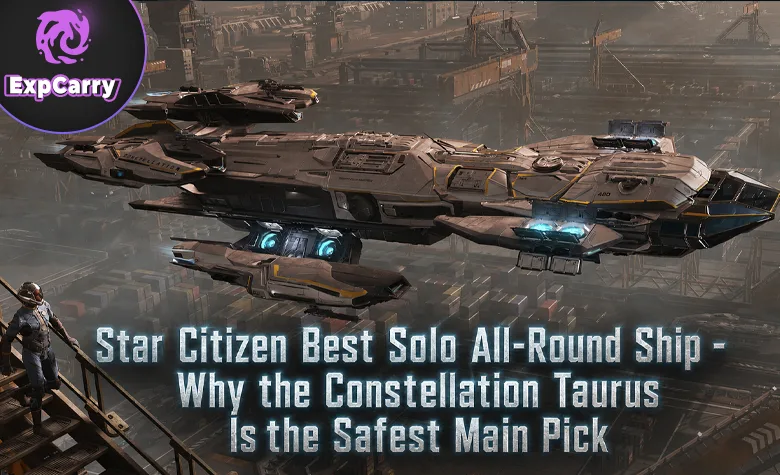
The RSI Constellation Mk IV Taurus is one of the best solo all-round ships in Star Citizen Alpha 4.10.2 LIVE. Its 174-SCU cargo capacity, four pilot-controlled Size 5 weapon mounts, tractor beam and spacious interior make it useful for hauling, PvE bounties, FPS missions, vehicle transport and loot recovery. The Taurus is not a dedicated fighter or industrial ship, but it handles more everyday activities than most specialized vessels without requiring another crew member for normal operations. Alpha 4.10.2 also rebuilt the Constellation Mk IV series, updating the cargo lift, access points, cockpit and engineering systems. This guide evaluates the Taurus as a solo daily driver, explains its current specifications, compares the main alternatives and identifies the situations where a smaller or specialized ship is a better choice.
Short answer: Choose the Constellation Mk IV Taurus if you want one long-term solo ship for cargo, PvE combat and mixed missions. Start with the Avenger Titan or Cutlass Black if easier handling and lower operating costs matter more, and use a specialist for mining, salvage or dedicated fighter PvP.
Why the Constellation Taurus Is a Strong Solo All-Round Ship
The Taurus succeeds because it combines three things that are rarely found together in the same practical solo vessel: meaningful cargo capacity, heavy pilot-controlled firepower and enough utility to support several mission types. You can complete a freight contract, take a suitable bounty, transport equipment to a bunker and recover valuable cargo without constantly changing ships.
Its main compromise is size. The Taurus handles more slowly than medium daily drivers, has a large target profile and requires more care when landing in confined spaces. A skilled light fighter can exploit those weaknesses, and the ship becomes more demanding when damage requires engineering attention. It is the best balanced choice for a particular combination of activities, not a universal winner in every role.
| Category | Assessment | Reason |
|---|---|---|
| Cargo and trading | Excellent | 174 SCU, cargo lift and tractor-beam utility support meaningful freight operations. |
| PvE bounties | Strong | Four pilot-controlled Size 5 mounts provide substantial forward firepower. |
| FPS and bunker support | Good | Interior, equipment space and vehicle transport support ground missions. |
| Defensive PvP | Situational | Heavy weapons and protection help, but agility is limited. |
| Beginner usability | Moderate | Accessible mission roles, but large-ship flying and cargo handling require practice. |
| Multicrew flexibility | Good | A second player can operate the gun turret or assist with logistics. |
| Mining and salvage | Not specialized | The Taurus lacks integrated mining and salvage equipment. |
Constellation Mk IV Taurus Specs in Alpha 4.10.2
The October 2026 Constellation Mk IV overhaul makes older Taurus specifications and interior descriptions unreliable. The updated cargo capacity is 174 SCU, not the 168 SCU quoted in older guides. The rebuild also improved access through the bridge and interior, redesigned the cargo lift and updated component management for the live engineering systems.
| Feature | Current Specification | Solo Implication |
|---|---|---|
| Manufacturer | Roberts Space Industries | Freight-focused member of the Constellation Mk IV family. |
| Cargo capacity | 174 SCU | Supports larger freight contracts and recovered cargo. |
| Pilot weapons | 4 × Size 5 mounts | Heavy forward firepower without a dedicated gunner. |
| Missiles | 24 × Size 2 in the listed loadout | Additional engagement options; ammunition must be replenished. |
| Crew stations | Manned gun turret and tractor-beam position | Additional crew improves coverage and loading efficiency. |
| Shield | 1 × Size 3 generator | Provides substantial protection, subject to power and system condition. |
| Interior | Crew facilities, cargo areas and updated access lifts | Supports longer sessions and varied mission equipment. |
| Primary drawback | Large hull and limited agility | Less forgiving than smaller ships in fighter duels and tight landing zones. |
The listed hardpoints and cargo capacity are confirmed by current ship data, but component performance, ammunition balance and weapon effectiveness can change between patches. The security hold and cargo-handling systems should be assessed according to their live functionality rather than assuming every advertised feature provides a fully implemented gameplay advantage.
Solo Cargo and Trading: The Taurus's Biggest Advantage
Cargo is the clearest reason to choose the Taurus instead of a smaller general-purpose ship. Its 174-SCU capacity provides meaningful room for freight contracts, commodity trading and recovered goods while retaining combat equipment that a dedicated hauler may lack.

The updated cargo lift and tractor-beam position matter because physical loading is part of the mission. A ship's nominal capacity does not determine how quickly you can move containers into place. Container dimensions, freight-elevator compatibility, destination access and available loading equipment can make a smaller contract more efficient than a larger one.
The Taurus is especially useful when a session includes several activities. You can deliver cargo, transport supplies to a bunker and bring recovered items back in the same ship. The hold can also accommodate compatible ground vehicles, although exact fit and loading clearance should be checked before committing to a particular vehicle.
| Ship | Cargo | Practical Difference |
|---|---|---|
| Constellation Mk IV Taurus | 174 SCU | Largest standard freight capacity in this selected group, with strong pilot weapons. |
| Zeus Mk II CL | 128 SCU | Smaller medium freighter with a more compact operating profile. |
| Drake Corsair | 72 SCU | Exploration and combat-oriented alternative with less freight space. |
| Crusader C1 Spirit | 64 SCU | Compact freight-focused daily driver. |
| Cutlass Black | 46 SCU | Lower capacity but useful flexibility for mixed missions. |
Higher cargo capacity does not guarantee higher profit per hour. Commodity runs require working capital and expose that investment to loss, while hauling contracts involve their own loading and delivery requirements. A ship purchase also needs a reserve for repairs, fuel, equipment and freight operations. Those expenses form part of the wider Star Citizen aUEC economy, regardless of how the player obtains the credits used for their ship.
Explore services related to this guide, selected from our Star Citizen catalog.
View All Star Citizen Services
PvE Combat: Bounties and Defensive Flying
Four pilot-controlled Size 5 weapon mounts give the Taurus substantial forward damage for a freight-oriented ship. It can handle many appropriate PvE targets without relying on an occupied turret, especially when the opponent is large enough or slow enough to remain in its firing arc.
The correct combat style is controlled positioning. Keep targets ahead of the ship, manage distance and avoid wasting time attempting light-fighter maneuvers that the hull cannot reproduce. Its protection can absorb punishment, but sustained incoming fire and damaged systems can still disable the vessel.
The Taurus becomes more valuable when the mission involves recovering goods after combat. A dedicated fighter may destroy a target faster, but it cannot necessarily transport containers or useful recovered equipment. The cargo bay turns suitable combat-and-recovery contracts into one continuous operation.
Contract difficulty still matters. Progressing through Star Citizen faction reputation can unlock harder bounty assignments, but higher reputation does not automatically make the Taurus suitable for every target or enemy formation. Small, agile opponents can be more troublesome than a slower and more heavily armored ship.
PvP Reality: Capable of Self-Defense, Not a Duel Specialist
The Taurus is a dangerous opponent when it can bring its forward weapons to bear. It can punish careless approaches, defend a cargo run and create enough pressure to discourage an attacker. However, its large cross-section and slow turning make it vulnerable to pilots who can remain outside its main firing arc.
That makes it unsuitable as a replacement for dedicated fighters such as the Gladius or other maneuver-focused combat ships. Against experienced opponents, superior weapon size does not help when the target cannot be tracked consistently.
For solo players, defensive priorities should come before chasing an evasive attacker: maintain useful distance, manage shield exposure, avoid unnecessary obstacles and preserve a route away from the encounter. A crewed turret can improve coverage, but the presence of a gunner does not remove the ship's handling limitations.
Understanding these distinctions also matters during Star Citizen flight and combat training, where aiming, positioning and power management are different skills from choosing a ship with stronger weapons on paper.
Best Taurus Loadout Priorities for Solo Gameplay
A dependable Taurus loadout should support mixed missions rather than optimize for one exceptional damage number. Weapon performance changes across builds, so it is more useful to understand what each equipment choice costs in ammunition, heat, power or repair requirements than to recommend a permanent set of individual weapon models.
| System | Priority | Reason |
|---|---|---|
| Pilot weapons | Reliable sustained damage and useful range | Supports repeatable PvE encounters without depending on turret crew. |
| Energy weapons | Consider for long mixed sessions | Avoids conventional ballistic ammunition consumption. |
| Ballistic weapons | Use when the damage profile justifies resupply | Ammo logistics can interrupt longer missions. |
| Shields | Stable protection and sufficient available power | Survival depends on more than the nominal shield capacity. |
| Power and cooling | Balance system demand and operational reliability | Combat and component damage can create resource-management problems. |
| Cargo equipment | Maintain clear grid access and working tractor equipment | Loading efficiency determines the usefulness of the hold. |
Energy weapons are convenient for sustained PvE sessions, but they are not automatically the highest-damage choice in every encounter. Ballistic setups can be useful when the player accepts ammunition management. Whichever option you use, test the actual fit and system performance in the live build before investing in a full replacement loadout.
Where to Buy the Constellation Taurus in Star Citizen
Current Alpha 4.10.2 community shop records list the Constellation Mk IV Taurus at New Deal in Lorville and Teach's Ship Shop in Levski. The reported in-game price is approximately 7,641,650 aUEC. Dealer availability and prices can change, so confirm the ship and amount at the in-game sales terminal before traveling or committing your entire balance.
The Taurus is best treated as a significant progression purchase rather than a mandatory first ship. A player should already understand landing, cargo handling, repair costs, ship recovery and the kinds of contracts they want to repeat. A large hold is only an advantage when there is enough working capital and suitable freight to use it.
There are also distinct ship-acquisition systems. Standard dealership purchases use aUEC, while certain Star Citizen Wikelo ship rewards require specific collection contracts and materials. A Wikelo special variant is not the same acquisition route as buying the standard Taurus from a ship dealer.
Is the Taurus Good for Beginners?
The Taurus is manageable after some flight experience, but it is not the easiest ship for someone learning basic controls. Its dimensions make tight hangars and uneven landing zones more demanding, and loading a large amount of physical cargo introduces additional steps that smaller starters avoid.
The Avenger Titan is a better first choice for learning short missions, early combat, inventory and docking. The Cutlass Black provides the next step with more cargo, vehicle transport and multirole flexibility. A C1 Spirit is another useful option for players who prefer a compact freight-focused ship.
Once a player understands their preferred activities, the Taurus becomes a stronger long-term purchase. It is particularly attractive when hauling or combat-and-loot missions are becoming routine and a smaller hold is repeatedly limiting what can be completed in one trip.
Taurus for Experienced Solo Players
Experienced pilots often have separate ships for combat and industrial careers, but a flexible daily driver still saves time. The Taurus can carry supplies, handle freight, defend itself and transport recovered equipment without requiring the player to plan an entire session around one specialized vessel.
Its updated Mk IV interior also matters here. Cargo access and engineering layout affect the time spent moving around the ship, not just how it looks. Players used to the older Constellation arrangement should become familiar with the revised lifts, access points and component locations before relying on the ship during a demanding contract.
Solo capability does not mean every onboard station can be used simultaneously. Additional crew remains valuable for gun coverage, tractor-beam operation, repairs and cargo handling, especially during longer or more dangerous missions.
Main Alternatives to the Constellation Taurus
The Taurus is a strong compromise, but several other ships are better when one particular requirement dominates the player's sessions. Smaller ships reduce landing and operating overhead, while combat-oriented alternatives can offer different handling or crew arrangements.

| Ship | Choose It When... | Trade-Off Against Taurus |
|---|---|---|
| Cutlass Black | You want a lower-cost multirole ship with a useful ramp and vehicle space. | Less cargo capacity and less heavy forward firepower. |
| C1 Spirit | You mostly haul modest loads and value a more compact freight workflow. | Less cargo and combat capability. |
| Zeus Mk II CL | You prefer a smaller dedicated cargo daily driver with 128 SCU. | Less freight space and pilot-controlled firepower. |
| Drake Corsair | You favor exploration and a combat-oriented ship layout. | Only 72 SCU and a different distribution of weapons and crew roles. |
| Constellation Mk IV Andromeda | You want a more combat-oriented Constellation with additional tactical equipment. | 96 SCU rather than the Taurus's 174 SCU. |
| Avenger Titan | You need an accessible starter for light combat, deliveries and FPS transport. | Far less capacity and room for vehicles or recovered cargo. |
The Corsair is not automatically the better solo fighter simply because its design emphasizes weapons. Actual pilot-controlled firepower, crew participation and the current loadout must be compared. Likewise, the Andromeda's additional combat equipment may justify its smaller hold for bounty-focused pilots, while a hauling-focused player will usually benefit more from the Taurus.
Best Gameplay Loops for the Constellation Taurus
The ship performs best when the session includes cargo or requires both combat capability and usable interior space. It becomes less attractive when a profession requires tools that the Taurus does not carry.
| Activity | Fit | Main Consideration |
|---|---|---|
| Hauling and trading | Excellent | Large practical hold and loading utility. |
| PvE bounties | Strong | Heavy forward guns; weaker handling against agile opponents. |
| FPS and bunkers | Good | Equipment and loot transport, but a larger landing footprint. |
| Vehicle transport | Good | Compatible vehicles only; verify physical clearance. |
| Defensive PvP | Situational | Effective when the pilot maintains weapon alignment. |
| Mining and salvage | Support only | Needs a dedicated mining vehicle or salvage ship for the core task. |
| Medical recovery | Poor | No dedicated medical bed. |
| Fighter duels and racing | Poor | Large profile and limited maneuverability. |
If mining is the main objective, the Prospector or Golem is better equipped for ship mining. If salvage is the goal, use the Vulture or another dedicated salvager. The Taurus may transport resources or support those operations, but cargo capacity does not replace the specialized equipment required to extract them.
Where the Taurus Falls Short
The first limitation is agility. Fast opponents can exploit its turning speed and size, particularly when they can attack from outside the forward firing arc. This makes experienced fighter PvP a different proposition from routine PvE encounters.
The second limitation is operating scale. A large ship requires more care when approaching hangars, landing on rough terrain or moving cargo through confined areas. The extra freight capacity is wasted on missions that involve only a small delivery box.
The third limitation is the engineering workload. In Alpha 4.10.2, component damage and resource management are live considerations, not hypothetical future features. A solo player may need to choose between piloting and dealing with an internal problem, whereas a crew can divide those responsibilities.
Finally, the Taurus cannot replace dedicated industrial, medical or racing ships. Its strength comes from combining several common mission roles, not from being the best vessel at every profession.
Best Ship Progression for a Solo Player
A useful progression route is Avenger Titan → Cutlass Black or C1 Spirit → Constellation Mk IV Taurus. Each step solves a different problem instead of simply increasing ship size.
The Titan teaches basic flight and early contracts. The Cutlass adds cargo and ground-vehicle flexibility, while the C1 favors a more focused freight workflow. The Taurus becomes worthwhile when the player consistently needs more capacity, heavier pilot-controlled weapons or the ability to combine recovery with combat.
This is not a mandatory upgrade order. A pilot who primarily wants fighter combat may benefit more from a Gladius or Vanguard. A dedicated miner may save directly for a Prospector, and a salvage player may prefer a Vulture. The best purchase is determined by the activity that will actually be repeated.
Constellation Taurus FAQ
These answers address common questions about the updated Taurus and its suitability as a solo ship.
How much cargo does the Taurus carry in Alpha 4.10.2? The Constellation Mk IV Taurus has 174 SCU of listed cargo capacity. Older articles quoting 168 SCU do not reflect the current Mk IV specification.
Can one player fly and fight with the Taurus? Yes. The pilot controls the ship and four Size 5 weapon mounts. Another player improves gun-turret coverage or cargo operations, but is not required for ordinary solo hauling and suitable PvE missions.
Is the Taurus better than the Cutlass Black? For substantial cargo and heavy forward weapons, generally yes. The Cutlass Black is easier to operate, has lower purchase and operating requirements, and remains a practical choice for smaller mixed missions.
Where is the Taurus sold in-game? Current Alpha 4.10.2 records list New Deal in Lorville and Teach's Ship Shop in Levski. Check the live dealership terminal for availability and price before traveling.
Final Verdict: Is the Constellation Taurus the Best Solo All-Round Ship?
The Constellation Mk IV Taurus remains one of the strongest long-term solo all-round choices in Star Citizen Alpha 4.10.2 because it combines 174 SCU of cargo space, substantial pilot-controlled weapons and flexible mission support. Its main weaknesses are handling, operating overhead and the absence of specialized career equipment. Choose it for regular hauling, PvE and cargo-recovery sessions; choose a smaller ship for inexpensive daily flying or a dedicated vessel when one profession dominates your time.