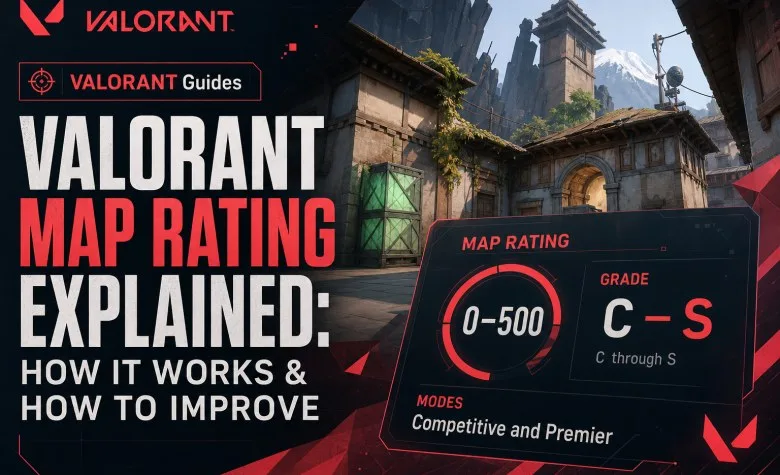
VALORANT Map Rating is a private 0–500 score that measures how well you perform on each individual map in Competitive and Premier. Every map also receives a grade from C to S. Riot calculates the rating from four areas: your overall win rate on that map, attacker-side win rate, defender-side win rate and Performance Score.
The most important distinction is simple: Map Rating does not affect your RR or MMR. It is a diagnostic system, not a second Ranked ladder. Use it to find which maps and sides consistently produce your strongest or weakest results.
| Map Rating fact | Current rule |
|---|---|
| Rating range | 0–500 |
| Grade | C through S |
| Modes | Competitive and Premier |
| Main inputs | Overall Win Rate, Attacker Win Rate, Defender Win Rate, Performance Score |
| Recent matches | Weighted more heavily than older matches |
| Act reset | No regular Act reset |
| RR/MMR impact | None |
| Visibility | Private; other players cannot see your rating |
What Is Map Rating in Valorant?
Map Rating is Riot's per-map proficiency system. Instead of reducing your entire Ranked experience to one rank, it separates performance by map and lets you see patterns that are otherwise easy to miss.
You may have the same Competitive rank as another player while being much stronger on Bind and much weaker on Corrode. Map Rating is designed to expose that difference.
It was introduced with Patch 13.08 at the start of VALORANT Season 2026 Act 6. Everyone started fresh when the system launched, meaning matches played before Map Rating went live were not imported into the initial rating.
How Is Valorant Map Rating Calculated?
Riot has confirmed four primary inputs. It has not published the exact formula or percentage weight of each factor.
| Factor | What it measures | What a weak result can reveal |
|---|---|---|
| Overall Win Rate | Your overall success on that map | The map may consistently produce poor match results regardless of side |
| Attacker Win Rate | How reliably you win attacking rounds | Weak entries, executes, trading, rotations or post-plants |
| Defender Win Rate | How reliably you win defensive rounds | Weak site holds, rotations, retakes or defensive positioning |
| Performance Score | Your individual impact during matches | Your team may win while your own round-to-round contribution remains limited |
Recent matches count more than older matches. This means Map Rating is not simply a lifetime win-rate display. Better recent results can gradually change how the system evaluates your current proficiency.
Map Rating vs Performance Score vs RR vs MMR
These systems answer different questions and should not be treated as interchangeable ratings.
| System | Main question | 0–500? | Affects Ranked RR? |
|---|---|---|---|
| Map Rating | How strong are you on this specific map over time? | Yes | No |
| Performance Score | How much impact did you have in this match? | Yes | No |
| RR | How much visible Ranked progress did you gain or lose? | No | It is the Ranked progress value |
| MMR | How does the matchmaking system evaluate your underlying skill? | Not publicly displayed | Indirectly related to Ranked matchmaking and RR behavior |
A high Map Rating does not give bonus RR. A low Map Rating does not directly remove RR. Likewise, improving Performance Score is not a hidden shortcut for receiving guaranteed extra RR.
This distinction matters because it prevents the wrong optimization goal. You should use Map Rating to understand your game, not farm a stat while sacrificing rounds.
Explore services related to this guide, selected from our Valorant catalog.
View All Valorant Services


How Does Performance Score Affect Map Rating?
Performance Score is one of the four published Map Rating inputs. It is Riot's broader measurement of individual match impact and replaced ACS in several game-result surfaces.
Performance Score ranges from 0 to 500 and evaluates multiple types of contribution, including:
- Damage;
- Adjusted Kills;
- Adjusted Deaths;
- Trades and being traded;
- Assists;
- Agent-normalized utility use;
- Spike plants;
- Spike defuses.
Riot lists these metrics in order of impact, with damage, adjusted kills and adjusted deaths among the most important factors. Adjusted kills and deaths account for context such as First Bloods and First Deaths instead of treating every frag or death as identical.
This is why two players with similar KDA can finish with different Performance Scores. A trade, useful ability, plant or high-impact opening kill can carry different value from a low-impact elimination after a round is effectively decided.
Does Map Rating Reset Every Act?
No regular Act reset has been announced for Map Rating.
There are two rules that can look contradictory unless the launch is separated from future Acts:
- When Map Rating launched in Patch 13.08, everyone started fresh and matches played before launch did not count.
- Once the system is active, Riot says Map Rating uses your accumulated map history and does not reset simply because a new Act begins. Recent matches still receive greater weight.
Patch 13.09 added another layer: your Act Best Match now has a larger impact on Map Rating each Act. Riot described this change as a way to better represent both consistency and peak performance.
That does not turn Map Rating into an Act-only score. Think of it as a persistent map profile in which recent performance and the strongest match of the current Act receive additional emphasis.
What Does C, B, A or S Map Rating Mean?
The numerical rating runs from 0 to 500, while Riot also translates the score into grades from C through S.
However, Riot has not published the exact numeric thresholds for every grade. Therefore, claims such as “400 always equals S” or “300 is exactly A” should not be treated as confirmed unless Riot publishes those breakpoints.
The useful interpretation is relative:
- C: the client currently considers this one of your weaker proficiency ranges;
- B: stronger results, but still clear room for improvement;
- A: strong measured proficiency;
- S: the highest displayed proficiency tier.
Use the underlying number to track smaller changes instead of focusing only on the letter.
Where Can You See Your Map Rating?
Riot exposes Map Rating in several places:
- Career: review ratings and map-specific information outside a match;
- Agent Select: see information such as your rating and Top Agents for the current map;
- End of Game: review the map information after a Competitive or Premier match.
Your Map Rating is private. Teammates and opponents cannot inspect it as a public skill badge.
How to Read Your Map Rating Correctly
The best use of Map Rating is not comparing the 0–500 number with another player's number. Use the four inputs to diagnose why one map performs differently from another.
| Pattern | Likely issue to review | First thing to check |
|---|---|---|
| High defense win rate, low attack win rate | Your map knowledge may be good, but attack structure is weak | Entry routes, default pressure, trading and post-plants |
| High attack win rate, low defense win rate | You create rounds well but lose holds or retakes | Site setups, first-contact survival and rotation timing |
| Good win rates, weak Performance Score | Your team results are stronger than your individual measured impact | Damage, trades, utility timing and objective contribution |
| Strong Performance Score, poor win rate | Individual impact is not converting into enough rounds | Late-round decisions, team coordination and high-value deaths |
| All four metrics are weak | Broad map proficiency problem | Agent choice, map fundamentals, callouts and repeatable setups |
This diagnostic approach is more useful than trying to “farm Map Rating.” The score is an output. Improve the actual reason rounds are being lost and the rating should follow over time.
How to Improve Your Valorant Map Rating
Because Riot publishes the inputs but not the exact formula, there is no legitimate trick that guarantees a specific number of rating points. The reliable method is to improve the four factors that feed the system.
1. Compare Attack and Defense Separately
Do not start with your overall win rate. First identify which side is dragging the map down.
If attack is substantially worse, review whether your team repeatedly loses the opening duel, fails to trade, arrives late to rotations or plants without a workable post-plant.
If defense is worse, check whether you die before teammates can rotate, over-rotate on early information or enter retakes from the same predictable positions.
2. Use Agents You Actually Understand on That Map
Map Rating shows Top Agents for a reason. Constantly switching to an unfamiliar meta pick can make your own performance worse even when that Agent is theoretically strong.
Start with an Agent whose utility patterns, timings and defensive setups you can reproduce consistently. Then expand the pool when the map fundamentals are stable.
3. Improve Round Impact, Not Just KDA
Performance Score rewards more than raw kills. Trading, useful assists, utility and Spike interactions also contribute.
A player going 18–16 while consistently trading teammates and helping secure objectives may be contributing more useful round value than a player protecting a prettier KDA in low-impact situations.
4. Review Repeated Round Losses
One bad game matters less than a repeated structural problem. Look for patterns:
- the same site repeatedly collapses on defense;
- your team cannot enter one particular choke;
- you lose man advantages in post-plants;
- you die first too often on one side;
- your utility is regularly unused when rounds end.
Fixing one repeatable leak is usually more useful than changing sensitivity, crosshair or Agent after every loss.
5. Judge Progress Across Multiple Matches
Recent games matter more, but Riot has not published an exact number of matches required for the rating to stabilize. Avoid drawing conclusions from a single result.
Review a block of matches on the same map and ask whether attack, defense and individual impact are moving in the same direction.
Can You Increase Map Rating by Playing Only One Map?
Normal Competitive matchmaking does not let you permanently choose one preferred map, so Map Rating is not a traditional “grind this one map” ladder.
Premier provides a different competitive structure, but your goal should still be improving repeatable map performance rather than trying to manipulate the displayed number.
Does Dodging a Bad Map Protect Your Map Rating?
Riot has not published a Map Rating formula that supports using dodges as a reliable rating-management strategy. More importantly, queue dodging has its own penalties and does not solve the skill gap that Map Rating is intended to expose.
If one map consistently shows weak results, that is exactly the map where reviewing agents, setups, rotations and attack plans provides the most information.
What Riot Has Not Revealed About Map Rating
Several details remain intentionally undisclosed. As of the current live system, Riot has not publicly provided:
- the exact mathematical formula;
- the exact weighting percentage of the four inputs;
- the numeric C/B/A/S grade thresholds;
- the precise recent-match weighting curve;
- a guaranteed number of matches needed for a stable rating;
- an exact point gain or loss formula per match.
This matters because precise calculators claiming to predict your next Map Rating from public information alone cannot reproduce an official formula Riot has not released.
Common Map Rating Misconceptions
| Claim | Correct? | Explanation |
|---|---|---|
| High Map Rating gives more RR | No | Riot explicitly separates Map Rating from RR and MMR |
| Map Rating is just map win rate | No | It uses three win-rate measures plus Performance Score |
| Performance Score is the same as Map Rating | No | Performance Score measures a match; Map Rating measures proficiency on a map over time |
| Only kills matter | No | Performance Score includes multiple combat, team and objective contributions |
| Map Rating resets every Act | No | The launch started fresh, but Riot says the ongoing map history persists across Acts |
| Other players can inspect my Map Rating | No | The system is private |
Valorant Map Rating FAQ
Does Map Rating affect RR?
No. Riot explicitly states that Map Rating does not affect RR.
Does Map Rating affect MMR?
No. Riot also states that Map Rating does not affect MMR.
What is the maximum Map Rating?
The maximum displayed score is 500.
What is the highest Map Rating grade?
S is the highest displayed grade. Riot has not publicly published the exact numerical threshold required for S.
What modes count toward Map Rating?
Map Rating is available for Competitive and Premier.
Can other players see my Map Rating?
No. Your Map Rating information is private.
Does Map Rating reset each Act?
Not as a normal Act reset. Everyone started fresh when the feature launched, but the system then retains your map history across Acts while weighting recent matches more heavily.
What changed in Patch 13.09?
Riot increased the impact of your Act Best Match on Map Rating so the system better reflects both consistency and peak performances within each Act.
How You Should Actually Use Map Rating
Map Rating is most valuable as a diagnostic tool. A 0–500 number alone tells you less than the relationship between your attack win rate, defense win rate, overall results and Performance Score.
Find the weakest input, identify the repeated round pattern behind it and work on that specific problem. If your defense collapses, review holds and rotations. If attack is weak, review entries, trades and post-plants. If the team wins but your Performance Score remains low, look at your individual round impact instead of simply chasing more kills.
That is the real value of Map Rating: not another rank to grind, but a way to turn “I hate this map” into a specific problem you can actually fix.
If you are working on your overall Competitive progression rather than one individual map, see our VALORANT progression services.