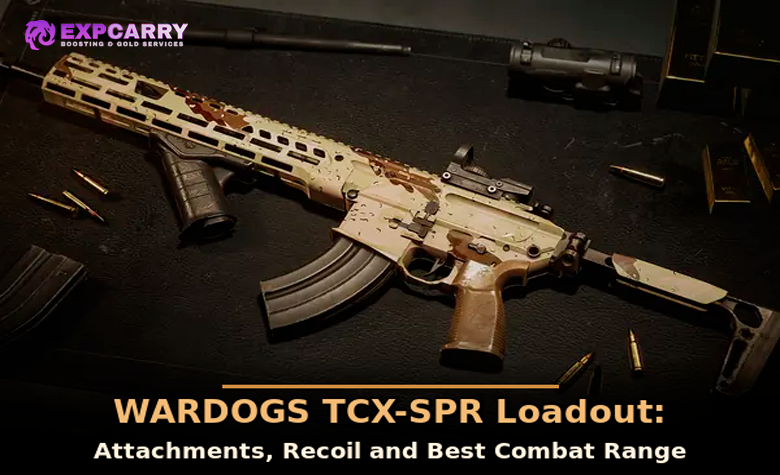
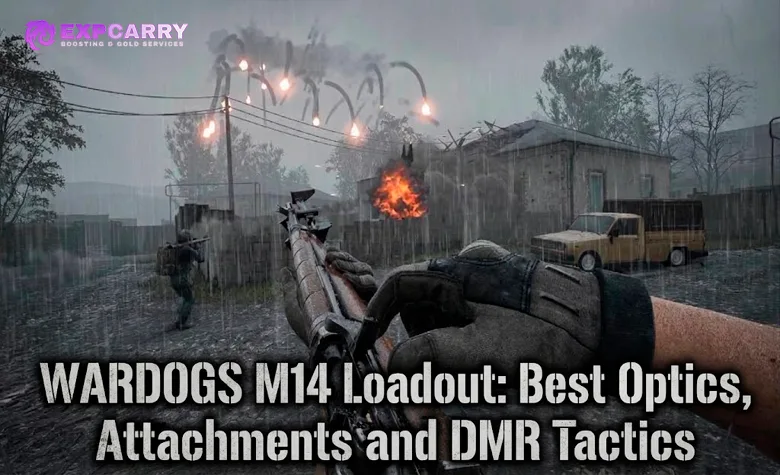
The WARDOGS M14 is a Season 2 marksman rifle built around .308 Winchester ammunition, a 700 RPM fire rate and a $7,400 purchase price. It offers faster theoretical follow-up shots than the SVD or BMR-308, but the Season 2 damage and recoil changes make that advantage difficult to exploit without controlled firing. The best M14 loadout uses an optic suited to the engagement distance, avoids unnecessary magazine penalties and takes advantage of its dedicated bipod when holding a supported position. This guide compares practical M14 builds, explains the value of its attachments and shows when the expensive rifle is worth choosing over other WARDOGS DMRs.
Short answer: Use the 2.5x Combat Optic and 10-round magazines for an affordable mobile M14, or the Leatherwood ART II, M14 Bipod and .30 Cal SS Phosphate Muzzle Brake for a prepared firing position. The 20-round magazine is a useful capacity upgrade, but the 30-round magazine imposes substantial recoil and handling penalties that make it a poor default choice after the Season 2 DMR balance changes.
Season 2 check: WARDOGS Update 0.2.0 went live on October 15, 2026. BULKHEAD reduced .308 Winchester base damage by 25%, adjusted DMR hit-location damage and introduced a new recoil pass across the DMR class. Weapon unlocks and vendor prices were checked against the official Season 02 patch notes and current weapon databases. The recommended combat tactics are practical interpretations of these changes, not official guarantees of accuracy or time to kill.
WARDOGS M14 Stats, Unlock Requirements and Season 2 Changes
The M14 unlocks at Recon level 25 for a one-time payment of $100,000, which also unlocks its standard 10-round magazine. After purchasing that unlock, the rifle costs $7,400 whenever it is bought for a loadout. This makes it the most expensive of the three DMRs compared in this guide: the SVD costs $4,800, while the BMR-308 costs $6,250. The M14 is therefore a significant investment for players who frequently die while attacking exposed objectives or moving between unsupported firing positions.
The rifle uses .308 Winchester ammunition, supports semi-automatic and fully automatic fire and has a listed rate of 700 rounds per minute. Its muzzle velocity is 853 m/s, listed effective range is 500 meters and weapon weight is 4.2 kg. The M14 has a higher theoretical firing rate than the BMR-308 at 450 RPM and SVD at 480 RPM, but its recoil can prevent a player from maintaining those maximum rates while landing accurate shots. Full-auto capability is useful in emergencies; it does not mean automatic fire is the best approach to ordinary DMR engagements.
Season 2 changed the relationship between these weapons. The .308 Winchester base damage reduction affects both M14 and BMR-308, while the SVD's 7.62x54mmR ammunition received a separate 20% reduction. DMR headshot and upper-body multipliers were also adjusted, and the class received a recoil pass intended to move DMR performance between assault rifles and dedicated sniper rifles. The practical consequence is that an M14 player must evaluate the number of accurate hits required rather than relying on the older expectation that a powerful DMR round will quickly end every encounter. The broader progression changes are covered in the WARDOGS Progression Guide.
Best M14 Optics for Medium and Long-Range Combat
The M14 supports several existing sights and the new Leatherwood ART II, which was introduced specifically alongside its Season 2 progression. The right optic should match how often you need to identify targets at distance and how much time you can spend aiming before firing. Stronger magnification can help against enemies crossing open terrain, but it also makes recoil recovery and close-range awareness more demanding. Because the M14 already suffers when rushed, choosing the highest available zoom without considering positioning can make an expensive rifle less useful.
- 2.5x Combat Optic — $690: the recommended affordable starting sight, unlocked at Assault level 17 for a one-time $10,000 payment. It provides enough magnification for ordinary medium-range DMR engagements while imposing a 5% aim-time penalty. This is the most practical choice for mobile Recon players who frequently change positions.
- 3x-6x LPVO Short Dot — $860: a stronger option unlocked at Recon level 11 for a one-time $15,000 payment, for players who alternate between medium-distance targets and longer approaches. Its listed 12% aim-time penalty makes pre-aiming and cover important. Choose it when additional target visibility matters more than rapid reactions to close threats.
- Leatherwood ART II — $950: the dedicated M14 optic unlocked at Recon level 27 for $35,000. It provides 3x magnification and a higher zeroing range, with listed steadying-related benefits and a 15% aim-time penalty. It is best suited to deliberate firing from prepared positions rather than constant movement.
For most players, the 2.5x Combat Optic offers the best balance between cost and practical usability. The Leatherwood becomes more attractive when the player regularly watches a long approach, has enough time to settle the sight and benefits from its steadying characteristics. Its benefits should not be interpreted as removing recoil between shots. The optic changes how the player observes and acquires targets; the firing rhythm still determines whether the next round lands accurately.
The M14's compatibility list also includes other sights, such as the 3x Tactical Prism Scope and several higher-magnification optics. These remain legitimate alternatives when already unlocked, but additional zoom does not automatically improve performance. A magnified scope is valuable only when the firing position and expected engagement distance let the player use it comfortably.
M14 Magazine Comparison: 10 vs 20 vs 30 Rounds
Magazine choice has a larger effect on M14 handling than the small differences in purchase price might suggest. Season 2 offers three dedicated capacities: 10, 20 and 30 rounds. The 10-round magazine is the standard option and avoids the listed handling penalties attached to the larger versions. The 20-round magazine doubles capacity but increases recoil and aim time, while the 30-round version imposes much heavier penalties. A DMR player should therefore choose capacity according to the number of expected targets, not assume the largest magazine is always an upgrade.
| Magazine | Purchase Price | Recon Unlock | Handling Changes | Recommended Role |
|---|---|---|---|---|
| M14 10 RND | $60 | Level 25, included with rifle unlock | No listed magazine modifiers | Precision shots and mobile Recon |
| M14 20 RND | $110 | Level 31, $27,500 | +8% aim time, +7% vertical recoil, +5% horizontal recoil, +8% aim sway | Repeated engagements with fewer reloads |
| M14 30 RND | $180 | Level 36, $50,000 | +20% aim time, +22% vertical recoil, +24% horizontal recoil, +24% aim sway | Specialized capacity-first setups |
The 20-round magazine is a reasonable compromise when the player expects multiple exposed enemies or needs to remain active between reload opportunities. However, its 7% vertical recoil increase and 8% aim-time penalty are meaningful on a rifle already affected by the DMR recoil pass. For a player who fires only a few carefully aimed shots from each position, carrying additional 10-round magazines can preserve more predictable handling. The 30-round version is harder to justify for ordinary Recon work because it worsens recoil, sway and aiming speed without increasing the damage of an individual shot.
The attachment data also lists equipment-speed penalties of 5% for the 20-round magazine and 7% for the 30-round magazine. That reinforces the distinction between a mobile marksman rifle and a capacity-focused weapon. If a player chooses the 30-round magazine, the most important question is whether the additional ten rounds will regularly be used before moving or taking cover. If not, the handling sacrifice is likely greater than the benefit.
Explore services related to this guide, selected from our Wardogs catalog.
View All Wardogs Services

M14 Bipod and Muzzle Attachments: What Improves Recoil?
The dedicated M14 Bipod is the rifle's main underbarrel attachment option. It becomes available at Recon level 29 for a $25,000 one-time unlock and costs $1,480 when purchased. Its in-game description identifies it as a folding bipod that can be mounted on suitable flat surfaces to improve stability, recoil control and accuracy. This is important because the M14 does not have the same conventional foregrip selection as rifles such as the BMR-308. Players who buy the bipod should build their tactics around supported positions rather than expect it to behave like an ordinary vertical grip during every movement.
To use the bipod properly, find a suitable surface, establish a firing position and mount the weapon before beginning a longer engagement. An elevated window, stable ledge or appropriate piece of cover can provide the opportunity to engage targets while limiting unnecessary movement. The key benefit is that the player can concentrate on observing targets and correcting shots instead of repeatedly rebuilding a firing position. The current attachment listings do not provide a reliable standalone percentage for the M14 Bipod's mounted recoil reduction, so a precise numerical bonus should not be assumed.
The .30 Cal SS Phosphate Muzzle Brake is the strongest directly quantified M14 recoil attachment in its dedicated progression. It unlocks at Recon level 37 for $22,500 and costs $950 per purchase. Its listed modifiers reduce vertical recoil by 15% and spread by 12%, while increasing horizontal recoil by 5% and aim time by 5%. This makes it useful when vertical climb is the main obstacle to accurate follow-up shots, but players should not describe it as a universal recoil improvement without acknowledging the horizontal penalty.
The alternative .30 Cal Steel Black Flash Hider unlocks at Recon level 42 for $27,500 and costs $730. Its listed handling benefit is a 3% reduction in aim time, without the same recorded recoil reduction as the muzzle brake. The flash hider is therefore better viewed as a lighter handling option than a substitute for dedicated recoil control. A stationary player trying to keep successive shots on the same target will generally have a stronger reason to try the brake, while a player moving between shorter engagements may prefer to avoid its additional aim-time penalty.
Best WARDOGS M14 Loadouts for Different Combat Situations
The M14 performs best when its attachments support a defined job rather than attempting to turn it into an assault rifle, sniper rifle and suppressive weapon simultaneously. Three configurations cover the most practical starting points: mobile Recon with minimal handling penalties, medium-range engagements requiring more ammunition and a supported marksman position built around the bipod. The complete costs below include the specified rifle attachments, magazines, ammunition, basic armor, helmet, vest, backpack, grenade and medical supplies, with one-time unlock fees calculated separately.
| Build | Optic | Magazines | Muzzle and Bipod | Best Situation | Complete Kit |
|---|---|---|---|---|---|
| Mobile Recon | 2.5x Combat Optic | 3 × 10 RND | None | Changing positions and taking deliberate shots | $10,000 |
| Medium-Range Rifleman | 3x-6x LPVO Short Dot | 3 × 20 RND | None | Watching approaches with repeated targets | $10,320 |
| Supported Marksman | Leatherwood ART II | 3 × 10 RND | SS Phosphate Brake + M14 Bipod | Holding a prepared firing lane | $13,740 |
These totals use standard FMJ ammunition and Level 1 protection. The first two builds use a Scout Backpack, while the supported configuration uses a Medium Backpack + Sling. The absence of a bipod or muzzle attachment in the cheaper builds is intentional: those parts have separate progression requirements, and their value is lower when the player rarely remains in one firing position. The suggested roles are tactical recommendations based on the current weapon characteristics, not rankings from controlled live-match testing.
Mobile Recon M14: Best Affordable Starting Build
The mobile configuration keeps the M14 relatively simple. A 2.5x Combat Optic provides useful magnification for ordinary Recon engagements, while three 10-round magazines avoid the handling penalties of extended magazines. With no muzzle device or bipod, the player retains the rifle's standard behavior and can concentrate on learning its recoil recovery. The $10,000 complete kit is still expensive, but it avoids paying for advanced attachments that may not help while constantly moving between buildings, ridgelines and short firing opportunities.
Use this setup when the team needs a player to watch an approach, eliminate a briefly exposed opponent and reposition rather than remain on one defensive surface. Fire deliberately and avoid trying to exploit the full 700 RPM rate unless an enemy is close enough for fast follow-up shots to remain accurate. The limited magazine capacity encourages more selective target engagement, which is often beneficial after the DMR recoil changes. This configuration is also useful for deciding whether the M14's shooting behavior is worth further investment before buying the dedicated Leatherwood or bipod unlocks.
Medium-Range M14: More Ammunition Between Reloads
The medium-range configuration uses the 3x-6x LPVO Short Dot with three 20-round magazines. Its main purpose is to keep the rifle active when multiple enemies may cross the same road, compound entrance or objective approach within a short period. The larger magazines reduce the frequency of reloads, but their recoil and aim-time penalties mean the player should establish a clear firing position before exposing themselves. At $10,320 for the specified equipment, the build is only moderately more expensive than the mobile option, though its magazines require Recon level 31 and a separate $27,500 unlock.
Do not interpret the larger magazine as permission to sustain maximum-rate fire. The 20-round magazine already increases vertical recoil, horizontal recoil and sway, making long uncontrolled strings less consistent. The stronger optic is most useful when the player has enough cover to observe targets before firing and can return the sight to the same area between shots. If rapid reactions to nearby opponents become the main concern, switch back to the lower-magnification mobile configuration instead of adding an even larger magazine.
Supported M14: Best Setup for Holding a Firing Lane
The supported configuration combines the Leatherwood ART II, M14 Bipod and .30 Cal SS Phosphate Muzzle Brake with standard 10-round magazines. Its purpose is to make deliberate firing from cover more consistent while avoiding the recoil penalties of extended magazines. The Leatherwood supports target observation, the mounted bipod provides a steadier firing position and the muzzle brake reduces vertical recoil. This combination is best suited to players who already know which approach they are protecting and can remain behind suitable cover long enough to use the attachments effectively.
The complete kit costs $13,740, substantially more than the entry build. It also requires deeper Recon progression: Leatherwood at level 27, the bipod at 29 and the muzzle brake at 37, with separate one-time unlock payments. The investment is easier to justify when the player regularly holds elevated positions, overwatches a defended objective or supports teammates advancing through an exposed area. If the position does not allow the bipod to be mounted or requires constant close-range movement, much of the reason for paying the additional attachment cost disappears.
M14 DMR Tactics: Firing Rhythm, Positioning and Recoil Recovery
The M14's listed 700 RPM rate creates an impressive theoretical damage sequence, but a player cannot assume every shot will land while firing at that speed. Season 2's DMR recoil adjustments make the timing between shots especially important. A good M14 player should control exposure, watch the reticle's recovery and fire again when the target can be hit reliably. Shortening the delay between accurate shots improves performance; firing rapidly while the sight is off target does not.
- Begin engagements from cover: use terrain, walls and elevated positions to reduce the amount of movement needed while aiming. A supported firing position is particularly valuable with the Leatherwood and bipod configuration, but avoid remaining exposed after an enemy identifies the location.
- Prioritize the first accurate hit: place the sight on an upper-body target before firing instead of shooting immediately and attempting to correct every later round. The rifle's strong theoretical follow-up speed is only useful when the player can keep the sight near the same target.
- Reset between difficult shots: when recoil lifts the sight away from a distant opponent, pause until the aiming point can be corrected. Semi-automatic fire is generally more controllable for deliberate DMR work, even though the weapon also supports full auto.
- Change position after revealing a firing lane: an enemy who survives the first shots can return fire, use cover or approach from another direction. Relocating between engagements reduces the risk of being trapped in a predictable overwatch position.
- Keep an escape route for close encounters: the M14 is expensive and poorly suited to repeated unprepared close-range fights. Plan where to withdraw or regroup before entering a location that can be approached from several sides.
Full-auto fire should be treated as a situational option when an opponent appears close enough that rapid shots can remain on target. It is less appropriate for tracking distant movement because recoil can quickly move the sight away from the opponent. In a sustained exchange, accuracy, target visibility and ammunition management matter more than reaching the maximum cyclic rate. This distinction explains why the M14 can appear powerful in theoretical calculations yet feel inconsistent to players who use it like a conventional assault rifle.
M14 vs SVD vs BMR-308: Which DMR Is Better?
The M14, SVD and BMR-308 serve overlapping Recon roles but offer different trade-offs. M14 has the highest listed fire rate, SVD has the longest listed effective range and BMR-308 costs less than M14 while sharing .308 ammunition. All three are affected by the Season 2 DMR balance changes, so their practical value depends on recoil recovery, magazine selection and the distances at which the player can reliably land shots. The comparison below uses current weapon statistics rather than assuming older DMR damage behavior remains valid.
| Statistic | M14 | SVD | BMR-308 |
|---|---|---|---|
| Caliber | .308 Win | 7.62x54mmR | .308 Win |
| Fire rate | 700 RPM | 480 RPM | 450 RPM |
| Fire modes | Semi / Full Auto | Semi-auto | Semi-auto |
| Weapon price | $7,400 | $4,800 | $6,250 |
| Recon unlock | Level 25 | Level 12 | Level 20 |
| One-time unlock fee | $100,000 | $50,000 | $125,000 |
| Muzzle velocity | 853 m/s | 800 m/s | 880 m/s |
| Listed effective range | 500 m | 800 m | 500 m |
| Shots to kill in specified test | 4 | 4 | 4 |
| Theoretical time to kill in specified test | 0.26 s | 0.38 s | 0.40 s |
The damage test uses a 100 HP target wearing Level 1 Armor, standard FMJ ammunition, upper-torso hits and zero-meter range. Theoretical time to kill assumes every required shot lands at the listed firing rate. It does not account for recoil recovery, target movement, missed shots or longer-distance damage changes.
Choose M14 for faster follow-up opportunities from a supported position. Its 700 RPM rate gives it the best theoretical time to kill in the specified test, while its dedicated bipod and Leatherwood provide an attachment route for controlled marksman play. This advantage matters when an opponent remains visible long enough for accurate successive shots. It is much less valuable when recoil repeatedly forces the player to pause or the rifle must be fired while moving.
Choose SVD for longer sightlines and better replacement value. Its listed effective range is 800 meters compared with the M14's 500 meters, and it costs $2,600 less for the base weapon. SVD also unlocks much earlier in Recon progression. A player who spends most of the match observing distant roads, hillsides or enemy movement has a stronger reason to consider the SVD than to pay extra for M14's maximum firing rate. Season 2 recoil changes still apply, so its longer range should not be confused with effortless rapid fire.
Choose BMR-308 when you want a less expensive .308 DMR with conventional attachment flexibility. At $6,250, it costs $1,150 less than M14 and becomes available at Recon level 20. It uses the same ammunition family and has a lower maximum firing rate, but its compatible equipment includes conventional foregrips and multiple muzzle options rather than relying on the M14's dedicated bipod arrangement. That distinction can make it easier to tailor the BMR-308 to a moving marksman role. The existing WARDOGS Weapon Tier List covers their place in the wider Season 2 arsenal without treating the theoretical time-to-kill table as an automatic ranking.
M14 Full Kit Cost and Which Attachments to Unlock First
The M14's purchase price is only part of its total cost. Every recommended build includes the $7,400 rifle, two 40-round stacks of standard .308 FMJ ammunition for $80, Level 1 Armor for $400, a Level 1 Helmet for $200, a Small Tac Vest for $100, an M67 Frag Grenade for $200 and two Bandages for $400. Those shared items total $8,780 before adding magazines, optic, backpack, muzzle attachment or bipod. Each loadout price in the comparison table is calculated from that same equipment foundation, making the difference between builds attributable to the selected attachments and carrying equipment.
The mobile build adds three 10-round magazines for $180, a $350 Scout Backpack and a $690 2.5x Combat Optic, reaching $10,000. The medium-range build uses three 20-round magazines for $330, the same backpack and an $860 3x-6x LPVO, reaching $10,320. The supported configuration adds three 10-round magazines for $180, a $1,400 Medium Backpack + Sling, the $950 Leatherwood, a $1,480 bipod and a $950 muzzle brake, totaling $13,740. These figures cover exactly the listed items; optional sidearms, additional supplies, different ammunition types and vehicles are separate expenses. Situational vendor discounts can also change the actual checkout price.
For a new M14 owner, the most sensible upgrade order depends on whether the rifle is already proving useful. First, learn the weapon with a compatible optic and standard magazines. Next, consider the Leatherwood at Recon level 27 if you regularly take deliberate shots from a fixed position. The M14 Bipod at level 29 becomes useful when suitable cover is consistently available, while the 20-round magazine at level 31 is a better upgrade for sustained engagements with multiple targets. The .30 Cal SS Phosphate Muzzle Brake at level 37 should be prioritized when vertical recoil is a measurable problem, not simply because it is the next dedicated unlock.
The one-time unlock fees for the rifle, Leatherwood, bipod, 20-round magazine and muzzle brake are $100,000, $35,000, $25,000, $27,500 and $22,500 respectively. Buying all five from a completely locked progression state would require $210,000 in one-time payments, although the supported build described here uses standard 10-round magazines and therefore does not require the 20-round unlock. Without that optional magazine unlock, the supported build's dedicated unlock fees total $182,500 before its recurring equipment purchase. The mobile and medium-range builds also require separate optic unlocks costing $10,000 at Assault level 17 and $15,000 at Recon level 11 respectively, if not already owned. This separation is essential when deciding whether the M14 deserves further investment after the recoil changes.
Common M14 Mistakes After the DMR Balance Changes
Most M14 problems come from investing in additional firepower while overlooking the rifle's handling limitations. A 700 RPM stat can make the weapon look like an automatic rifle with unusually strong ammunition, but its recoil and high replacement cost encourage a different approach. The following mistakes are particularly expensive when the player repeatedly purchases a fully equipped M14 without gaining consistent results.
- Holding full auto against distant targets: maximum rate of fire does not translate into maximum effective damage when the reticle moves away from the target after each shot.
- Equipping the 30-round magazine by default: its 20% aim-time, 22% vertical recoil and 24% horizontal recoil penalties work against ordinary precision shooting.
- Buying the bipod without using supported positions: the attachment is intended to be mounted on suitable surfaces. Players who constantly move without setting up a position may gain little practical value from its purchase.
- Using excessive magnification in close-range fights: high zoom makes situational awareness and target reacquisition more demanding when enemies appear nearby.
- Ignoring the muzzle brake's horizontal penalty: the SS Phosphate Brake reduces vertical recoil but increases horizontal recoil, so players should evaluate the resulting firing behavior rather than assume every modifier is beneficial.
- Expecting old DMR damage thresholds: Season 2 changed caliber damage, hit-location multipliers and recoil. Earlier damage expectations should not be used to justify current equipment purchases.
WARDOGS M14 FAQ
These answers address several practical attachment and weapon-control questions that can affect the choice between an affordable M14 and a specialized marksman configuration.
Can the M14 use full-auto fire in WARDOGS?
Yes. The M14 supports semi-automatic and fully automatic firing modes with a listed maximum rate of 700 RPM. Semi-auto is generally the more practical choice for deliberate medium- and long-range shots, while full auto is situationally useful when an enemy appears close enough for rapid hits to remain controllable.
Does the M14 Bipod reduce recoil without being mounted?
The attachment is described as a folding bipod that can be mounted on suitable surfaces for greater stability. The current item listings do not provide a confirmed universal passive recoil-reduction percentage. Players should evaluate its benefit while mounted rather than assume it works exactly like a permanent vertical foregrip.
Is the M14 worth unlocking if you already own the BMR-308?
It can be worth the additional investment if you regularly hold supported firing positions and want the M14's higher theoretical follow-up rate. If you mainly move between short engagements, already control the BMR-308 well and need to preserve Cash, the M14's $7,400 replacement price and dedicated attachment requirements may not provide enough practical benefit.
Conclusion
The M14 is most valuable as a controlled marksman rifle, not as an expensive replacement for an assault rifle. Start with a 2.5x optic and standard magazines, use the 20-round option only when additional capacity is worth the handling penalties, and reserve the Leatherwood, bipod and muzzle brake for prepared firing positions. Choose M14 when its faster follow-up capability can be used accurately; choose SVD for longer sightlines and lower replacement cost, or BMR-308 for a more affordable .308 platform with flexible attachments. After the Season 2 damage and recoil changes, reliable hits and disciplined positioning matter more than the M14's maximum firing rate.