
Where Winds Meet Homestead is a permanent progression system built around restoring Blissful Retreat, running businesses, recruiting Retainers, and expanding into the free-build Beyond Mundane zone. The fastest way to progress is not to decorate everything at once. Build one working production chain first, make the inn generate Bounty Gourds reliably, upgrade the facility that is blocking the next Chapter Goal, and only then spend heavily on Prosperity or large diagrams.
This Where Winds Meet Homestead guide follows that progression route from the first Qinghe unlocks through Retainer management, the inn, Porcelain Kiln, Aromas Brewery, farming, Homestead resources, Beyond Mundane, diagrams, and later leveling. Version 1.8 introduced the system, and as of Version 2.1 Homestead remains active and continues to receive interface and usability improvements. This guide therefore separates permanent mechanics from unlock requirements, limits, and other details that may change in future patches.
How to Unlock the Where Winds Meet Homestead
Homestead has more than one gate. Current Global progression separates Homestead management from the general Construction tools, which is why some players can enter the system but still cannot place the structures they expect. The safest route is to finish the Qinghe Homestead quests first, then verify that Construction mode is unlocked separately.
Current Global guides identify Where Bamboos Remember and Childhood Reverie as the Qinghe Exploration Quests that open the management side of Blissful Retreat. Building: One Last Job is the separate Construction quest used to unlock normal building tools. Current Global building guides place it around character level 25, but quest progression still matters and level alone should not be treated as the only requirement.
The official Version 1.8 Homestead developer Q&A confirms the core structure: you return to Qinghe as the Young Master, restore Blissful Retreat, run businesses such as an inn, porcelain kiln, and brewery, recruit human and animal Retainers, and later gain a standalone Homestead space called Beyond Mundane.
If the missing gate is a quest rather than Homestead production itself, a Where Winds Meet quest completion route is one external option. For self-play, check the Qinghe Exploration Quest log first and test whether you can both open Homestead management and place one simple Construction component before troubleshooting anything more complicated.
Blissful Retreat and Beyond Mundane Have Different Jobs
The Homestead system is easier to understand when the two major spaces are treated separately. Blissful Retreat is the guided production estate. Beyond Mundane is the freer construction space. Both contribute to the broader Homestead, but they should not compete for your early resources.
| Area | Main Purpose | What to Prioritize | When to Invest Heavily |
|---|---|---|---|
| Blissful Retreat | Production, businesses, Retainers, Chapter Goals | Inn, crops, cooking, housing, kiln, brewery, facility upgrades | Immediately after unlock |
| Beyond Mundane | Free-build Homestead zone and larger creative layouts | Prosperity, residences, diagrams, and compatible facility layouts | After the first Blissful Retreat production loop works |
Blissful Retreat should pay for the expansion. If the inn is idle, Retainers have no valid jobs, or the next facility upgrade is blocked, spending thousands of Bounty Gourds on a decorative Beyond Mundane project slows the system that is supposed to fund it.
Homestead Progression Route: What to Build First
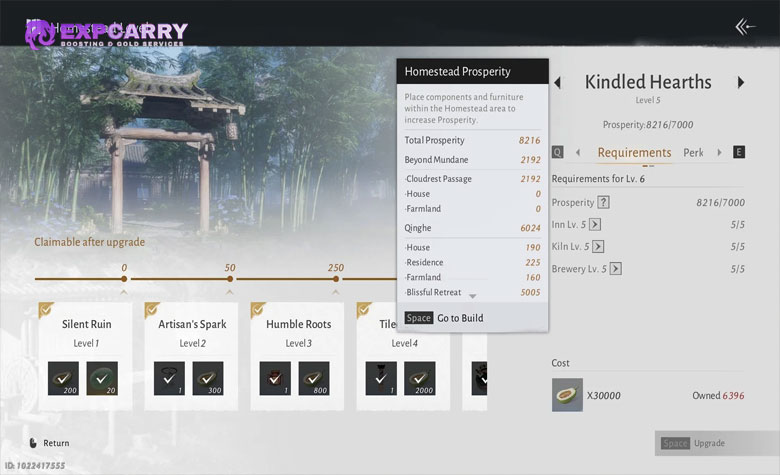
The most reliable route is to follow Chapter Goals until one complete business loop is operating. Chapter Goals are not filler tutorials: they point toward the facilities and systems that open the next layer, while also returning enough early Homestead resources to keep construction moving.
| Stage | Priority | Unlock or Result | Do Not Waste Resources On |
|---|---|---|---|
| 1. Access | Finish Homestead management and Construction gates | Blissful Retreat management plus building tools | Diagram troubleshooting before simple building works |
| 2. Inputs | Open farmland and grow only the crops needed by current recipes | Reliable cooking inputs | Large seed stock with no production plan |
| 3. Inn | Place a stove, Cook, dining tables, and Caterers | First repeatable Bounty Gourd income | Decorative expansion before the inn serves anything |
| 4. Industry | Restore and staff Porcelain Kiln and Aromas Brewery as Chapter Goals require | Pottery, drink production, more trade options | Upgrading every station equally |
| 5. Leveling | Raise Prosperity and upgrade the bottleneck facility | Higher Homestead levels, more capacity, later features | Prosperity spam that consumes the currency needed for the next unlock |
| 6. Expansion | Open Beyond Mundane and later trade tools | Free-build space, more Prosperity options, broader economy | Moving the whole project away from a functioning Blissful Retreat |
This order keeps every purchase attached to the next unlock. The estate can look incomplete for a while and still progress faster than a beautifully decorated Homestead with no working production chain.
Explore services related to this guide, selected from our Where Winds Meet catalog.
View All Where Winds Meet Services


Businesses and Production: Build One Complete Loop
Blissful Retreat progresses fastest when farming, cooking, processing, and service are treated as one chain. Build the smallest version that produces Bounty Gourds, then expand whichever stage cannot keep up with demand.
Build a Working Inn Before Chasing Maximum Prosperity
The inn is the early economic engine because it converts food and drink into Bounty Gourds. A useful starter configuration is deliberately simple: one working cooking station, a Retainer assigned as Cook, at least the required dining tables, Caterers assigned to serve, finished dishes selected for service, and production actually started.
A common failure is to stop after placing furniture. The inn does not earn currency because a stove and table exist. You need the inputs, a compatible worker, a selected product, serving stock, and active production. If the interface looks complete but income is zero, trace the chain from raw ingredient to cooked dish to table assignment before buying another facility.
Current Homestead guides also recommend using the inn's live recommendations when deciding what to cook and cater. Exact best-profit recipes can change with Homestead level and available stock, so the client recommendation is safer than hard-coding one permanent recipe into an evergreen guide.
Farming and Homestead Resources: Produce for the Next Job
Farming exists to support the production chain, not to fill the warehouse with every crop. Early on, plant for the dish or order you are actively trying to complete. When the next Chapter Goal or Weekly Touchstone Order changes the demand, change the crop plan instead of continuing the previous one automatically.
Homestead resources come from several places: crops, Retainer gathering jobs, production facilities, normal character inventory deposits, Chapter Goals, recurring Homestead activities, and trade. The warehouse connects those systems, but it should be treated as working storage rather than a dumping ground.
Current Global community documentation reports that normal materials transferred from the character inventory into the Homestead warehouse share a weekly deposit cap of 1,200 items in total rather than 1,200 of each material. Because transfer limits and resource rules are patch-sensitive, check the live warehouse panel before committing a large deposit. The durable rule is to transfer only materials that solve a known production bottleneck.
Porcelain Kiln and Aromas Brewery: Upgrade the Bottleneck
The Porcelain Kiln and Aromas Brewery expand the estate from simple food service into a larger production network. The kiln produces pottery and containers used by later production and trade, while the brewery creates drinks that can feed the inn or other Homestead objectives.
Do not upgrade both buildings simply because an upgrade button is available. Raise the facility that is preventing the next Chapter Goal, order, or profitable production line from running. If the brewery has no required container input, the kiln is the bottleneck. If storage is full of ceramics but drink production cannot keep up, the brewery is the bottleneck.
This is also where extra Retainers begin to matter. One worker pool must cover raw materials, processing, food, service, and recovery. Recruiting another worker is valuable when it creates a new simultaneous job, not when the new Retainer has no bed or useful assignment.
Retainers: Recruit for Jobs, Not Rarity Alone
Retainers are the workforce behind every serious Homestead business. They are separate from the Companion system: Companions use Bond and social interactions, while Retainers are assigned to cooking, catering, mining, logging, gathering, production, and other estate jobs.
Each Retainer can have innate strengths, restrictions, and learnable job skills. The correct first recruitment target is therefore not the worker with the most impressive rarity color. It is the Retainer who can immediately cover a job your estate cannot currently staff.
Match Retainer Skills to the Facility
When choosing between two workers, inspect the skill they already know and whether they can learn the profession you need. A Retainer with useful Mining or Logging talent should usually start in the relevant resource job rather than being retrained as a Cook while a better cooking candidate sits idle.
Retainer job skill levels improve production efficiency. Current guides document passive job experience from working and Artisan's Manuals as a direct leveling item. Because manuals and other recruitment resources can have limited stock, improve the Retainers who are already supporting your core production loop before spreading upgrades across every worker.
Housing, Vigor, and Provisions Are Part of Production
A worker problem is not always a talent problem. Retainers need valid housing and enough Vigor to keep working. They also consume provisions during production. If a worker refuses an assignment or stops contributing, check whether the Retainer is already dispatched, has a bed, has enough recovery, and has the required provisions before replacing them.
Crane Retreat is the dedicated recovery facility for Retainers. It becomes more valuable as the workforce grows because downtime becomes a production bottleneck. A small estate can often recover workers manually; a larger operation needs recovery capacity planned alongside additional job slots.
Where Winds Meet Version 2.1 continued to improve this interface. The August 20 Version 2.1 patch notes improved the Homestead Retainer dispatch candidate list so worker status is easier to read. This confirms that Homestead continues to be maintained beyond its Version 1.8 launch.
Bounty Gourds and Repeatable Income
Bounty Gourd is the main Homestead currency and competes across progression, staffing, consumables, construction, and decoration. Early players often stall because they treat a growing Gourd balance as permission to decorate instead of as the cost of the next Homestead level.
The efficient priority is to spend on the next required facility, worker, production input, recipe, or Chapter Goal first. Once those costs are covered, use remaining Gourds for Prosperity components and cosmetic plans. This keeps the production engine ahead of the decoration budget.
If the currency bottleneck is the part of Homestead you want to outsource, Where Winds Meet currency farming is one external route for general account resources. Bounty Gourds themselves remain an internal Homestead economy, so the important self-play solution is still to keep the inn, routines, and trade systems working rather than expecting normal Coins to replace them.
Young Master's Routine and Weekly Touchstone Orders
Repeatable Homestead activities are important because they turn a functioning estate into progression rather than decoration. Young Master's Routine is a weekly-limited activity that can currently be completed up to three times per week, while Weekly Touchstone Orders are weekly delivery objectives accessed through Trade for Profit. Together, they give the production chain a reason to make specific goods instead of endlessly producing the same easy recipe.
Before starting a large production batch, inspect the active orders and current recommendations. If an active order wants an item your kiln or brewery can make with existing stock, finish that order before redirecting workers to lower-priority production. Progress becomes much faster when the available weekly objectives are allowed to influence what the estate produces.
At the early levels, Chapter Goals should still take priority over min-maxing weekly profit. Once the core facilities are open, Weekly Touchstone Orders become more important because they turn the same production chain into additional Bounty Gourd progression.
Homestead Leveling: Prosperity, Facilities, and Currency Move Together
Homestead level is not raised by one experience bar alone. Current Global guides describe three recurring gates: enough Prosperity, enough Bounty Gourds, and sufficient progress or level in the relevant facilities. If one of those is behind, adding more of the other two will not solve the block.
Prosperity comes from eligible Homestead components, furniture, residences, and other placed objects that explicitly provide Prosperity. Ordinary Personal Building Components should not be assumed to increase the value unless the live interface shows that they do. Prosperity can be accumulated across more than one Homestead area, so Beyond Mundane becomes useful later as a large place to add eligible components without crowding the working side of Blissful Retreat.
Do Not Spam Prosperity Before the Economy Works
Cheap eligible components can be an efficient way to close a small Prosperity gap, but they still consume resources. Early progression is usually faster when you build only enough Prosperity to reach the next level, then reserve the remaining Bounty Gourds for facility upgrades and production.
After the economy becomes stable, the calculation changes. At that point, Beyond Mundane and larger builds using Prosperity-granting components can supply the Prosperity needed for higher Homestead levels while Blissful Retreat stays organized around work rather than being filled with progression furniture.
Beyond Mundane: Expand After the First Production Loop

Beyond Mundane is the standalone free-build Homestead zone confirmed by the developers. It is separate from the open world and designed for much freer placement than the guided production spaces around Qinghe. It is the right place for larger residences, personal layouts, compatible facility components, and later Prosperity expansion.
Current Global guides place the Beyond Mundane unlock around Homestead Level 4 after the guided early Homestead goals. Because the official announcement confirms the zone but does not publish Level 4 as a permanent requirement, treat Level 4 as the current Global route rather than an immutable rule for every future patch.
Current Global community guides also place the Fortune's Fool quest and Touchstone Vessel progression around this stage. The Touchstone system opens the Trade for Profit loop, allowing eligible warehouse goods to be exchanged for Bounty Gourds and connecting the estate to Weekly Touchstone Orders. If you reach the expected Homestead stage and these features do not appear, check unfinished guided goals before assuming the account is bugged.
Homestead Diagrams: A Layout Is Not Free Materials
Diagrams make large construction projects faster because they save or share layouts, but they do not make the required building pieces free. Imported or saved diagrams can still require specific components, furniture, Homestead level, space, and resource costs before the full structure can be placed.
That creates a simple troubleshooting order:
- Test one normal component. If you cannot place anything, fix the Construction unlock first.
- Open the diagram requirements. Check missing components instead of judging only the preview.
- Check Homestead level and placement area. Some shared builds use pieces or limits unavailable to a lower-level estate.
- Use the recommended placement when the build has complex terrain work. Large imported structures can depend on sunk or elevated components.
- Do not dismantle a working estate to diagnose one failed diagram. Confirm whether the failure belongs to the diagram, inventory, level, or construction system first.
Community blueprint libraries now contain full Homestead and Beyond Mundane layouts, which makes diagrams valuable after the production side is stable. They are a poor first investment if importing the structure consumes the same Gourds and raw materials needed for the next facility or Homestead level.
What to Do From Homestead Level 4 Onward
After the early guided phase, progression becomes less about unlocking the basic loop and more about scaling it. The correct order depends on whichever resource is limiting you, but the same priorities keep working.
- Keep one reliable inn production plan active. Never let the main Gourd engine sit idle while decorating.
- Complete available Young Master's Routine attempts and Weekly Touchstone Orders. Let current weekly demand choose your production targets.
- Upgrade the facility with the longest queue or missing recipe access. Do not level every building evenly.
- Add Retainers when they create a real extra production slot. Pair recruitment with beds, provisions, and recovery capacity.
- Use Beyond Mundane for Prosperity and creative builds. Protect the fixed working zones from decoration clutter.
- Improve key Retainer skills before leveling every worker. Concentrated efficiency on the busiest jobs produces more value.
- Save diagrams for after their components are affordable. A blueprint should use surplus resources, not block the economy.
Current Global community material still treats Homestead Level 10 as the progression ceiling. Because this maximum is documented primarily by community resources rather than as a permanent official rule, check the live Homestead panel before treating Level 10 or any exact upgrade threshold as immutable.
What Is Live and What Is Still Planned
Homestead ownership remains individual in the current Global version. Blissful Retreat businesses, Retainers, Beyond Mundane, production, Prosperity, diagrams, and Beyond Mundane social features such as neighbourhood interactions and resource assistance are available now. Those social functions should not be confused with shared Homestead ownership or cohabitation.
The official July developer AMA says shared or cohabitation-style Homestead ownership with partners or friends is being worked on. The same AMA says warehouse resource recycling is planned for a future update. Neither feature should be treated as live until the developers officially release it.
That means excess warehouse materials can still become a planning problem. Avoid depositing or overproducing large amounts of an input simply because you expect future recycling to recover it later.
Common Where Winds Meet Homestead Mistakes
Most Homestead stalls are caused by spending or staffing in the wrong order rather than a hidden progression requirement. Check the production chain from the bottom before buying another building.
- Decorating before the inn works: establish repeatable Bounty Gourd income first.
- Confusing management with Construction: Homestead access and general building tools have separate quest gates.
- Recruiting Retainers without jobs or beds: every worker should have a purpose, housing, and enough Vigor support.
- Upgrading every facility evenly: upgrade the station blocking the next goal or production chain.
- Growing random crops: plant for active recipes and orders instead of warehouse volume.
- Ignoring Start Production or product selection: assigned workers do not automatically create the item you intended.
- Spending all Gourds on Prosperity: keep enough currency for the next Homestead and facility requirement.
- Importing a diagram too early: layouts still require components, resources, space, and sometimes higher Homestead progression.
- Treating Companions as Retainers: Companion Bond progression does not replace Homestead staffing.
- Planning around future cohabitation or recycling: both have been discussed as future features, not current live tools.
When progress stops, open Chapter Goals and the Homestead level requirement panel before searching for a hidden quest. Those two screens usually show whether the actual bottleneck is Prosperity, Bounty Gourds, facility progress, or an unfinished guided objective.
Blissful Retreat Entry and Homestead Bugs
Homestead received several fixes after Version 1.8 launched, so older troubleshooting posts can describe bugs that no longer exist. The developers adjusted the Dreamscape: Blissful Retreat entry point for characters who had already started rebuilding and fixed issues involving missing tutorial quests, the Porcelain Kiln interface, Homestead shop inventory, guided objectives, and Personal House placement.
If Blissful Retreat does not behave like an old launch-week video, use the current quest marker and live interface rather than trying to reproduce the obsolete route exactly. The system has already had its entry and guided steps repaired through later Version 1.8 patches.
The existing ExpCarry Version 1.8 overview covers the broader Companions Make Home update. This Homestead guide stays focused on the permanent progression loop instead of repeating pets, Phantom Thief Goose, multiplayer modes, or the rest of the patch.
A 10-Minute Homestead Maintenance Check
Once the system is established, it does not need to consume an entire play session. A short maintenance check keeps production moving and makes the next larger building session much easier. Weekly-limited activities only need attention while attempts or orders are available.
- Collect completed production and crops. Clear finished queues before assigning new jobs.
- Check Retainer Vigor and recovery. Rotate tired workers before a long production batch.
- Check Young Master's Routine if weekly attempts remain, then review active Trade for Profit orders. Produce for the current objective instead of treating these systems as daily resets.
- Restart inn, kiln, brewery, and gathering jobs. Do not leave idle facilities with stock available.
- Review the next Homestead level requirement. Know whether you are saving for Prosperity, Gourds, or a facility upgrade.
- Spend only after the next gate is covered. Decorative purchases come from surplus.
If you prefer handing off repetitive management while keeping major construction decisions for yourself, the WWM Hourly Driving service is the broad external option that can cover custom routine work. A self-managed estate follows the same principle: short checks keep Retainers and production active while large design sessions happen only when resources are ready.
Where Winds Meet Homestead FAQ
These answers focus on current Global Homestead progression in Version 2.1 and separate officially confirmed permanent features from community-documented unlock levels, limits, and costs that may change in future versions.
How do I unlock Homestead in Where Winds Meet?
Current Global guides use Where Bamboos Remember and Childhood Reverie to open Homestead management at Blissful Retreat, while Building: One Last Job separately unlocks Construction mode. Current building guides place the latter around character level 25, but quest progression should still be checked directly.
What should I build first in Blissful Retreat?
Follow Chapter Goals until you have crops, a working cooking station, the inn, required tables, Retainers, and a complete food-to-Bounty-Gourd loop. Production should come before heavy decoration.
What are Retainers?
Retainers are Homestead workers. They can be villagers or certain animals and are assigned according to job skills such as cooking, catering, mining, logging, or other estate work.
How do I level Retainers?
Retainer job skills gain progress through work and can also be improved with Artisan's Manuals. Prioritize the workers supporting your busiest production jobs before leveling the whole roster.
How do I level the Homestead?
Current progression combines Prosperity, Bounty Gourds, guided goals, and facility upgrades. Read the live Homestead level panel to see which requirement is currently blocking the next level.
When does Beyond Mundane unlock?
Current Global guides place the unlock around Homestead Level 4 after the early guided goals. The developers officially confirm Beyond Mundane exists but have not published Level 4 as an unchangeable permanent rule.
What is Beyond Mundane?
It is a standalone Homestead zone separate from the open world, designed for freer construction, compatible facility layouts, and decoration. It also gives you more room for eligible Prosperity components after Blissful Retreat is already functioning.
What is a Homestead diagram?
A diagram stores or shares a construction layout. It does not provide the required materials automatically, so imported builds can still fail if you lack components, resources, space, or the required Homestead progression.
Why is my inn not making Bounty Gourds?
Check the complete chain: ingredients, cooking station, Cook, selected dish, finished stock, tables, Caterers, provisions, and active production. A placed building by itself does not generate income.
Is Homestead co-op or shared with friends?
Not as a shared-ownership or cohabitation system yet. Beyond Mundane already includes some social and neighbourhood interactions, but developers have said they are still working on shared or cohabitation-style Homestead functionality. Do not treat that feature as live until it is officially released.
Conclusion
The fastest Where Winds Meet Homestead progression route is to make Blissful Retreat functional before making it beautiful. Finish the management and Construction unlocks, use Chapter Goals to open the first production chain, assign Retainers according to the jobs the estate actually needs, and make the inn generate Bounty Gourds before investing heavily in Prosperity. From there, upgrade the facility that blocks the next stage, keep the kiln and brewery tied to active production demand, and use available routines and weekly orders to decide what to make.
Beyond Mundane and diagrams become better investments after that core loop is stable. Use the second Homestead space for creative construction, compatible facilities, and additional Prosperity, keep saved diagrams within your real component budget, and treat Retainer efficiency, Bounty Gourds, and facility capacity as one connected system. When the next level stalls, check the live requirement panel first: the missing piece is usually Prosperity, currency, a facility upgrade, or an unfinished guided goal rather than another random decoration.