TBC Classic PvP and Arena Guides
Explore practical TBC Classic Anniversary PvP guides covering Arena compositions, Honor farming, PvP gear, Resilience, rating progression and seasonal rewards. This category helps you prepare for 2v2, 3v3, 5v5 and Battlegrounds with clear strategies based on your class, specialization, current equipment and PvP goals.
TBC PvP is not decided by damage alone. Consistent results depend on team composition, positioning, crowd-control timing, defensive cooldowns, target selection and a realistic gearing plan. Our guides explain these systems in a practical format so you can identify your win condition, understand difficult matchups and stop losing rating to the same avoidable mistakes.
What You Will Find in Our TBC PvP Guides
- Arena composition guides: strong 2v2, 3v3 and 5v5 teams, their win conditions, weaknesses and common counters.
- Class and specialization guides: talents, gear priorities, openers, crowd control, defensive play and role-specific decisions.
- Honor farming routes: efficient Battleground priorities, objective play, mark management and purchase planning.
- PvP gear guides: Honor gear, Arena gear, off-pieces, weapons, set bonuses, gems, enchants and upgrade order.
- Resilience and stat priorities: how survivability, pressure and important offensive thresholds interact.
- Arena rating guides: realistic milestones, weekly progression, team preparation and rating-push planning.
- Season updates: start and end dates, currency conversions, vendor changes and catch-up opportunities.
- Matchup strategies: target selection, cooldown trading, positioning and adjustments against common team archetypes.
Choose the Right Arena Bracket
| Bracket | Main Characteristics | Best For |
|---|
| 2v2 | Small-team coordination, repeatable crowd-control chains, strong individual decision-making and clear kill setups. | Players who want easier scheduling, focused matchup practice and steady weekly Arena participation. |
| 3v3 | More complex team compositions, coordinated offensive setups, defensive rotations and frequent target swaps. | Competitive players who want deeper team strategy and the main coordinated Arena experience. |
| 5v5 | Fast burst windows, extensive dispels, multiple interrupts and high pressure from coordinated teams. | Groups with a stable roster, clear target calling and strong cooldown coordination. |
The strongest bracket for your character depends on more than a general tier list. Consider your specialization, available partners, preferred playstyle and the amount of time your team can queue together. A theoretically stronger composition can perform worse than a familiar team with reliable communication and a repeatable game plan.
How to Choose an Arena Composition
A successful TBC Arena composition needs a clear win condition. Some teams win through coordinated burst and crowd control, while others create sustained pressure, force defensive cooldowns and finish the match after the opposing healer runs out of resources.
Before committing to a composition, check:
- Damage profile: burst, sustained pressure, damage over time or a combination of several sources.
- Crowd control: which effects can be chained without overlapping diminishing returns.
- Defensive tools: how the team survives enemy openers, target swaps and offensive cooldowns.
- Dispel coverage: which buffs, debuffs, roots, poisons, curses or magic effects can be removed.
- Mobility: whether the composition can connect to targets, escape pressure and control line of sight.
- Matchup spread: which common teams are favorable and which require a different opener or target priority.
Our Arena tier lists do not only rank compositions. Each guide explains how the team wins, what usually stops it and which adjustment should be made first when a matchup becomes difficult.
Honor Farming and Battleground Progression
Honor gear provides the foundation for many fresh level 70 characters entering TBC PvP. Efficient progression requires more than repeatedly queuing the shortest Battleground. You must balance Honor gains, required marks, objective completion and the specific items on your purchase list.
- Create a PvP gear shopping list before starting the grind.
- Check the Honor and Battleground marks required for each priority item.
- Queue for the Battleground that supports your next purchase instead of farming one mark type indefinitely.
- Prioritize objectives and match completion over unproductive fighting away from the objective.
- Recheck your currency totals before reaching a cap or purchasing a low-impact upgrade.
Use our TBC Anniversary Honor Farming Guide for a practical Battleground rotation, mark plan and role-specific objective priorities.
TBC PvP Gear Progression
A complete PvP setup is usually built in stages. Fresh characters first need enough survivability to avoid losing every match during the enemy opener. After establishing that baseline, the focus moves to offensive stats, set bonuses, weapons and bracket-specific upgrades.
| Progression Stage | Main Goal | Typical Priorities |
|---|
| Fresh Level 70 | Build a functional PvP baseline. | Accessible Honor pieces, PvP trinket, survivability, gems and basic enchants. |
| Weekly Arena Progression | Earn Arena Points consistently and replace weak slots. | Set pieces, high-impact off-pieces and upgrades that support the chosen composition. |
| Rating Push | Optimize the complete setup for difficult matchups. | Weapons, final set combinations, profession advantages and role-specific stat balance. |
Do not evaluate PvP items only by item level. Resilience, Stamina, set bonuses, socket choices and the loss of an important offensive stat can make a lower-level PvP item more useful than a PvE replacement. Review your complete equipment set after every major upgrade.
Resilience and PvP Stat Priorities
Resilience is one of the core defensive stats in TBC PvP, but there is no single universal target for every class and bracket. The amount you need depends on your armor type, role, composition, defensive toolkit and the type of teams you face most often.
A healer or frequently targeted caster may prioritize additional survivability, while a protected damage dealer in a coordinated composition may retain more offensive gear. The correct balance is the point where you can survive the opponent's main offensive setup without losing so much pressure that your own team cannot create a kill window.
Each class guide should therefore explain:
- the practical Resilience range for the role;
- important Hit and Spell Hit requirements;
- when Stamina is more valuable than additional damage;
- which PvE items remain worth using in PvP;
- which gems and enchants support the selected Arena composition.
Current TBC Anniversary Arena Season Update
Arena seasons change available gear, vendor inventories and catch-up routes. Before spending Honor or Arena Points, verify the current season, regional reset date and any announced currency conversion.
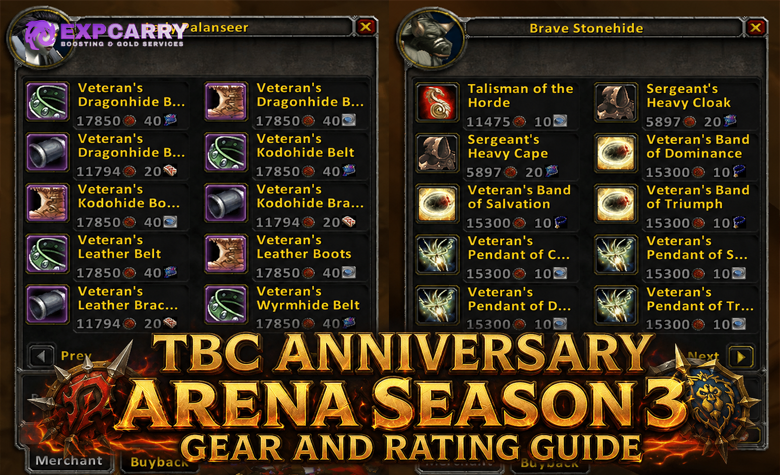
For the transition into Arena Season 3, remaining Season 2 Arena Points are converted into Honor Points at a rate of 1 Arena Point to 10 Honor Points. Season 2 equipment becomes available at a discount without an Arena rating requirement, while Season 1 gear moves to Honor vendors. These changes create an important catch-up window for fresh characters and returning players.
Season-specific guides in this category will be updated when Blizzard confirms new dates, vendor changes, rating requirements or reward availability. Evergreen class and matchup sections remain separate from temporary seasonal information.
How to Improve Your Arena Win Rate
Most rating loss comes from repeated decision errors rather than one weak item. Review every session around a small set of questions:
- Did your team agree on the primary target and a possible swap before the gates opened?
- Which enemy defensive cooldown must be forced before your real kill attempt?
- Did crowd-control effects overlap or trigger diminishing returns unnecessarily?
- Were defensive abilities used before the incoming damage or only after a teammate was already in danger?
- Did the healer maintain safe positioning and line of sight?
- Was the match lost to composition limits or to an execution mistake that can be corrected?
Change one decision at a time. Replacing the entire composition after several losses usually prevents the team from learning its matchups. Improve the opener, target priority or defensive rotation first, then evaluate whether the composition itself is the problem.
Use This PvP Guide Hub
Start with the guide that matches your current objective. Fresh level 70 characters should begin with Honor farming and a PvP gearing route. Players with an established equipment baseline should choose a bracket, compare suitable compositions and prepare a repeatable strategy for the most common matchups.
During every new Arena season, review the seasonal guide before spending currencies. Vendor prices, available sets and rating requirements can change which upgrade gives the highest value.
Need Help With TBC PvP?
Explore our WoW TBC Classic PvP services for Honor farming, Arena Points, 2v2, 3v3, 5v5, PvP gear, rating progression and coaching. All available options, formats and scheduling conditions are shown on the service page.



 ExpCarry Editorial TeamExpCarry Editorial Team