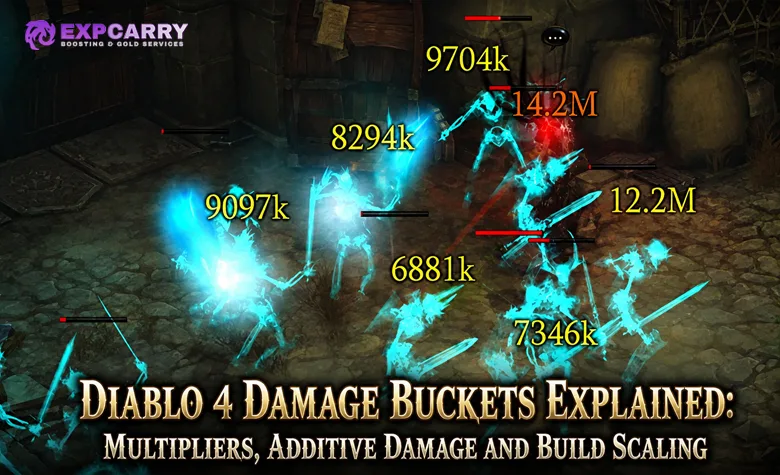
Diablo 4 damage buckets are easiest to understand when you stop asking whether a stat says 20%, 50%, or 100% and start asking where that number enters the calculation. Two bonuses with the same displayed percentage can produce completely different gains because one may join an additive pool that is already enormous, while another may increase a multiplicative layer that is still relatively small. That is why a +50% additive bonus can sometimes be worth less than a x15% multiplier, and why blindly copying an endgame build can lead to bad gear swaps on your own character.
The modern system also differs sharply from many launch-era Diablo 4 guides. Critical Strike Damage, Vulnerable Damage, and Overpower Damage no longer work as three unrestricted multiplicative buckets the way they did at release, while the 3.0 itemization rework introduced explicit Damage Multiplier affixes on gear with their own stacking rules. This guide uses simple numbers to explain additive damage, gear multipliers, Critical Strikes, Vulnerable, Overpower, main-stat scaling, and a repeatable method for comparing upgrades without needing a full combat simulator.
Diablo 4 Damage Buckets: The Short Answer
A damage bucket is a convenient theorycrafting term for values that are combined before they interact with other parts of the damage calculation. The game does not reduce every build to one universal five-line formula because skills, passives, Legendary Aspects, Unique powers, class mechanics, conditional effects, and special procs can introduce their own rules. For normal build decisions, however, a simplified bucket model is extremely useful.
| Damage layer | How to think about it | Common examples | Practical rule |
|---|---|---|---|
| Base damage and skill scaling | The starting amount your skill or effect scales from | Weapon Damage, skill coefficient, skill ranks, proc base damage | Improving the base can strengthen every later multiplier that uses it |
| Main-stat scaling | A separate character power factor tied to your class | Primary Core Stat and effects that scale from it | Compare the actual character-sheet gain rather than assuming one fixed conversion forever |
| Additive damage pool | Applicable bonuses marked as additive are combined before becoming one factor | Applicable Paragon, passive, skill, and effect bonuses explicitly using additive [+] scaling | The larger the existing pool, the smaller the relative gain from another equal-sized additive bonus |
| Named gear multiplier groups | Current gear can roll Damage Multiplier affixes; repeated values belonging to the same multiplier category stack additively within that category | All Damage Multiplier, Critical Strike Damage Multiplier, Vulnerable Damage Multiplier, elemental or damage-type multipliers | Combine values belonging to the same applicable multiplier group before comparing the new factor with the old factor |
| Conditional multiplicative effects | Separate effects can multiply damage when their condition is active | Skill passives, Legendary powers, Paragon effects, class mechanics | Uptime matters as much as the tooltip percentage |
| Crit, Vulnerable, Overpower baseline effects | Special combat states with baseline multiplicative behavior | Critical Strike x50%, Vulnerable x20%, Overpower up to x50% baseline | Do not confuse the baseline effect with additive bonuses or newer multiplier affixes carrying a similar name |
A useful mental model is: final damage is built from a base value, then scaled by main stat, applicable additive bonuses, applicable multiplier groups, and conditional multiplicative effects that are active for that hit. That is intentionally a comparison model rather than an exact engine formula. The exact order and eligibility of special effects can vary by skill and patch, but this model is enough to explain why two apparently similar percentages can have very different real value.
Why Old Diablo 4 Damage Bucket Guides Are Outdated
At launch, Critical Strike Damage and Vulnerable Damage were disproportionately valuable because their full bonus amounts sat in separate multiplicative buckets. Blizzard changed that structure in Season of Blood. In the official damage bucket explanation, Blizzard states that only the baseline bonus for Critical Strike, Vulnerable, and Overpower remains inherently multiplicative, while additional additive bonuses for those categories are combined with other applicable additive damage.
The baseline values established by that overhaul were x50% for Critical Strikes, x20% for Vulnerable, and up to x50% for Overpower. Patch 2.3 later removed Overpower's inherent additive scaling from Life and Fortify while retaining its up-to-x50% trigger bonus. This is why both launch-era bucket guides and early post-launch Overpower formulas can now be outdated.
The next major change arrived with the 3.0 itemization rework. Damage-oriented gear affixes were redesigned around explicit Damage Multipliers. Blizzard explains that these multipliers stack additively with themselves while still counting as multiplicative damage. In practical terms, repeated values that belong to the same multiplier category should be combined before evaluating the resulting factor rather than automatically treating every x20% shown on gear as its own independent 1.20 multiplier.
If you are rebuilding a character around current affixes rather than following an old screenshot, the verified Diablo 4 Builds service is one way to get help with a complete setup. For self-planning, the rest of this guide shows the math needed to judge upgrades on your own.
The Simplified Modern Diablo 4 Damage Formula

For build comparisons, you do not need to reproduce every internal combat step. Normalize the hit you are comparing and hold unchanged variables constant. A practical simplified model looks like this:
Compared damage = Base Damage x Skill Scaling x Main-Stat Factor x Additive Factor x Applicable Multiplier Factors x Conditional Hit Factors.
The point is not that every Diablo 4 hit literally passes through only these six boxes. The point is that when two choices leave five of those boxes unchanged, you can isolate the one or two factors that actually differ and calculate the relative gain.
Base damage and skill ranks come before percentage arguments
A percentage modifier can only scale the damage source it applies to. If one weapon gives substantially higher Weapon Damage, or an item adds ranks to the skill producing most of your damage, that base change can beat a larger-looking conditional modifier. Comparing only the colored percentages on two items is therefore incomplete.
This is especially important for builds whose main skill or proc scales directly from Weapon Damage or skill ranks. Before comparing two additive or multiplicative bonuses, verify that the base damage source is equivalent. If it is not, calculate or test that difference first.
Main stat is its own scaling decision
Your Primary Core Stat contributes to damage, but the exact relationship can change through class and system updates. For an evergreen comparison, the safest method is to use the damage contribution displayed by the current character sheet or test the stat change directly rather than memorizing an old conversion rate from a previous season.
Main stat can also have secondary value through Paragon thresholds, class mechanics, or other effects. That means an item with less obvious offensive wording can still win if its stat allocation activates a meaningful node or multiplier elsewhere in the build.
Explore services related to this guide, selected from our Diablo IV catalog.
View All Diablo IV Services


Additive Damage Explained: Why +50% Is Not +50% Final Damage
Additive bonuses are combined before the resulting total becomes one factor. This creates one of the most common Diablo 4 scaling mistakes: reading a +50% additive bonus as if it increases the character's final damage by 50%.
Imagine that all additive bonuses currently applicable to your main attack total +500%. A +500% pool means the additive factor is 6.00: the original 100% of the hit plus 500% bonus damage. Now add another applicable +50% additive bonus from a Paragon node, passive, skill effect, or another source explicitly marked as additive. Your total becomes +550%, so the factor rises from 6.00 to 6.50.
Actual gain = 6.50 / 6.00 - 1 = 8.33%.
The source gave +50%, but the final damage increase from that layer was only 8.33% because the new value joined a pool that was already +500%. Nothing is broken and the bonus is not secretly nerfed. You are simply comparing the new total with an already-large existing total.
| Existing additive bonus | New additive bonus | Old factor | New factor | Relative damage gain from this layer |
|---|---|---|---|---|
| +100% | +50% | 2.00 | 2.50 | 25.00% |
| +300% | +50% | 4.00 | 4.50 | 12.50% |
| +500% | +50% | 6.00 | 6.50 | 8.33% |
| +900% | +50% | 10.00 | 10.50 | 5.00% |
This is why additive damage is not "bad." A +50% additive bonus is excellent when the relevant pool is small and progressively less impressive when the pool is already saturated. The mistake is treating all additive bonuses as worthless or all large tooltip numbers as equally valuable. Also remember that the 3.0 gear rework moved normal damage affixes on equipment toward explicit Damage Multiplier stats, so current gear should not be evaluated with the old assumption that every offensive affix simply joins this additive pool.
Multiplicative Damage Explained After the Gear Rework
Modern Diablo 4 gear can carry explicit Damage Multiplier affixes. Blizzard's itemization explanation for Damage Multipliers on Gear says these multipliers stack additively with themselves while still counting as multiplicative damage. Current live itemization includes names such as All Damage Multiplier, Critical Strike Damage Multiplier, Vulnerable Damage Multiplier, Physical Damage Multiplier, elemental damage multipliers, and Damage Over Time Multiplier.
The safest practical interpretation is to group repeated values belonging to the same applicable gear multiplier category when comparing upgrades. Do not automatically multiply every visible x20% gear affix by every other x20% copy of that same category as if each created a separate 1.20 factor. At the same time, do not assume every skill, Aspect, Paragon, Unique power, gem bonus, or class mechanic follows the gear-affix stacking rule. Effect-specific multipliers still need to be read according to their own wording and current behavior.
Example: adding x20% to an existing x80% multiplier group
Suppose your current applicable gear multiplier group totals x80%. Its factor is 1.80. You add another x20% that belongs to that same multiplier group. Because repeated values in the group are added, the new total is x100%, giving a factor of 2.00.
Actual gain = 2.00 / 1.80 - 1 = 11.11%.
The new bonus says x20%, but it does not create another independent 1.20 factor in this example. It increases the existing multiplier group from 1.80 to 2.00. The relative improvement is 11.11%.
Example: starting a multiplier group at x20%
If an applicable multiplier group currently contributes no bonus and you add x20% to that group, its simplified factor moves from 1.00 to 1.20. In that isolated comparison the gain is 20%. However, do not use this example to assume that every differently worded damage multiplier automatically creates a separate factor. Whether bonuses share a group or interact separately depends on the exact multiplier category and effect wording.
Current Unique itemization makes this distinction especially relevant because live patch notes list guaranteed affixes such as All Damage Multiplier, Critical Strike Damage Multiplier, Vulnerable Damage Multiplier, elemental multipliers, and Damage Over Time Multiplier on different Uniques. The related Diablo 4 Mythic Uniques 3.0 guide covers the newer item-quality system separately; this article focuses only on how to evaluate damage scaling once those affixes appear on your gear.
Critical Strike, Vulnerable and Overpower Damage Explained
Critical Strike, Vulnerable, and Overpower are the three categories most likely to be explained with outdated launch-era rules. Each has a baseline combat effect, while additional scaling can come from additive sources, current gear multiplier groups, or effect-specific multiplicative bonuses depending on the exact stat name and source.
Critical Strike Damage: Separate Chance From Damage
Critical Strike scaling has two different questions: how often you crit and how much a Critical Strike is worth. Blizzard's Season of Blood damage overhaul established a baseline Critical Strike bonus of x50%. Additional bonuses explicitly using additive Critical Strike Damage scaling join the applicable additive pool, while current gear can also contain a specifically named Critical Strike Damage Multiplier affix.
This means additive Critical Strike Damage, Critical Strike Damage Multiplier, Critical Strike Chance, and effect-specific x Critical Strike Damage are not interchangeable. One can join an additive pool, one belongs to the newer gear multiplier system, one changes how often the crit condition happens, and another may be an independent effect defined by a skill, Aspect, Unique, or Paragon node.
Why +10% Critical Strike Chance is not automatically +10% DPS
Take a simplified build with only the baseline x50% Critical Strike bonus and no other crit-specific effects. At 25% Critical Strike Chance, the average hit factor is 0.75 x 1.00 + 0.25 x 1.50 = 1.125. Raise Crit Chance to 35%, and the average becomes 0.65 x 1.00 + 0.35 x 1.50 = 1.175.
Actual average gain = 1.175 / 1.125 - 1 = 4.44%.
That does not make Crit Chance weak. If your build has additional crit multipliers, procs that activate on crit, guaranteed-crit windows, or resources generated by crits, the value can rise dramatically. The example only demonstrates why percentage points of chance must be converted into expected output rather than read as direct DPS.
Vulnerable Damage: Additive Bonuses and Multiplier Stats Are Different
Vulnerable has the same naming trap. The baseline Vulnerable state provides x20% increased damage. Additional Vulnerable Damage from a source explicitly marked as additive joins the applicable additive pool. A current affix explicitly called Vulnerable Damage Multiplier is a different stat and should be evaluated through its multiplier group.
For example, if your additive pool is already +500%, adding an applicable +50% additive Vulnerable Damage bonus while the enemy is Vulnerable changes the additive factor from 6.00 to 6.50, an 8.33% gain during Vulnerable uptime. It does not turn the baseline Vulnerable factor from 1.20 into 1.70.
This distinction remains important even though normal damage affixes on current 3.0+ gear were reworked toward multiplicative stats. Always read the full stat name, its [+] or [x] notation where available, and the source of the bonus instead of shortening every Vulnerable-related modifier to "Vuln damage" in your notes.
Overpower Damage: Powerful but Build-Specific
Overpower should not be evaluated like a normal always-on multiplier. Overpower currently grants up to x50% increased damage when it triggers. An older version of the system also granted inherent additive Overpower damage from Life and Fortify, but Blizzard removed that built-in additive portion in Patch 2.3. Other Overpower bonuses still need to be read according to their current additive, multiplicative, or effect-specific notation rather than assumed to inherit the removed Life/Fortify scaling.
The practical problem is frequency. A huge Overpower bonus has little value to a build that rarely Overpowers, while a build with guaranteed or frequent Overpower mechanics can make the same category central to its entire scaling plan. Always compare Overpower scaling against the actual trigger rate and the build mechanic that creates the Overpower, not against a normal hit in isolation.
If your Paragon setup is missing key nodes or stat thresholds that make an endgame scaling plan work, the verified Diablo 4 Paragon progression service is relevant to that part of character development. For self-testing, isolate the same skill and target so you can see whether the Paragon change affects every hit or only a conditional window.
How to Compare Two Diablo 4 Items Without Copying a Build
A gear comparison becomes much easier when you stop trying to calculate your entire character from zero. Keep every unchanged factor out of the calculation and compare only what Item A and Item B actually alter.
- Check the base first. Compare Weapon Damage, skill ranks, and any direct effect that changes the damage source itself.
- List only applicable bonuses. Damage tied to a condition you cannot maintain should not receive full value.
- Separate additive sources from current gear multipliers. Bonuses explicitly marked as additive belong in the applicable additive pool; current Damage Multiplier gear affixes need their multiplier grouping.
- Group repeated gear multipliers correctly. Add a repeated value to its applicable multiplier group before calculating the relative gain.
- Check Crit, Vulnerable, and Overpower frequency. Conditional damage only matters when the condition happens.
- Include main stat and threshold effects. A stat loss may disable a Paragon bonus or class mechanic even if the item tooltip looks stronger.
- Check attack speed, cooldown, and resource flow. More damage per hit can lose to more casts per minute if the build is resource or cooldown limited.
- Adjust for uptime. An always-on 8% gain can outperform a conditional 15% gain that is active only a small part of the fight.
- Test the close call. Use repeatable enemies or the Training Grounds when the theoretical difference is small.
This method is much more reliable than copying the item shown in a planner because the planner may assume different Greater Affixes, Paragon thresholds, Crit Chance, resource generation, multiplier values, or condition uptime than your character currently has.
Two Scaling Changes: A Full Numerical Example
Assume the choices being compared leave armor, Weapon Damage, skill ranks, attack speed, and survivability unchanged. Your attack currently has a +500% applicable additive pool, giving an additive factor of 6.00. It also has a x30% applicable named multiplier group, giving a multiplier factor of 1.30.
Choice A adds +60% applicable additive damage through an additive effect. Choice B adds x15% to the existing named multiplier group. The displayed 60 is four times larger than 15, but the real comparison looks different.
| Comparison | Choice A: +60% additive | Choice B: x15% same multiplier group |
|---|---|---|
| Current factor | 6.00 additive | 1.30 multiplier |
| New factor | 6.60 additive | 1.45 multiplier |
| Relative gain | 6.60 / 6.00 - 1 = 10.00% | 1.45 / 1.30 - 1 = 11.54% |
| Winner if uptime and all other stats are equal | No | Yes |
Choice B wins this simplified comparison even though 15% looks much smaller than 60%. The reason is not that multipliers are always automatically better. The reason is that Choice A joins an already-large additive pool, while Choice B improves a smaller multiplier group.
Now change one assumption and the answer can flip. If Choice B's multiplier only applies while the enemy is Vulnerable and your real Vulnerable uptime is poor, its average value falls. If Choice A also changes resource generation or skill ranks, the simple two-number comparison is incomplete. The formula helps you find the important difference; it does not excuse ignoring the rest of the build.
What Damage Buckets Do Not Capture by Themselves
Bucket math explains how a hit scales, but a real build also depends on uptime, cast frequency, resources, cooldowns, and progression thresholds. These factors are why the mathematically larger damage-per-hit option can still lose over a full encounter.
Why Uptime Matters More Than the Tooltip
Many Diablo 4 bonuses are conditional: while Healthy, while Fortified, against Vulnerable enemies, against Crowd Controlled targets, after spending Resource, during Berserking, after using a specific skill, or for a short period after a trigger. A conditional x20% multiplier with 50% real uptime is not automatically better than a smaller always-on gain.
You can use a rough weighted estimate for simple comparisons. If a multiplier gives about 20% more damage during a state that is active half the time, its average contribution is roughly around 10% before considering interactions with burst windows. That estimate is only a starting point because many builds deliberately align their strongest cooldowns, guaranteed Critical Strikes, Vulnerable windows, and boss stagger periods. A multiplier that has 50% total uptime may still cover nearly 100% of the damage that matters.
Boss damage and farming damage can value the same bonus differently
A conditional stat that is always active against a boss may be excellent for Pit pushing but mediocre in fast Helltide farming. An AoE build may prefer attack speed and resource flow because killing packs is limited by animation and movement, while a boss build may prefer the highest multiplicative burst window.
Before calling one item "BiS," define the content it is supposed to optimize. Build scaling is contextual, and the best mathematical item for one damage window can be the slower item for another activity.
Attack Speed, Resource and Cooldown Can Beat a Damage Affix
Damage buckets mostly explain damage per hit. Real build output also depends on how many meaningful hits you can produce. If a skill is limited by attack speed, resource generation, cooldown recovery, or animation time, improving that bottleneck can outperform another damage percentage.
A 10% increase in damage per cast is close to a 10% output gain only if cast frequency stays unchanged. If another item gives enough Attack Speed to produce more attacks, or enough Resource Generation to remove downtime, the second item may deliver more damage over a full encounter even with a weaker damage tooltip.
The same logic applies to cooldown builds. A Unique that reduces downtime on the ability responsible for most of your damage can be stronger than a larger generic multiplier that only affects the casts you were already able to make.
Paragon and Glyph Scaling: Do Not Count Only the Printed Percent
Paragon boards can contribute main stat, additive damage, conditional multipliers, Glyph scaling, and threshold bonuses at the same time. This makes them a common source of misleading comparisons. A node that says +10% damage may look weak next to a large gear multiplier, yet the path to that node can also provide the stat needed to activate a Rare node or improve a Glyph.
When comparing Paragon changes, calculate the package rather than one node. Check whether the route changes Dexterity, Strength, Intelligence, Willpower, or another required stat around the Glyph; whether a Legendary node adds a separate conditional effect; and whether the build can actually maintain that condition.
Glyph levels can therefore change the value of surrounding nodes rather than merely adding one isolated number. The verified Diablo 4 Glyph leveling service is relevant for players who want that progression completed, while self-builders should compare the board before and after the Glyph radius and scaling changes instead of reading a single tooltip.
How Current Gear Shows Multipliers
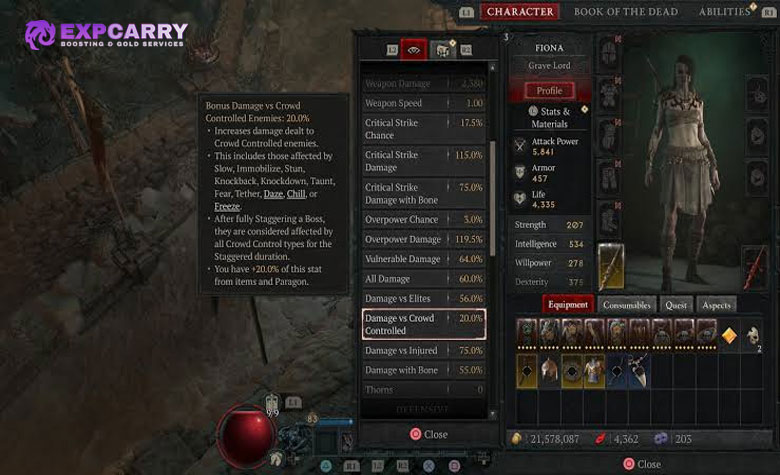
The current Diablo IV live patch notes show the modern naming directly on guaranteed Unique affixes. Examples include All Damage Multiplier, Critical Strike Damage Multiplier, Vulnerable Damage Multiplier, Physical Damage Multiplier, Lightning Damage Multiplier, Poison Damage Multiplier, Fire Damage Multiplier, and Damage Over Time Multiplier.
That naming makes the intended scaling category clearer than the pre-3.0 system of ordinary damage affixes on gear. It also creates a new mistake: assuming the x symbol means every copy is its own independent multiplier. Blizzard's gear rule is that Damage Multipliers stack additively with themselves while remaining multiplicative damage, so repeated values belonging to the same multiplier category need to be grouped during a comparison.
Patch 3.0 also changed weapon Gems so that they provide multiplicative damage bonuses for specific damage categories, including All Damage, Physical, Shadow, Poison, Fire and Holy, Cold, and Lightning. Do not automatically merge those bonuses with a gear multiplier merely because the wording looks similar; use the current tooltip and effect behavior to determine how each source is grouped.
Tooltips can also contain effect-specific wording that changes the result. If an Aspect, skill, Paragon node, Unique power, or class mechanic says it deals x% increased damage under one condition, do not automatically merge that effect into a gear multiplier just because both display multiplicative language. Treat each system according to its own wording and test unclear interactions after major patches.
Common Diablo 4 Damage Scaling Mistakes
Most gearing errors come from applying one correct rule too broadly. Additive damage is not useless, gear multipliers are not all automatically independent, and the largest tooltip number is not automatically the largest final gain.
- Using the launch-era Crit and Vulnerable model: extra Critical Strike Damage and Vulnerable Damage stopped being unrestricted independent multiplicative buckets after the Season of Blood overhaul.
- Using pre-3.0 gear rules: current damage affixes on equipment were redesigned around Damage Multiplier stats, so an old guide that treats normal gear damage rolls as one large additive pool can mislead you.
- Treating +50% as +50% final damage: a genuinely additive bonus joins the existing applicable additive pool.
- Multiplying repeated gear multipliers independently: repeated values belonging to the same current Damage Multiplier category stack additively within that group before acting as multiplicative damage.
- Ignoring the exact stat name: an additive Vulnerable bonus, Vulnerable Damage Multiplier, and an effect-specific x Vulnerable modifier do not necessarily follow the same rule.
- Ignoring condition uptime: a bigger conditional multiplier can lose to a smaller always-on improvement.
- Comparing percentages before Weapon Damage or skill ranks: the starting damage source may have changed more than either modifier.
- Ignoring Crit Chance: Critical Strike scaling has less value if the build rarely crits, unless a mechanic guarantees Critical Strikes during important windows.
- Ignoring resource and cooldown bottlenecks: damage per cast is not the same as damage per minute.
- Copying a planner item one-for-one: the planner may have completely different Paragon thresholds, Greater Affixes, or multiplier values.
- Assuming a character-sheet number tells the full story: conditional and effect-specific multipliers may not be represented in one static number.
The safest habit is to calculate the relative change in the factor that actually changes, then test any close decision in combat. You rarely need the complete global damage formula to decide between two pieces of gear.
Diablo 4 Damage Buckets FAQ
These answers focus on the questions that cause the most confusion when players compare additive and multiplicative scaling in the current itemization system.
What are damage buckets in Diablo 4?
Damage buckets are a theorycrafting way to group bonuses that combine before they interact with other parts of the damage calculation. The term is useful for comparing upgrades, but individual skills and effects can have additional rules.
Is additive damage bad in Diablo 4?
No. A genuinely additive bonus becomes less valuable per additional percentage point as its applicable pool grows. It can still be a strong upgrade when the existing pool is small or when it has much better uptime than an alternative.
Why does +50% additive Damage not increase my final damage by 50%?
Because it joins an existing additive pool. If that pool is already +500%, adding another applicable +50% changes the factor from 6.00 to 6.50, which is an 8.33% relative increase from that layer.
Do multiplicative damage bonuses have diminishing relative returns?
They can when you add more percentage to an existing multiplier group. Moving a factor from 1.80 to 2.00 is an 11.11% gain even though the added value says x20%. A multiplier applied to a previously empty applicable group can have a larger relative effect, but not every differently named x% bonus should automatically be treated as a fresh independent factor.
Do gear Damage Multipliers stack with each other?
Blizzard states that current Damage Multipliers on gear stack additively with themselves while still counting as multiplicative damage. For comparison, combine repeated values belonging to the same applicable multiplier category before calculating the new factor.
Is Critical Strike Damage additive or multiplicative?
The baseline Critical Strike effect is x50%. Additional scaling depends on the source. An explicitly additive Critical Strike Damage bonus joins an additive pool, current gear can roll Critical Strike Damage Multiplier, and skills, Aspects, Uniques, or Paragon effects can provide their own multiplicative crit bonuses. Read the exact notation and source instead of applying one rule to every crit-related stat.
Is Vulnerable Damage additive or multiplicative?
The baseline Vulnerable state provides x20% increased damage. Additional scaling depends on the source: an explicitly additive Vulnerable bonus joins the applicable additive pool, while current gear can roll Vulnerable Damage Multiplier and individual effects can introduce their own multiplicative modifiers.
How do I compare two Diablo 4 items?
Hold unchanged factors constant. Compare Weapon Damage and skill ranks first, separate genuinely additive bonuses from current gear multiplier groups, calculate the relative change to the factors that differ, then account for Crit Chance, condition uptime, main-stat thresholds, attack speed, resource flow, cooldowns, and survivability.
Should I always choose a multiplier over additive damage?
No. A multiplier with poor uptime can lose to an always-on additive improvement, and an additive bonus can be strong when its current pool is small. Compare the old and new total factors instead of ranking bonus types by name.
How can I test a close gear upgrade?
Use a repeatable target or the Training Grounds, keep buffs and conditions consistent, and compare many hits rather than one Critical Strike or Overpower spike. The closer the theoretical difference, the more valuable controlled testing becomes.
Conclusion
Diablo 4 damage buckets become manageable once every upgrade is treated as a change to an existing factor rather than a percentage printed in isolation. Additive bonuses join an additive pool, so their relative value falls as that pool grows. Since the 3.0 itemization rework, current gear uses explicit Damage Multiplier affixes for offensive scaling, and repeated values belonging to the same multiplier category stack additively within that category while still contributing multiplicative damage. Critical Strike, Vulnerable, and Overpower also retain baseline multiplicative behavior that must be separated from other additive, gear-based, or effect-specific bonuses carrying similar names.
When comparing two items, start with Weapon Damage and skill ranks, identify which additive pools and multiplier groups actually change, calculate old factor versus new factor, and then adjust for condition uptime, Crit Chance, resource flow, attack speed, cooldowns, and Paragon thresholds. That method explains why a large additive bonus can lose to a much smaller multiplier upgrade in one build and win in another. The goal is not to memorize one permanent bucket chart; it is to understand enough of the current math to judge your own character instead of copying somebody else's finished build blindly.