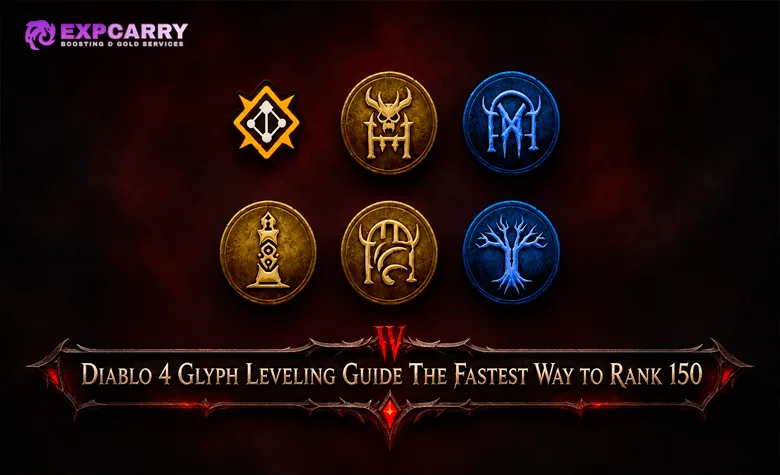
Diablo 4 glyph leveling in Season 15 is all about farming the right Pit tier instead of blindly pushing the highest difficulty your build can survive. Paragon Glyphs can reach rank 150, but their upgrade chance depends on the difference between the completed Pit tier and the current glyph rank. A Pit at least 10 tiers above your glyph guarantees the next upgrade, while larger gaps can award multiple ranks per attempt. Season of Hell's Legacy also adds useful bonuses through War Plans and the Splinter of Hatred, making efficient farming even more important. The current live version is patch 3.2.4, released on October 28, 2026. This guide covers how to unlock the Pit, calculate upgrade chances, choose the fastest farming tier, reach the Legendary glyph milestone, and decide when to level several glyphs instead of pushing one straight to 150.
Short answer: Farm the highest Pit tier you can clear quickly while maintaining reliable glyph upgrades. Bring your important equipped glyphs to their useful breakpoints and Legendary rank 51 first, then focus on the strongest glyphs for your build. Use Choron's Blessing and other available Season 15 bonuses to reduce wasted attempts as you approach rank 150.
How Glyph Leveling Works in Diablo 4 Season 15
Paragon Glyphs are one of the main ways to scale character power after reaching the endgame. You place them into Glyph Sockets on your Paragon Boards, where they interact with nearby nodes and provide bonuses based on attributes, allocated points, and the glyph's own effects. Leveling a glyph increases its effectiveness and eventually unlocks its Legendary bonus. However, higher glyph rank does not automatically fix a poorly planned Paragon Board. You still need the correct glyph, a useful socket, and enough nearby attributes to activate its additional effect.
The biggest change from older Diablo 4 guides is where upgrades come from. Glyph leveling moved from Nightmare Dungeons to the Pit of the Artificers, and the system now uses upgrade attempts rather than the old Glyph XP reward. Blizzard originally explained this redesign in its official Paragon and Pit progression overhaul. Season 15 retains the Pit based system with a higher maximum glyph rank and additional seasonal progression options.
| Mechanic | Current rule | Why it matters |
|---|---|---|
| Glyph leveling activity | The Pit of the Artificers | Nightmare Dungeons no longer upgrade glyph ranks |
| Maximum glyph rank | 150 | The long term target for fully developed glyphs |
| Maximum Pit tier | 150 | Limits how far above a high rank glyph you can farm |
| Standard upgrade attempts | 3 after successful mastery | The baseline reward for a qualifying Pit clear |
| Deathless bonus | 1 additional attempt | Rewards consistent survival |
| Guaranteed upgrade | Pit tier at least 10 above current glyph rank | Removes normal upgrade failure risk |
| Bonus glyph ranks | Additional ranks for every 20 tiers of advantage | Allows low rank glyphs to catch up quickly |
| Legendary promotion | Rank 51 | Unlocks an additional glyph effect |
| Seasonal bonuses | War Plans and Urn of Glyphs | Can improve the number or reliability of upgrades |
These rules make choosing a Pit tier a real farming decision. A higher tier can offer better glyph progression, but it also means tougher monsters and a potentially longer boss fight. If the extra difficulty makes each run twice as long, the increased upgrade rewards may not compensate for the time lost.
Glyph Ranks Are Not the Same as Paragon Levels
Your character level, Paragon level, glyph rank, and Pit tier are separate progression systems. Character leveling gets you into the endgame, Paragon Points unlock nodes and additional board paths, glyph upgrades strengthen selected socketed bonuses, and Pit tiers determine the difficulty and potential rank rewards of a run.
This distinction matters when planning your next upgrade. If your Paragon Board has not reached an important Glyph Socket, raising a glyph in your inventory may provide little immediate value. On the other hand, if your build already has its key sockets and enough surrounding attributes, upgrading those glyphs can improve damage or survivability without replacing your gear.
How to Unlock the Pit and Start Leveling Glyphs
The Pit is a timed endgame activity accessed through the Artificer's Obelisk. Season 15 provides access through different progression requirements depending on whether you are playing on the Seasonal or Eternal realm. Once available, you choose a tier, clear monsters to fill the progress bar, and defeat the Pit Guardian before the timer expires. Successful completion grants the glyph upgrade interface where you spend your earned attempts.
The current Diablo 4 live patch notes confirm patch 3.2.4, while the access requirements below distinguish Seasonal and Eternal characters.
| Requirement | Season 15 information |
|---|---|
| Seasonal realm | Complete Hellish Descent through Season Rank II progression |
| Eternal realm | Reach character level 70 |
| Entry location | Artificer's Obelisk in Cerrigar or Temis |
| Run timer | 15 minutes |
| Available tiers | 1 through 150 |
| Main glyph reward | Upgrade attempts after successful completion |
Start with a Pit tier your current build handles comfortably. You do not need to jump immediately into the hardest available run, and unlocking a new Torment difficulty does not mean your character can farm that tier efficiently. The first objective is to establish a consistent clear with enough damage for the Guardian and enough defense to avoid unnecessary deaths.
How to Upgrade a Glyph After a Pit Run
Once the Pit is unlocked, the upgrade loop is straightforward. The important part is checking which glyph you want to improve before entering and using the completion screen carefully rather than spending attempts without a plan.
- Open the Artificer's Obelisk and select a Pit tier suitable for your character.
- Clear enough monsters to finish the progress objective and reach the Pit Guardian.
- Defeat the Guardian before the timer expires and meet the applicable mastery conditions.
- Open the Glyphstone upgrade interface after completion.
- Select one of your glyphs and check the displayed success chance and rank gain.
- Spend the attempts on your chosen glyphs, reassessing the result after each upgrade.
- Return to the Obelisk and adjust the tier when the reward or completion time changes.
Do not confuse reaching the boss with completing the run. If your build clears ordinary packs quickly but spends several minutes fighting the Guardian, that boss time belongs in your farming calculation. Similarly, dying during the run can reduce the upgrades you would otherwise receive, so defensive consistency is part of efficient glyph leveling.
How Pit Tier Affects Glyph Upgrade Chance and Bonus Ranks
The glyph upgrade system compares the tier you completed against the glyph's current rank. If the Pit is at least 10 tiers higher, the normal upgrade is guaranteed. If the difference is larger, individual attempts can award several ranks at once. Once the gap drops below the guarantee threshold, the upgrade chance falls and you need to decide whether accepting that risk is still worthwhile.
The key detail is that the comparison changes after every successful upgrade. A glyph that starts a run far below your Pit tier can gain several ranks from its first attempt, then receive fewer ranks from later attempts as the gap narrows. This is why a simple claim that one particular Pit always grants a fixed number of glyph levels is misleading.
| Pit tier above current glyph rank | Upgrade chance | Ranks gained per successful attempt |
|---|---|---|
| 10 to 19 tiers | Guaranteed | 1 |
| 20 to 39 tiers | Guaranteed | 2 |
| 40 to 59 tiers | Guaranteed | 3 |
| 60 to 79 tiers | Guaranteed | 4 |
| 80 or more tiers | Guaranteed | 5 |
| Less than 10 tiers | Reduced or potentially unavailable depending on the gap | Check the displayed upgrade result |
The basic guarantee and bonus rank system comes from Blizzard's Pit redesign. The current Icy Veins Paragon Glyph guide also describes how Pit tier differences affect upgrade rewards.
Example of Multiple Glyph Upgrades from One Pit
Suppose you finish Pit Tier 60 with a rank 20 glyph and earn four standard attempts through a deathless completion. Your starting tier advantage is 40, so the first successful upgrade grants three ranks. The glyph reaches rank 23 and the gap becomes 37, reducing subsequent upgrades to two ranks each while that tier difference remains in the corresponding range.
| Attempt | Starting rank | Pit advantage | Resulting rank |
|---|---|---|---|
| First | 20 | 40 tiers | 23 |
| Second | 23 | 37 tiers | 25 |
| Third | 25 | 35 tiers | 27 |
| Fourth | 27 | 33 tiers | 29 |
In this example, one successful run raises the glyph from 20 to 29. The result follows the normal tier difference rules and assumes all four attempts are available. It is not a guarantee that every Pit 60 run will grant nine ranks, because the starting glyph level, bonus attempts, and active modifiers may be different.
What Happens When the Pit Is Less Than 10 Tiers Above the Glyph?
When the gap falls below 10, an upgrade is no longer guaranteed by the normal rule. You can still attempt an eligible upgrade, but failed attempts waste part of your Pit reward. As the glyph rises, the same Pit tier gradually becomes a worse option for dependable progress.
At that point, you have three choices. Increase the Pit tier to restore the guarantee, keep farming the easier tier while accepting the displayed success chance, or spend the remaining attempts on a different glyph whose rank is still low enough for guaranteed gains. The best choice depends on your clear time and which glyphs your build currently needs.
Explore services related to this guide, selected from our Diablo IV catalog.
View All Diablo IV Services

Important Glyph Leveling Breakpoints Before Rank 150
Rank 150 is the maximum, but it is not the first milestone worth chasing. A glyph gains important benefits well before reaching the cap, and those upgrades can make a larger difference to a developing build than a handful of additional ranks on an already strong Legendary glyph. The most efficient progression plan targets those power spikes before committing to the long final climb.
Current Season 15 references describe radius upgrades at rank 25 and rank 50, followed by the Legendary promotion at rank 51. Some older or incompletely updated guides still list different radius milestones, so check the live glyph tooltip when planning a Paragon Board around a newly unlocked radius.
| Glyph rank | Milestone | Recommended priority |
|---|---|---|
| 1 | Rare glyph with its initial radius and bonuses | Socket the glyphs required by your current build |
| 25 | First radius increase in the Season 15 progression references | Reach this on important equipped glyphs |
| 50 | Second radius milestone and preparation for Legendary promotion | Prepare the required Gem Fragments |
| 51 | Glyph becomes Legendary and gains an additional effect | Major target for your active glyph setup |
| 150 | Maximum glyph rank | Long term optimization after the build is functional |
The important point is not just the number on the glyph. A larger radius can bring more useful nodes into range, but only allocated nodes contribute to the relevant bonuses. If an additional effect requires a certain amount of Strength, Dexterity, Intelligence, or Willpower, the character still needs those points in the correct part of the board.
Why Legendary Glyph Rank 51 Matters So Much
Rank 51 is the point where a Rare Glyph becomes Legendary and receives another bonus. This can be a much bigger improvement than adding a few more ranks to a glyph that has already completed its promotion. For that reason, bringing your main equipped glyphs to 51 is usually a better early target than pushing only one glyph deep into triple digits while the rest remain undeveloped.
Season 15 references list a cost of 15,000 Gem Fragments for the promotion from rank 50 to 51. Check the required fragment type and amount in your own upgrade interface before spending materials elsewhere. The glyph cannot complete its Legendary promotion merely because you have enough Pit attempts if the additional material requirement is unmet.
Blizzard also increased Gem Fragment drops from Elite monsters on Torment X and above in the Season of Hell's Legacy update. That helps advanced characters replenish their materials, but it does not mean new players need to reach Torment X before promoting their first glyph. Collect fragments through available content and save the amount needed for your next promotion.
Check Your Paragon Board After Increasing Glyph Radius
Once the glyph radius increases, revisit the socket rather than automatically spending another dozen upgrades. Additional nearby nodes may now fall within range, allowing you to activate a missing attribute threshold or improve the main glyph bonus. Sometimes changing a few Paragon Points produces a better result than spending the same playtime on several more glyph ranks.
This is particularly relevant when a build guide assumes the full radius is already unlocked. A socket that looks weak at rank 1 might become valuable after the radius expansion, while another board may still fail to meet the necessary attribute requirement. Your equipped glyphs and your board layout need to support one another.
What Is the Fastest Pit Tier for Glyph Leveling?
The fastest Pit tier is the one that produces the most successful glyph ranks per minute across repeated runs. It is not necessarily your highest unlocked tier, and it is not always the tier exactly 10 above your glyph. Larger differences can grant bonus ranks, but those extra ranks are only valuable when they compensate for the additional time needed to kill enemies and the Pit Guardian.
Start by identifying two or three Pit tiers your build can complete consistently. Compare the full time spent clearing, fighting the boss, claiming upgrades, and starting the next run. If a higher tier provides more ranks but takes dramatically longer, the easier tier may still be the better farming choice.
How to Choose a Pit Tier Based on Glyph Rank
For ordinary guaranteed upgrades, add 10 to the glyph's current rank. That gives you the minimum Pit tier needed under the normal success rules. If you want bonus ranks per attempt, consider a difference of at least 20 or 40 tiers when your character can handle the increased difficulty without turning the run into a slow boss grind.
These thresholds describe the next upgrade attempt, not every attempt earned from that Pit. As the glyph levels, the tier difference shrinks and may cross into a lower reward bracket before the run's attempts are exhausted.
| Current glyph rank | Normal guaranteed Pit tier | With active rank 20 Choron's Blessing |
|---|---|---|
| 25 | 35 | 25 |
| 50 | 60 | 50 |
| 51 | 61 | 51 |
| 100 | 110 | 100 |
| 140 | 150 | 140 |
| 149 | 159 which exceeds the Pit cap | 149 |
The seasonal column assumes that the active Choron's Blessing modifier provides its full 10 tier increase to the success chance calculation. It does not assume the same modifier grants extra ranks per attempt. The actual upgrade preview remains the final check, particularly if a seasonal power is inactive or another modifier changes your available attempts.
When to Increase Pit Difficulty
Raise the tier when your current runs remain fast but the glyph upgrade rewards are losing value. The clearest sign is that the same tier no longer guarantees upgrades for the glyph you are trying to level. Another reason is that a slightly higher tier crosses the next bonus rank threshold without making your clear noticeably slower.
Do not increase difficulty simply because another tier becomes available. If regular monsters are taking much longer to kill, the Guardian is becoming a damage sponge, or you keep losing the deathless bonus, test a lower tier again. A stable run with useful rewards is better than a theoretically stronger run that you barely finish.
For players comparing different options for progressing through the Pit, Diablo 4 Pit tier progression is a separate objective from choosing an efficient glyph farming tier. Unlocking or clearing a difficult tier once does not establish that it is the best tier to repeat for glyphs.
When Should You Lower the Pit Tier?
Drop the difficulty when the additional ranks stop paying for the extra time. This commonly happens when the Guardian fight becomes much longer than the rest of the run, deaths reduce your rewards, or an easier tier still provides a large enough difference above the current glyph rank.
A useful example is comparing a four minute clear that awards four successful ranks with an eight minute clear that awards seven. The first produces the equivalent of 60 ranks per hour while the second produces 52.5. Those are illustrative calculations, not guaranteed game rewards. They show why a higher Pit tier can be less efficient even when the completion screen awards more total progress.
Best Season 15 Bonuses for Faster Glyph Leveling
Season of Hell's Legacy adds ways to improve Pit farming beyond raw character power. The most relevant systems are Mephisto's Splinter of Hatred, the Pit War Plan activity tree, and the Urn of Glyphs Seasonal Blessing. These bonuses do different things, so it is important to distinguish extra attempts from an improvement to upgrade success chance.
Blizzard confirms that Mephisto's Splinter of Hatred is associated with the Pit and Nightmare Dungeons. Players obtain the Prime Evil Splinters through seasonal progression and develop the related reputation and War Plan upgrades. The official Season 15 overview also confirms that only one Prime Evil Splinter can be borne at a time, so the Hatred setup needs to be active when you want its relevant seasonal effects.
Choron's Blessing and the Rank 20 Splinter of Hatred
Choron's Blessing is one of the strongest tools for pushing high rank glyphs. Its Pit War Plan node grants one additional glyph upgrade attempt, while the Hatred reputation rank 20 modifier calculates upgrade success as though the completed Pit were 10 tiers higher. The latter makes upgrades more reliable when your actual Pit tier falls short of the normal guarantee.
The effect is particularly important near rank 150. Without it, the highest Pit tier cannot remain 10 levels above glyphs once they pass rank 140. With the active rank 20 effect, a Pit Tier 150 clear can satisfy the normal guarantee condition for much higher ranks under the adjusted chance calculation.
Do not treat the 10-tier success adjustment as a guaranteed increase to the ranks awarded by each attempt. The War Plan node's extra attempt is separate from that adjustment. Check the active node and upgrade preview before assuming it changes bonus rank calculations.
Choron's Haste and Faster Clears
Choron's Haste provides another reason to focus on clear speed. Current Season 15 references describe an additional attempt for every five minutes remaining when the relevant Hatred reputation bonus is active at rank 18. That rewards builds that finish quickly rather than barely beating the Pit timer.
This changes the value of a fast farming tier. An easier Pit might award fewer ranks per individual attempt, but additional attempts from the time remaining can make its total reward competitive. If your build clears a tier quickly enough to reach an extra reward threshold, pushing higher and losing that threshold may actually slow your glyph progression.
Check the active War Plan node and completion reward rather than assuming every seasonal character receives the bonus automatically. You need the applicable progression and modifier conditions for the extra attempts to matter.
Urn of Glyphs Seasonal Blessing
The Urn of Glyphs is a separate Season 15 bonus that provides a chance to earn an additional upgrade when improving glyphs. Blizzard lists it among the Seasonal Blessings purchased with Smoldering Ashes earned through seasonal objectives and rewards.
Unlike the standard guaranteed difference between Pit tier and glyph rank, this benefit is chance based. Do not calculate every run as though the Urn always provides an extra attempt. Treat it as a possible bonus and compare your actual results over multiple clears.
For players preparing a character around glyph progression, focused Paragon Glyph development is a distinct part of the endgame from ordinary item farming. The main goal is to invest each available attempt where it improves the current build rather than spreading the reward across unused glyphs.
Why Survival Mastery and Deathless Runs Matter
The standard completion rules reward successful Pit mastery, with an additional attempt for avoiding deaths. Season 15 also includes Survival Mastery conditions that affect the reward. Blizzard's 3.2.1 patch notes specifically fixed an issue involving glyph upgrade rewards not being reduced correctly when Survival Mastery objectives were failed.
This means an efficient glyph run is more than simply reaching the Guardian eventually. Pay attention to the current mastery requirements shown in the activity and avoid unnecessary deaths or failures. Extra attempts are part of your progression rate, so a slightly easier run that preserves them can outperform a higher tier where you repeatedly lose reward opportunities.
Should You Level One Glyph to 150 or Upgrade Several Glyphs?
For most builds, leveling one glyph straight to 150 while the others remain at rank 1 is inefficient. Early radius improvements and Legendary bonuses can strengthen several important parts of your Paragon setup. Leaving those bonuses inactive while concentrating every attempt on one already developed glyph delays power that could make later Pit runs faster.
The better approach is to level by meaningful breakpoints. Invest in the glyph that provides the strongest immediate benefit, reach the relevant milestone, then move to another equipped glyph before returning to the long climb toward 150. This does not require keeping every glyph at exactly the same rank. A build with one exceptionally important damage glyph may still benefit from prioritizing it above the others.
Which Glyph Should You Level First?
Start with the glyph that improves your build's main damage engine or activates a critical bonus in its current socket. A glyph that increases the damage of your primary skill can help speed up every future Pit run, while a defensive glyph may be a higher priority if you are regularly dying before reaching the Guardian.
Do not choose the first glyph alphabetically or upgrade one simply because it dropped first. Look at the build you are actually playing, inspect the active Paragon Boards, and prioritize effects your abilities can trigger consistently. A glyph linked to a mechanic you rarely use will not become valuable just because it has a higher rank.
Recommended Glyph Upgrade Order for a Fresh Endgame Build
Once you have the core glyphs for your build, follow a progression order that brings their important effects online before starting the final push. The exact order can change for a build that depends heavily on one particular glyph, but this framework works as a starting point for most characters.
- Identify the glyphs used by your current Paragon Board setup and ignore unused alternatives for now.
- Level the most important equipped glyph until its first useful radius or bonus milestone.
- Bring the other active glyphs through the corresponding early milestones as their sockets become useful.
- Prepare Gem Fragments and promote your highest impact glyph to Legendary rank 51.
- Continue promoting the remaining equipped glyphs instead of leaving important Legendary bonuses inactive.
- Once the active setup is functional, prioritize the glyphs with the strongest scaling toward rank 150.
- Level alternate build glyphs only when the main setup no longer needs the available upgrade attempts.
The goal is to make your character stronger while farming, not only after the grind is finished. Every meaningful power increase can shorten future clears or allow a higher tier with reliable upgrades, creating a better progression loop than blindly saving all the useful bonuses for later.
When Is Focusing One Glyph Better Than Splitting Attempts?
Focusing one glyph makes sense when it provides a particularly valuable Legendary effect, fixes a major damage problem, or is already close to a breakpoint you can reach with the remaining attempts. If the next successful upgrade activates a major bonus, finish that target before switching to a lower priority glyph.
It also makes sense when the rest of your active glyphs already have their important effects and you are deliberately optimizing your strongest scaling bonus. At that stage, pushing one core glyph closer to 150 can be a reasonable decision. Just remember that its upgrade success chance may decline while a lower rank glyph would still receive guaranteed bonus ranks from the same Pit.
When Should You Spread Upgrades Across Multiple Glyphs?
Split attempts when several equipped glyphs are still missing their radius or Legendary bonuses, or when the main glyph's success chance has fallen enough to make upgrades unreliable. Spending a low probability attempt on a rank 145 glyph may be less attractive than upgrading another important glyph from rank 40 with guaranteed progress.
This is particularly useful at the end of a Pit run. You can direct early attempts toward a high priority glyph and move the remaining attempts to another glyph when the displayed result becomes less favorable. Recheck after every upgrade rather than assuming the first selection remains optimal for the entire reward screen.
How to Push Glyphs from Rank 100 to Rank 150
The climb from 100 to 150 is where Pit selection becomes more demanding. Earlier in the journey, even a moderate Pit tier can sit far above a low rank glyph and award several levels per attempt. Once your glyph reaches triple digits, that advantage shrinks unless your character can consistently farm much higher tiers.
At this stage, upgrading your build and improving clear speed matter as much as the glyph upgrade system itself. If a higher tier takes too long, it can be worth farming a lower tier while accepting some failures, then returning to higher difficulty after improving your gear or unlocking relevant seasonal bonuses.
Glyph Ranks 100 to 140
Under the normal guarantee rule, a rank 100 glyph needs Pit Tier 110 for a guaranteed next attempt. A rank 120 glyph needs Tier 130, and a rank 140 glyph needs Tier 150. These are simple tier difference calculations, not recommended farming tiers for every build. The correct choice remains the highest useful difficulty you can clear efficiently.
If your character cannot farm those tiers reliably, use the best available lower tier and watch the displayed success chance. You may also benefit from spending the same run's attempts on another lower rank glyph while preparing your build for higher difficulty. The main goal is consistent progression rather than repeatedly failing a Pit that is not yet practical.
When a higher Torment unlock or Pit challenge becomes the bottleneck, Diablo 4 difficulty progression is a separate consideration from the actual speed of repeated farming. Completing a difficult tier once can establish access, but it does not guarantee efficient clears afterward.
Why the Final Ten Glyph Ranks Are Different
The normal 10 tier guarantee becomes increasingly difficult to maintain at the top of the glyph progression. At rank 140, Pit Tier 150 is exactly 10 tiers higher and guarantees the next upgrade. After the glyph reaches 141, the same Pit is only nine tiers higher, so the normal guarantee no longer applies.
At rank 149, a guaranteed normal attempt would require Pit Tier 159, which is above the game's Tier 150 cap. That does not make rank 150 impossible. It means you may need to accept a lower success chance or use a seasonal modifier that improves the upgrade calculation.
Choron's Blessing at Hatred reputation rank 20 is particularly useful here because it can make the upgrade chance behave as though the Pit were 10 tiers higher. Under that active modifier, the final ranks become much more manageable without needing a Pit tier beyond the available maximum. Always inspect the displayed chance to confirm that the relevant bonus is working.
Do You Need to Clear Pit 150 to Max a Glyph?
No. Reaching glyph rank 150 does not require a successful Pit Tier 150 clear as a separate unlock condition. Lower tiers can still provide eligible upgrade attempts, although the success chance depends on the glyph's rank, the completed tier, and your active modifiers.
For example, with the applicable rank 20 Choron's Blessing effect active, a Tier 149 clear can meet the normal guarantee condition for a rank 149 glyph through the adjusted success calculation. Without that bonus, you need to evaluate the lower odds and decide whether repeating an easier run is preferable to forcing a difficult Tier 150 clear.
How to Calculate the Fastest Glyph Farming Route
The easiest way to stop wasting time in the Pit is to measure useful glyph progression instead of judging a run solely by its tier. The strongest farming setup produces reliable ranks with as little downtime as possible. That includes clearing monsters, killing the Guardian, spending attempts, and restarting the next run.
Use a small sample of several completed runs for each candidate tier. Record the time spent, the number of attempts available, how many succeed, and the total ranks gained. A lucky single run is not enough to establish a reliable route, especially when your upgrade chance has fallen below the guarantee threshold.
| Run option | Full run time | Successful ranks gained | Equivalent ranks per hour |
|---|---|---|---|
| Fast lower tier | 4 minutes | 4 | 60 |
| Moderate higher tier | 6 minutes | 7 | 70 |
| Slow high tier | 9 minutes | 8 | About 53 |
These figures are examples of how to compare results, not measured Season 15 farming rates. Calculate your own equivalent rate by multiplying the ranks gained by 60 and dividing by the total minutes. In the example, the moderate tier produces the best result despite not being the fastest run or the highest difficulty.
Why Pit Guardian Damage Matters
A build with excellent area damage can still be a poor Pit farming setup when it struggles against the Guardian. If most of your time is spent fighting the final boss, improving single target damage may do more for glyph progression than adding another movement speed modifier or pushing a higher tier.
Pay attention to whether the Guardian fight becomes disproportionately longer as you increase difficulty. If clearing ordinary monsters takes three minutes but the boss takes another six, the problem is not the map route. You may need different damage scaling, better resource management, or a lower Pit tier until the build improves.
For players evaluating their damage and Paragon setup, Diablo 4 build and Paragon development is closely related to sustained Pit performance. A stronger build can improve the farming tier you handle consistently, but no specific setup guarantees the same completion time for every character.
When Survival Is More Valuable Than Damage
Deathless completion is valuable because of the extra upgrade attempt, and failing applicable mastery objectives can reduce rewards. A glass cannon build may clear packs quickly but lose efficiency when it regularly dies to Guardians or elite effects.
Sometimes replacing a small amount of damage with reliable defenses gives better results over a full farming session. A slightly slower clear that consistently grants full rewards can be more efficient than a faster run that frequently loses attempts or fails outright. This matters even more for Hardcore characters, where an unnecessary risk has consequences beyond one Pit completion.
Common Diablo 4 Glyph Leveling Mistakes in Season 15
The most common mistakes come from outdated Nightmare Dungeon advice, farming unnecessarily high Pit tiers, and ignoring the difference between a useful glyph milestone and the final rank cap. Avoiding these problems makes progression more consistent without requiring an extreme endgame build.
Farming Nightmare Dungeons for Glyph XP
Nightmare Dungeons no longer award the old glyph leveling experience. They remain useful for other rewards and crafting materials, but glyph upgrades are handled through the Pit. If an older guide tells you to rush Nightmare Dungeon objectives and upgrade a glyph at the end, it is describing an obsolete system.
Always Choosing the Highest Unlocked Pit Tier
A higher tier is only useful when its rewards compensate for the additional completion time and risk. If your highest unlocked tier takes much longer than a nearby lower tier, compare the successful ranks gained per minute before treating it as your normal farming difficulty.
Pushing One Glyph Toward 150 While Others Are Still Rare
Keeping important equipped glyphs at low ranks can leave several major bonuses inactive. Prioritize useful radius milestones and Legendary promotions before spending all your time on the final ranks of one glyph, unless your specific build has a clearly stronger reason to focus it first.
Ignoring Glyph Attribute Requirements
A larger radius does not automatically activate every bonus. Check which attributes your glyph requires and how many qualifying points you have allocated within the socket's range. A high rank glyph in the wrong board position can still underperform.
Assuming Seasonal Pit Bonuses Are Always Active
Choron's Blessing and Choron's Haste depend on the relevant seasonal setup. The Urn of Glyphs is also a separate chance based bonus. Do not calculate every Pit clear as though all of these effects are active unless the character meets their conditions.
Assuming Pit 150 Guarantees Every Final Upgrade
Without a seasonal success adjustment, Pit 150 stops satisfying the normal 10 tier guarantee once a glyph rises above rank 140. At rank 149, the ordinary guarantee would require a tier higher than the available maximum. Check your actual upgrade chance and use the relevant seasonal mechanics when available.
Spending Attempts Without Checking the New Glyph Rank
Every successful upgrade changes the tier difference for the next attempt. A glyph can move from a multiple rank reward into a lower bracket during the same completion. Recheck the upgrade interface before spending the remaining attempts, especially when another equipped glyph would receive a better result.
Diablo 4 Glyph Leveling FAQ
These answers cover the remaining questions about reaching rank 150 and choosing an efficient Pit farming strategy.
What is the maximum Glyph level in Diablo 4 Season 15? Paragon Glyphs can reach rank 150. Rank 51 unlocks Legendary quality, but glyphs continue gaining levels beyond that milestone.
What Pit tier guarantees a glyph upgrade? Under the normal rules, the completed Pit tier must be at least 10 levels above the glyph's current rank. Seasonal modifiers can improve the success calculation, and the upgrade interface shows the applicable result.
Should I max one glyph or level all five together? Prioritize the glyphs equipped in your current build and bring their most important bonuses online first. After the key Legendary promotions, focus more heavily on the glyphs offering the strongest scaling instead of forcing every rank to remain equal.
Can I get a rank 150 glyph without completing Pit 150? Yes. Rank 150 is not locked behind a mandatory Pit 150 clear. Lower Pit tiers can provide eligible upgrade attempts, and the Season 15 Hatred bonus can help maintain better success chances near the maximum.
Conclusion
The fastest glyph leveling strategy in Diablo 4 Season 15 is to combine efficient Pit clears with smart upgrade allocation. Reach the important radius and Legendary milestones on your active glyphs, farm tiers that provide reliable rewards without wasting time on difficult Guardians, and take advantage of the available seasonal bonuses. As your glyphs approach rank 150, watch the success chance after every upgrade and choose the tier that produces the most useful progress over a full farming session.