The Diablo 4 Horadric Cube is most useful when you treat it as a controlled crafting station instead of a button for random upgrades. The dangerous recipes are not dangerous because they are complicated. They are dangerous because a player can put an already-good item into the Cube without understanding which part of that item is being replaced, whether the result stays modifiable, or whether the input disappears completely. A safe crafting order protects the affixes you already won before spending Primordial Dust on the affix you still need.
This Diablo 4 Horadric Cube guide covers the live 3.1.3 system: the recipes that modify ordinary gear, Focused Reroll and Chaotic Reroll, Unique Power Reroll, Unique and Mythic crafting, Charms, Amalgamation, Tuning Prisms, and the hidden recipe system. The Cube belongs to the Lord of Hatred expansion and remains available on Seasonal and Eternal characters after it is unlocked. It is not a seasonal mechanic, although the current live Mythic recipe uses Season of Death Awakening currency.
How to Unlock the Horadric Cube
The Cube is unlocked through the Lord of Hatred campaign and becomes available in Temis. Blizzard places it in the expansion feature set rather than the list of free permanent systems, so ownership of Lord of Hatred is required. Once unlocked, it serves as a permanent crafting station for equipment, Talisman items, socketables, consumables, and transmutation recipes. The official Lord of Hatred systems overview also confirms that its material economy is tied to activities such as Elite kills, War Plan Cube Spoils, Undercity Tributes, and Whisper Caches.
There is one important restriction for returning characters: Legacy items cannot be used in the Horadric Cube. If an old item was converted to Legacy status by the 3.0 itemization changes, use a current drop as the crafting base instead. This matters because a seemingly perfect pre-expansion item cannot be turned into a modern Cube project simply because its affixes still look usable.
Before investing rare Dust into a base, decide what the finished item is supposed to do. The Cube gives you several ways to repair a weak item, but it cannot make every starting point equally efficient. If the build itself is still changing, a Diablo 4 build setup can help clarify which affixes and item slots are worth protecting before committing high-tier materials.
Diablo 4 Horadric Cube Recipes: Inputs, Costs, Results, and Risks
The table below is the practical reference for the live Cube. It separates the item you feed into the recipe from the actual result, the material cost, and the part of the input that can be lost. Costs reflect the current live recipe set where the material requirement is published and consistently exposed by current guides. For any recipe that accepts a Tuning Prism, the Prism is optional unless the recipe specifically needs one for the desired targeting behavior.
| What You Put In | Recipe | What Changes | Cost | What Can Be Lost |
|---|---|---|---|---|
| Common, Magic, Rare, or Legendary item with room for another affix | Add Affix | Adds an affix and can raise the item's rarity as the affix count increases | 1 Coarse Primordial Dust + 5 Raw Primordial Dust | No existing affix is intentionally removed, but the new roll may not be useful unless a Tuning Prism narrows the category |
| Magic, Rare, or Legendary item | Chaotic Reroll | Replaces an eligible affix with an affix from a different category; a Tuning Prism can steer the affected category | 1 Refined Primordial Dust + 15 Raw Primordial Dust | The selected old affix is gone; a valuable affix can be replaced if the recipe is aimed at the wrong category |
| Magic, Rare, or Legendary item | Focused Reroll | Replaces an eligible affix with another affix from the same targeted category | 1 Refined Primordial Dust + 15 Raw Primordial Dust | The original affix is replaced permanently; another affix in the same category can be endangered if targeting is misunderstood |
| Magic or Rare item | Remove Affix | Removes an eligible affix and lowers the item's crafting state accordingly | 1 Refined Primordial Dust + 15 Raw Primordial Dust | The removed affix is lost; without correct targeting this can destroy the reason the base was valuable |
| Legendary, Unique, or Mythic item | Transfigure Item | Adds a special Transfiguration outcome; the result depends heavily on whether no Prism, Entropic, or Kullean targeting is used | 1 Volatile Primordial Dust + optional compatible Tuning Prism | Most Transfiguration paths can make the item Unmodifiable, and an untargeted result can include a negative outcome |
| Eligible Unique equipment or Talisman Charm | Unique Power Reroll | Rerolls the modifiable range of the item's Unique Power without replacing the entire item | 1 Attuned Primordial Dust + 100 Raw Primordial Dust for the standard gear recipe | The previous Unique Power roll is replaced; repeated attempts consume rare materials and can roll worse before they roll better |
| 3 items of the same supported type | 3 to 1 Transmutation | Consumes three inputs and returns one new item of that type | 3 eligible items; no Primordial Dust cost on the base transmutation | All three donor items are consumed and their individual affixes are not preserved |
| 3 copies of the same Unique equipment item or eligible Unique Charm | Recycle Unique | Creates a fresh version of that same Unique | 3 matching Unique copies | All donor copies are consumed; their rolls are replaced by the new item's rolls |
| Common equipment base | Upgrade to Unique | Creates a random Unique of the same equipment type | 1 Enhanced Primordial Dust + 10 Raw Primordial Dust | The Common base is consumed and does not transfer its ordinary affix identity to the new Unique |
| Rare equipment base | Upgrade to Legendary | Turns the base into a Legendary by adding a Legendary power; a Prism can influence the power category | 1 Pure Primordial Dust + 10 Raw Primordial Dust | The result may receive the wrong Legendary power if the recipe is used without useful category targeting |
| Set Charm | Reroll Set Charm | Changes it into another Charm from the same set | 25 Raw Primordial Dust + 50 Infused Horadric Resin | The original Set Charm is consumed and its previous roll is not retained |
| 1 Ancestral Unique equipment item + 3 eligible Unique Charms | Craft Unique Charm | Creates the supported Unique Charm associated with the eligible donor Unique equipment item | 1 Enhanced Primordial Dust + 50 Raw Primordial Dust + 100 Infused Horadric Resin | The equipment donor and three Unique Charms are consumed; some Uniques are not eligible inputs, and Mythic Uniques are not valid donors |
| Supported matching consumables, socketables, trophies, Tributes, gems, or dungeon keys | Amalgamation | Combines a group of matching inputs into a higher-value or transformed result defined by that item family | Usually 5 matching eligible inputs; exact result depends on the family | All five inputs are consumed, so do not amalgamate an item you still need individually |
| Level 70 Torment character: 1 item-power-850+ Unique occupying the desired gear slot | Craft | Creates a random class-usable Mythic Unique for the same gear slot | 4 Pandemonium Fragments + the Unique donor | The donor is consumed; its identity, affix rolls, and Greater Affixes do not carry into the random Mythic result |
| Stamina Potion + Rusted Bardiche + Neyrelle's Hand | ??? Secret Recipe | Produces the Trophy of the Faithful Cache used in the solved Cow Level chain | The three hidden quest ingredients | All three ingredients are consumed; this is a community-discovered recipe rather than a combination published by Blizzard |
The key pattern is that Cube recipes fall into three risk levels. Add Affix and carefully targeted rerolls are reversible only in the sense that you can spend more materials and try again. Transmutation and crafting recipes consume the donor items outright. Transfiguration can go further and close the item to future modification, so it should normally be the final stage rather than the first experiment on an expensive base.
Focused Reroll Versus Chaotic Reroll
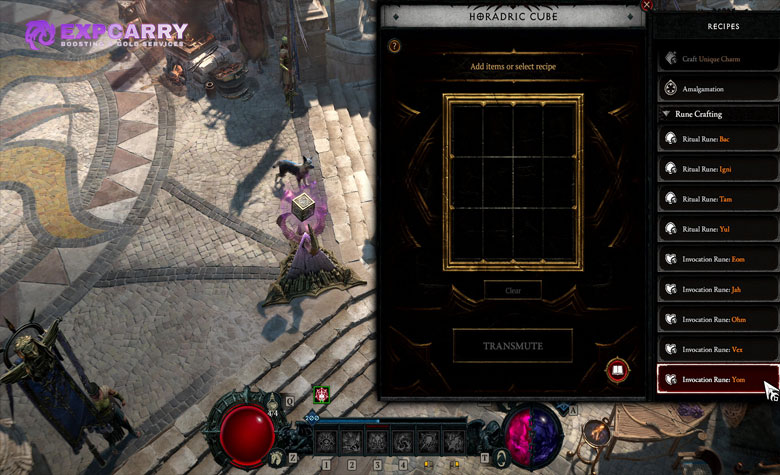
Focused Reroll and Chaotic Reroll solve different problems. Use Focused Reroll when the unwanted affix already belongs to the category that contains the replacement you want. Use Chaotic Reroll when the item needs to cross from one affix category into another. That difference sounds small, but it determines whether the Cube searches within a controlled group or deliberately changes the category of the affected stat.
The safety problem is not the Dust cost. It is targeting. A strong item can contain two or more affixes that belong to the same broad Prism category. If you tell the Cube to work inside that category without checking which affix can be selected, you can replace the good stat instead of the bad one. Do not use a reroll because the recipe name sounds precise. Read the current preview, identify every affix that falls inside the targeted group, and only confirm when every possible affected slot is expendable.
When Focused Reroll Is the Better Choice
Focused Reroll is best when the category is already correct but the specific stat is wrong. A Utility affix that needs to become another Utility affix is the clean use case. The recipe costs 1 Refined Primordial Dust and 15 Raw Primordial Dust per attempt, so repeated searches can become expensive even before higher-tier materials enter the project.
Do not confuse Focused with guaranteed. It narrows the search logic; it does not promise the exact stat or roll you want on the first attempt. Keep a base only if you can tolerate several failures and still afford the next craft.
When Chaotic Reroll Is the Better Choice
Chaotic Reroll is the repair tool for the wrong category. If an item is nearly perfect but one affix belongs to a category your build does not use, Chaotic can move that slot into a more useful category. Tuning Prisms are what make this much safer than an unrestricted random replacement.
The common mistake is using Chaotic too early. If Add Affix, Remove Affix, or a cheaper base-selection step can produce a cleaner starting item, do that first. Chaotic Reroll is strongest as a targeted correction on a base that already deserves investment.
Explore services related to this guide, selected from our Diablo IV catalog.
View All Diablo IV Services

Unique and Mythic Items Use Different Rules in Live 3.1.3
Older PTR guides are dangerous here. During 3.1 testing, Blizzard allowed Chaotic and Focused Reroll on Unique and Mythic items with an extra Attuned Primordial Dust cost. That interaction did not survive into the live release. In the current Diablo IV patch notes, Blizzard states that Unique, Mythic Unique, and Iconic Mythic affixes can be changed through Enchanting, while Chaotic and Focused Reroll were removed for those item classes.
That means a live Cube guide should not tell you to repair a Unique's normal affixes with Focused Reroll. Use the Enchanter for the affix slot that the current item allows you to alter. Use the Cube's Unique Power Reroll when the problem is the Unique Power range itself. These are separate systems and spending resources in one does not make the other unnecessary.
Unique Power Reroll also received broader eligibility than the original launch implementation. The live 3.1 changes allow the recipe to work with Talisman Charms and non-Ancestral items. If you find an otherwise excellent Unique with a weak power roll, this is the Cube interaction to consider before replacing the whole item.
Bosses remain one of the main ways to generate enough Unique copies to make recycling and power rerolls practical. Players who want to concentrate on a specific Lair Boss loot pool can use a Diablo 4 boss farming option, but the crafting rule stays the same: never recycle the best copy until the replacement result is already secured.
Craft: Current Mythic Crafting in Diablo 4
The current Cube recipe is named Craft. You may still see screenshots and older articles calling it Upgrade to Mythic because Blizzard renamed the recipe from Upgrade to Craft in patch 3.1.2 to better describe what it actually does. It is not a direct upgrade of the exact donor Unique. The donor determines the gear slot, while the result is a random Mythic Unique that your class can use in that slot.
The recipe appears at level 70 in Torment difficulty. It requires an item-power-850-or-higher Unique in the target slot plus Pandemonium Fragments. The original Season 14 launch documentation listed five fragments, but patch 3.1.1 reduced the live cost to four. Feeding a perfect Greater Affix donor into this recipe gives no advantage because the donor's rolls are not transferred to the crafted result.
Blizzard's Season of Death Awakening Mythic crafting guide documented the original launch restriction that allowed only one crafted Mythic Unique to be equipped at a time. That restriction was removed in patch 3.1.1a on July 16, 2026 for PC and July 17 for consoles, so it is not a live 3.1.3 rule. Crafted Mythics from the current Season 14 Cube recipe can be equipped without that special one-crafted-item limit, subject to normal item and slot restrictions.
Pandemonium Fragments are tied to the current seasonal Mythic loop, so the Cube itself is permanent while this particular cost is not a safe evergreen assumption beyond the current season. Players should verify the Cube preview before spending fragments because the material economy can change with a new season even when the underlying Cube remains available.
Do Not Use the 3.2 PTR Mythic Recipe on a Live Guide
Blizzard has already tested a different future method called Upgrade Direct Item to Mythic for 3.2.0. That future recipe is designed as a one-to-one conversion that preserves the exact base and its existing modifications, which is fundamentally different from the live 3.1.3 Craft recipe. It is not active in the current game and should not be used to plan today's material costs or donor selection.
This distinction is especially important for expensive Greater Affix, Tempering, and Masterworking projects. In live 3.1.3, do not assume those investments survive the current random same-slot Mythic craft. The 3.2 PTR version also marks Mythics made with the direct Cube upgrade as Crafted and limits you to one Crafted item equipped, but that rule belongs to the future direct-upgrade path and is not active in live 3.1.3. If the future direct-conversion recipe reaches LIVE, this section and the table will need to be updated rather than quietly mixing PTR behavior into the current guide.
Primordial Dust and Tuning Prisms: What to Save
Primordial Dust exists in several tiers because not every Cube operation is meant to have the same opportunity cost. Raw Dust is the recurring foundation, while higher-grade Dust gates progressively more specialized recipes. Coarse is used for simple affix addition, Refined for standard reroll and removal work, Enhanced for Unique-oriented transformations, Volatile for Transfiguration, Attuned for Unique Power work, and Pure for high-end rarity conversion such as the Legendary upgrade. Resonant Primordial Dust is not a usable live 3.1.3 recipe material; Blizzard fixed an earlier bug that allowed this non-functional currency to drop.
Do not spend rare Dust merely because a recipe is available. The best use is determined by how replaceable the base is. A mediocre item should not receive Attuned or Volatile investment when another hour of normal farming is likely to replace it. Save the rarest materials for pieces that already have the correct slot, Item Power, Greater Affix structure, or Unique identity.
Tuning Prisms are category controls rather than free extra stats. Aggressive Tuning Prism, Pragmatic Tuning Prism, Protector's Tuning Prism, Resourceful Tuning Prism, Adept's Tuning Prism, and Chromatic Tuning Prism steer affix families, while Entropic Tuning Prism and Kullean Tuning Prism are tied to Transfiguration behavior. The live 3.1 update also expanded Chromatic targeting so All Resistance can participate in Add, Remove, Chaotic, and Focused operations.
Safe Crafting Order for a Valuable Base
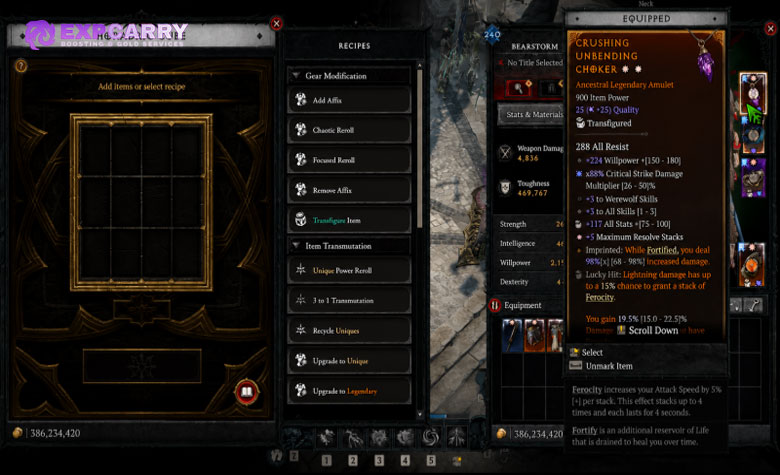
The safest crafting route starts with the least destructive decision and ends with the operation most likely to lock or consume the item. This order is more important than memorizing individual costs because it prevents you from paying a premium to repair a mistake created by an earlier recipe.
- Evaluate the untouched base. Mark the affixes, Greater Affixes, Unique Power, and item type that must survive.
- Use Add or Remove only while the item's basic structure is still being built. Do not make a rare base more complicated before you know which slots are disposable.
- Use Focused or Chaotic Reroll for one defined problem. Choose Focused for a same-category correction and Chaotic for a category change.
- Finish normal Enchanting, Tempering, and Masterworking decisions where the item type allows them. Unique and Mythic normal-affix changes belong at the Enchanter in live 3.1.3, not in Focused or Chaotic Cube rerolls.
- Reroll the Unique Power only if the item itself is already worth keeping. Attuned Dust is too valuable to spend on a Unique that will soon be replaced.
- Transfigure last. Many Transfiguration results make an item Unmodifiable, which can close the door on corrections you forgot to make.
The purpose of this order is not to guarantee a perfect item. The Cube remains a probabilistic crafting system. The goal is to make sure the random step only touches a part of the item you have consciously chosen to risk.
Transfigure Item: The Recipe That Should Usually Come Last
Transfiguration is where the Cube stops behaving like a normal affix editor. With no Tuning Prism, the item can receive a broad random outcome that may be positive or negative, and it has a very high chance to become Unmodifiable rather than being guaranteed to do so. An Entropic Tuning Prism reduces the gambling range by removing the riskiest negative outcomes, gives up the most extreme positive outcomes, and makes the item Unmodifiable.
Kullean Tuning Prism follows a different path and is used on eligible Amulets. It can add a bonus Legendary Aspect through Transfiguration while leaving the item Modifiable, which makes it strategically different from the usual final-lock outcome. Because these Prisms are rare and the rules differ by target, always read the Transfiguration preview for the exact item instead of assuming every Prism is interchangeable.
The irreversible part is why Transfiguration belongs at the end. If an item still needs an affix repaired, a Temper changed, or another normal crafting operation, finish that work before using a route that can lock the item.
Recycle Unique, Upgrade to Unique, and Unique Charm Crafting
These three recipes all consume items, but they solve different inventory problems. Recycle Unique converts three duplicate copies into a fresh version of that same Unique, making duplicate farming useful when the current rolls are poor. Upgrade to Unique starts from a Common base and creates a random Unique of the same equipment type, which is strongest when the class has a narrow Unique pool for that slot. Craft Unique Charm converts an eligible Ancestral Unique equipment item plus three Unique Charms into the supported Unique Charm associated with that donor item.
Recycling should be done from the bottom of the pile, not the top. Keep the best usable copy equipped or stored, then recycle the three worst eligible duplicates. Blizzard also fixed a 3.1.2 issue that could prevent Mythic Unique items from being recycled, but the intended recycling recipes still consume the donor items themselves.
Upgrade to Unique is not a guarantee of a named Unique unless the eligible pool for that class and item type contains only one possible result. Check the current class pool before treating a Common base as a deterministic craft. If multiple Uniques share the type, the recipe is a slot-targeting tool rather than a named-item recipe.
Unique Charm crafting is even more expensive because it asks for an Ancestral Unique, three Unique Charms, Enhanced Dust, Raw Dust, and Infused Horadric Resin. Use it after the Talisman layout is established, not while you are still experimenting with which set or Unique Charm belongs in the build. The Diablo 4 Charms guide covers the live Talisman slot and Charm rules that should be settled before making that conversion.
Amalgamation Recipes Worth Remembering
Amalgamation is the Cube's conversion family for groups of matching non-gear resources and activity items. It is easy to overlook because it does not look as powerful as affix crafting, but it can convert unused stockpiles into a more focused reward. The common pattern is five matching eligible inputs for one transformed or upgraded result.
- Nightmare Sigils: five eligible regular Nightmare Sigils can be turned into an Escalation Sigil.
- Lair Boss trophies: five matching trophies can be converted into a Unique tied to the corresponding boss loot pool.
- Gems: five Grand gems of one type create the next Horadric tier, and five Horadric gems continue into the Flawless Horadric tier.
- Eligible Tributes: matching Tributes can be combined upward through supported rarity steps.
Do not assume every stack of five is a valid Amalgamation. The Cube only accepts supported families and combinations. Put the intended inputs into the interface and inspect the shown result before consuming a rare Tribute or boss trophy that may be more valuable when used directly.
Secret Horadric Cube Recipes
Secret recipes are real, but Blizzard deliberately did not publish their ingredients in the Lord of Hatred system documentation. That means a guide should distinguish between an officially confirmed hidden-recipe system and combinations discovered by players. The existence of secret recipes is official; the solved ingredient lists are community findings verified through the live game.
The best-established example is the hidden Cow Level chain. Combining the Stamina Potion, Rusted Bardiche, and Neyrelle's Hand exposes the `???` Cube recipe and produces the Trophy of the Faithful Cache. This is not a rumor-only combination: the route has been solved and reproduced, but Blizzard never supplied the ingredient list in its official recipe documentation. ExpCarry's Diablo 4 Secret Cow Level guide covers the relic acquisition and the steps that follow the Cube transmute.
Do not label every useful Amalgamation as a secret recipe. Five Sigils, five boss trophies, and gem tier conversion are obscure enough that many players discover them late, but they belong to the normal Amalgamation system. A true hidden recipe is one where the input combination itself is deliberately concealed and the Cube exposes the result only after the correct ingredients are assembled.
Outdated Horadric Cube Advice to Avoid
The Cube changed several times in the weeks after Lord of Hatred launched, so an old recipe sheet can be wrong even if most of its rows still look familiar. The safest approach is to compare any expensive craft with the live interface before clicking Transmute.
- Do not use Unique or Mythic Focused and Chaotic Reroll advice from the 3.1 PTR. Those interactions were removed for LIVE and normal affix changes moved to Enchanting.
- Do not budget five Pandemonium Fragments for the current Cube Mythic craft. The live cost was reduced to four in 3.1.1.
- Do not search for a recipe literally named Upgrade to Mythic in the current menu. Patch 3.1.2 renamed it Craft.
- Do not assume Mythic crafting returns any random gear slot. Live 3.1 makes the result match the donor's gear slot.
- Do not feed a Mythic Unique into the Craft recipe. Mythic Unique inputs are not valid donors for that recipe.
- Do not trust old specific Rune recipe lists without checking the Cube. Individual prerequisites can be patched even when the broader Rune crafting system stays the same.
These are not minor naming differences. They change which item you should protect, which crafting station you should use, and how many rare materials you need before starting a project.
Diablo 4 Horadric Cube FAQ
The questions below cover the current interactions that are easiest to misread when moving between launch guides, PTR notes, and the live 3.1.3 client.
Is the Horadric Cube seasonal?
No. It is a permanent Lord of Hatred expansion feature once unlocked, and it can be used on Seasonal and Eternal characters. Some individual recipes can still rely on seasonal materials, such as the current Pandemonium Fragment Mythic craft.
Can Focused Reroll change a Unique item in live Diablo 4?
No. That interaction existed in the 3.1 PTR plan but was removed for LIVE. Unique and Mythic normal affixes can instead be altered through Enchanting where the item permits it.
What is the difference between Focused Reroll and Chaotic Reroll?
Focused stays within a targeted affix category, while Chaotic is used to replace an affix across categories. Both cost 1 Refined Primordial Dust and 15 Raw Primordial Dust on supported Magic, Rare, and Legendary items.
How much does Craft cost in the Horadric Cube?
In live 3.1.3, the Cube recipe uses an item-power-850-or-higher Unique in the desired gear slot and 4 Pandemonium Fragments. The earlier five-fragment cost is outdated. Players who are still building toward that seasonal material goal can use a Diablo 4 seasonal progression option, but the recipe preview should remain the final check before crafting.
Does Craft preserve Greater Affixes from the donor Unique?
No. The current recipe uses the donor to determine the slot, not to preserve its exact rolls. Do not sacrifice a perfect donor because you expect its Greater Affixes to transfer.
Can I reroll only the Unique Power?
Yes. Unique Power Reroll is a separate Cube recipe. Live updates expanded it to Talisman Charms and non-Ancestral eligible items.
What does Primordial Dust do?
Different Dust tiers gate different Cube operations. Raw Dust supports many recipes, while Coarse, Refined, Enhanced, Volatile, Attuned, and Pure Dust are used for progressively more specialized crafting jobs.
Are there real secret Horadric Cube recipes?
Yes. Blizzard officially confirms that hidden recipes exist but does not publish their ingredient lists. The Cow Level `???` combination using the Stamina Potion, Rusted Bardiche, and Neyrelle's Hand is a community-discovered live example.
Conclusion
The Diablo 4 Horadric Cube is safest when every recipe has a specific job. Add Affix builds a base, Focused Reroll fixes a stat inside the right category, Chaotic Reroll changes the category, Unique Power Reroll repairs the power range, and Transfiguration belongs near the end because it can close the item to further modification. Transmutation recipes should be treated as consumption recipes: the donor items are payment, not protected templates.
For current Unique crafting, keep live 3.1.3 separate from older PTR and future 3.2 information. Unique and Mythic normal affixes use Enchanting rather than Cube rerolls, Craft costs 4 Pandemonium Fragments and returns a random class-usable Mythic in the donor's slot, and secret recipes remain a separate discovery layer rather than ordinary Amalgamation. The old one-crafted-Mythic equip restriction is no longer active in live 3.1.3. Check the preview before every expensive transmute, protect the best donor copy, and only spend rare Primordial Dust after the base is good enough to justify the risk.