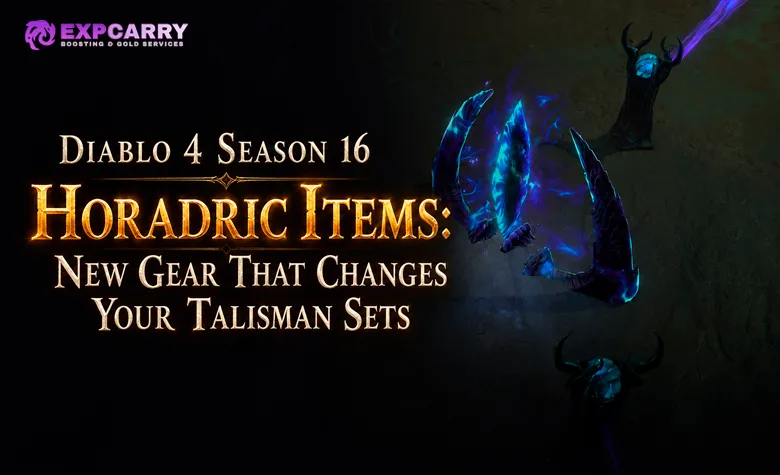
Diablo 4 Season 16 Horadric Items change how you assemble Talisman sets because your equipment can now contribute to Charm bonuses. On the 3.3.0 PTR, Horadric rings and amulets add one count toward a specific Talisman set, while Horadric weapons and armor provide additional effects when the matching set's two-piece bonus is active. That creates new combinations: one Charm and a matching ring can unlock a two-piece bonus, while four matching Charms and one Horadric jewelry item can reach a five-piece threshold. The important decision is no longer just which Charms fit inside your Talisman, but which equipment slots are worth dedicating to a particular set. These changes are being tested from October 27 to November 3, 2026, and PTR bonuses, interactions and bugs may change before Season 16 launches.
Short answer: Horadric jewelry lets you reach Talisman set bonuses with fewer equipped Charms, freeing slots for another set or a Unique Charm. Horadric weapons and armor can then strengthen those combinations, but their additional effects require the matching two-piece set bonus to be active.
How Horadric Items Work in Diablo 4 Season 16
Horadric Items are Legendary equipment introduced for testing with the Death Cult of Ullo Sar theme in Season 16. Their defining feature is an additional Horadric affix associated with a named Talisman set. The affix behaves differently depending on whether the item is jewelry, armor or a weapon, so two Horadric drops can serve completely different purposes in the same build. A ring can help activate a bonus, while a matching weapon can improve the character after that bonus is already active.
| Equipment | Horadric effect | Main build decision |
|---|---|---|
| Rings and amulets | Add +1 to the set count of the named Talisman set | Reach an important set threshold while using fewer Charm slots |
| Weapons | Provide an additional set-specific effect while its two-piece bonus is active | Compare the extra effect against the weapon's overall damage and other properties |
| Armor | Provide an additional set-specific effect while its two-piece bonus is active | Gain offensive or defensive value without disrupting essential equipment bonuses |
This is an expansion of the existing Talisman system, not a replacement for it. As explained in Blizzard's Lord of Hatred overview, a Seal activates the Talisman and can unlock up to six Charm slots. Those slots remain the foundation of the setup; Horadric gear changes how much set progress you can obtain from them. A Horadric affix does not provide an extra physical Charm socket, and it is not another name for the Horadric Cube or the Talisman Seal.
The restriction that matters most is the name attached to the affix. A Horadric item affecting one Talisman set should not be treated as a universal bonus for every set in your loadout. Its value depends on whether you actually use the corresponding Charms and whether the additional count or effect reaches a useful threshold. When evaluating Talisman and Seal progression, the equipment plan now deserves as much attention as the Charm inventory.
How Horadric Jewelry Changes Two-, Three- and Five-Piece Set Bonuses
The clearest Season 16 improvement comes from rings and amulets. According to Blizzard's official 3.3.0 PTR announcement, jewelry with a matching Horadric affix contributes one additional count to its named Talisman set. Blizzard specifically confirms that one equipped Charm plus the corresponding jewelry is enough to activate a two-piece bonus. This is useful even before you obtain every Charm needed for a complete set.
| Equipped Charms | Matching Horadric jewelry | Effective set count | What changes |
|---|---|---|---|
| 1 Set A Charm | 1 piece for Set A | 2 | Activates the two-piece bonus using one Charm slot |
| 2 Set A Charms | 1 piece for Set A | 3 | Reaches the three-piece threshold |
| 4 Set A Charms | 1 piece for Set A | 5 | Reaches the five-piece threshold with four physical Charms |
| 1 Set A Charm and 1 Set B Charm | 1 piece for Set A and 1 for Set B | 2 for each set | Activates two different two-piece bonuses using two Charm slots |
These are set-count examples, not claims that every named set has equally valuable bonuses at every threshold. A jewelry affix is most valuable when it activates an effect your build needs or releases a Charm slot for something better. Increasing a set from three to four effective pieces may provide no immediate new breakpoint if its next bonus requires five. In that situation, the Horadric item is useful only if you intend to complete the remaining step or if its ordinary equipment properties justify wearing it.
For that reason, think in terms of completed bonuses rather than the largest possible number of counted pieces. A ring that takes your main set from four to five can be more important than another ring that raises an unrelated set from two to three without improving your rotation. The comparison also changes when your current jewelry carries a Unique power, strong affixes or another effect that the Horadric replacement would remove. Reaching the next Talisman threshold is valuable, but the rest of the equipment slot still matters.
Season 16 PTR Talisman Combinations Worth Testing
The most interesting combinations use Horadric jewelry to make room for effects that previously competed for the same Charm slots. Some provide a simpler route to one complete set, while others combine a major set bonus with a smaller secondary bonus or a Unique Charm. The examples below follow Blizzard's announced counting rules, but the final equipment choice still depends on actual item rolls, Seal restrictions and PTR functionality. They are build-planning examples, not verified best-in-slot recommendations for every class.
Rogue: Reach Spellbound Steel's Three-Piece Bonus Earlier
Consider a Rogue with two Spellbound Steel Charms and a Horadric ring whose affix names Spellbound Steel. Under the PTR jewelry rule, the ring provides the third effective piece, activating the set's three-piece threshold without occupying a third Charm slot. Blizzard's 3.3.0 patch notes also increase Spellbound Steel's potion-related Maximum Life figure from 30% to 40% at that threshold. The practical appeal is that the Rogue can retain another Charm for a different benefit instead of committing the slot solely to completing Spellbound Steel.
This does not automatically make the ring better than every alternative. If the Rogue is primarily struggling with damage, a potion-related survival effect may not solve the actual problem. The freed slot becomes valuable when it holds a useful offensive Charm, helps another set reach a breakpoint or preserves an important Unique power. PTR testing should compare the complete loadout before and after the change rather than judging the three-piece bonus in isolation.
Druid: Complete Song of the Old Mountain With Four Charms
A Druid pursuing Song of the Old Mountain illustrates the more dramatic five-piece case. Four matching Set Charms and a corresponding Horadric jewelry item create five effective pieces under the announced counting rule. That leaves additional physical Charm capacity on a suitable six-slot Seal, allowing the player to consider a secondary effect without giving up the main set's intended complete bonus. It is an attractive layout for a character whose build already depends on Song of the Old Mountain.
There is an important PTR warning here. Blizzard's 3.3.0 patch notes increase the set's five-piece Petrify explosion damage from 200% to 300%, but the official known-issues list says the PTR is still applying the older 200% value. As a result, an early damage comparison may undervalue the intended updated effect or produce confusing results. Treat this combination as a valid threshold-planning example while withholding final damage recommendations until the bug is resolved.
One Five-Piece Set, One Two-Piece Set and a Unique Charm
A more flexible six-slot example is four Charms from Set A, one Charm from Set B and one Unique Charm permitted by the equipped Seal. Add a Horadric ring for Set A and a Horadric amulet for Set B, and the intended result is a five-piece bonus for Set A, a two-piece bonus for Set B and the separate Unique Charm effect. This arrangement uses the new jewelry counts to create room for three distinct sources of power. It is particularly attractive when Set A defines the main rotation and Set B supplies a useful supporting bonus.
For a named Rogue example, Spellbound Steel and Nilfur's Narrow Eye are both Talisman sets identified in Blizzard's 3.3.0 notes. The exact Charm split should be chosen around the threshold you actually want from each set, not simply because both names appear on the same class's equipment options. An effective two-piece bonus that supports your main skills may outperform a larger secondary set package with poor synergy. Finding the two matching jewelry affixes is also a gear requirement, not something automatically granted by equipping the Charms.
Explore services related to this guide, selected from our Diablo IV catalog.
View All Diablo IV Services

Can Horadric Items Enable Two Complete Five-Piece Sets?
The possibility of running two complete Talisman sets is one of the most tempting Season 16 ideas, but it needs careful counting. A standard Talisman can provide up to six physical Charm slots, while three jewelry slots could theoretically contribute three additional set counts if all three carry relevant Horadric affixes. That gives nine potential set counts, whereas two ordinary five-piece thresholds require ten. Horadric jewelry alone therefore does not establish that two five-piece bonuses fit into a standard six-slot setup.
The Seal of the Diamond Mind changes the calculation because its special rule reduces the number of pieces needed for set bonuses by one, to a minimum of two. If its threshold reduction combines with Horadric jewelry as expected, two complete sets may become possible through a carefully divided Charm and jewelry arrangement. However, the exact interaction should be verified through active set indicators on the 3.3.0 PTR before describing a dual-five-piece layout as a confirmed working build. Seal-specific rules and actual Charm counts matter more than theoretical arithmetic.
There is also a difference between activating two full sets and building the strongest character. Complete set bonuses can compete with Unique Charms, useful individual Charm affixes and the equipment properties sacrificed for matching jewelry. Blizzard's earlier Talisman PTR additions expanded the available Unique Charm options, making that opportunity cost more significant. A five-piece primary set with a strong Unique Charm may still be preferable to two complete sets that require awkward skill choices or weak equipment.
When Horadric Weapons and Armor Are Worth Equipping
Horadric weapons and armor work differently from jewelry. They do not provide the +1 set count described for rings and amulets; instead, they add set-specific effects that become active once the corresponding two-piece bonus is running. Blizzard describes possible benefits such as additional skill ranks, damage and defensive capabilities. That means a powerful-looking Horadric weapon can contribute nothing from its special affix if the required Talisman set is not active.
The first step is to decide whether you are building around that set at all. If your main skills have little connection to the named Talisman package, a Horadric bonus for that package should not dictate your weapon or armor selection. If the set is central to your rotation, however, the extra affix may improve an important skill, fill a defensive gap or strengthen damage without spending another Charm slot. The right question is whether the full equipped item improves the character, not whether its Horadric line has the highest-looking value.
- Establish the set threshold first. Confirm that the required two-piece bonus is active before valuing a conditional Horadric weapon or armor effect.
- Check the exact skill interaction. Skill ranks are useful only when they affect abilities your build actually uses, while conditional damage effects must match the attacks or combat states you maintain.
- Compare the entire equipment slot. A new Horadric item may require replacing a strong Legendary, Unique, Aspect combination or important defensive property.
- Evaluate the real content goal. Damage improvements may help with boss fights, but movement, damage reduction and consistent uptime can matter more in long endgame encounters.
- Test one change at a time. Keep the same Charm layout when comparing two weapons, then change the Talisman arrangement separately to identify which upgrade actually improved performance.
A character pushing difficult Pit tiers may benefit more from a reliable defensive Horadric effect than from a small damage increase that only works during a narrow window. Conversely, a build that already survives comfortably may gain more from stronger offensive skill interactions. Neither conclusion requires assuming that every Horadric affix is multiplicative or that every extra skill rank has the same value. Those details must be checked on the actual item tooltip and against the current PTR behavior.
How to Get and Test Horadric Items on the Season 16 PTR
For testing, Blizzard provides a direct way to access the new equipment without relying entirely on ordinary drops. PTR vendor Mrak appears near the main Waypoint in major cities and offers character boosts, including separate options for Talisman Items and Seasonal Items identified as Horadric Items. Use the relevant boosts to obtain test gear, then build a matching Charm arrangement before comparing performance. These vendor options are PTR testing tools, not confirmed live Season 16 farming methods.
War Plans provide a broader framework for preparing the required equipment and Charms. The new War Plans Tactics system lets players invest in reward categories including Armor, Weapons, Jewelry and Talisman Items, while individual activity choices affect the content available in their plans. This makes it sensible to select rewards according to the missing part of your build, but a category preference is not a guarantee that the next item will have the exact Horadric affix you need. Players considering War Plans activity routes should distinguish general equipment rewards from a confirmed source of specific Horadric set rolls.
Season 16 also introduces Tyrael's Boons, a seasonal War Plans tree that can influence parts of the reward economy. Its Curious Addition path modifies options at the Purveyor of Curiosities, while Scent of Gold includes choices affecting Legendary drops and certain resources. Those bonuses may support a broader equipment-farming plan, but Blizzard has not published a guaranteed Horadric target-farming recipe or a definitive drop-rate table in the cited 3.3.0 announcement. Avoid promising a specific number of runs for a named Horadric ring, weapon or armor piece.
Once your test layout is functional, repeat comparable activities instead of judging it from a single fight. Infernal Hordes encounters offer a useful environment for observing sustained damage, survivability and how consistently set-related effects remain useful during waves. The Pit offers a different comparison because movement, elite pressure and the final boss can expose weaknesses that ordinary farming conceals. Record the actual set counters, equipped bonuses and relevant skill behavior before making a permanent build recommendation.
PTR Bugs and Build Mistakes That Can Distort Your Results
Not every disappointing Horadric combination is necessarily a weak build. Blizzard has already identified several issues affecting Horadric effects and Talisman sets on the 3.3.0 PTR. Some prevent a bonus from activating correctly, while others cause a set to use an older damage value or behave incorrectly with a particular skill interaction. These problems matter because a player can otherwise discard a promising combination based on a test that does not reflect its intended design.
- Warlock — Flesh of Abaddon: The Demonform damage bonus may not apply until the player exits and re-enters Demonform.
- Warlock — Fulcrum of Mephis: The Lesser Demon conversion effect requires the actual Fulcrum set bonus; the Horadric Item effect alone does not activate it correctly on the PTR.
- Paladin: A Horadric bonus involving damage to Weakened enemies is listed as not applying.
- Druid — Song of the Old Mountain: Its five-piece Petrify explosion still uses the older 200% damage value instead of the updated 300% PTR value.
- Rogue — Spellbound Steel: Its five-piece bonus does not properly increase Shadow Imbuement when used by Shadow Clone.
All five issues appear in Blizzard's official 3.3.0 PTR known-issues thread. They should not be interpreted as intended long-term restrictions or proof that a specific class combination is fundamentally weak. When one of these effects is central to your build, check whether the problem has been resolved before relying on damage comparisons. Blizzard can also change set values and item effects after reviewing feedback, so PTR rankings should remain provisional.
There are several avoidable planning mistakes even when every effect works correctly. Do not assume a Horadric weapon activates its own set bonus, count jewelry as an extra physical Charm slot, or replace a strong item without comparing its complete properties. Do not assume a ring for one set helps a different set, and do not treat a theoretically possible dual-set layout as proven until the active indicators match the planned counts. Above all, keep the main skill rotation intact while experimenting with the new Talisman options.
Diablo 4 Season 16 Horadric Items FAQ
These questions address the most common points of confusion when moving from an ordinary Talisman loadout to one supported by Horadric equipment.
Do Horadric Items create extra Charm slots?
No. Jewelry adds a set count to its named Talisman set, effectively helping reach a bonus without consuming another physical Charm slot. The Seal still determines the available Charm slots.
Can one Horadric ring activate a two-piece set bonus?
Not by itself. Blizzard confirms that one equipped Charm from the named set, together with its matching Horadric jewelry item, is enough to activate the two-piece bonus.
Do Horadric weapons and armor work without matching Charms?
Their additional set-specific effects require at least the corresponding two-piece Talisman bonus. If the required set is inactive, do not count the conditional Horadric line as part of your effective build power.
Are Season 16 Horadric Item values final?
No. The 3.3.0 PTR runs through November 3, 2026, and Blizzard is collecting feedback before the season launches. Known bugs and future tuning can change the performance of individual combinations.
Which Horadric Items Should You Prioritize?
Start with jewelry that reaches an important breakpoint for a set your character already uses. A matching ring that activates a two-piece bonus or helps complete a five-piece bonus can immediately change how the remaining Charm slots are allocated. After the Talisman layout is stable, look for Horadric weapons and armor whose conditional effects strengthen the main rotation or solve a genuine defensive weakness. Treat ambitious dual-set combinations as experiments until their counters and interactions work correctly, and avoid sacrificing an otherwise excellent equipment slot merely to add another Horadric affix.