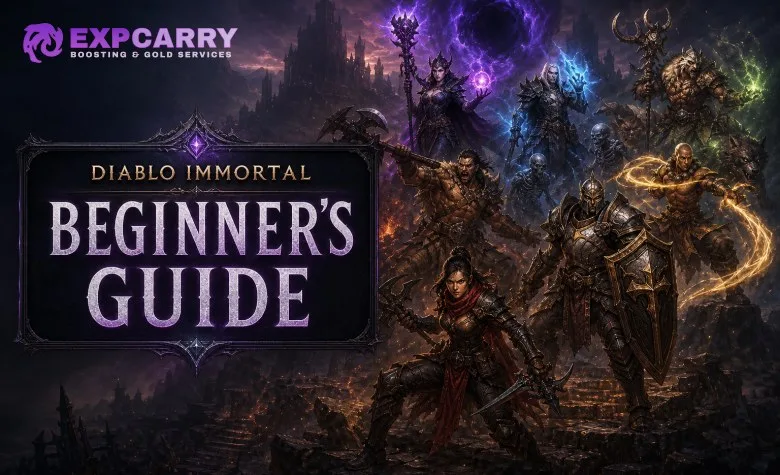
Diablo Immortal Beginner’s Guide: Classes and Progression is primarily a beginner progression and character-leveling guide with a major class-selection component. The goal is to help a new player choose a suitable class, reach the endgame efficiently, understand Combat Rating and Paragon progression, and build a reliable daily routine without wasting materials or spending money unnecessarily. Diablo Immortal currently has ten playable classes: Barbarian, Blood Knight, Crusader, Demon Hunter, Druid, Monk, Necromancer, Tempest, Warlock, and Wizard.
Choose a Class That Matches Your First Goal
Your first class matters because every class uses different Legendary Essences, skills, and combat patterns. However, you are not permanently locked into the choice. Class Change allows an established character to move to another class while retaining major progression such as Paragon progress, equipment upgrades, gems, and other account development. You will still need to collect class-specific Legendary items for the new class.
For a first character, choose the class whose combat style you will enjoy playing repeatedly. The fastest theoretical class is less useful than a class you are comfortable using for open-world farming, dungeons, raids, and daily activities.
| Class | Primary Playstyle | Best Beginner Use |
|---|---|---|
| Barbarian | Melee damage, mobility, crowd control, party utility | Strong all-rounder for solo play, dungeons, and group content |
| Blood Knight | Mid-range melee, vampiric effects, shields, control | Durable class with flexible damage and survival tools |
| Crusader | Melee support, mounted movement, buffs, control | Excellent group utility and comfortable open-world movement |
| Demon Hunter | Ranged single-target and sustained damage | Simple damage-focused option for bosses and farming |
| Druid | Nature magic, transformations, companions, healing | Flexible hybrid class with several different play patterns |
| Monk | Melee mobility, defensive skills, control, support | Good for players who prefer active positioning and utility |
| Necromancer | Summons, ranged damage, curses, battlefield control | Beginner-friendly solo progression and safe combat |
| Tempest | Fast melee combat, movement, wind-based attacks | Strong choice for players who enjoy speed and aggressive positioning |
| Warlock | Infernal magic, minions, damage-over-time effects, control | Flexible ranged and summoning gameplay |
| Wizard | Ranged spells, area damage, crowd control | Excellent for clearing groups and controlling encounters |
Best beginner classes for solo progression
Necromancer is one of the most forgiving starting classes because summons can absorb pressure while you attack from a safer position. Necromancer also offers useful area damage and control, making quests, open-world farming, and early dungeons comfortable.
Barbarian is a strong alternative if you want direct melee combat. The class combines damage, movement, survivability, and useful party effects. You must stay closer to enemies than a Necromancer or Demon Hunter, but Barbarian is forgiving when you make positioning mistakes.
Demon Hunter is suitable if you prefer ranged damage and want to focus on killing enemies before they reach you. Demon Hunter can feel fragile when surrounded, so movement and defensive Essences become increasingly important.
Best classes for group play
Crusader, Barbarian, Monk, and support-oriented versions of other classes can contribute more than raw damage. Group utility may include movement effects, damage buffs, defensive support, crowd control, or enemy debuffs. A class that deals slightly less personal damage can still improve a dungeon or raid group by making the entire party faster and safer.
Should you create multiple characters?
For a new account, concentrate on one main character first. Diablo Immortal contains many progression systems, and splitting time between several characters delays gear upgrades, Paragon advancement, Legendary Gem development, and activity knowledge.
Use Class Change later when you want to test another class without abandoning your established progression. A new class receives class-appropriate equipment, but its Legendary Essence collection will still need to be developed.
Understand the Two Main Leveling Stages
Diablo Immortal progression has two connected stages. First, you level your character through the story and unlock core activities. After the normal character-leveling phase, you continue advancing through Paragon levels, difficulty tiers, gear upgrades, Legendary items, Set items, Helliquary progression, Gems, and other long-term systems.
Your immediate objective is not to obtain a perfect build. Your objective is to unlock content, maintain enough Combat Rating for the next difficulty, and establish a repeatable routine that supplies experience, gear, upgrade materials, and crafting resources.
| Progression Source | What It Provides | Early Priority |
|---|---|---|
| Main quests | Experience, equipment, systems, zones, and activity access | Very high |
| Battle Pass activities | Battle Points, experience, materials, and useful rewards | Very high |
| Bounties | Experience, gold, materials, and activity progress | High |
| Bestiary turn-ins | Experience, gear, and collection rewards | High |
| Dungeons | Experience, equipment, and Set item opportunities | High when available |
| Elder Rifts | Run rewards, Fading Embers, and Legendary Gem opportunities with Crests | Regularly |
| Challenge Rifts | Milestone rewards and progression-related materials | Push when comfortable |
| Helliquary activities | Raid progress, rewards, and long-term character power | Complete when unlocked |
What to Do During the Story
1. Follow the main quest first
The main quest is the most reliable way to unlock zones, vendors, activities, and progression systems. Do not spend your first hours repeatedly farming a low-level area when a story objective is available. Story progression also introduces important features in a controlled order, which is easier to understand than opening every menu at once.
Complete side activities when they are directly on your route or when the game specifically directs you to them. Avoid abandoning the main quest for long periods to chase random Legendary drops. Early Legendary equipment will quickly be replaced as your level and difficulty increase.
2. Equip upgrades, but compare Combat Rating intelligently
During early leveling, replace equipment frequently. The item with higher Combat Rating is usually the better immediate choice for PvE progression, especially when the alternative has much lower basic attributes or comes from an earlier level range.
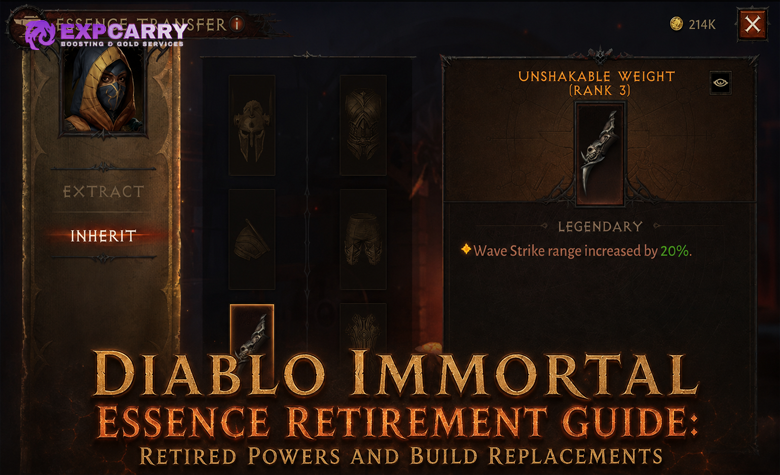
Do not destroy useful Legendary items before extracting their Legendary Essences. If a Legendary item introduces a new power for one of your skills, salvage or extract it according to the available menu option so the power can be used later. Once you have extracted an Essence, you can usually apply it to suitable Legendary equipment through the Essence system.
3. Upgrade equipment as materials allow
Primary equipment upgrades provide dependable power and should not be ignored while you wait for perfect drops. Salvage unwanted equipment regularly, then use the resulting materials to improve your primary equipment slots.
Do not save every upgrade material for a future item. Diablo Immortal provides systems that transfer or preserve much of your upgrade progress, and delaying upgrades makes quests, dungeons, and difficulty transitions slower than necessary.
4. Keep your skills simple
Use a leveling loadout with at least one movement or defensive skill, one reliable area-damage skill, and one ability that handles elites or bosses. A balanced setup is more practical than a build designed only for stationary target dummies.
Experiment with skills as they unlock. Early leveling is the best time to learn how your class generates resources, maintains buffs, groups enemies, and survives crowd-control effects.
Explore services related to this guide, selected from our Diablo Immortal catalog.
View All Diablo Immortal Services


How to Build a Leveling Loadout
Your leveling build should prioritize reliable clearing and low downtime rather than maximum damage against one target. Most new players progress faster when they can gather enemies, use an area attack, reposition, and continue moving without waiting for every cooldown.
Melee classes
Barbarian, Blood Knight, Crusader, Monk, and Tempest should combine a primary attack with a movement skill and at least one defensive or control tool. Avoid equipping four long-cooldown attacks that leave you helpless after one rotation.
Use movement skills to pass through weak enemies, group packs, or reach ranged monsters. Against elites, activate defensive effects before committing to a full melee rotation rather than waiting until your Life is already low.
Ranged classes
Demon Hunter, Wizard, Necromancer, and Warlock should use spacing to reduce incoming damage. Place persistent area effects where enemies will move, then use your primary attack or direct-damage skill while enemies remain inside the effect.
Necromancer and Warlock can often allow summons or other controlled entities to hold enemy attention. Wizard and Demon Hunter generally rely more heavily on movement, crowd control, and correctly timed defensive abilities.
Druid
Druid can alternate between spellcasting, companions, and Werewolf or Werebear transformations. Primal Power is the Druid’s unique resource. Several skills generate Primal Power, while major transformations and other powerful abilities consume it.
During leveling, avoid activating a transformation immediately after spending all available Primal Power on other abilities. Use generators first, then transform when the resource is sufficient to maintain the form during the encounter.
Combat Rating: The Main PvE Gate
Combat Rating is the primary PvE power check in Diablo Immortal. It affects how effectively you deal damage and survive against content with a higher or lower recommended rating. Combat Rating is not the same as Resonance, primary attributes, secondary attributes, or PvP matchmaking power.
When you are below the recommended Combat Rating for an activity, enemies can become disproportionately difficult. If your character feels weak after entering a new difficulty, the solution is usually to improve gear quality and progression systems rather than endlessly changing skills.
Reliable ways to increase Combat Rating
- Equip newer Legendary and Set items with stronger Combat Rating.
- Upgrade primary equipment slots using salvaged materials.
- Advance Paragon levels and use the current Paragon specialization appropriate to your activity.
- Progress through Challenge Rifts and other activities that provide upgrade materials.
- Complete Helliquary content and use its current progression features when available.
- Improve Legendary and Normal Gems over time.
- Move into the next difficulty only when your character can clear current content efficiently.
Recent progression changes have reduced the importance of several older systems. Ancestral Tableau progression and the former Helliquary upgrade path are no longer the same Combat Rating sources they were in earlier versions. Do not follow launch-era guides that tell you to prioritize removed or reworked systems.
Combat Rating versus damage
Combat Rating is excellent for meeting PvE requirements, but it does not fully describe performance. Two characters with similar Combat Rating can clear at different speeds because of Legendary Essences, skill synergy, Gem effects, secondary attributes, Set bonuses, and player execution.
Use Combat Rating to decide whether you are ready for a difficulty or activity. Use your actual clear speed and survivability to decide whether your build is effective.
Paragon Progression After Character Leveling
Paragon levels continue your character’s progression after the normal leveling phase. Current Diablo Immortal progression also provides direct benefits from Paragon advancement, including Combat Rating and primary progression effects. This makes Paragon experience valuable even when you are temporarily unable to farm the newest difficulty.
Paragon specializations provide different benefits for PvE, PvP, farming, survivability, and class-specific playstyles. The correct choice depends on your activity. A node setup that improves monster clearing may be less useful in Battlegrounds, while a PvP-oriented setup may reduce your open-world farming speed.
How to gain Paragon experience efficiently
- Complete available Battle Pass activities before choosing optional farming.
- Follow the main quest until the current story objective is blocked by level or Combat Rating.
- Run Bounties and turn in Bestiary progress while collecting Monstrous Essence.
- Use open-world farming routes when you need experience, gear, or Bestiary progress.
- Run dungeons when you need Set items or when the Codex provides strong activity rewards.
- Complete Elder Rifts with available Crests and use Challenge Rifts for progression milestones.
- Join Helliquary activities and other scheduled group content as soon as your character can participate.
Catch-up bonuses can make new and returning characters advance rapidly when they are below the current Server Paragon level. The exact bonus depends on the live server state, so do not plan around an old guide’s multiplier or a fixed number of Paragon levels per day.
Legendary Items, Essences, and Set Items
Legendary items do more than provide higher attributes. Their Legendary Essences modify skills, create new interactions, change damage types, add movement effects, or provide defensive utility. A leveling build should use the strongest available Essence combination, but you should not delay progression while waiting for a perfect six-slot setup.
How to manage Legendary Essences
- Extract new Legendary powers when you obtain them.
- Save Essences that affect skills you may use in future builds.
- Use the recommended Essence for the skill you actually press most often.
- Replace an Essence when a new one improves clearing, survival, or cooldown flow.
- Keep a separate farming loadout if your combat build moves too slowly through open-world content.
Set items are most useful after your character begins farming a stable difficulty. During the story, a higher Combat Rating item can be better than a lower-level Set item with an incomplete bonus. Once your equipment level becomes more consistent, target Set bonuses that complement your main damage pattern, summons, continual damage effects, primary attack, or defensive rotation.
Set drops remain subject to RNG. You can improve the number of farming attempts by selecting suitable dungeons and completing activity bonuses, but you cannot guarantee a specific Set item on a particular run.
Legendary Gems for New and Free-to-Play Players
Legendary Gems provide effects, attributes, and Resonance. Resonance is a separate progression system from Combat Rating and is strongly associated with Gem investment. A high-Resonance character is not automatically better at every PvE task, and a low-spending or free-to-play player can make meaningful progress without copying an expensive Gem setup.
Early Gem priorities
- Use the best Legendary Gems you already own rather than waiting for an ideal collection.
- Prioritize effects that improve your class’s main damage pattern or survival.
- Do not spend Platinum impulsively on a Gem that does not fit your planned class.
- Keep useful duplicate Gems when they are needed for upgrades.
- Compare Gem rank, star rating, effect, and long-term upgrade cost before committing resources.
Free-to-play players should focus on consistent Gem acquisition, market discipline, and gradual upgrades. Low spenders can prioritize a small number of efficient Gems rather than spreading resources across every available effect. Higher-investment accounts have more freedom to pursue Resonance, but expensive Gems still need to match the activity and class.
Daily and Weekly Activity Routine
A good beginner routine should reward time spent without forcing you to complete every activity every day. Start with tasks that provide Battle Points, then add activities that address your current bottleneck: experience, Combat Rating, Set items, Gems, materials, or Helliquary progress.
| Available Time | Recommended Routine |
|---|---|
| 15 minutes | Claim available rewards, complete quick Battle Pass activities, progress Bounties, and salvage or upgrade equipment. |
| 30 minutes | Complete Battle Pass objectives, Bounties, Bestiary progress, or a short dungeon and Elder Rift session. |
| 60 minutes | Combine Bounties, open-world farming, dungeons, Elder Rifts, and one progression activity such as a Challenge Rift. |
| 120 minutes or more | Farm the current difficulty, target Set items, complete group content, advance Helliquary objectives, and finish weekly activity limits. |
Battle Pass priorities
Battle Pass progress is valuable because it combines experience, materials, and other rewards with activities you already need to perform. Complete the Battle Pass tasks that overlap with your normal routine instead of choosing inefficient activities solely for points.
Free-track rewards remain useful for every account. Paid Battle Pass rewards can accelerate progression, but they do not remove the need to farm gear, learn mechanics, or meet Combat Rating requirements.
Bounties and Bestiary
Bounties are reliable daily objectives for experience, gold, and materials. Complete Bounties in zones where you can also collect Monstrous Essence, finish open-world objectives, or progress another Codex task.
Bestiary turn-ins are easy to neglect because Monstrous Essence is collected while doing other activities. Turn in completed Bestiary pages regularly rather than allowing the resource to sit at its storage limit.
Elder Rifts and Challenge Rifts
Elder Rifts are useful for Gem-related progression, Fading Embers, and general activity rewards. Use Crests when you have them, especially when the resulting rewards support your planned Gem strategy.
Challenge Rifts are progression checks rather than ordinary farming zones. Push them when your build clears current content comfortably, but do not spend an excessive amount of time forcing a Rift far above your practical power. Revisit them after upgrading equipment, Gems, Paragon progression, or Essences.
Dungeons
Farm dungeons when you need Set items, dungeon-specific rewards, or Battle Pass progress. The best dungeon is usually the one that contains the Set item you need and that you can complete quickly without frequent deaths.
Do not remain in an old difficulty solely because a guide lists it as the traditional farming location. Current difficulty and Set item rules can change, and lower difficulties may now offer broader access to Set items than they did in older versions.
Helliquary and Group Progression
Helliquary content provides raid encounters, boss progression, and rewards that contribute to long-term character development. Enter Helliquary activities when your character meets the current requirements and can survive the encounter.
Before joining a raid, equip a stable PvE build, read the encounter objectives, and bring at least one defensive or mobility option. Raid success depends on mechanics and group execution as well as Combat Rating. A character that ignores telegraphed attacks can fail even when the displayed rating appears sufficient.
Join a Warband or active clan if you want regular access to group activities. Solo players can progress, but organized groups reduce queue time and make scheduled content more reliable.
PvE and PvP Require Different Builds
Your leveling and farming build should not be treated as a universal PvP build. PvE rewards area damage, movement speed, sustained damage, and efficient cooldowns. Battlegrounds place greater value on survivability, crowd-control resistance, positioning, interruption, objective pressure, and the ability to survive enemy focus.
Do not judge a class only by its solo damage. A class with excellent PvE clearing may require a different skill loadout in Battlegrounds, while a support-oriented PvP setup may feel slow during open-world farming.
Beginner PvP advice
- Stay near allies instead of entering objectives alone.
- Use movement and defensive skills before being caught by crowd control.
- Focus on objectives and enemy positioning rather than chasing every low-Life target.
- Expect matchmaking to include players with different Resonance, Gem investment, and experience.
- Do not assume a build can compensate for a large account-power difference.
- Change Paragon specialization and skills when moving from PvE to Battlegrounds.
F2P Progression Priorities
Free-to-play players should spend scarce resources on permanent or broadly useful progression before cosmetic or speculative upgrades. Combat Rating, equipment upgrades, class-appropriate Essences, activity rewards, and consistent Gem development provide the most dependable early value.
- Choose one main class and learn its basic skill rotation.
- Complete the story and unlock all major activities.
- Upgrade primary equipment regularly.
- Use free Battle Pass rewards and complete overlapping Codex tasks.
- Farm Bounties, Bestiary progress, dungeons, and Elder Rifts consistently.
- Spend Platinum carefully and avoid buying Gems that do not fit your long-term plan.
- Join group activities for rewards that are difficult to obtain efficiently alone.
- Save major resources when you are uncertain about a Gem, class, or build direction.
Free-to-play accounts should not measure success only by Resonance or Battleground performance. PvE progression, story completion, dungeon farming, Helliquary participation, and class experimentation remain accessible through consistent activity.
Common Beginner Mistakes
| Mistake | Why It Hurts | Better Approach |
|---|---|---|
| Changing classes repeatedly at the start | Delays Essence collection and makes the account feel unfocused | Play one class until core progression is established |
| Ignoring equipment upgrades | Reduces Combat Rating and makes new content unnecessarily difficult | Salvage regularly and upgrade primary equipment |
| Keeping every low-level Legendary item | Fills storage and wastes useful Essence opportunities | Extract useful powers and salvage the remainder |
| Chasing perfect Set items too early | Slows leveling while replacement gear is frequent | Use stronger current equipment, then target Sets at stable difficulty |
| Confusing Resonance with Combat Rating | Leads to poor upgrade decisions and unrealistic PvE expectations | Use Combat Rating for difficulty checks and Gems for long-term specialization |
| Copying an old Paragon guide | Paragon systems and progression benefits have changed | Review the current specialization options in-game |
| Ignoring Bestiary and Bounty progress | Leaves steady experience and rewards unclaimed | Combine both activities with open-world farming |
| Using one build everywhere | PvE and PvP reward different stats and skill patterns | Keep separate farming, dungeon, raid, and PvP loadouts |
A Practical First-Character Progression Plan
- Select a class you enjoy playing. Necromancer, Barbarian, Demon Hunter, and Crusader are comfortable starting points, but every current class is viable for learning the game.
- Follow the main quest. Use the story to unlock zones, vendors, activities, and progression systems.
- Equip stronger drops immediately. During early leveling, Combat Rating and current item quality matter more than a perfect build.
- Extract useful Legendary Essences. Save powers that support your preferred skills and discard obsolete equipment after extraction.
- Complete Battle Pass activities. Choose tasks that overlap with Bounties, dungeons, Elder Rifts, or open-world farming.
- Upgrade primary equipment. Do not wait for perfect gear before investing in dependable upgrades.
- Build a daily routine. Prioritize Bounties, Bestiary progress, dungeons, Elder Rifts, and current Codex objectives.
- Use Paragon specialization for the activity. Select PvE farming, damage, survivability, or PvP-oriented options according to your current goal.
- Advance difficulty when Combat Rating and clear speed allow it. A new difficulty should improve rewards without turning every activity into a slow survival test.
- Begin targeted endgame farming. Once your difficulty is stable, pursue Set items, class Essences, Gem upgrades, Challenge Rift milestones, and Helliquary progression.
The most efficient beginner strategy is consistency: advance the story, keep equipment upgraded, complete overlapping daily activities, and change your build when your objective changes. Diablo Immortal rewards accounts that steadily improve several progression systems at once rather than accounts that spend all of their time chasing one perfect random drop.