

The best Warlock build in Diablo Immortal depends on the activity, but a strong general-purpose setup is built around Soulgorger, Demonic Portal, Infernal Eruption, Hellswarm, and Warp Strike. This combination gives you a durable demon companion, several summoned attackers, reliable area damage, Burning effects, mobility, and strong single-target pressure. For PvP, replace some damage-over-time tools with crowd control, damage reduction, mobility, and anti-dash effects.
The Warlock is Diablo Immortal’s tenth class and specializes in demon summoning, Hellfire damage, portals, sacrificial skills, and temporary control effects. The class is suitable for solo farming, dungeons, raids, open-world content, and Battlegrounds, but its best skill loadout changes significantly between PvE and PvP.
How the Warlock plays
The Warlock’s passive ability, Soulgorger, summons a powerful demon that fights beside you. Soulgorger is resistant to knockback and total loss of control effects, can leap to targets, stuns enemies with Pummeling Eruption, restores your Life with Voracious Sacrifice, and evolves by devouring other demons that die nearby.
Warlock gameplay revolves around maintaining demons, applying damage-over-time effects, positioning Infernal Eruption, and managing Life costs. Several abilities consume your Life or the Life of your summons, so the strongest damage setup is not always the safest setup. Siphon Life and Soulgorger’s healing effects are valuable when you use Blood Offering, Spiteful Sacrifice, or Devouring Darkness repeatedly.
| Activity | Recommended approach | Main priority |
|---|---|---|
| Open-world farming | Use summons, Hellswarm, Burning Ascent, and fast movement | Clear speed and mobility |
| Dungeons | Use grouped area damage and a reliable Soulgorger setup | Consistent damage while moving between packs |
| Helliquary raids | Use single-target damage, Burning effects, and summon uptime | Boss damage and survival |
| Battlegrounds | Use control, portals, defensive tools, and anti-dash effects | Positioning and objective pressure |
Best general PvE Warlock skill build
For a flexible PvE build, equip Lunatic Rush, Demonic Portal, Hellswarm, Infernal Eruption, and Warp Strike. This setup works well for open-world farming, dungeons, bounties, Bestiary runs, and most routine PvE activities.
| Skill | Purpose | Best use |
|---|---|---|
| Lunatic Rush | Fast primary attack that summons an exploding Fallen Lunatic | Finishing enemies and maintaining pressure while moving |
| Demonic Portal | Summons a demon with a role determined by the portal result | General damage, crowd control, and Soulgorger evolution |
| Hellswarm | Applies an infernal plague and creates additional Plagued Thornstriders | Area damage and sustained clearing |
| Infernal Eruption | Creates repeated Hellfire eruptions and Burns enemies | Elite packs, dungeon groups, and bosses |
| Warp Strike | Moves Soulgorger through a portal and knocks enemies up | Engaging, repositioning, and controlling dangerous enemies |
Why this PvE setup works
Demonic Portal gives the build additional bodies on the battlefield and creates different tactical options. Bloodlords provide a charge and stun, Demonic Soldiers add several basic attackers, and Rasplet Hulks offer stronger direct damage with Bleed. The summoned demon also contributes to Soulgorger’s Devour mechanic when it dies.
Hellswarm is especially useful against groups because infected enemies can hatch Plagued Thornstriders when they die. The effect continues spreading while you move through a zone, making Hellswarm a strong choice for open-world farming and dungeon trash packs.
Infernal Eruption is the main area-damage tool. Place it beneath elites, bosses, or tightly grouped enemies. If one of your demons is hit by an eruption, that demon becomes engulfed in Hellfire and damages nearby enemies over time.
Warp Strike is more than a movement ability. It gives Soulgorger a controlled leap, knocks enemies up, and temporarily increases its Attack Speed. The skill also benefits from the Warlock affix that reduces its cooldown based on Soulgorger’s attacks.
PvE rotation
- Summon Soulgorger and use Demonic Portal to establish your demon army.
- Cast Hellswarm through the largest group of enemies.
- Place Infernal Eruption under elites or the center of the infected pack.
- Use Warp Strike to reposition Soulgorger, interrupt enemies, or begin a boss phase.
- Use Lunatic Rush between cooldowns and keep attacking while moving.
- Use Life-restoring tools before repeated sacrifices reduce your health too far.
Against bosses, avoid wasting Infernal Eruption on empty ground. Cast it when the boss is stationary or when Soulgorger is already attacking inside the area. Against ordinary monsters, prioritize movement and uptime rather than waiting for a perfect placement.
Best PvE Legendary Essences
Warlock Legendary Essences are highly specialized. The best collection is not one fixed list because you should change several slots for farming, dungeons, raids, and survival. The following Essences are strong starting points because they improve the class’s central mechanics.
| Equipment slot | Legendary Essence | Recommended purpose |
|---|---|---|
| Main Hand | Mordscrape | Improves Demonic Portal with a Hellflyer that creates a damaging vortex |
| Main Hand | Cavalier Cutter | Protects Soulgorger from immediate death and increases its damage and Movement Speed |
| Off-Hand | Jawless Grin | Increases Infernal Eruption damage against Burning enemies |
| Off-Hand | Iron Reins | Adds control and increased damage taken after Warp Strike |
| Chest | Winnow Wrap | Hellswarm applies armor-shattering effects that increase damage taken |
| Chest | Heretic Pride | Improves Soulgorger’s damage and reduces its incoming damage after Warp Strike |
| Legs | Rivenrile | Lash of Pain shatters enemy armor and stacks increased damage taken |
| Helmet | Ridicule the Flames | Increases Soulgorger’s damage against Burning enemies |
| Shoulders | Battleweight | Soulgorger’s attacks increase damage dealt by your summons |
Alternative PvE Essence packages
For a Burning build, combine Infernal Eruption with Jawless Grin, Ridicule the Flames, and Watch Them Writhe or Ashes of Liberty. This package rewards you for keeping enemies and summons Burning and is strongest in dense encounters.
For a summon build, use Demonic Portal, Soulgorger, Battleweight, Repeated Sins, Under Pressure, and Tattertooth Chausses. The goal is to maintain more demons, improve Soulgorger’s evolution, and reduce the downtime caused by dead summons.
For a Spiteful Sacrifice build, use Spiteful Sacrifice with Cruel Destination, The Dark Trade, Measured Halves, or Pyrestorm. This setup can deal high damage but consumes your Life and is less forgiving when you are under-geared or fighting content with frequent unavoidable damage.
For a mobility build, use Burning Ascent with Harsh Discipline, Scarred Memories, Necessary Nutrition, or Impassioned Misery. This is useful for open-world farming and for encounters where staying mobile is more valuable than standing still to channel.
Explore services related to this guide, selected from our Diablo Immortal catalog.
View All Diablo Immortal Services


Warlock PvE raid and dungeon setup
For dungeons, retain Hellswarm and Infernal Eruption because both skills clear grouped monsters efficiently. Demonic Portal remains valuable, but choose the Essence combination that gives the most consistent summon uptime rather than the highest theoretical burst.
For Helliquary raids, replace one clearing skill with Siphon Life, Spiteful Sacrifice, or Devouring Darkness, depending on your available Essences and survivability. Siphon Life is the safest option because it can transfer Life between you and Soulgorger while increasing damage. Spiteful Sacrifice offers more damage but requires careful health management.
When playing in a group, coordinate Infernal Eruption with the party’s damage windows. Do not place every area effect independently if the boss is about to move. Warlock damage improves when demons remain alive and attacking, so avoid placing Soulgorger in avoidable frontal attacks or persistent ground effects.
Best Warlock PvP build
A practical Battleground build should focus on control, survival, and positioning rather than copying a pure PvE damage setup. Use Warp Strike, Brimstone Gateway, Tyrant’s Grasp, Lash of Pain, and either Hellswarm or Siphon Life.
| Skill | PvP function | How to use it |
|---|---|---|
| Warp Strike | Engage, disengage, knock up, and reposition Soulgorger | Use it to disrupt attackers or escape a collapsing fight |
| Brimstone Gateway | Creates linked portals for rapid movement | Cross objectives, rescue allies, or change the fight’s angle |
| Tyrant’s Grasp | Area damage and control | Place it on narrow routes, objectives, or grouped enemies |
| Lash of Pain | Knock-up and demon frenzy effect | Interrupt channels and punish enemies approaching your summons |
| Hellswarm | Persistent pressure and enemy weakening | Apply it before committing to a prolonged engagement |
Use Brimstone Gateway before your team needs it, not after the fight has already been lost. The portals allow your group to rotate around an objective and can create escape routes when melee classes commit to you.
Tyrant’s Grasp is strongest when enemies are forced to move through a limited area. Use it near the Idol, at a doorway, or beside a teammate who is being attacked. The Warlock class affix can increase damage taken after Tyrant’s Grasp applies knockback or total loss of control.
Lash of Pain provides disruption and can increase your Attack Speed when its Burning condition is met. Use the skill to interrupt enemy attacks rather than casting it only for damage. Against mobile targets, the Warlock affix that prevents Dash skills at low enemy Life can be particularly useful.
PvP Essence priorities
- Iron Reins: Adds a stun and makes enemies take increased damage after Warp Strike.
- Together in Peril: Reduces Soulgorger’s damage taken from players, improving its value as a body blocker.
- Close Combat: Reduces damage dealt by enemies affected by Tyrant’s Grasp.
- Diabolist’s Dream: Pulls escaping enemies back toward the portal and stuns them.
- Vilest Freedom: Provides a temporary untargetable portal state for repositioning.
- Harsh Discipline: Gives Burning Ascent a dash, control immunity, untargetability, and a shield.
- Gorewyrn: Adds healing, harmful-effect removal, control immunity, and damage reduction to Demonic Pact.
Do not assume that a PvE summon build will perform equally well in Battlegrounds. Players can focus Soulgorger, avoid Infernal Eruption, cleanse harmful effects, and punish long channels. A PvP Warlock needs at least one reliable escape or defensive tool and should not spend every cooldown before the objective fight begins.
Legendary Gem recommendations
Legendary Gem choices should match your budget, Resonance target, and activity. A high-star gem is not automatically better for every account if you cannot rank it efficiently. For most players, a balanced set of upgraded, compatible gems is more useful than several expensive gems left at low ranks.
New Warlock-friendly Legendary Gems
- Hellbound Desire: Increases damage and Movement Speed, applies Soul Shard Fragments through repeated attacks, increases damage taken by afflicted enemies, and reduces the duration of beneficial effects they gain. It is valuable in both PvE and PvP because the effect supports sustained attacks and target pressure.
- Interminus Stone: Increases damage and Evasion while moving. The gem fits mobile Warlock setups using Burning Ascent, Brimstone Gateway, or frequent repositioning.
- The Jolted Eye: Causes Critical Hits to call down a lightning blast and increases damage for each nearby Shocked enemy. It is more attractive for builds that reliably produce Critical Hits and fight clustered enemies.
F2P and low-spender gem priorities
Free-to-play and low-spender players should prioritize gems that can be upgraded consistently through regular play, crafting, events, and market purchases. Do not spend all Platinum on a five-star gem simply because it appears on a high-investment build. A lower-cost gem at a strong rank can provide better practical value while you build Resonance and secondary attributes.
For PvE, prioritize damage, attack speed, continual damage, and effects that remain active against bosses. For PvP, value damage reduction, shields, control resistance, healing, movement, and effects that function against players. Hellbound Desire and Interminus Stone are natural candidates for Warlock accounts, but their final priority depends on your existing gem collection and rank levels.
Set items and gear priorities
Warlock does not require one universal set-item combination. Choose set bonuses according to the activity and the mechanic your build actually uses. Summon builds should favor bonuses that improve skill damage, beneficial-effect duration, cooldown availability, or sustained damage. PvP builds should favor survivability, control resistance, movement, and defensive uptime.
Do not destroy a useful set item merely because it belongs to a different activity setup. Keep separate dungeon, raid, farming, and PvP configurations when your Armory slots allow it. Set-item drops remain subject to RNG, so farm the dungeon that provides the bonus or slot you need rather than expecting a particular item on a particular run.
Primary and secondary stats
Keep Combat Rating close to or above the requirement of the content you are attempting before chasing small damage optimizations. After meeting the content requirement, prioritize damage, Critical Hit Chance, Critical Hit Damage, Attack Speed, cooldown-related bonuses, and skill-specific effects that support your chosen build.
Warlock summons benefit from reliable uptime, so cooldown reduction and summon-related bonuses can outperform a small amount of sheet damage when Soulgorger or Demonic Portal is central to your build. In PvP, Armor, Armor Penetration, Resistance, Potency, Control, Life, and damage reduction become more important than a pure PvE damage sheet.
Combat Rating, Resonance, and secondary attributes are separate progression systems. Increasing Resonance does not replace the need to upgrade gear, Helliquary progress, equipment ranks, and Combat Rating for higher difficulties.
Paragon and progression advice
Use the current Paragon system to support the activity you play most often rather than copying a damage tree designed for a different mode. For general PvE, select offensive nodes that improve damage and survivability while maintaining enough mobility or cooldown support for your rotation. For Battlegrounds, defensive, control, and utility choices are usually more valuable than maximum monster-clearing damage.
- Replace low-level gear frequently while leveling and keep Combat Rating moving upward.
- Extract useful Warlock Essences as soon as you obtain them so future upgrades can inherit the effect.
- Build one reliable PvE loadout before investing heavily in a specialized PvP setup.
- Upgrade equipment ranks, Helliquary bonuses, normal Gems, and Legendary Gems consistently rather than focusing on only one system.
- Use dungeons and daily activities to target set items and crafting materials after your skill and Essence foundation is stable.
- Save expensive resources for gems and gear that remain useful after your next difficulty transition.
Warlock players reaching the current endgame should also track the difficulty gates for Ancient Legendary equipment and the available Inferno tiers. Ancient Legendary acquisition is restricted to the higher endgame difficulties, so improving Combat Rating and Helliquary progression remains necessary even when your Legendary Gem build is already strong.
F2P Warlock setup
A free-to-play Warlock should begin with the summon-and-Burning package: Demonic Portal, Hellswarm, Infernal Eruption, Warp Strike, and Lunatic Rush. The setup provides damage without requiring a fully developed five-star gem collection and remains useful while you are still collecting Essences.
- Use the highest Combat Rating Legendary equipment available instead of waiting for a perfect Essence combination.
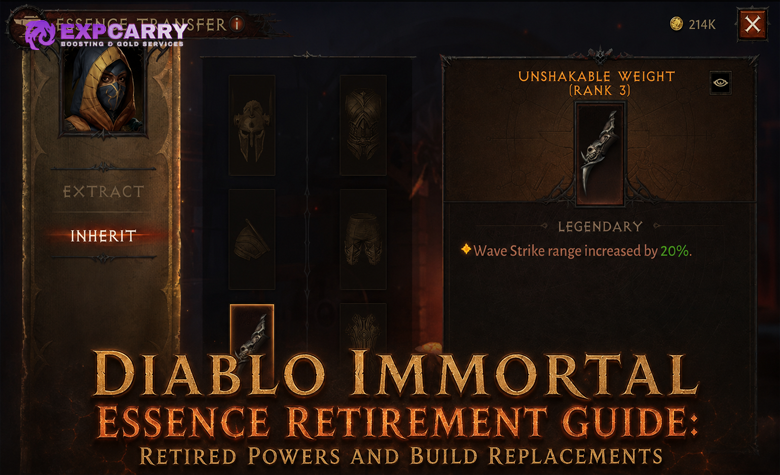
- Extract every useful Warlock Essence and use the Essence Transfer system to preserve effects as gear improves.
- Prioritize bound Legendary Gems and upgrade materials that you can obtain repeatedly.
- Keep at least one defensive Essence for difficult content instead of equipping five damage effects.
- Use Siphon Life when Life costs from Spiteful Sacrifice or Blood Offering become difficult to sustain.
- Do not copy high-Resonance PvP builds without equivalent secondary attributes and equipment ranks.
For a low-spender account, Hellbound Desire can be a practical offensive investment if you can obtain duplicate copies and rank it without delaying every other gem upgrade. Interminus Stone is attractive for mobile farming builds, while The Jolted Eye is more dependent on Critical Hit frequency and enemy density.
Common Warlock build mistakes
- Using every Life-consuming skill together: Blood Offering, Spiteful Sacrifice, and Devouring Darkness can drain you faster than your healing tools recover you.
- Ignoring Soulgorger positioning: A dead or misplaced Soulgorger removes much of the Warlock’s damage and control.
- Using Infernal Eruption without Burning synergy: Pair the skill with Burning effects and Essences that increase damage against Burning enemies.
- Taking a pure PvE build into Battlegrounds: PvP requires escape tools, control, defensive effects, and better positioning.
- Overvaluing five-star Gems: Expensive Gems are not automatically efficient when their rank is low.
- Standing still during channels: Use portals, Burning Ascent, and Warp Strike to avoid predictable attacks.
- Farming only one dungeon: Set-item farming is RNG-based, so rotate targets according to the bonuses and slots you actually need.
- Confusing Combat Rating with Resonance: Both matter, but they improve different parts of character progression.
Which Warlock build should you choose?
Choose the summon-and-Burning PvE build if you want the best general-purpose setup for solo play, dungeons, and open-world farming. Choose the Siphon Life or Spiteful Sacrifice variant for bosses when you can manage Life costs and want more sustained single-target pressure.
Choose the control-and-mobility PvP build if you play Battlegrounds regularly. Brimstone Gateway, Warp Strike, Tyrant’s Grasp, Lash of Pain, and a defensive or persistent-damage skill give you more practical value than simply adding another PvE damage cooldown.
For most accounts, the correct upgrade order is Combat Rating and gear quality first, core Warlock Essences second, equipment and Helliquary ranks third, and expensive Legendary Gem upgrades after the foundation is stable. The strongest Warlock build is the one that matches your activity, survives its mechanics, and can be upgraded consistently.