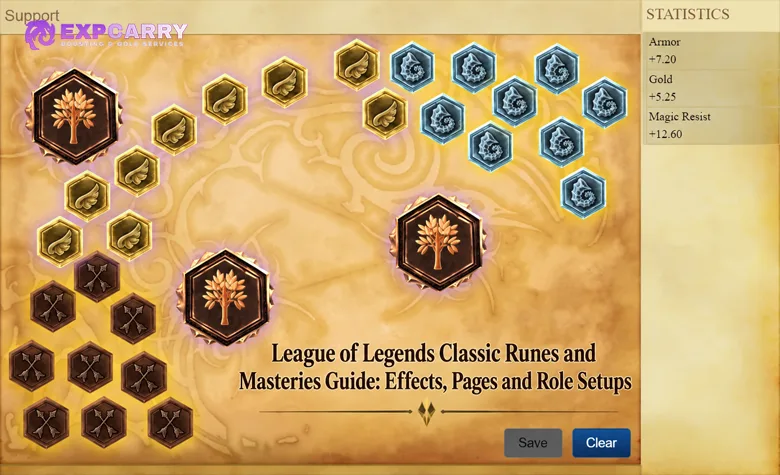
The best League of Legends Classic rune page is not one page that every champion copies. Classic gives you 30 rune sockets, a 30-point mastery page, and enough matchup-specific stats that two players on the same role can need different choices. This League of Legends Classic runes and masteries guide is built as a live system reference: it lists every current rune effect, every Offense, Defense, and Utility mastery, practical League Classic role setups, and the unlock and Influence Point rules that decide what you can actually build.
The important changes since launch are economic rather than a total rune redesign. Patch 26.17 gave every player two extra Rune Pages, more than doubled IP gained per game, doubled Classic XP, reduced Quintessence cost from 1250 to 1000 IP, reduced Minor Rune cost from 650 to 500 IP, and increased the Health Regeneration Quintessence from +1.5 to +3 Health Regen per 5 seconds. Riot's September 8 developer update also confirms a second Win of the Day bonus. That makes multiple matchup pages much easier to maintain, but it does not make one generic page correct for every lane.
How Runes and Masteries Work in League Classic
League Classic uses the legacy pre-game loadout model rather than modern keystones: you choose a Rune Page and a Mastery Page before the match. Riot explains in its League Classic developer overview that runes and masteries unlock through Classic play, use old Tier 3 strength from the start, and do not require a Tier 1-to-Tier 3 upgrade grind. Runes are persistent purchases, so a broadly useful row can be reused across many champions and saved pages instead of being repurchased for every match.
A full Rune Page has 9 Marks, 9 Seals, 9 Glyphs, and 3 Quintessences. Marks are usually the most efficient offensive row, Seals tend toward physical defense, health, and resource sustain, Glyphs are strong for Magic Resist, Ability Power, and Cooldown Reduction, and Quintessences deliver the largest single-slot bonuses. These are tendencies, not restrictions: Minor runes let you put an off-row stat such as Armor into Marks or Glyphs when a matchup makes that trade worthwhile.
Do not confuse an empty early account with a zero-stat account. Patch 26.16 raised the automatic placeholder rune power from 66% to 80% of the equivalent value. That protects new players from being crushed purely because their collection is incomplete, but a real page remains stronger because it can use the exact stats your champion and matchup need. If you are learning why a specific lane repeatedly goes wrong rather than only copying a loadout, League of Legends coaching can be used for role and matchup review; it is separate from Riot's Classic progression and does not unlock runes or mastery points.
Masteries work differently from runes. Mastery Pages unlock for free at Classic Level 3, and the complete system uses 30 points across the Offense, Defense, and Utility trees. A new tier opens after every four points invested in that tree, so reaching the final node requires committing 21 points. Splits such as 21/9/0, 9/21/0, 21/0/9, and 0/9/21 are therefore structural choices: they tell you which final tree you value, not the exact champion build by themselves.
Every Rune Type and Effect
The current live rune pool contains 53 options across four socket types. The numerical list below uses live client-derived values and reconciles the two recent Riot patches that changed the pool: Patch 26.16 added Energy, Energy Regeneration, Mana, Mana Regeneration, Ability Power, and Health Regeneration options and raised Scaling Armor Seals, while Patch 26.17 changed the Health Regeneration Quintessence again. Riot also corrected the Energy Regeneration Seal tooltip in 26.17 so the value is explicitly per 5 seconds.
| Type | Rune | Effect per rune |
|---|---|---|
| Mark | Mark of Attack Damage | +1 Attack Damage |
| Mark | Mark of Attack Speed | +1.7% Attack Speed |
| Mark | Mark of Critical Chance | +1% Critical Chance |
| Mark | Mark of Critical Damage | +2% Critical Damage |
| Mark | Mark of Lethality | +1.25 Lethality |
| Mark | Mark of Magic Penetration | +1 Magic Penetration |
| Mark | Mark of Scaling Attack Damage | +0.15 Attack Damage per level (+2.7 at level 18) |
| Mark | Minor Mark of Armor | +0.8 Armor |
| Mark | Minor Mark of Cooldown Reduction | +0.3% Cooldown Reduction |
| Mark | Minor Mark of Health | +3 Health |
| Mark | Minor Mark of Ability Power | +0.7 Ability Power |
| Seal | Seal of Armor | +1 Armor |
| Seal | Seal of Gold | +0.25 Gold per 10 seconds |
| Seal | Seal of Health | +8 Health |
| Seal | Seal of Health Regeneration | +0.5 Health Regen per 5 seconds |
| Seal | Seal of Mana Regeneration | +0.4 Mana Regen per 5 seconds |
| Seal | Seal of Scaling Armor | +0.17 Armor per level (+3.06 at level 18) |
| Seal | Seal of Scaling Health | +1.3 Health per level (+23.4 at level 18) |
| Seal | Minor Seal of Attack Speed | +0.8% Attack Speed |
| Seal | Minor Seal of Critical Chance | +0.45% Critical Chance |
| Seal | Minor Seal of Critical Damage | +0.7% Critical Damage |
| Seal | Minor Seal of Magic Resist | +0.75 Magic Resist |
| Seal | Seal of Energy Regeneration | +0.7 Energy Regen per 5 seconds |
| Glyph | Glyph of Ability Power | +1.2 Ability Power |
| Glyph | Glyph of Cooldown Reduction | +0.83% Cooldown Reduction |
| Glyph | Glyph of Magic Resist | +1.4 Magic Resist |
| Glyph | Glyph of Mana | +12 Mana |
| Glyph | Glyph of Scaling Ability Power | +0.2 Ability Power per level (+3.6 at level 18) |
| Glyph | Glyph of Scaling Cooldown Reduction | +0.1% Cooldown Reduction per level (+1.8% at level 18) |
| Glyph | Glyph of Scaling Magic Resist | +0.2 Magic Resist per level (+3.6 at level 18) |
| Glyph | Minor Glyph of Armor | +0.8 Armor |
| Glyph | Minor Glyph of Attack Speed | +0.8% Attack Speed |
| Glyph | Minor Glyph of Critical Damage | +0.7% Critical Damage |
| Glyph | Minor Glyph of Health | +3 Health |
| Glyph | Glyph of Energy | +2.3 Energy |
| Glyph | Minor Glyph of Mana Regeneration | +0.33 Mana Regen per 5 seconds |
| Quintessence | Quintessence of Ability Power | +5 Ability Power |
| Quintessence | Quintessence of Armor | +4.3 Armor |
| Quintessence | Quintessence of Attack Damage | +2.25 Attack Damage |
| Quintessence | Quintessence of Attack Speed | +4.5% Attack Speed |
| Quintessence | Quintessence of Critical Damage | +4.5% Critical Damage |
| Quintessence | Quintessence of Experience | +2% Experience gained |
| Quintessence | Quintessence of Gold | +1 Gold per 10 seconds |
| Quintessence | Quintessence of Health | +26 Health |
| Quintessence | Quintessence of Life Steal | +1.5% Life Steal |
| Quintessence | Quintessence of Movement Speed | +1.5% Movement Speed |
| Quintessence | Quintessence of Percent Health | +1.5% maximum Health |
| Quintessence | Quintessence of Spell Vamp | +2% Spell Vamp |
| Quintessence | Quintessence of Energy Regeneration | +1.8 Energy Regen per 5 seconds |
| Quintessence | Quintessence of Energy | +6 Energy |
| Quintessence | Quintessence of Cooldown Reduction | +2.5% Cooldown Reduction |
| Quintessence | Quintessence of Health Regeneration | +3 Health Regen per 5 seconds |
| Quintessence | Quintessence of Mana | +38 Mana |
Read the table by row efficiency rather than by the biggest number. Nine Attack Damage Marks give +9 Attack Damage, while nine Attack Speed Marks give +15.3% Attack Speed; neither is universally better. A champion that needs a faster jungle clear or repeated on-hit effects can value Attack Speed more, while a lane that depends on last-hit thresholds or short physical trades can prefer flat Attack Damage. The same logic applies to Magic Penetration versus Ability Power: penetration helps spell damage against the target you are actually hitting, while raw Ability Power can also strengthen shields, heals, or ratios that do not care about enemy resistance.
Marks: damage and early combat
Marks are the first place to solve an offensive requirement. Attack Damage, Attack Speed, Lethality, and Magic Penetration are the most reusable purchases because they directly affect common physical, on-hit, and spell-based patterns. Critical Chance and Critical Damage are higher-variance choices. A single 1% Critical Chance Mark can create a rare lane swing, but it is not a stable replacement for damage or penetration when you need predictable last hits and trades.
Seals: lane durability, sustain, and resources
Armor Seals are the safest generic row because every role takes physical damage from basic attacks, minions, monsters, or an AD opponent. Flat Health is useful when surviving one early all-in matters more than long scaling, while Scaling Health and Scaling Armor pay back later. Mana Regeneration, Energy Regeneration, and Gold Seals are deliberate opportunity-cost choices: every resource or economy Seal is one less defensive Seal, so use them when the matchup lets you survive without the missing durability.
Glyphs: Magic Resist, cooldowns, and scaling
Flat Magic Resist is the default defensive answer to a spell-heavy lane. Scaling Magic Resist is stronger when early magic damage is low and the important threat arrives in mid or late game. Cooldown Reduction Glyphs front-load spell frequency, while Scaling Cooldown Reduction sacrifices the first levels for a larger late total. AP and scaling AP are best on champions whose lane is safe enough that giving up Magic Resist will not cost more health than the damage gained.
Quintessences: page-defining stats
Three Quintessence slots are where a page can change identity. Three Movement Speed Quintessences provide 4.5% Movement Speed for roaming, sticking to targets, or avoiding skillshots. Three Attack Damage Quintessences provide +6.75 Attack Damage; three Ability Power Quintessences give +15 Ability Power; three Life Steal Quintessences give 4.5% Life Steal; and three Gold Quintessences generate 3 Gold per 10 seconds. Patch 26.17 makes all three Health Regeneration Quintessences worth +9 Health Regen per 5 seconds together, which is now a serious sustain option rather than a negligible filler stat.
Patch 26.16 is also why Energy users should not blindly copy a Mana page. The Patch 26.16 notes added Energy Regeneration Seals, Energy Glyphs, Energy Quintessences, and Energy Regeneration Quintessences. Maximum Energy helps a champion fit more casts into one burst window; Energy Regeneration is better when repeated trades and recovery between casts are the actual limit.
Offense, Defense and Utility Masteries

League Classic masteries are a second loadout layer, not a replacement for runes. The table below lists the current 56 nodes and exact rank values. Mastery Pages unlock for free at Classic Level 3, and every four points invested in one tree opens its next tier. The final mastery in a tree is therefore a 21-point commitment, which is why the familiar 21/9/0 and 0/9/21 shapes remain useful shorthand.
| Tree | Mastery | Max ranks | Effect |
|---|---|---|---|
| Offense | Summoner's Wrath | 1 | Improves Exhaust by another 10 Armor and Magic Resist reduction; gives +5 Attack Damage and Ability Power while Ignite is on cooldown; raises Ghost's Movement Speed bonus to 35%; makes allied Garrisoned turrets deal 50% splash damage. |
| Offense | Fury | 4 | +1 / 2 / 3 / 4% Attack Speed. |
| Offense | Sorcery | 4 | +1 / 2 / 3 / 4% Cooldown Reduction. |
| Offense | Butcher | 2 | Basic attacks deal +2 / +4 bonus damage to minions and monsters. |
| Offense | Deadliness | 4 | +0.166 / 0.333 / 0.498 / 0.664 Attack Damage per level, reaching about 2.99 / 5.99 / 8.96 / 11.95 Attack Damage at level 18. |
| Offense | Blast | 4 | +0.25 / 0.5 / 0.75 / 1 Ability Power per level, reaching 4.5 / 9 / 13.5 / 18 Ability Power at level 18. |
| Offense | Destruction | 1 | Increases damage to turrets by 5%. |
| Offense | Havoc | 3 | Increases damage dealt by 0.67 / 1.33 / 2%. |
| Offense | Weapon Expertise | 1 | +8% Armor Penetration. |
| Offense | Arcane Knowledge | 1 | +8% Magic Penetration. |
| Offense | Lethality | 2 | +2.5 / 5% Critical Strike Damage; melee champions receive 5 / 10%. |
| Offense | Brute Force | 2 | +1.5 / +3 Attack Damage. |
| Offense | Mental Force | 3 | +2 / +4 / +6 Ability Power. |
| Offense | Spellsword | 1 | Basic attacks deal bonus magic damage equal to 5% of Ability Power. |
| Offense | Frenzy | 1 | Landing a critical strike grants 10% Attack Speed for 2 seconds. |
| Offense | Sunder | 3 | +2 / +4 / +6 Armor Penetration. |
| Offense | Archmage | 4 | Increases Ability Power by 1.25 / 2.5 / 3.75 / 5%. |
| Offense | Executioner | 1 | Increases damage dealt by 5% against targets below 50% Health. |
| Defense | Summoner's Resolve | 1 | Improves Cleanse by extending its disable-reduction effect by 1 second; Heal passively grants +5 Health per level; Smite grants 10 bonus Gold on use; Barrier gains 20 shield strength. |
| Defense | Perseverance | 3 | Grants up to +2 / +4 / +6 Health Regen per 5 seconds based on missing Health. |
| Defense | Durability | 4 | +1.5 / +3 / +4.5 / +6 Health per level, reaching +27 / +54 / +81 / +108 Health at level 18. |
| Defense | Tough Skin | 2 | Reduces damage taken from monsters by 1 / 2. |
| Defense | Hardiness | 3 | +2 / +4 / +6 Armor. |
| Defense | Resistance | 3 | +2 / +4 / +6 Magic Resist. |
| Defense | Bladed Armor | 1 | Deals 6 damage to a monster whenever that monster attacks you. Requires 2 points in Tough Skin. |
| Defense | Unyielding | 2 | Reduces damage taken from enemy champions by 1 / 2. |
| Defense | Relentless | 2 | Reduces the effectiveness of slows by 7.5 / 15%. |
| Defense | Veteran's Scars | 1 | +30 Health. Requires 4 points in Durability. |
| Defense | Safeguard | 1 | Reduces damage taken from turrets by 5%. |
| Defense | Block | 1 | Reduces damage taken from champion basic attacks by 3. |
| Defense | Tenacious | 3 | Reduces crowd control duration by 5 / 10 / 15%; stacks multiplicatively with Tenacity. |
| Defense | Juggernaut | 3 | Increases maximum Health by 1.5 / 2.75 / 4%. |
| Defense | Defender | 1 | Grants +1 Armor and Magic Resist for each nearby enemy champion. |
| Defense | Legendary Armor | 3 | Increases bonus Armor and Magic Resist by 2 / 4 / 6%. |
| Defense | Good Hands | 1 | Reduces time spent dead by 10%. |
| Defense | Reinforced Armor | 1 | Reduces damage taken from critical strikes by 10%. |
| Defense | Honor Guard | 1 | Reduces damage taken from all sources by 3%. |
| Utility | Summoner's Insight | 1 | Teleport casts 0.5 second faster; Revive grants bonus Health for 2 minutes; Flash cooldown is reduced by 15 seconds; Clarity restores 25% more Mana; Clairvoyance grants additional vision of revealed enemy units. |
| Utility | Wanderer | 3 | Grants 0.66 / 1.33 / 2% Movement Speed while out of combat. |
| Utility | Meditation | 3 | +1 / +2 / +3 Mana Regen per 5 seconds. |
| Utility | Improved Recall | 1 | Reduces Recall cast time by 1 second and Enhanced Recall cast time by 0.5 second. |
| Utility | Scout | 1 | Wards gain 25% more vision range for the first 3 seconds after placement. |
| Utility | Mastermind | 3 | Reduces Summoner Spell cooldowns by 4 / 7 / 10%. |
| Utility | Expanded Mind | 3 | +4 / +7 / +10 Mana per level, reaching +72 / +126 / +180 Mana at level 18. |
| Utility | Artificer | 2 | Reduces the cooldown of activated items by 7.5 / 15%. |
| Utility | Greed | 4 | Grants +0.5 / +1 / +1.5 / +2 Gold every 10 seconds. |
| Utility | Runic Affinity | 1 | Increases the duration of shrine, relic, quest, and neutral monster buffs by 20%. |
| Utility | Vampirism | 3 | +1 / +2 / +3% Life Steal and Spell Vamp. |
| Utility | Biscuiteer | 1 | Starts the game with a regenerative biscuit that restores 80 Health and 50 Mana over 10 seconds. |
| Utility | Wealth | 2 | Increases starting Gold by 40 / 75. |
| Utility | Awareness | 4 | Increases Experience gained by 1.25 / 2.5 / 3.75 / 5%. |
| Utility | Strength of Spirit | 3 | Grants up to +1 / +2 / +3 Health Regen per 5 seconds for each 400 Mana you possess. Patch 26.17 removed an incorrect Expanded Mind prerequisite. |
| Utility | Explorer | 1 | On Summoner's Rift, starts you with a ward that reveals its area for 60 seconds; on other maps it grants 25 starting Gold. |
| Utility | Pickpocket | 1 | Basic attacking an enemy champion grants 5 Gold for melee champions or 3 Gold for ranged champions, with a 5-second cooldown. |
| Utility | Intelligence | 3 | +2 / +4 / +6% Cooldown Reduction. |
| Utility | Nimble | 1 | Grants 3% Movement Speed. |
The table is the reference, but the practical decision is simpler. Offense is for converting stats into kills, wave pressure, turret damage, and execution thresholds. Defense is for surviving lane, jungle camps, crowd control, crits, and team fights. Utility buys movement, Summoner Spell frequency, resource sustain, starting economy, vision, and experience. The wrong tree is usually not the one with a lower theoretical total; it is the one that fails to solve the matchup that can stop your champion from reaching its intended item and level timings.
Offense mastery priorities
Physical carries usually care about Weapon Expertise, Sunder, Brute Force, Deadliness, and Executioner, while AP carries care about Arcane Knowledge, Mental Force, Blast, Archmage, and Executioner. Fury and Sorcery decide whether basic attacks or spell frequency matter more in the first tier. Summoner's Wrath is only efficient when one of the affected Summoner Spells is actually in your loadout, so do not spend the point out of habit.
Defense mastery priorities
Lane durability starts with the damage type. Hardiness is the direct Armor answer and Resistance is the Magic Resist answer. Durability into Veteran's Scars gives a broader Health cushion, while Unyielding and Block are strongest against repeated champion hits and basic attacks. Junglers should pay special attention to Tough Skin and its Bladed Armor prerequisite path. Deep Defense pages use Juggernaut and Honor Guard when surviving the first engage matters more than adding another small damage multiplier.
Utility mastery priorities
Utility is strongest when time, movement, resources, or low-income play are the bottleneck. Meditation and Expanded Mind address Mana, Mastermind and Summoner's Insight improve Summoner Spell access, Greed, Wealth, and Pickpocket help low-income roles, and Intelligence provides up to 6% Cooldown Reduction. Nimble is the 21-point payoff for movement-focused pages. Strength of Spirit is now easier to reach correctly because Patch 26.17 fixed the bug that incorrectly forced three points in Expanded Mind before it.
Classic masteries are unrelated to the modern account-facing Champion Mastery progression. If a player is separately working on one champion's long-term account mastery, ExpCarry's Champion Mastery service covers that different system; it does not provide Classic mastery-tree points, Rune Pages, or IP.
Explore services related to this guide, selected from our League of Legends catalog.
View All League of Legends Services


Top, Jungle, Mid, ADC and Support Pages
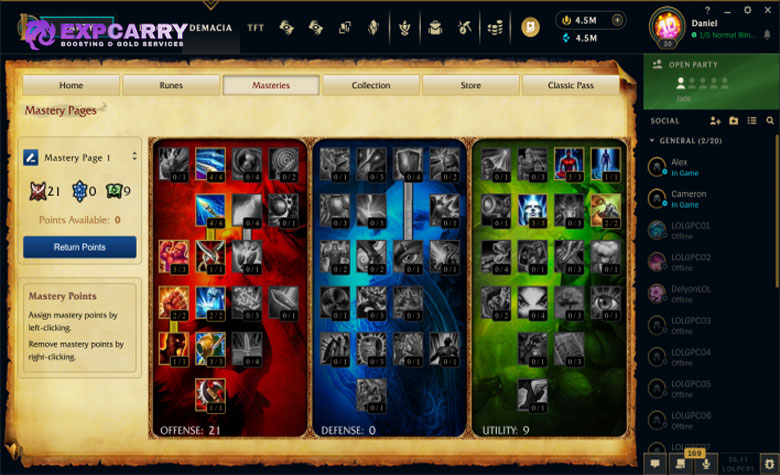
These League Classic role setups are deliberately broad starting pages rather than 60 champion builds. They are designed to be useful before you know the enemy lane and then easy to modify when draft reveals a specific threat. The rune rows are exact 30-slot pages; the mastery split gives the correct structural direction, while the nodes inside that split should follow champion damage type, Summoner Spells, and the matchup rules explained below.
| Role | Baseline Rune Page | Mastery shell | Why it works |
|---|---|---|---|
| Top | 9 Attack Damage Marks; 9 Armor Seals; 9 Scaling Magic Resist Glyphs; 3 Attack Damage Quintessences | 9/21/0 durable baseline; 21/9/0 for carry tops | Stable last hitting, physical lane defense, late Magic Resist, and enough damage to trade. Swap toward Movement Speed or flat Magic Resist when the lane demands it. |
| Jungle | 9 Attack Speed Marks; 9 Armor Seals; 9 Scaling Magic Resist Glyphs; 3 Movement Speed Quintessences | 9/21/0 tank or bruiser baseline; 21/9/0 for aggressive physical junglers | Attack Speed and Armor improve early clears while Movement Speed helps reach camps and gank angles. Keep Tough Skin and Bladed Armor on defense-heavy pages. |
| Mid | 9 Magic Penetration Marks; 9 Armor Seals; 9 Magic Resist Glyphs; 3 Ability Power Quintessences | 21/0/9 AP baseline | A balanced AP page that still respects physical auto attacks and opposing spell damage. In a safe lane, trade defense for scaling AP, CDR, Mana, or Mana Regen. |
| ADC | 9 Attack Damage Marks; 9 Armor Seals; 9 Magic Resist Glyphs; 3 Attack Damage Quintessences | 21/9/0 | Reliable early last hits and trading with standard defenses. Life Steal or Attack Speed Quintessences are matchup and champion swaps, not automatic upgrades. |
| Support | 9 Magic Penetration Marks or 9 Minor Armor Marks; 9 Armor Seals; 9 Magic Resist Glyphs; 3 Gold Quintessences | 0/9/21 | Use Magic Penetration when lane damage matters, Minor Armor for engage tanks taking repeated autos, and Gold Quintessences when the lane is safe enough to invest in economy. |
Top: choose between surviving and carrying
The durable 9/21/0 top shell is best when the opponent can force extended trades or when your champion becomes useful by simply reaching mid game. Flat Armor Seals protect the first waves, while Scaling Magic Resist Glyphs preserve value against later spell damage. A carry top that reliably wins the lane can flip to 21/9/0 and keep the same rune skeleton. Against an AP lane, swap Armor-heavy pieces toward flat Magic Resist, Health, or sustain; against a ranged lane, Movement Speed Quintessences can be worth more than another small damage stat because reaching or escaping the trade is the real problem.
Jungle: clear safety comes before theoretical damage
Classic jungle monsters punish weak first clears, so the generic page uses Attack Speed Marks and Armor Seals. A tank or bruiser can run 9/21/0 with Tough Skin and Bladed Armor, while an aggressive physical jungler that already clears safely can move to 21/9/0 for Weapon Expertise, Sunder, and Executioner. Movement Speed Quintessences are not just a gank stat: they reduce travel time between camps, which can translate into earlier recalls and more windows to contest lanes.
If your jungle champion relies on abilities instead of repeated basic attacks, do not preserve Attack Speed just because the page says Jungle. AP junglers can use Magic Penetration Marks and Ability Power or Movement Speed Quintessences, while energy-based junglers can use the Energy runes introduced in 26.16. The rune page follows the clear pattern, not the role label.
Mid: defend the lane you actually have
The default AP mid page uses Magic Penetration Marks, Armor Seals, Magic Resist Glyphs, and Ability Power Quintessences on a 21/0/9 shell. That is intentionally conservative. Against a physical assassin or auto-attack-heavy mid, keep Armor and consider additional flat Health. Against a low-pressure AP farmer, Scaling Ability Power or Cooldown Reduction Glyphs can replace some Magic Resist. Champions with expensive spell loops can move Seals toward Mana Regeneration only when the lost Armor will not turn every enemy auto attack into a losing trade.
ADC: consistency usually beats novelty
ADC pages need reliable last hitting, short-trade damage, and enough lane defense to stay in range of the wave. Nine Attack Damage Marks, nine Armor Seals, nine Magic Resist Glyphs, and three Attack Damage Quintessences provide that stable floor. The 21/9/0 mastery shell then pushes toward Weapon Expertise, Sunder, crit-related nodes when relevant, and Executioner. Attack Speed Quintessences are better on champions whose damage pattern scales harder with repeated attacks; Life Steal Quintessences are a sustain answer when surviving poke matters more than maximum first-hit damage.
Support: economy is only good if you can survive
Support is the role where a Gold-focused page can be genuinely correct because farm income is limited, but it is also the role where buying too much economy can make lane unplayable. Three Gold Quintessences add 3 Gold per 10 seconds, and Utility masteries can add Greed, Wealth, and Pickpocket. Against a hard engage lane, replace Gold or offensive Marks with Health, Armor, or Movement Speed. A dead support earns no value from a greedier page.
Bot-lane rune decisions also depend on how the two-player lane is coordinated. Players who practice duo lane communication in standard League can use ExpCarry's LoL Duo Boost as a separate self-play service, but it should not be confused with Classic progression: it does not unlock Classic runes, pages, or mastery points. For Classic itself, the useful lesson is to tune the page around the combined enemy damage and engage pattern, not around the Support label alone.
Item choice must then match the page rather than fight it. A sustain-heavy rune setup, for example, may let you delay defensive components, while a greedy scaling page may require a safer first recall. ExpCarry's League Classic items guide covers the separate question of first-buy spikes and build paths without turning this system reference into another champion build article.
When to Change Individual Runes
The fastest way to improve a Rune Page is to identify what decides the first ten minutes of the specific matchup, then change the smallest number of slots that solves it. Do not rebuild all 30 runes every time. Keeping a stable core makes it easier to understand whether a substitution actually helped.
- Against heavy physical pressure: prioritize Armor Seals, and add Minor Armor Marks or Glyphs only when basic attacks and physical burst are the main reason you cannot lane. Defense mastery points in Hardiness, Unyielding, and Block reinforce the same plan.
- Against magic burst: use flat Magic Resist Glyphs instead of scaling Magic Resist. Resistance in the Defense tree is more valuable when the dangerous spell combo arrives before scaling runes have caught up.
- Against sustained poke: flat Health, Health Regeneration, Life Steal, Spell Vamp, or the newly buffed Health Regeneration Quintessence can outperform a pure damage page if the extra sustain prevents a forced recall.
- For safe scaling lanes: move from flat defenses into Scaling Health, Scaling Armor, Scaling Magic Resist, Scaling Ability Power, Scaling Attack Damage, or Scaling Cooldown Reduction. Only do this when you are confident the opponent cannot punish the weaker first levels.
- For roaming or target access: Movement Speed Quintessences are often more valuable than another offensive stat because being in range creates damage that a stationary stat cannot.
- For resource-limited champions: Mana, Mana Regeneration, Energy, and Energy Regeneration are different solutions. Maximum resource expands one cast sequence; regeneration improves repeated trades over time.
- For low-income supports: Gold Seals, Gold Quintessences, Greed, Wealth, and Pickpocket can compound over a game, but every economy slot removes combat strength. Keep enough defense to survive the lane first.
- For cooldown breakpoints: combine Glyphs, Quintessences, Sorcery, and Intelligence only until the planned item build reaches the cooldown target you need. Extra CDR that pushes far beyond the cap is wasted page budget.
One of the most common mistakes is comparing only level-18 totals. Flat runes buy certainty now; scaling runes buy a stronger future. If a melee top is being zoned from the wave at level 3, a larger level-18 number does not recover the lost farm by itself. Conversely, a safe control mage that never takes meaningful early damage may be wasting a row on flat defense that could have become scaling AP or CDR.
Critical Chance is the clearest example of risk versus consistency. One Mark gives 1% Critical Chance and can produce a memorable early crit, but the expected outcome over a small number of trades is volatile. Use it only when you accept that variance. For stable farming and repeatable matchup planning, Attack Damage, Attack Speed, penetration, or defense are easier to evaluate.
Unlocks, Costs and Extra Rune Pages
Classic progression gates the system by level rather than making every loadout available immediately. Mastery Pages unlock at Classic Level 3, Marks at Level 4, Seals at Level 6, Glyphs at Level 7, and Quintessences at Level 8. Rune categories unlock as groups, not one socket at a time. Riot's launch design starts each player with three Rune Pages; the progression track then awards one additional page at Classic Level 13 and another at Level 20. Patch 26.17 separately granted two more free Rune Pages to every player, so an account that reaches Level 20 can have seven free Rune Pages before any store or pass purchases.
The safest way to quote costs after 26.17 is to separate what Riot explicitly changed from older launch ranges. Standard Marks, Seals, and Glyphs were the 500-IP baseline, while Minor Runes were the 650-IP off-row options; Patch 26.17 reduced those Minor Runes to 500 IP. Riot reduced the called-out Quintessence cost from 1250 to 1000 IP. An extra Rune Page has been listed at 1500 IP in the Classic Store, and Patch 26.17 did not announce a change to that page price.
- Mastery Pages: free from Classic Level 3.
- Standard Mark, Seal, or Glyph baseline: 500 IP per rune.
- Minor Rune after Patch 26.17: 500 IP, down from 650 IP.
- Quintessence after Patch 26.17: 1000 IP, down from the 1250-IP value Riot changed.
- Additional Rune Page: 1500 IP in current Classic Store references; the 26.17 notes did not list a price change.
At the 500-IP baseline for all 27 non-Quintessence slots plus 1000 IP for each of three Quintessences, a full 30-slot page built entirely from store purchases is 16,500 IP. That is a planning number, not a reason to buy 30 isolated runes for every saved page. Runes are persistent collection pieces and can support multiple saved pages, while missions, Classic levels, and pass rewards can also add runes or pages to the account.
The correct purchase order is usually a reusable row before a niche experiment. Physical players get more value from completing Attack Damage or Attack Speed Marks than buying several unrelated one-off Marks. Almost every role can use Armor Seals. Magic Resist Glyphs are a strong universal defensive row. Quintessences should come after the category is unlocked because each slot is more expensive, but three good Quintessences can define multiple pages at once.
- Unlock Mastery Pages and finish a legal 30-point shell before spending IP on convenience.
- Complete one reusable Mark row for your main damage type.
- Add Armor or another matchup-relevant Seal row once Seals unlock.
- Buy a reusable Magic Resist, CDR, or AP Glyph row at Level 7.
- At Level 8, buy three Quintessences that work across several champions, such as Attack Damage, Ability Power, or Movement Speed.
- Only then spend on narrow Gold, Energy, critical, sustain, or matchup pages unless your main champion specifically requires them.
- Use extra Rune Pages to preserve role and matchup variants instead of rebuilding the same page before every queue.
Patch 26.17 makes this path materially faster. Riot's Patch 26.17 notes confirm the two free Rune Pages, more than doubled IP gain, doubled Classic XP, cheaper Minor Runes and Quintessences, and the Health Regeneration Quintessence buff. Riot's September 8 developer update also confirms a second Win of the Day bonus. ExpCarry's separate League Classic Patch 2 guide covers the rest of 26.17's champion, item, champion-select, and Council changes, so this article can stay focused on the rune and mastery system.
Conclusion
A strong League Classic Rune Page starts with a role baseline, then changes only the slots that answer the draft. Marks usually solve damage, Seals solve early durability or resources, Glyphs handle Magic Resist and cooldown needs, and Quintessences make the largest page-level tradeoffs. Masteries follow the same principle: 21/9/0, 9/21/0, 21/0/9, and 0/9/21 are useful shells, but the correct nodes depend on damage type, Summoner Spells, lane pressure, jungle safety, and whether your champion needs damage, durability, or utility to reach its first real power spike.
For account progression, unlock Mastery Pages first, then Marks, Seals, Glyphs, and Quintessences as Classic Levels open them. Spend IP on reusable rows before niche experiments, take advantage of the extra Rune Pages, faster IP and XP, and the additional Win of the Day bonus introduced through Riot's recent Classic progression updates, and keep matchup variants rather than one universal page. That approach gives you a small collection of pages that remain practical across Top, Jungle, Mid, ADC, and Support without turning the system into dozens of champion-specific builds.