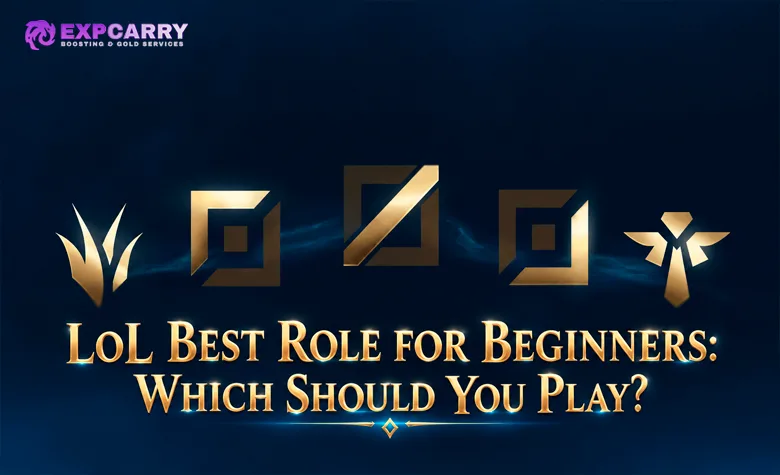
The best role for beginners in League of Legends depends on what you find difficult. Top lane is a practical starting point if you want to learn farming and fighting without making frequent decisions across the entire map. Support is better if you dislike last hitting and enjoy helping a teammate, although it still requires positioning, vision and judgment. Mid lane teaches a broad range of skills but demands more map awareness, while ADC requires consistent farming and careful positioning. Jungle removes ordinary lane farming but adds substantial responsibility for pathing, ganks and objectives. As of Patch 26.20, the 2026 Role Quest system also gives positions different progression rewards, making their responsibilities more distinct. This guide compares all five roles by learning difficulty, farming requirements, map awareness and pressure so you can choose a position that suits your experience and playstyle.
Short answer: Start with top lane if you want to learn core League fundamentals at a manageable pace, or support if last hitting is your biggest obstacle. Choose mid for a broader introduction to laning and map decisions, while ADC and jungle are better starting points when you specifically enjoy their more demanding responsibilities.
What Is the Best Role for Beginners in LoL?
There is no officially designated easiest role in League of Legends. Every position can be learned by a new player, but each demands a different combination of mechanics, farming, map awareness and teamwork. The most suitable starting role is the one that lets you concentrate on a manageable number of decisions while still learning how to contribute to a victory.
For a player who has no strong preference, top lane is a reasonable first recommendation. You can begin by learning a single lane matchup, collecting minions and deciding when to trade or retreat. Support is the natural alternative for someone who wants to contribute without being responsible for ordinary minion last hits. Neither position is universally easier: top lane can punish unfavorable matchups, while support involves coordinating with another player and making important vision decisions.
| Role | Main Learning Challenge | Farming Requirement | Map Decision Load | Best For |
|---|---|---|---|---|
| Top | Solo matchups and wave control | Regular minion last hitting | Lower early, increases later | Players wanting to focus on one lane |
| Support | Lane coordination, vision and protection | Limited ordinary last hitting; support-item income | Moderate to high | Players who dislike farming and enjoy teamwork |
| Mid | Farming while monitoring nearby fights | Regular minion last hitting | High | Players wanting to learn many core skills |
| ADC / Bot | Last hitting, positioning and surviving fights | Very important for item progression | Moderate, with demanding combat awareness | Players who enjoy sustained damage |
| Jungle | Pathing, timing, ganks and objectives | Jungle camps instead of lane last hits | Very high | Players who enjoy planning and map-wide decisions |
The difficulty descriptions are practical editorial judgments, not official Riot difficulty ratings or measured win-rate rankings. Champion choice, opponents and personal experience can change how demanding a role feels. A beginner comfortable with strategy games may enjoy jungle immediately, while another player may prefer the more predictable early structure of a lane.
Which Role Should You Choose Based on What You Struggle With?
A useful way to select your first role is to identify which part of League feels overwhelming. Some players find last hitting difficult, others cannot track enemy movement, and some dislike having to initiate fights or make decisions for teammates. Those are different problems and should not lead automatically to the same recommendation.
Choose a role that reduces your biggest immediate obstacle without preventing you from learning skills you will eventually need. A position can make your first games more comfortable, but avoiding every difficult mechanic forever may limit your development.
| Your Main Difficulty | Recommended Starting Role | Why It Fits | Important Trade-Off |
|---|---|---|---|
| I struggle to last-hit minions | Support | Ordinary minion farming is not your main source of income | You must learn vision and lane coordination instead |
| I rarely notice enemies moving around the map | Top | Early decisions focus more heavily on one lane | You still need to track ganks and later rotations |
| I dislike making calls for the whole team | Top | Provides a more defined early lane responsibility | Solo mistakes can be difficult to recover from |
| I want to learn the most transferable lane skills | Mid | Combines farming, trading, wave control and map movement | Requires attention to several nearby threats |
| I prefer helping other players | Support | Focuses on enabling and protecting teammates | Requires active decisions, not simply following the ADC |
| I want to deal sustained damage in fights | ADC | Develops attacking, spacing and target-selection skills | Small positioning mistakes can be heavily punished |
| I enjoy routes, planning and map control | Jungle | Rewards structured pathing and strategic decisions | Requires a broad early understanding of other positions |
Best Role If You Are Bad at Farming
Support is the clearest option if last hitting is your biggest concern. A support normally purchases a dedicated income item and helps the bot carry farm rather than competing for ordinary minion kills. You can focus on positioning, using abilities effectively, protecting your partner and learning where to place vision.
However, support does not remove the need to understand minions. You still need to recognize when a wave is dangerous, when your lane partner wants to push and when leaving bot lane would expose them. Support-item quest stacks can be consumed through eligible minion kills or combat interactions, so follow the item's current instructions rather than assuming you should never touch a wave.
If your long-term goal is to play mid, top or ADC, practicing last hitting directly may be more useful than switching to support solely to avoid it. The best starting role should match the type of game you actually want to learn.
Best Role If You Have Poor Map Awareness
Top lane is a practical starting choice for players who struggle to follow several fights at once. Early top-lane play often concentrates on your direct opponent, the wave and the possibility of a jungle gank. This gives you a smaller set of immediate responsibilities than navigating between jungle camps or deciding when to roam from mid.
Top lane is not disconnected from the rest of the map. You still need to notice missing enemies, protect yourself from ganks and eventually decide whether to push a side lane or join your team. The advantage is that you can introduce those skills gradually while learning a fairly consistent early lane routine.
Best Role If You Are Afraid of Team Responsibility
Top lane can feel more manageable if you are uncomfortable making frequent calls about objectives or coordinating movements between several teammates. During the early game, you can concentrate on farming, understanding your matchup and avoiding unnecessary deaths. Your first objective does not need to be directing the entire team's strategy.
That does not mean top lane has little impact or that its mistakes do not matter. A badly managed wave or repeated death can create a large disadvantage. Likewise, support is not a responsibility-free alternative: a missed engage or poor defensive decision can affect the bot carry and later teamfights. Choose the type of responsibility you are willing to learn rather than searching for a role where your decisions never matter.
Top Lane: Best Starting Role for Learning the Fundamentals
Top lane is our default recommendation for beginners who want to understand ordinary Summoner's Rift laning. It provides a clear early routine: go to your assigned lane, collect farm, learn the enemy matchup and protect your position. Because there is usually one opposing solo laner, you can more easily identify which trades and wave decisions are working.
Its main drawback is isolation. If an opponent builds a lead, recovering can be difficult without help from teammates. Some matchups heavily favor one side, and champions with strong early dueling or wave control can punish unfamiliar players. Choosing a straightforward, durable champion can reduce mechanical complexity but does not eliminate these matchup challenges.
What to Focus on During Your First Top-Lane Games
Begin by staying close enough to receive experience and learning when a minion is safe to last-hit. Watch whether the enemy has more minions, an important ability ready or enough health to win an extended fight. You do not need a solo kill to have a useful laning phase; consistent farming and avoiding unnecessary deaths provide a solid foundation.
After the lane becomes more comfortable, begin learning when to push a wave, recall or help with a nearby objective. This introduces map awareness without requiring you to manage every lane simultaneously.
When Top Lane Is a Poor Beginner Choice
Top may not suit you if extended one-on-one matchups feel frustrating or if you strongly prefer playing beside a teammate. Its quieter early structure comes with fewer immediate opportunities for a partner to correct your mistakes. A losing lane can feel especially restrictive when the opposing champion controls the wave.
If you enjoy protecting others and sharing a lane, try support instead. If you want more opportunities to move between lanes and influence nearby fights, mid may be a better long-term choice.
Explore services related to this guide, selected from our League of Legends catalog.
View All League of Legends Services
Support: Best Role for Beginners Who Dislike Last Hitting
Support offers a different learning path. Instead of concentrating on ordinary minion last hits, you help the bot carry trade, survive and access resources. You also contribute vision and crowd control that can influence fights without requiring the same gold income as a farming damage dealer.
For a player who enjoys cooperation, this can make the first matches more approachable. Your success is not measured only by kills or CS. A well-timed defensive ability, a useful ward or a correctly chosen engage can contribute to a winning fight even when you have fewer items than your teammates.
What to Focus on During Your First Support Games
Start by staying near enough to help your lane partner without standing so far forward that the enemy can attack you freely. Learn when your basic abilities can protect an ally or create a safe trade. Pay attention to your support item and use the available warding tools to reveal likely approaches.
Do not roam simply because experienced support players frequently move across the map. First understand whether the bot carry can safely remain alone and whether another part of the map offers a realistic opportunity. The 2026 support quest also penalizes early progress outside bot lane, with stricter early-lane restrictions introduced in Patch 26.16. Leaving at the wrong time can therefore hurt both your lane partner and your own progression.
Why Support Is Not Automatically the Easiest Role
Support removes a major mechanical task but adds decisions involving other players. You must understand when to engage, when to retreat, which teammate needs protection and how to establish vision without being caught. These responsibilities become more important as games move beyond the laning phase.
Support also teaches a different set of fundamentals from solo farming roles. You may become comfortable with vision and teamfighting while remaining inexperienced at last hitting or controlling a solo wave. If you eventually want to transition to another position, some additional laning practice will be necessary.
Mid Lane: Best Role for Learning Both Laning and Map Play
Mid lane is a strong choice for players who want a broad understanding of League of Legends. It combines ordinary minion farming with trading, wave management, nearby jungle interactions and opportunities to move toward either side of the map. Many skills learned in mid transfer naturally to top, bot and other positions.
The disadvantage is attention. You must watch both sides of the river, recognize enemy roams and decide when leaving the lane is worth the farm you might lose. Mid can be more demanding than top during the early learning process because several different threats may become relevant in a short period.
What to Focus on During Your First Mid-Lane Games
Begin with a champion whose abilities and farming pattern you can understand. Concentrate on collecting waves, controlling your distance from the opponent and checking the minimap before pushing far from your turret. It is acceptable to stay in lane and farm instead of attempting every possible roam.
As you improve, start connecting the wave to map movements. When you safely push, look for useful vision or a nearby teammate who needs help. If leaving would cost a large wave or expose you to an unknown enemy, remaining in lane may be the better choice.
Top vs Mid: Which Teaches More Useful Skills?
Both teach farming, trading, wave control and basic matchups. Top generally lets you focus more deeply on one opponent and side-lane decisions, while mid introduces more frequent opportunities to evaluate movements across the map. Neither set of skills is universally better; they emphasize different parts of the game.
Choose top if you want to slow down the number of decisions you need to make at once. Choose mid if you already feel comfortable controlling your champion and want to develop lane mechanics and map awareness together.
ADC: Best Role If You Enjoy Damage and Precise Positioning
ADC, usually played as the bot carry, is appealing to beginners who enjoy attacking enemies and becoming stronger through purchased items. Its main responsibility is to collect enough resources to deal meaningful damage while staying alive during fights. Unlike support, the bot carry depends heavily on ordinary farming and must share the lane with a teammate whose decisions also affect the matchup. Although bot can also be played by some mages, this section focuses on the traditional marksman playstyle.
This can make ADC demanding early. You are learning last hitting, enemy attack ranges, support interactions and movement while trying to avoid being eliminated by opponents with strong engage tools. A champion with straightforward abilities can make the mechanical side more manageable, but positioning remains essential.
What to Focus on During Your First ADC Games
Learn to secure minions while remaining within a safe distance of your support. Avoid taking unnecessary damage just to attack the opposing champions. In fights, focus on surviving and dealing damage to an accessible target instead of moving through dangerous enemies to reach someone farther away.
ADC becomes more rewarding as you learn to move between attacks, anticipate engage abilities and recognize when your support is ready to fight. These skills are developed through repetition, so a few difficult early matches do not mean the role is unsuitable for you.
Should Complete Beginners Avoid ADC?
No. ADC is a reasonable starting role if sustained damage and careful movement are what interest you most. Its difficulty comes from needing several skills at once, not from being inaccessible to new players. If you enjoy the playstyle, practice farming and positioning gradually rather than changing roles only because the first matches feel difficult.
However, if last hitting, managing a second player in lane and surviving close fights all feel overwhelming simultaneously, trying top or support first may make the learning process less frustrating.
Jungle: No Lane Last Hitting, but More Map Responsibility
Jungle is unusual because it does not require traditional lane last hitting. Instead, you earn resources by defeating neutral camps and decide where to move between them. This can initially seem easier than facing an opponent over every minion, but the position requires frequent decisions about routes, ganks and objectives.
Junglers also use Smite and a jungle companion system to improve their clearing and objective control. Their decisions influence several lanes, which can make the role demanding when you are still learning what those lanes need. A beginner who does not understand wave positions may struggle to identify which gank opportunities are realistic.
What to Focus on During Your First Jungle Games
Start with a straightforward jungle champion and learn a basic camp-clearing route. Practice moving between camps efficiently and finishing your clear with enough health to make a useful next decision. Look for ganks when opponents are exposed and a nearby teammate can assist, rather than moving between lanes without collecting resources.
When your clear becomes comfortable, begin paying attention to objective availability and nearby lane pressure. You do not need complicated invasion plans or perfect enemy jungle tracking immediately. Understanding where to farm and when a gank is realistic provides a better foundation.
Why Jungle Can Be the Hardest First Role
Jungle has less direct lane farming but a larger number of possible actions at almost every moment. You can clear another camp, help a lane, establish vision, defend part of your jungle or prepare an objective. Choosing between those actions becomes easier when you understand what is happening in the lanes around you.
The position can also attract more expectations from teammates because the jungler can appear in several places. You are not responsible for controlling every teammate's lane, but you do need to recognize which actions are realistically useful. If you enjoy planning and learning the map, jungle is still a valid first role; expect a steeper strategic learning curve rather than an impossible one.
How the 2026 Role Quest System Changes Each Position
League of Legends expanded Role Quests in Patch 26.1, introducing quests for top, mid and bot while updating the existing jungle and support systems. In standard queues with assigned positions, players receive a quest based on their assigned role, with progress earned through relevant gameplay actions and rewards tailored to that position. Subsequent patches adjusted the system: Patch 26.9 changed quest progression and rewards, Patch 26.16 tightened early support-roaming penalties, and Patch 26.19 improved the cooldowns of Teleport granted or upgraded through the top-lane quest. These changes remain relevant in Patch 26.20.
For choosing a beginner role, the important point is that each position has a different progression focus and reward. Riot designed these quests to reinforce normal role responsibilities, not to make one position officially easier than the others. The descriptions below summarize the mechanics without relying on exact quest thresholds that may change between patches.
| Role | Progression Focus | What It Means for a Beginner |
|---|---|---|
| Top | Solo-lane progression; bonus experience and access to a free or upgraded Teleport | Practice farming, managing waves and using Teleport to return to lane or influence the map |
| Jungle | Jungle companion growth, camp clearing and Smite upgrades | Learn efficient clears, gank timing and objective control |
| Mid | Laning and champion combat; upgraded boots and bonus AD/AP after quest completion | Balance farming, trading and map awareness while learning your reward's power spike |
| Bot / ADC | Minion farming; extra gold income and boots moving into the Role Quest slot | Practice consistent farming and understand how additional gold and inventory space support item scaling |
| Support | Support-item quest progression; vision utility and Control Ward storage in the Role Quest slot | Learn to support teammates, manage quest stacks and establish vision without depending on ordinary CS income |
Riot's Patch 26.1 notes establish the role-specific system, while the Patch 26.9 notes document later progression changes, including the replacement of mid lane's empowered Recall reward with bonus AD and AP. Patches 26.16 and 26.19 subsequently adjusted support quest progression and top-lane Teleport respectively. You do not need to memorize every reward to choose a role, but you should recognize which actions your assigned position is intended to perform.
Why Swiftplay and Normal Draft May Feel Different
The expanded 2026 Role Quest system is active in standard queues with assigned positions but is not enabled in Swiftplay. Riot retained separate jungle and support quest mechanics there while providing a shorter, accelerated Summoner's Rift experience. As a result, a role can feel different in Swiftplay from how it plays in standard Normal Draft or Ranked.
Use Swiftplay to explore champion movement, combat and the general feel of a position. Once Normal Draft becomes available, it provides a more suitable environment for learning the full assigned-position responsibilities of standard Summoner's Rift. Do not assume every role-specific mechanic or timing carries over unchanged between the two modes.
How to Find Your Best Role Before Committing
You do not need to select a permanent main role after one match. A short comparison between two or three positions can reveal which responsibilities feel natural and which make the game difficult to follow. The goal is to compare your experience, not your win rate after a tiny number of games.
Start by choosing the two roles most closely matching your preferences. For example, compare top and support if you want a manageable introduction but are unsure whether you prefer farming or helping a teammate. Compare top and mid if you want to learn laning but are uncertain how much map activity you enjoy.
A Simple Role Trial Plan
Try a small series of matches with straightforward champions and keep the same role long enough to understand its basic routine. Repeated games are more informative than switching roles every few minutes because early confusion may come from unfamiliar abilities rather than the position itself.
- First trial: Play two games in the role that currently interests you most, concentrating on its normal responsibility.
- Second trial: Play two games in an alternative role using a beginner-friendly champion.
- Compare the experience: Consider whether farming, map movement, teammate coordination or combat positioning felt more comfortable.
- Choose a temporary main: Use the role you most want to improve at for several additional matches.
- Keep a backup: Learn the basics of a second position so an unavailable primary role does not force you into a completely unfamiliar situation.
This is a suggested testing routine, not a Riot requirement. You can continue trying roles for longer if necessary. Avoid treating one bad matchup or one difficult teammate as proof that the role itself is unsuitable.
How to Know Whether a Role Fits Your Playstyle
After a few games, ask what you enjoyed doing and which decisions you understood. Did you like controlling your own lane? Did helping another player feel rewarding? Were map movements interesting or stressful? Did you enjoy dealing consistent damage, or did you prefer controlling enemies and protecting teammates?
A good starting role is not necessarily the one where you performed best immediately. It is a role whose responsibilities you can understand and want to practice again. Learning becomes more consistent when you enjoy the actions required by the position instead of choosing it solely because someone described it as easy.
Which Main and Backup Role Should a Beginner Choose?
Once you have a preferred position, choosing a compatible backup helps you avoid starting from zero whenever the primary role is unavailable. Riot's role-based queues allow players to express position preferences, but your first choice is not guaranteed in every match. A secondary role should be one whose basic responsibilities you have practiced.
The following pairings are practical learning combinations rather than queue-time recommendations. They emphasize transferable skills or a different style of play that can help when your main position is unavailable.
| Main Role | Possible Backup | Why It Works |
|---|---|---|
| Top | Mid | Both teach solo-lane farming and trading |
| Mid | Top | Transfers wave-management and matchup fundamentals |
| ADC | Mid | Preserves farming practice while introducing a solo lane |
| Support | Top | Adds independent laning and last-hit practice |
| Jungle | Top | Helps develop an understanding of lane matchups and wave pressure |
These combinations are suggestions, not mandatory pairings. If you enjoy support and mid, or jungle and ADC, you can learn those roles instead. Just avoid expecting every skill to transfer automatically. A player who learns vision and roaming on support will still need to practice last hitting when moving into a farming position.
After selecting your roles, the LoL Beginner Champions Guide explains suitable champion choices for each position. It focuses on which champions to learn, while this article focuses on which role best matches your needs.
When Should a Beginner Switch Roles?
Switching roles can be useful when you discover that another playstyle is more enjoyable or that your current position does not match your learning goals. It becomes less useful when every difficult match triggers a new decision. All five positions involve losses, mistakes and uncomfortable matchups, particularly while learning.
Give yourself enough games to understand the ordinary rhythm of your chosen role before evaluating it. If top lane feels frustrating because you cannot yet last-hit consistently, the solution might be more farming practice rather than immediately moving to jungle. If support is enjoyable but you want more independent control over gold and experience, trying a farming role may be a worthwhile next step.
Signs That Another Role May Suit You Better
Consider trying another position when the activities required by your main role consistently feel unappealing. If you dislike managing waves and individual duels but enjoy helping teammates, support may fit better than top. If you find yourself wanting to influence several lanes and enjoy planning routes, jungle may eventually become more interesting than remaining in one position.
By contrast, a difficult opponent, an unfavorable game or a brief losing streak does not necessarily indicate a poor role choice. Those situations happen in every position. The better question is whether you enjoy learning the skills that will help you handle them.
Best Role for Beginners FAQ
These answers address common questions about learning different positions and choosing a role for Normal or future Ranked games.
Is support a good role if you play with a friend? Yes, especially if your friend plays bot carry and you enjoy coordinated laning. Sharing a lane can make communication easier, but it does not remove the need to understand positioning, trading and vision. Both players still have their own responsibilities.
Can you learn jungle as your very first role? Yes. Start with a simple clearing route and learn camps before attempting complex map decisions. Jungle has a steeper strategic learning curve because you need information from several lanes, but genuine interest in that playstyle is a valid reason to begin there.
Should you choose the role with the highest win rate? No. Role win rates are not a reliable measure of beginner difficulty, and individual champion statistics vary by patch, rank and player experience. Choose a role whose responsibilities you can learn consistently, then evaluate your progress over time.
Can you change your main role later? Yes. Learning one role first does not prevent you from switching. Experience with farming, trading, map awareness or team coordination can help in other positions, although each new role still has responsibilities you will need to practice.
Conclusion
Top lane is a practical default for beginners who want to learn farming and trading with fewer simultaneous early-map decisions. Support is a strong alternative for players who dislike last hitting and prefer helping teammates, while mid offers a broader introduction to laning and map awareness. ADC rewards players interested in damage and positioning, and jungle suits those who enjoy planning and map-wide decisions despite its higher strategic demands. Choose the position you want to practice, test it for several games and build confidence in its core responsibilities before expanding to another role.