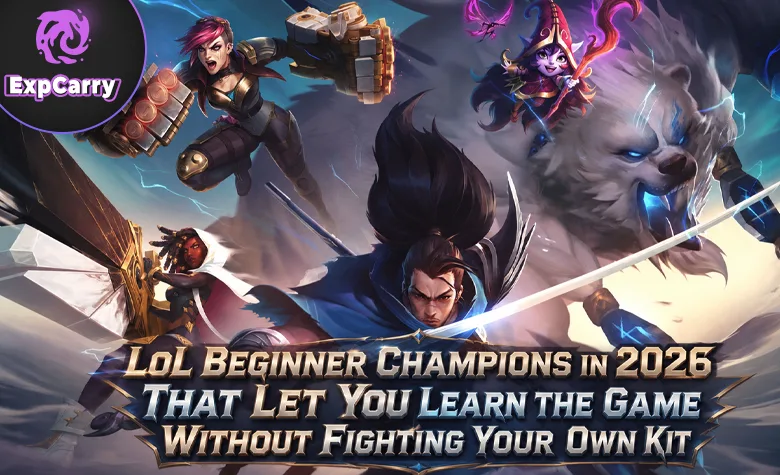
The best League of Legends champions for beginners in 2026 are Garen for Top, Warwick for Jungle, Lux for Mid, Ashe for ADC, and Leona for Support. These champions make it easier to learn the fundamentals of each role without spending every match worrying about difficult combos. They remain useful starting picks in Patch 26.21, although individual builds and matchups still matter.
Learning League is already complicated enough. New players have to manage minion waves, last-hitting, jungle objectives, vision, positioning, item purchases, and teammates who sometimes expect everyone to understand the game after three matches. Your first champion should reduce that workload. The goal is to learn why a decision worked or failed, not to fight your own abilities while everything else happens around you.
Short answer: Start with Garen, Warwick, Lux, Ashe, or Leona depending on your preferred role. They have clear abilities, manageable mechanics, and useful lessons that carry over to more difficult champions.
LoL Beginner Champions by Role in 2026
The best beginner champion is not necessarily the champion with the highest win rate. A strong learning pick makes mistakes understandable. Garen shows when a melee trade is worth taking. Warwick teaches jungle opportunities. Lux rewards good spacing. Ashe makes positioning essential, while Leona teaches when a team can safely commit to a fight.
These recommendations are intended for standard Summoner's Rift, not League Classic, Arena, or ARAM: Mayhem. The current live version is Patch 26.21. Champion balance changes over time, but the fundamentals these five champions teach are much more stable. Players who are still learning the map, objectives, or basic ability controls can also use Riot's official League of Legends beginner guide alongside the recommendations below.
| Role | Main beginner pick | What you learn | Alternative champions |
|---|---|---|---|
| Top | Garen | Melee trading, sustain, wave management, side-lane pressure | Malphite, Nasus, Darius |
| Jungle | Warwick | Jungle clears, ganks, dueling, objective timing | Amumu, Nunu & Willump, Master Yi |
| Mid | Lux | Skillshot accuracy, spacing, waveclear, mage positioning | Annie, Malzahar, Veigar |
| ADC | Ashe | Last-hitting, kiting, target selection, vision, teamfighting | Miss Fortune, Caitlyn, Sivir |
| Support | Leona | Engage timing, crowd control, vision, frontline positioning | Nami, Sona, Soraka |
These picks are recommendations for learning, not a universal power ranking. Annie may be easier than Lux for someone who struggles with skillshots. Malphite may be more comfortable than Garen against certain top-lane opponents. Amumu is an excellent alternative to Warwick for players who prefer teamfight initiation over chasing individual enemies. Choose a champion whose basic gameplay makes sense to you, then give yourself enough matches to improve.
Best Top Lane Beginner Pick: Garen

Garen remains one of the most practical champions for learning Top lane in Patch 26.21. His abilities are straightforward, he does not use mana, and his passive regeneration helps him recover from trades. His Q provides movement speed and a silence, W helps him survive incoming damage, E deals sustained area damage, and R finishes vulnerable opponents.
The real benefit is that Garen lets you concentrate on the lane. Instead of memorizing a complicated combo, you can practice managing minion waves, deciding when to trade, understanding enemy cooldowns, and recognizing when you are vulnerable to a gank. His basic abilities are easy to understand, but winning consistently still requires good decisions.
Garen also introduces side-lane pressure. Once you understand when to push and when to retreat, you can make opponents respond to your waves without joining every unnecessary fight. Riot's official Garen champion page provides a useful overview of his abilities before your first games.
Garen Beginner Build for Top Lane
Conqueror is a reliable starting keystone for extended melee fights. In the Precision tree, Triumph, Legend: Haste, and Last Stand are practical options. Resolve secondary gives a forgiving defensive setup: choose Second Wind against repeated poke or Bone Plating against opponents who rely on short bursts of damage. Overgrowth is a useful scaling option.
For items, Stridebreaker is a comfortable starting point when you need help staying close to enemies. Black Cleaver can provide health, ability haste, and armor reduction, while Sterak's Gage improves survival during larger fights. Dead Man's Plate is valuable for movement and physical defense. Force of Nature becomes more attractive against heavy magic damage. Choose Plated Steelcaps against teams relying on basic attacks, or Mercury's Treads when magic damage and crowd control are the bigger problem.
Do not treat every listed item as mandatory. If the opposing team has little armor, you may get more value from another defensive item than rushing Black Cleaver. If a ranged opponent constantly prevents you from approaching, surviving lane can matter more than maximizing damage. A stable build that lets you stay alive and practice your decisions is more useful than a theoretical maximum-damage setup.
Garen Habits Beginners Should Learn Early
Practice short trades using Q and E, then step away long enough for Perseverance to restore health. Use W deliberately when meaningful damage or crowd control is coming. The ability is much more valuable when it prevents an opponent's important combo than when it is pressed automatically at the beginning of every fight.
Wave management is the next lesson. Garen's E can clear minions quickly, but pushing constantly is dangerous when the enemy jungler is missing. Sometimes the correct play is to let the wave approach your tower and force your opponent to expose themselves. Learn to distinguish between pushing to recall, pushing to pressure a tower, and pushing simply because you can.
Garen's greatest weakness is predictability. Opponents with good spacing can kite him, while strong duelists may punish careless approaches. If you repeatedly lose the same matchup, reviewing your trades through League of Legends coaching can help identify specific positioning or wave-control mistakes. Regardless of how you review your games, the important habit is understanding why a fight went wrong before repeating it.
Best Jungle Beginner Pick: Warwick

Warwick is an excellent first jungler because his healing and straightforward combat make early clears less punishing. His passive and Q support sustained fighting, while Blood Hunt helps identify injured enemy champions. He is capable of dueling opponents, chasing vulnerable targets, and initiating ganks with his ultimate.
Jungle is difficult because there is no direct lane opponent telling you what to do next. You must decide which camps to clear, which lanes need help, when to contest objectives, and whether a fight is worth your time. Warwick gives you enough safety to practice those choices without requiring complicated mechanical execution.
His biggest educational advantage is that he encourages map awareness. Blood Hunt highlights opportunities, but it does not automatically make them good opportunities. Following a low-health enemy into an unwarded jungle can still be a terrible idea. Warwick helps you notice possible ganks; learning whether to take them is your responsibility.
Warwick Beginner Build for Jungle
Lethal Tempo is a useful starting rune for sustained fighting, while Press the Attack offers a more direct damage-focused alternative. Triumph, Legend: Alacrity, and Last Stand support his skirmishing. Resolve secondary can improve durability, whereas Inspiration provides options for players who value utility and tempo.
Warwick benefits from bruiser items that combine damage with enough health or resistance to survive after engaging. Stridebreaker can help him stay close to targets. Blade of the Ruined King improves sustained dueling, while Titanic Hydra offers additional health and damage. Spirit Visage is situationally valuable against magic damage because Warwick uses substantial self-healing. Armor, anti-heal, or another defensive item may be more important against different compositions.
Full-damage Warwick can punish isolated enemies, but it is less forgiving when several opponents turn on you. A bruiser approach is easier for beginners because it gives you more room to correct positioning mistakes. Your first priority should be completing reliable clears and arriving at fights with enough health to participate.
Warwick Habits Beginners Should Learn Early
Start by practicing a repeatable jungle clear. Learn where your camps spawn, how to move between them, and when to check nearby lanes. Do not abandon three available camps every time Blood Hunt activates. A successful gank must justify the time you spend away from farming.
Before ganking, ask three questions: Is the enemy far enough from safety? Can my teammate help? Do we know where the opposing jungler might be? A low-health opponent under their tower is not automatically an easy target, especially if your teammate cannot follow.
Use Primal Howl before taking heavy damage, and remember that Infinite Duress can be interrupted or punished if you leap into several enemies without support. Warwick's sustain is helpful, but it does not make him invincible.
Players still progressing through early account requirements should distinguish learning the role from completing a set number of normal matches. Match completion and jungle improvement are separate goals. Repeating a clear in Practice Tool, reviewing a failed gank, and recognizing objective windows will teach you much more than simply accumulating games without reflection.
Explore services related to this guide, selected from our League of Legends catalog.
View All League of Legends Services
Best Mid Lane Beginner Pick: Lux

Lux is a strong beginner choice for Mid lane because she teaches players to control space with ranged abilities. Her E provides poke and waveclear, Q can bind enemies, W protects allies, and R delivers long-range damage. You can contribute to fights without standing next to an enemy bruiser, which is exactly where an inexperienced mage should avoid being.
Lux is not the simplest mid laner mechanically. Annie is easier when you want reliable targeted damage and a straightforward stun. However, Lux is excellent for developing skills that transfer to other control and artillery mages: judging distance, aiming abilities, managing mana, and staying safe while contributing damage.
Her weaknesses are important learning tools. Missing Q against an assassin can leave you exposed, while repeatedly using E on an unnecessary wave can waste mana and create a dangerous lane position. Good Lux players do not win only because they land impressive lasers. They win because they choose the right moments to use their abilities.
Lux Beginner Build for Mid Lane
Arcane Comet is a dependable starting keystone for Lux's poke-oriented playstyle. Manaflow Band supports lane mana, Transcendence provides ability haste, and Scorch or Gathering Storm can fill the final Sorcery slot. Scorch favors early pressure, while Gathering Storm offers additional scaling. Inspiration secondary is comfortable for beginners who want extra lane utility.
Luden's Echo remains a practical first major item for a burst-oriented mid-lane build in Patch 26.21. Stormsurge and Shadowflame can increase damage against vulnerable targets, while Rabadon's Deathcap becomes valuable later. Void Staff is important when enemies accumulate magic resistance. Zhonya's Hourglass is a situational defensive purchase against dangerous dive and burst compositions.
Sorcerer's Shoes are a common offensive choice. However, buying the same six items every game is not the goal. If an enemy assassin repeatedly reaches you, surviving their engage may be more valuable than another damage component. If opponents build magic resistance, percentage penetration becomes more important than adding damage without considering defenses.
Lux Habits Beginners Should Learn Early
Learn to manage the wave with E without automatically pushing it into enemy territory. Try to use E so it pressures both the minion wave and an opposing champion when possible. Preserve enough mana to respond if the enemy commits to a fight.
Do not throw Q simply because it is available. It is both an offensive setup tool and one of your most important defensive abilities. When an assassin is approaching, holding Q can create more pressure than missing an unnecessary attempt at poke.
In teamfights, position behind your frontline and use abilities against enemies entering narrow areas. Q can set up E and Final Spark, while W can shield teammates during an engagement. You do not have to land every possible spell. Sometimes the best decision is to wait for a target to move into a predictable position instead of gambling your most important cooldown.
Best ADC Beginner Pick: Ashe

Ashe is one of the best ADC champions for beginners because she teaches positioning without giving players an easy escape from every mistake. Her attacks slow enemies, Volley provides ranged pressure, Hawkshot supplies valuable vision, and Enchanted Crystal Arrow can initiate a fight or stop an approaching threat.
ADC is demanding because even strong damage output means little if you die before a fight begins. Ashe teaches that dealing consistent damage from a safe position is usually more important than chasing a low-health enemy through the opposing frontline. Her slows make kiting easier, but they do not replace correct movement.
Miss Fortune is an excellent backup for players who prefer direct lane damage and a clear teamfight ultimate. Caitlyn is also useful for learning attack range and lane pressure, although her traps and spacing reward additional practice. Patch 26.21 adjusted Caitlyn's damage by reducing late-game Headshot scaling while increasing Piltover Peacemaker's damage at higher ranks. That does not make her a bad beginner pick, but it reinforces the value of choosing champions for their learning benefits rather than following a temporary tier list.
Riot's official Ashe champion page describes her slows and abilities, which are worth understanding before focusing on item builds.
Ashe Beginner Build for Bot Lane
Lethal Tempo is a natural starting keystone for sustained auto-attack damage. Presence of Mind, Legend: Alacrity, and Cut Down are practical Precision choices. Inspiration secondary with Approach Velocity and Biscuit Delivery can make Ashe's lane and chase patterns more comfortable.
Hexoptics C44 is a relevant early offensive option in Patch 26.21. Berserker's Greaves and Phantom Dancer support consistent attacks and movement, while Infinity Edge and Lord Dominik's Regards can contribute to a critical-strike-focused damage build. Bloodthirster provides sustain, and Guardian Angel can be valuable when surviving a single dangerous engage determines the outcome of a fight.
Alternative item paths can work depending on the matchup and enemy frontline. Blade of the Ruined King or other sustained-damage options may be useful in appropriate situations. Mortal Reminder is a possible armor-penetration choice when anti-healing is also required. Remember that Ashe's passive changes how critical strikes work: she does not simply gain the normal bonus damage from an individual critical attack. Critical-strike-related stats instead interact with her Frost Shot damage and slow mechanics.
Ashe Habits Beginners Should Learn Early
Focus first on last-hitting without taking unnecessary damage. Learning to collect minions while watching the opposing support and jungler is more valuable than constantly trying to force kills. Practice attacking, moving, and attacking again rather than standing still throughout a fight.
Use Hawkshot to reveal dangerous jungle paths, objective entrances, and areas where you suspect the opposing jungler is moving. Good vision can prevent fights your team should never take. Save Enchanted Crystal Arrow for an engage that teammates can follow or for stopping a dangerous opponent.
During teamfights, attack the closest target you can hit safely. Walking past an enemy tank to reach a distant carry often leads to an immediate death. Sustained damage only matters while Ashe remains alive.
Repetition matters more than a flashy performance. Champion Mastery progression is a separate account goal from learning to kite or position correctly. Regardless of your displayed Mastery Level, review whether you maintained damage uptime, used Hawkshot deliberately, and respected enemies who could reach you.
Best Support Beginner Pick: Leona

Leona is a strong beginner support because her job is easy to understand: create opportunities for teammates and prevent dangerous enemies from acting freely. She has substantial crowd control, defensive tools, and clear engage patterns. Her abilities are not especially complicated, but choosing when to use them takes practice.
Leona teaches a different style of support from Nami, Sona, or Soraka. Enchanters often focus on healing, shielding, and protecting allies from a safer position. Leona moves toward enemies to start a fight. That makes her excellent for learning engage timing, brush pressure, target selection, and the importance of knowing whether your ADC can follow.
Her biggest limitation is commitment. Once Leona uses Zenith Blade to enter a fight, leaving can be difficult. A successful engage depends on positioning, allied readiness, enemy cooldowns, and whether the opposing jungler might be nearby. Landing an ability does not automatically mean you should continue fighting.
Leona Beginner Build for Support
Aftershock is a reliable keystone for Leona because immobilizing an enemy activates additional defenses. Font of Life, Bone Plating, and Overgrowth or Unflinching can support her frontline role. Inspiration secondary offers options such as Biscuit Delivery and Cosmic Insight when extra lane resources and summoner-spell utility are valuable.
Choose a defensive support-item upgrade appropriate to your team and the matchup. Celestial Opposition can help with initial engage survival. Locket of the Iron Solari provides team protection, Knight's Vow helps protect an important ally, and Zeke's Convergence can complement Leona's crowd control. Frozen Heart is situationally useful against attack-speed-heavy opponents, while magic resistance becomes important against strong magic-damage teams.
Leona should not rush expensive damage items simply to make her personal statistics look better. Support gold is limited, and her main value comes from crowd control, vision, and protecting allies. When your support item provides wards, use them actively and consider Oracle Lens to remove enemy vision around objectives.
Leona Habits Beginners Should Learn Early
Before using E, check your ADC's position and the minion wave. Engaging while your ADC is too far away usually gives the enemy a favorable fight. Early minion damage also matters: jumping into a large hostile wave can lose an otherwise reasonable trade.
Leona's basic engage sequence is E to reach the target, Q to stun, and R when additional crowd control or longer-range initiation is useful. The order can change depending on distance and the situation. Sometimes opening with Solar Flare gives your team a better chance to follow, while other times holding R prevents an enemy from escaping after the first engagement.
Outside lane, work with teammates to establish vision around dragons, Baron, and important jungle entrances. Avoid wandering into unwarded areas alone simply because Leona is durable. When your team cannot follow an engage, protect your carries instead. A well-timed stun against an assassin can be more valuable than diving toward the enemy backline.
Beginner Champion Ranking for 2026 Solo Queue
The following ranking reflects how useful these champions are for learning fundamental skills, not a claim that they have the highest win rates in Patch 26.21. Champion strength depends on rank, matchup, team composition, and player experience. For beginners, clarity and consistency matter more than a small statistical advantage.
| Rank | Champion | Role | Why choose them |
|---|---|---|---|
| 1 | Garen | Top | Simple abilities, forgiving sustain, clear melee trading lessons |
| 2 | Warwick | Jungle | Healthy clears, straightforward dueling, useful gank signals |
| 3 | Ashe | ADC | Excellent for learning kiting, vision, target selection, and positioning |
| 4 | Lux | Mid | Teaches mage range, skillshots, waveclear, and defensive positioning |
| 5 | Leona | Support | Clear engage tools, crowd control, and frontline responsibilities |
| 6 | Annie | Mid | Low mechanical complexity and understandable stun timing |
| 7 | Malphite | Top | Accessible tank gameplay with a powerful teamfight ultimate |
| 8 | Miss Fortune | ADC | Direct lane damage and an easy-to-understand teamfight plan |
| 9 | Nami | Support | Introduces healing, trading, disengage, and engage follow-up |
| 10 | Nunu & Willump | Jungle | Good for practicing gank routes and objective control |
These champions are not equally easy for everyone. Some players naturally understand ranged positioning, while others are more comfortable with melee combat. If Lux's skillshots feel frustrating, try Annie. If Leona's all-in approach feels too risky, try Nami. If Warwick's chase-focused gameplay distracts you from clearing camps, Amumu may provide a calmer way to learn Jungle.
Simple Builds for LoL Beginner Champions in 2026
A beginner build should give you a reliable starting point without pretending that every match requires the same purchases. The combinations below are practical directions for Patch 26.21, not permanent six-item prescriptions. Check the current client recommendations before playing, especially after future balance updates.
| Champion | Starting rune | Item direction | Typical ability priority |
|---|---|---|---|
| Garen | Conqueror with Resolve secondary | Stridebreaker; situational Black Cleaver, Sterak's Gage, and defenses | E, then Q, then W |
| Warwick | Lethal Tempo or Press the Attack | Stridebreaker or a bruiser damage option; health and resistances afterward | W, then Q, then E |
| Lux | Arcane Comet with mana support | Luden's Echo; situational Stormsurge, Shadowflame, penetration, or Zhonya's | E, then Q, then W |
| Ashe | Lethal Tempo with Precision | Hexoptics C44; attack speed, crit, penetration, and situational defense | Usually W, then Q, then E |
| Leona | Aftershock with Resolve | Defensive support upgrade, Locket, Knight's Vow, and tank utility | Usually W, then E, then Q |
Upgrade your ultimate whenever it becomes available at the relevant levels. Remember that skill priorities describe the usual order of maxing abilities, not necessarily which ability to unlock first in every matchup.
The most useful item adjustments are straightforward. Buy appropriate anti-heal when enemy sustain is a serious problem and your champion can apply it effectively. Prioritize armor penetration against substantial armor or magic penetration against substantial magic resistance. Choose defenses against threats that repeatedly reach you. The exact answer depends on the champion and game state.
Do not copy a professional player's unusual item path without understanding its purpose. High-level players sometimes build around narrow matchups or coordinated team compositions. A beginner usually benefits more from dependable items and a clear reason for each purchase.
Beginner Champion Pool That Actually Makes Sense
Trying to learn every champion and every position at once slows progress. Pick one primary role and one secondary role. Start with one champion for each, then add a backup after you can handle the basics without concentrating on every ability press.
If Top is your preferred role, Garen and Malphite form a useful pair. Warwick and Nunu & Willump offer different jungle approaches. Lux and Annie cover ranged skillshots and simpler burst patterns. Ashe and Miss Fortune offer utility-focused and damage-focused ADC styles. Leona and Nami let support players experience both engage and enchanter gameplay.
The Cleanest Two-Champion Setup by Role
Each pair provides a second option without forcing you to learn an entirely unfamiliar role. The goal is to practice the same basic responsibilities while experiencing a different champion style.
| Role | Main champion | Backup champion | What the combination teaches |
|---|---|---|---|
| Top | Garen | Malphite | Melee trades and side lanes versus tank initiation |
| Jungle | Warwick | Nunu & Willump | Dueling and target pursuit versus gank routes and objectives |
| Mid | Lux | Annie | Ranged skillshots versus simple burst and stun control |
| ADC | Ashe | Miss Fortune | Kiting and utility versus direct damage and ultimate positioning |
| Support | Leona | Nami | Engage and frontline responsibility versus healing and disengage |
Give each champion several games before deciding whether it fits. One difficult matchup does not mean your pick is bad. Try to identify a specific improvement after every session: better farming, safer ward placement, fewer unnecessary deaths, or more useful objective participation.
For newer accounts, account leveling is a separate progression objective from improving with a champion. Reaching an account-level milestone does not automatically make someone ready for Ranked. Understanding your role and developing consistent habits are still essential, regardless of the number displayed on your profile.
Patch 26.21 Notes for New League Players
Patch 26.21 is the current Summoner's Rift patch as of October 26, 2026. Riot published the main update on October 20 and added a Varus adjustment on October 22. The patch includes champion and item balance changes, but it does not directly change Garen, Warwick, Lux, Ashe, or Leona in its standard Summoner's Rift champion balance section.
Some alternative beginner picks were affected. Caitlyn received reduced late-game Headshot scaling alongside higher Piltover Peacemaker damage at later ranks. Miss Fortune gained damage on Make It Rain and improved critical-strike scaling on Bullet Time. Nunu & Willump received increased maximum damage on Absolute Zero. These changes are relevant when choosing backup champions, but they do not automatically determine which pick is easiest to learn.
Items also changed. Gluttonous Greaves became more expensive, ranged users received less benefit from Hubris, and Dawncore gained additional ability-power scaling from mana regeneration. These are examples of why specific item orders should be checked against the current patch. Read Riot's official Patch 26.21 notes for the full changes, including other game modes that are separate from standard Summoner's Rift.
The practical lesson for beginners has not changed: understand the purpose of your runes and items. A consistent build that supports the champion's role is usually more useful than repeatedly swapping setups after one bad match. If your opponent is dealing mostly physical damage, consider armor. If the enemy team has dangerous crowd control, think about defensive tools and positioning. Learn the basic response first; detailed optimization can come later.
Best LoL Champions for Beginners in 2026: Final Picks
For a straightforward introduction to all five roles, the main recommendations remain Garen, Warwick, Lux, Ashe, and Leona. Garen offers a forgiving way to learn melee lanes. Warwick simplifies early jungle survival and highlights possible ganks. Lux teaches ranged mage fundamentals. Ashe makes positioning and vision part of every game. Leona introduces engage timing and support responsibility.
Their shared advantage is understandable feedback. If Garen loses a trade, you can examine cooldowns and spacing. If Warwick fails a gank, check the lane position and route. If Lux dies after missing Q, consider whether holding the bind would have been safer. If Ashe gets caught, review her distance from the closest threat. If Leona engages alone, look at whether teammates were close enough to follow.
Those lessons are more valuable than chasing a different supposedly overpowered champion every patch. A strong pick can win a match; a clear learning process helps you improve across many matches and future balance changes.
Final Thoughts
The best beginner champions make League of Legends easier to understand, not effortless to win. Garen, Warwick, Lux, Ashe, and Leona provide accessible ways to practice the responsibilities of Top, Jungle, Mid, ADC, and Support in Patch 26.21.
Start with one role, choose a champion you enjoy, and spend enough games learning the same fundamentals. Focus on last-hitting, safe trades, map awareness, useful wards, objective timing, and surviving teamfights. Add a backup champion once those habits become more natural.
There is no need to rush toward mechanically difficult champions. Mastering the simple decisions first gives you a foundation that remains useful when the meta changes. The best first champion is the one that helps you recognize your mistakes, correct them, and feel more confident in the next match.