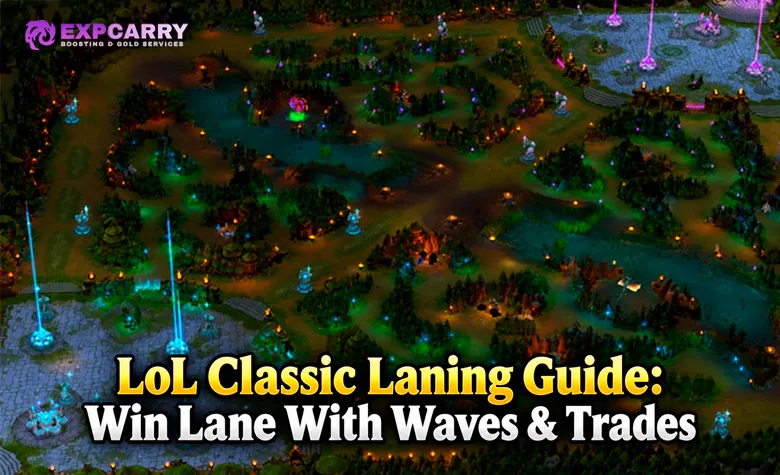
Winning your lane in League of Legends Classic depends on controlling minion waves, protecting experience, taking favorable trades and recalling without sacrificing valuable farm. A kill can create an advantage, but a player who consistently manages waves can gain gold, experience and turret pressure without needing to eliminate the opponent. Classic makes these decisions particularly important because early leads can have greater consequences than in modern Summoner's Rift. Its older champion abilities, rune system and lane economy also change how safely you can trade or recover from a mistake. Patch 26.16 adjusted minion gold, passive income, early death timers and turret durability, so archived Season 3 numbers are not always accurate for the current Classic mode. This guide explains freezing, slow pushing, crashing waves, experience denial, trading windows and recall timing, with practical advice for top, mid and bot lane.
Short answer: To win lane in LoL Classic, secure minion experience, last-hit consistently, control where the wave meets and trade when the opponent is vulnerable. Use freezes to make enemies overextend, slow pushes to build pressure and wave crashes to create safer recalls or map opportunities.
How to Win Lane in League of Legends Classic
A winning lane is not necessarily the one with the most kills. Your position is stronger when you have more useful gold and experience, can farm safely, control the wave and make the opponent take risks to access resources. These advantages help you reach important ability ranks and item purchases before your opponent.
Classic rewards those fundamentals particularly heavily. Riot designed the mode to preserve the higher-stakes gameplay of early League, where losing control of a lane can have consequences that last beyond the first few minutes. However, that does not mean every losing matchup is decided by the first kill.
Think of laning as a sequence of decisions: collect resources, manage the wave, identify a favorable trade, create a recall or pressure window, and use the resulting advantage to make the next wave easier to play.
| Skill | What You Control | How It Creates an Advantage |
|---|---|---|
| Last hitting | When you deliver the killing blow to minions | Provides reliable gold for items |
| Experience management | Whether you remain near dying enemy minions | Helps you reach important champion levels |
| Wave management | Where and how quickly minion waves advance | Creates safer farming, recalls and pressure |
| Trading | When and how you exchange damage with an opponent | Can force the opponent away from farm or into a bad recall |
| Recall timing | When you return to base and spend gold | Converts earned gold into usable combat power |
The strongest laning decisions often accomplish more than one goal. A successful trade can force the opponent away from the wave, allowing you to collect gold while denying their access to experience. A properly timed crash can both protect your next recall and allow you to purchase an item before the opponent can respond.
Why Classic Laning Feels Different From Modern League
Classic restores older champion kits, items, runes and masteries while keeping selected quality-of-life changes. Many champions have different ability costs, ranges, damage patterns and defensive tools from their current versions. That changes which trades are favorable and how much risk is involved in approaching a wave.
Classic also does not share every economic system with modern Summoner's Rift. Riot has explicitly described it as more prone to snowballing and has adjusted its gold income without introducing modern objective-bounty mechanics. Current modern Role Quest strategies, turret reward assumptions and champion builds should not be copied into Classic automatically.
Use the live Classic champion abilities and actual wave behavior as your reference. Historical guides are useful for understanding concepts, but their exact values may belong to a different version.
How Minion Gold and Experience Work in Classic
Minions provide two fundamental resources: gold and experience. These rewards are related but have different acquisition rules. Understanding the difference is essential because missing a last hit does not always mean losing the experience, while leaving the wave entirely can cost both resources.
For most lane minions, the player delivering the killing blow receives the ordinary last-hit gold. Eligible champions near the dying enemy minion receive experience even if they did not attack it. When multiple allied champions are within experience range, that experience is shared according to the applicable game rules. Gold from passive income is separate from last-hit rewards.
How to Last-Hit Minions Reliably
Last hitting means waiting until an enemy minion has little enough health for your attack or ability to finish it. Attacking a wave continuously can make last hits harder to control because you change the timing at which several minions die.
During a quiet lane, practice moving between attacks and collecting the killing blow as late as practical. Observe your basic attack animation and projectile travel time if you are ranged. Champions with low early Attack Damage may need different timing from champions with stronger basic attacks or a convenient farming ability. Pay attention to allied minion projectiles already traveling toward your target.
Do not sacrifice a large amount of health for one minion. If the opponent can land a powerful ability whenever you approach, evaluate whether the gold is worth the damage. Sometimes the correct decision is to remain close enough for experience while allowing an unsafe last hit to go.
Why Experience Can Matter More Than One Last Hit
Champion levels provide additional ability points and statistics. Losing access to several dying minions can delay an important ability unlock or upgrade, even when the visible gold difference appears manageable.
If you are losing a matchup, focus on staying within experience range without entering a situation where the opponent can kill you. You may need to give up an unsafe minion's gold, but remaining close enough to receive experience preserves your ability to contest later waves. You do not need to damage the minion yourself to receive ordinary proximity-based experience.
This is also why recalling or roaming at the wrong moment is expensive. You may return with a useful purchase yet still be behind because multiple enemy minions died while you were away.
Important distinction: Riot doubled Classic XP earned from matches for Classic account progression in Patch 26.17. That change should not be confused with doubling champion experience from minions during an individual match.
Classic Minion Gold After Patch 26.16
Riot adjusted Classic's gold economy in Patch 26.16. The change reduced the base gold value of ordinary melee and ranged minions while increasing the early passive gold rate and delaying the start of passive income from 65 to 90 seconds. This was intended to preserve the importance of farming without making it excessively difficult for a player to recover from an early disadvantage.
| System | Before | After |
|---|---|---|
| Melee minion base gold | 20 | 19 |
| Ranged minion base gold | 15 | 14 |
| Passive gold generation begins | 65 seconds | 90 seconds |
| Passive gold per 5 seconds | 8 / 10.5 / 11.5 / 13 at 1 / 10 / 15 / 25 minutes | 10.5 / 11.5 / 13 at 1 / 15 / 25 minutes |
These numbers come from the official Patch 26.16 notes. They describe base minion gold and passive-income rates, not a promise that every minion always awards exactly the same amount throughout a match. Cannon minions and later game scaling should not be inferred from the melee and ranged figures.
The practical lesson remains straightforward: consistent farming builds advantages, but increased early passive gold means an opponent who misses a few last hits is not automatically unable to recover. Maintaining experience and wave control remains essential.
League Classic Wave Management: Freeze, Slow Push and Crash
Wave management means controlling how quickly allied and enemy minions die so the waves meet in a useful position. It allows you to farm more safely, deny an opponent access to resources, force reactions and create time for recalls or movements around the map.
You do not need to memorize a universal number of minions to begin using these techniques. Instead, observe which side has more surviving minions, where the waves are meeting and how quickly one wave is defeating the other. The number needed to maintain a freeze depends partly on its position in the lane and the arrival of reinforcements.
| Technique | What You Do | When It Is Useful | Main Risk |
|---|---|---|---|
| Last-hit only | Avoid unnecessary damage to minions | Maintain control without accelerating the wave | The wave may still push because of its existing balance |
| Freeze | Maintain the wave near your turret but outside its attack range | Safer farming and forcing the opponent forward | Enemy pressure may break the freeze |
| Slow push | Build a gradually growing allied wave | Prepare a strong crash, recall or pressure window | Overextending while the wave grows |
| Fast push | Quickly damage and clear the opposing wave | Reach the enemy turret before recalling or moving | Wasting mana or pushing into an unsafe position |
| Crash | Move allied minions into enemy turret range | Force a response and create a temporary movement window | Returning without a plan as the wave changes direction |
How to Freeze a Wave Near Your Turret
A freeze holds the meeting point close to your own turret without allowing the enemy minions to enter its range. The opponent must walk farther forward to farm, making them more vulnerable to harassment or a jungle gank.
To establish a freeze, allow the enemy wave to move toward your side of the lane. Keep a manageable enemy minion advantage and last-hit only when necessary. The enemy wave usually needs enough extra minions to offset your reinforcements arriving sooner near your own turret. If the opposing wave becomes too large, thin it enough to prevent it from overwhelming your minions and crashing into your turret.
A freeze is not simply standing beside your tower and refusing to attack. You must monitor whether the enemy wave is winning too quickly and whether your turret is about to begin clearing it. If you briefly hold enemy minions outside turret range, avoid taking unnecessary damage while waiting for your next wave.
Example: You are playing Garen into a ranged top laner who repeatedly attacks you when you approach minions. Instead of permanently pushing, let the wave move toward your side. When the enemy must step farther forward to last-hit, look for a short favorable trade or allow your jungler to approach. If fighting is still unsafe, use the position to collect experience and farm with less exposure.
How to Slow Push and Build a Large Wave
A slow push happens when your allied minions have enough of an advantage to gradually overwhelm the opposing wave. As another allied wave arrives, the group can grow and apply increasing pressure toward the enemy turret.
To begin, create a small allied minion advantage by removing some enemy minions, then avoid clearing the rest unnecessarily quickly. Continue last hitting while the allied wave develops. If you eliminate every enemy minion immediately, you turn the attempt into a fast push instead.
A larger allied wave can make an enemy trade more dangerous because minions may contribute damage. It can also provide cover while you pressure the opponent or prepare a later crash.
Slow pushing is especially useful when you want to make the opponent choose between collecting a large incoming wave and responding to another threat. However, building a wave also moves you toward the enemy side of the lane, where you may be vulnerable if the opposing jungler appears.
How to Fast Push and Crash a Wave
Fast pushing means using attacks and appropriate abilities to remove enemy minions quickly. The usual goal is to make your allied wave reach the opposing turret before you recall, place vision or move toward an objective.
A successful crash forces the opponent to deal with the incoming minions. If they are absent, some may die before the opponent returns, costing them gold and possibly experience. If they are present, they may still collect the wave, but their need to deal with it can create temporary freedom for you.
Do not automatically cast every damaging ability into the wave. Classic champions may have substantial early mana costs, and spending all your mana to push can leave you unable to defend yourself.
Before committing to a crash, make sure you can clear the wave quickly enough and that the enemy is unlikely to stop it outside turret range. A failed push that stops outside the enemy turret can leave you exposed with no safe recall window.
What Is a Wave Bounce?
A wave bounce describes a situation where a wave pushed into the enemy turret is cleared, and the resulting lane state begins moving back toward your side. When this develops naturally, it can create a safer position for collecting the next waves after your recall.
A bounce is not guaranteed every time minions touch a turret. The opponent may clear quickly, hold part of the wave or alter the state through additional attacks and abilities. Both teams' incoming waves also affect the result. A complete crash is more likely to create a predictable reset than a partial push that leaves allied minions outside turret range.
After crashing, inspect what happens rather than assuming the next wave will automatically return to you. The useful habit is to recognize the developing wave state and position yourself accordingly.
Explore services related to this guide, selected from our League of Legends catalog.
View All League of Legends Services
How to Play Your First Three Waves in Classic
The opening waves determine your first opportunities to gain experience, trade and control the lane. You should approach them with a simple plan rather than automatically pushing or attacking the opponent whenever they come into range.
Different champions have different starting abilities and trading patterns, so the following is a decision-making framework rather than a fixed historical minion-timing script. Experience shared between two bot-lane partners also changes the timing of their early level advantages compared with solo lanes.
First Wave: Secure Experience and Establish Position
At the first wave, identify whether your champion can contest the opponent directly. Check their range, available starting ability and the location of both minion waves before beginning an exchange.
If you have a favorable early matchup, use positioning to make the opponent work for their last hits. If they are stronger, stay close enough to receive experience and avoid losing a large amount of health before you can access additional abilities.
Avoid damaging the wave without a purpose. If your intention is to let it approach your side, unnecessary attacks may produce the opposite result. If you want an early level advantage, you need to contest the wave deliberately rather than assuming it will happen automatically.
Second Wave: Respect Level Advantages
As the next wave arrives, pay attention to the experience bars of both champions. In a normal solo-lane opening, clearing the first wave and the first melee minion of the second wave is a common level-two timing, provided no experience was missed. Bot-lane experience sharing changes that timing, so watch the actual experience bars rather than relying on the solo-lane rule.
If the enemy is about to level up while you are still behind, back away before they can use the advantage. If you reach your level first and have the resources to fight, look for a favorable trade without chasing so far that the wave or enemy jungler creates a new danger.
Do not assume that every champion has an equally powerful early level-up. The importance of the window depends on the abilities unlocked and the lane matchup.
Third Wave: Decide Whether to Crash or Hold
By the next wave, you should have a clearer idea of which player controls the lane. If you have built a wave that can be pushed safely into the enemy turret, consider finishing the crash and preparing vision or a recall. If your opponent is stronger, preserving a safer position near your own side may be more useful. Do not force a third-wave crash when you lack the damage or safety to complete it.
Pay attention to the enemy jungler's possible approach. Pushing farther forward without vision can turn a favorable lane into a death, particularly when you have already used movement abilities during a trade.
The objective is to leave the opening waves with a useful position, preserved health and as much reliable gold and experience as your matchup allows.
How to Win Trades in League Classic
Trading means exchanging damage with the opposing champion. A successful trade leaves you in a better position afterward, whether through remaining health, resource advantage, improved wave access or the ability to threaten a later all-in.
Classic trading differs from modern League because many champions use their original ability kits, historical mana costs and different defensive interactions. An ability combination familiar from modern Summoner's Rift may not have the same effects in Classic.
Before trading, evaluate the wave, current health, ability cooldowns and whether the enemy jungler could interfere. Consider your own minion position as well as the opponent's ability to retaliate.
Trade When the Opponent Goes for a Last Hit
An opponent preparing to last-hit is briefly occupied with a predictable action. This creates an opportunity to attack while they are choosing between securing the minion and responding to your damage.
For a ranged champion, one basic attack or a carefully aimed ability may be enough to create a favorable exchange. For a melee champion, the opportunity might come when the opponent approaches too close to your minions or has already used an important ability.
Do not force the trade if moving forward exposes you to a stronger counterattack. The goal is to punish a predictable moment, not to accept any exchange just because the opponent is farming.
Punish Important Ability Cooldowns
A champion becomes temporarily weaker after using an ability that provides significant damage, crowd control or protection. If the opponent spends that ability unsuccessfully, you may have a window to farm or trade before it becomes available again.
For example, an opponent who misses a binding or hook may have fewer tools to prevent you from stepping forward. A melee fighter who has used an important defensive ability may be more vulnerable to short damage exchanges.
Read Classic ability descriptions carefully. Original champion versions may have different spell effects and cooldowns from their modern counterparts. A trade based on a modern champion's limitations can fail if Classic restores an older mechanic.
How Minion Aggro Changes a Trade
Enemy minions are not harmless background units. They can contribute damage during a champion exchange, particularly if the opposing wave is large or your own minions have already died.
Basic attacks and certain targeted actions against an enemy champion can attract nearby enemy minion attention. Minion targeting behavior has also been an area of Classic-specific adjustments and bug fixes, including a Runaan's Hurricane interaction with minion Call for Help addressed in Patch 26.19. Do not rely on unverified historical aggro ranges or exact targeting priorities.
Watch the wave when you trade. If several minions begin attacking you, retreat or reposition so you do not continue losing health after your intended exchange has ended.
When you have a significantly larger allied wave, an opponent who starts a prolonged trade may take additional damage from your minions. That can make maintaining wave advantage useful even before you directly attack the enemy champion.
When to Short Trade and When to All-In
A short trade uses a limited number of attacks or abilities before disengaging. It is useful when you can deal damage safely but cannot survive a prolonged fight. An all-in commits to a longer engagement intended to force a kill or decisive retreat.
Choose the exchange based on your champion's strengths, the opponent's remaining health and available abilities. A champion with reliable poke and disengage may prefer repeated short trades, while a fighter with a strong sustained-damage window may gain more from extending combat after the opponent uses a defensive ability.
Do not start an all-in simply because the enemy has less health. Consider whether your champion has enough mana, whether the opponent has Flash or another escape, and whether additional enemies could arrive before the fight ends.
Health, Mana and Recall Timing in Classic
Health and mana determine what actions are available to you during lane. A player with a full inventory of unspent gold may still lose an exchange if their health is low or they cannot cast important abilities. Effective laning means managing these resources alongside the wave.
Older champion versions often have different ability costs and sustain tools, making it important to read the live Classic tooltips rather than assuming modern spell usage is sustainable.
How to Manage Mana Without Losing Lane Pressure
Every ability cast should serve a purpose: secure a difficult minion, threaten the opponent, escape danger or change the wave state. Repeatedly casting into the wave without deciding what happens afterward can create a mana shortage before an important trade or gank.
If your champion relies on mana to survive a fight, preserve enough for the relevant defensive or movement ability. When you are already low, avoid using your last available resources for a minion that can be collected safely with a basic attack.
Some Classic champions use Energy or other resources instead of mana. The same principle applies: plan your exchange around the resources required to complete it.
When Is the Best Time to Recall?
A good recall allows you to buy useful items while minimizing the gold and experience lost during your absence. Ideally, create a wave state that makes it difficult for the opponent to deny you multiple minions before you return.
One common method is to push a wave fully into the opposing turret when it is safe, then recall while the enemy deals with it. Another is to use a naturally favorable wave position to return without leaving an exposed wave that the opponent can immediately exploit.
Do not recall simply because you have enough gold for an item. Consider the current wave, available health and mana, whether the opponent can quickly push, and whether the enemy jungler is nearby. A crash can provide a useful recall window, but you still need to account for how the next waves will move.
Sometimes recalling with slightly less gold is better than staying for another wave while dangerously low. Dying may cost more time and resources than the small purchase improvement you hoped to obtain.
How to Use Your First Item Purchase
Your first purchase should solve the problem preventing you from playing the lane effectively. That could be insufficient damage to last-hit comfortably, a lack of movement speed, or not enough durability to survive the opponent's main trading pattern.
Classic has its own item economy and older item versions. A defensive component can be more valuable than a damage component when a dangerous opponent can repeatedly force you away from the wave.
The League Classic Items Guide covers item statistics, components and purchase paths. This guide focuses on choosing a useful recall window rather than prescribing full builds for individual champions.
How Much Does an Early Death Cost?
Death costs more than the gold awarded to the opponent. You also spend time away from the lane while minions continue moving and dying. If your opponent pushes the wave into your turret, you may return having lost gold, experience and control of the next wave.
Patch 26.16 reduced death timers at levels 1–8 to 10 / 12 / 14 / 17 / 20 / 23 / 26 / 29 seconds, respectively, from 12 / 14 / 16 / 19 / 22 / 25 / 28 / 30 seconds. Timers at level 9 and above were unchanged. The same patch delayed Homeguard activation from the start of the match until 15 minutes. Riot made these changes to create additional comeback opportunities without removing the importance of winning early fights.
Do not interpret the shorter timers as making early deaths harmless. The wave and recall state still determine how much an opponent can gain while you are absent.
How to Deny Gold and Experience in League Classic
Denial means preventing the opponent from collecting resources they would normally receive. This can happen by controlling a wave near your side, threatening a trade when they approach or forcing them to recall while important minions are dying.
Gold denial and experience denial are different. An opponent may fail to last-hit a minion yet still receive experience by remaining nearby. To deny experience, you must create a situation where they cannot safely remain within the relevant range when the minion dies.
Deny Last Hits With a Freeze
When a wave is frozen near your turret, the opponent may need to move farther away from their own safety to collect minions. If you have a favorable matchup, this creates opportunities to punish their movement without requiring you to push into dangerous territory.
Do not break your own freeze by repeatedly attacking the enemy minions when there is no reason to do so. However, be willing to thin a large enemy wave or abandon the freeze if the enemy jungler is nearby and defending the position becomes unsafe. A freeze only provides value while you can maintain it without giving up a larger advantage.
Zone the Opponent Away From Experience
Zoning means using your position and the threat of a favorable exchange to make an opponent avoid part of the lane. If they cannot safely approach the dying minions, they can lose experience as well as gold.
This tactic is strongest when you already have a meaningful advantage in health, level or combat tools. It can backfire if you position too aggressively, particularly when you do not know where the enemy jungler is.
Do not attempt to deny experience by standing dangerously far forward against an opponent who can win the fight. Preserving your own resources and life is more important than forcing an additional small denial.
Force the Opponent to Miss a Wave
After winning a fight or forcing the opponent to recall, examine whether you can push the current wave into their turret. If they are absent, the turret and opposing minions may kill allied minions before the opponent returns, denying resources.
The outcome depends on how quickly the wave reaches the structure and whether the opponent has a way to return. Do not assume that every crash automatically causes a complete wave loss. If you cannot finish the push before the opponent returns, preserving a favorable wave position may be better than forcing a partial crash.
Once the crash is secured, decide whether to recall, establish vision or take another useful action. The advantage comes from combining denial with your own safe progression.
How to Avoid Ganks While Controlling Your Lane
Wave pressure creates opportunities, but it also changes your exposure to enemy movements. The farther you push toward the opposing turret, the more distance you may need to retreat if the enemy jungler approaches.
Classic jungle routes and older champion abilities can produce dangerous early ganks. You do not need perfect jungle tracking to reduce that risk, but you should understand which side of the lane is safer and what information your wards provide.
Ward Before You Commit to a Long Push
When you plan to slow push or repeatedly pressure the enemy turret, use available vision to monitor likely jungle approaches. A ward is most helpful when it reveals the route an opponent would need to take to reach you.
Do not assume that one ward makes the entire lane safe. Enemies may approach from another direction, and a champion with long-range mobility can still create a dangerous situation.
Check the minimap before continuing to pressure a wave. If several opponents disappear, consider whether the additional minions or turret damage are worth the risk of being caught.
Use Wave Position to Set Up Your Jungler
A wave close to your own turret can force the opponent to walk farther forward. This may provide a better gank opportunity than a lane where the enemy is already protected by their tower.
Communicate the opportunity through pings and avoid pushing the wave away immediately before the jungler arrives. However, do not deliberately lose large amounts of health or experience merely to create a possible gank.
Your jungler may be busy collecting camps or helping another lane. Treat the wave position as an advantage you can use independently, not a guarantee that a teammate will appear.
What to Do When the Enemy Jungler Is Missing
If you have no information about the opposing jungler, consider which side of the map they could reasonably approach. Your answer depends on their last known location, nearby camps and available paths.
When danger is high, play closer to the protected side of your lane or delay a risky trade. Giving up a small amount of immediate pressure can preserve the health and wave control needed to win the next exchange.
Recognizing risk is particularly important when your champion has already used Flash, a dash or another important escape ability.
How to Convert Lane Advantage Into Turret Pressure
A strong lane should eventually create opportunities to damage structures or help teammates. However, pushing into a turret without considering the enemy's position can waste a lead. The best turret pressure comes from a controlled wave and enough information to attack safely.
Classic received major turret durability adjustments in Patch 26.16. These are important because older videos and launch-era guides may show structures falling much faster than they do under the current tuning.
| Structure / System | Previous Value | Updated Value |
|---|---|---|
| Outer turret health | 3,000 | 3,500 |
| Inner turret health | 3,250 | 3,750 |
| Inhibitor turret health | 3,500 | 4,000 |
| Nexus turret health | 2,600 | 2,750 |
| Champion basic-attack damage conversion against turrets | 100% total AD + 40% AP | 100% total AD + 20% AP |
These changes mean that even after a successful crash, it may take longer to destroy a turret than an older Classic guide suggests. Riot also reduced the Ability Power contribution to the specified basic-attack damage conversion against turrets; this should not be mistaken for a universal reduction to all ability damage against structures.
When Should You Attack the Enemy Turret?
Attack when your allied minions are available to absorb turret shots and you have enough information to retreat safely. If the enemy jungler is missing and the opposing laner is about to return, remaining for another attack may expose you to an unfavorable fight.
Damaging a turret is worthwhile when it creates progress without surrendering a larger advantage. Do not treat every crash as a requirement to stay until the structure is destroyed.
Should You Push, Recall or Roam After Winning a Trade?
Choose based on what the trade accomplished. If the opponent is forced away and you can clear the wave, a crash followed by a useful purchase may be the most dependable play. If you have enough health and a nearby objective is vulnerable, a movement with your teammates may be more valuable.
If the wave is still in an unfavorable position or your resources are low, forcing a roam can cost farm while leaving your opponent free to recover. The sequence should begin with understanding the wave, not automatically leaving lane after every successful exchange.
Classic Laning Differences for Top, Mid, ADC and Support
Wave management principles apply across all lanes, but the purpose of each decision changes by role. Top lane emphasizes extended solo matchups, mid lane connects wave control with map movement, and bot lane adds coordination between two players.
The following advice focuses on lane mechanics rather than champion rankings or complete builds. The same champion may also use different wave plans against different opponents.
Top Lane: Use Wave Position to Control Solo Matchups
Top lane is particularly sensitive to wave position because the opponent can punish an extended lane for a long time. If you are stronger in direct combat, holding the wave near your side may force them into an unsafe position to farm.
For a melee champion such as Garen or Nasus, repeatedly pushing into a stronger ranged opponent can create difficult situations. A safer wave position may allow you to preserve experience and wait for a favorable trading window.
When you build a lead, slow pushes can create a large wave that makes it harder for the opponent to contest your movement. However, keep track of jungle pressure and avoid committing to a prolonged trade when the enemy wave is much larger than yours.
Mid Lane: Balance Wave Control With Roaming
Mid lane gives players access to both sides of the map. That makes pushing an important tool for creating movement opportunities, but leaving at the wrong moment can surrender valuable experience.
Champions such as Annie, Ahri and Malzahar have different combinations of waveclear, range and crowd control. The useful question is not simply whether your champion can roam, but whether you can prepare the wave before leaving.
If you push the wave into the enemy turret, you may have time to place vision or assist a nearby skirmish. If the wave is moving toward you and the enemy mid laner is absent, following blindly can cost farm and expose you to an ambush.
Use your own wave to decide whether to follow a movement, punish it by pushing or remain in lane and collect resources.
ADC: Farm Consistently and Respect Support Pressure
The ADC usually depends heavily on ordinary minion gold to reach important item purchases. Last hitting is therefore central to the position, but securing one extra minion is rarely worth taking a dangerous all-in from the opposing bot lane.
In Classic, older marksman abilities can change lane trading patterns. Ashe's historical passive, Graves's original short-range kit and Caitlyn's older trap interactions do not work exactly like their modern counterparts.
Use your support's position and available abilities when deciding whether to trade. If your support is too far away to help, a trade that looks favorable in a one-on-one comparison may become dangerous when the enemy support responds.
When your lane has control, coordinate a wave crash before recalling. A successful shared reset can reduce the chance that one partner returns to lane alone and becomes vulnerable.
Support: Help Control the Wave Without Taking Unnecessary Farm
The support's main responsibility is to help the bot lane operate effectively. This includes protecting the farming carry, applying pressure when appropriate, and assisting with wave management.
Do not attack minions randomly when the ADC is trying to hold the wave. If the lane needs a fast crash, helping damage enemy minions can be appropriate while allowing the carry to collect ordinary last hits where possible.
Classic supports use older income and vision systems rather than the same role progression as current standard Summoner's Rift. Understand the actual support item you purchased and its gold-generation rules before deciding how to interact with minions. Do not assume that modern support quest rewards or minion-execution mechanics apply.
For engage supports, a wave advantage can create space to threaten an opponent who approaches for farm. For protective supports, positioning and preserving defensive abilities may be more important than constant offensive pressure.
How to Play a Losing Lane in Classic
Not every lane can be won through direct fighting. Some opponents have better early damage, longer range or abilities that punish your champion's usual approach. In those situations, successful laning means reducing the advantage they can gain while preserving opportunities to recover.
You can still contribute to a victory after a difficult lane, but repeatedly forcing unfavorable trades usually makes the problem worse. Use wave position, safe experience collection and selective recalls to keep the disadvantage manageable.
How to Farm When the Opponent Is Stronger
Prioritize experience and safely obtainable last hits. If the opponent threatens a powerful exchange whenever you approach, wait until they use the dangerous ability or become occupied with their own minions.
If the wave is approaching your turret, avoid unnecessary attacks that would push it back toward the stronger opponent before you are ready. A safer position can allow you to collect resources without immediately entering their strongest trading range.
When an individual minion is unsafe, giving up its gold may be the correct decision. Preserving enough health to collect several later waves is often more valuable.
How to Break an Enemy Freeze
An enemy freeze can be difficult because you must approach a dangerous position to collect farm or push the wave. Do not automatically walk forward and attempt to break it by yourself when the opponent can win an all-in.
If you can safely use abilities to damage the minion wave, push enough minions forward to break the held position and reach the enemy turret. You may also need to wait for your jungler or another teammate to provide pressure so the opponent cannot freely punish your approach. Simply damaging a few minions without completing the push may leave the freeze intact.
If breaking the freeze is temporarily impossible, protect your health and collect experience whenever you can. Walking into a predictable death can deepen the disadvantage while leaving the freeze intact.
How to Recover After Dying in Lane
Before returning, look at the current wave position. If the opponent has pushed it into your turret, focus on collecting what remains safely. If the wave is moving away, consider whether your champion can approach without risking another death.
Do not force an immediate revenge fight. The opponent may return with more gold, a higher level or an important ability available. Your first priority is restoring access to the lane's resources.
When you regain a safe wave position, look for a controlled recall or a favorable trade rather than treating the next confrontation as a requirement to recover the entire lost advantage.
A Practical Classic Laning Practice Plan
Wave management improves through repetition and deliberate observation. A short practice plan can make it easier to recognize why a lane becomes favorable or difficult without trying to learn every matchup at once.
Use the same familiar champion for several games so differences in wave behavior are easier to identify. These exercises are recommendations for practice, not official Riot training requirements.
| Session | Main Focus | What to Review |
|---|---|---|
| 1 | Last hitting and experience | Missed safe last hits and time spent outside experience range |
| 2 | Freeze and wave position | Whether the wave stayed near a useful location |
| 3 | Slow pushes and crashes | Whether the push produced a recall or pressure window |
| 4 | Favorable trading | Opponent cooldowns, minion aggro and health exchanged |
| 5 | Combining the skills | How trades, waves, recalls and turret pressure supported each other |
What to Check After Every Lane
Review a few important moments rather than attempting to explain every minion. Focus on decisions that changed access to gold, experience or a favorable position.
- Opening waves: Did you preserve experience and recognize early level advantages?
- Wave position: Did you push, freeze or slow push with a clear purpose?
- Trading: Did you fight when the opponent lacked an important ability or was occupied with the wave?
- Resources: Did you preserve enough health and mana to act on your advantage?
- Recall: Did your return to base cost avoidable farm or experience?
- Pressure: Did your lane advantage create useful turret damage, vision or a map opportunity?
Choose the most repeated problem and practice it in the next session. If you consistently lose farm during recalls, for example, improving recall preparation may produce more useful progress than learning an entirely new champion.
LoL Classic Laning FAQ
These answers cover additional questions about wave control and the differences between Classic laning and modern Summoner's Rift.
Can you gain experience without last-hitting minions? Yes. Eligible champions near dying enemy minions receive experience even without delivering the killing blow. Ordinary last-hit gold and minion experience are separate rewards, so protecting experience range is important when farming is unsafe.
Is freezing always better than pushing? No. Freezing is useful for safer farming and forcing the opponent forward, while pushing creates opportunities to recall, pressure structures or move around the map. Choose the wave state that supports your next action.
Should you always recall after getting a kill? No. First evaluate the wave, your available resources and nearby enemy threats. Pushing into the turret before recalling can sometimes create a better return than leaving immediately, but staying too long can expose you to an unfavorable fight.
Are modern League wave-management guides accurate for Classic? The basic ideas of last hitting, freezing, pushing and crashing still apply. However, exact minion rewards, champion abilities, turret values and some game systems differ. Use Classic-specific patch information instead of assuming modern numerical values are identical.
Conclusion
Winning lane in League Classic requires more than dealing damage to the opposing champion. Protect your experience, secure reliable last hits, choose the correct wave position and trade when the opponent is vulnerable. Use freezes to create pressure, slow pushes to prepare crashes and recalls to convert earned gold into useful power. Once those habits become consistent, lane advantages are easier to maintain and convert into progress toward winning the match.