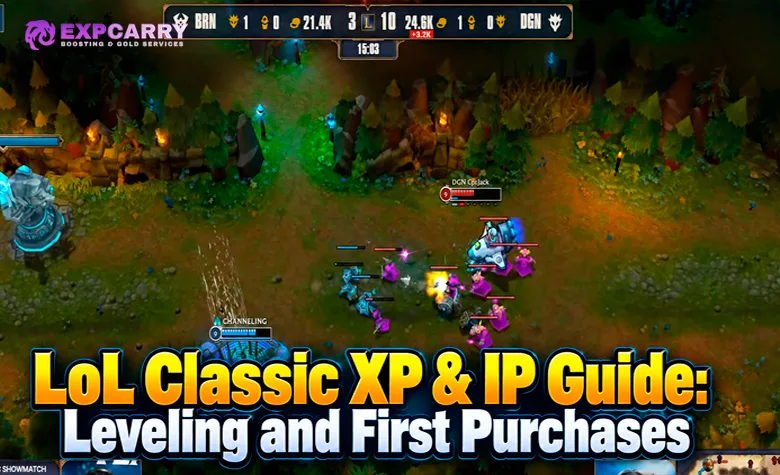
League of Legends Classic uses a separate experience and Influence Point progression system, making your first currency decisions important. Classic XP raises your Classic Account Level and unlocks Masteries, Rune slots, currencies and additional Rune Pages. Influence Points (IP) are spent on Classic Runes and Rune Pages, while champions are purchased with Blue Essence or RP. The most efficient starting route is to unlock Masteries at Classic Level 3, progress through Levels 4–8 to access all four Rune categories, and invest your first IP in reusable Runes for your main champions. At Level 10, Summoner's Journey introduces a separate competitive progression system. Patch 26.17 doubled Classic XP gains per match, more than doubled match IP gains and reduced certain Rune prices. This guide covers the important progression milestones, daily and weekly rewards, first-purchase priorities and the practical route toward a useful Classic account before the current mode run ends on January 6, 2027.
Short answer: Level your Classic account through matches and missions, unlock Masteries at Level 3 and Rune categories at Levels 4, 6, 7 and 8, then spend IP on versatile Runes for your main champions. Prioritize daily wins, eligible weekly missions, free level rewards and the upcoming free Act II Classic Pass Rune Page before purchasing additional pages or specialized Runes.
How Classic XP and IP Progression Works
League Classic has several independent progression systems. Some unlock permanent account features, some provide spending currency, and others track competitive performance or seasonal rewards. Understanding these differences prevents you from spending resources on the wrong items or expecting ordinary League matches to unlock Classic-specific features.
Your Classic Account Level begins at 0 and has a maximum of 30. Playing Classic and completing eligible missions increases that level. As you progress, you unlock Mastery Pages, Rune categories, extra Rune Pages and other rewards. Classic leveling is free, but the current Classic run is scheduled to end on January 6, 2027.
| System | How You Earn It | Main Purpose |
|---|---|---|
| Classic XP | Classic matches and eligible missions | Raises your Classic Account Level from 0 to 30 |
| Influence Points (IP) | Classic matches, missions and progression rewards | Purchases Classic Runes and additional Rune Pages |
| Blue Essence (BE) | Regular League progression and certain Classic rewards | Purchases eligible champions in the shared League collection |
| Classic Pass Coins | Eligible missions and pass-related rewards | Unlocks rewards within the applicable Classic Pass |
| Seasonal Points (SP) | Summoner's Journey match results after unlocking the system | Tracks competitive progression from Salt toward Legend |
| Council Voting Power | Specific progression rewards and other eligible sources | Provides voting weight during active Classic Council polls |
These systems are not interchangeable. You cannot spend SP as IP, and Classic Pass Coins do not function as ordinary Rune Shop currency. Classic XP determines which account features become available, IP pays for Runes and Rune Pages, and Blue Essence or RP is used for champion purchases. Keeping these currencies separate is essential when deciding which rewards actually improve your Classic loadouts.
Classic XP vs Regular League XP
Your regular League account level and Classic Account Level are separate. Classic XP advances the dedicated Classic progression track, while ordinary League account XP belongs to the broader game. A high-level modern League account does not automatically receive a fully completed Classic progression track.
You can see your current Classic Level in the League client. Open the Classic section, create a lobby and look for the progression tracker beside the Find Match button. Selecting it expands the reward track and shows completed and upcoming milestones.
Riot explains the location in its Where Is My League Classic Level? support article.
Influence Points vs Blue Essence
IP returned specifically for League Classic. They are earned through Classic matches, missions and progression rewards and are primarily spent on Runes and Rune Pages. Blue Essence remains part of the standard League champion economy, and certain Classic levels and missions also award it. Riot lists champions as purchasable with Blue Essence or RP, not IP.
If you already own a champion in regular League and that champion is available in Classic, Riot allows you to use it without purchasing the same champion again. This matters for resource planning: existing champion ownership lets you avoid unnecessary Blue Essence or RP purchases while reserving IP for your Rune collection.
Before purchasing a champion, check whether you already own it, whether it is included in the current Classic roster and whether it is available through a free rotation or progression reward. The Classic roster continues to expand during the remaining patches, so not every modern champion is necessarily playable in Classic.
League Classic Level Rewards: What to Unlock First
Classic Level rewards are the foundation of your account progression. Rather than trying to earn enough IP to purchase everything immediately, take advantage of the features and currencies the game unlocks as you level.
The most important early milestones are Levels 3–8. They unlock the systems needed to prepare a customized Rune and Mastery loadout. Level 10 then opens Summoner's Journey, while later levels provide additional Rune Pages, IP, cosmetics and voting rewards.
| Classic Level | Classic XP Needed for That Level | Confirmed Reward | What to Prioritize |
|---|---|---|---|
| 1 | 50 | League Classic Icon | Begin the progression track |
| 2 | 100 | 1,000 Blue Essence | Continue playing and collecting mission rewards |
| 3 | 100 | Mastery Pages and 500 Blue Essence | Configure Masteries and access your three starting Rune Pages |
| 4 | 100 | Mark Rune slots and 2,500 IP | Begin investing in reusable offensive Runes |
| 5 | 150 | Council voting access | Continue toward defensive Rune slots |
| 6 | 150 | Seal Rune slots and 2,500 IP | Develop a useful defensive Rune foundation |
| 7 | 150 | Glyph Rune slots and 2,500 IP | Add Runes that support your champion's main needs |
| 8 | 200 | Quintessence slots and 5,000 IP | Complete a practical Rune Page |
| 10 | 200 | Summoner's Journey and 1,000 IP | Unlock separate competitive progression |
| 11 | 250 | 2,500 IP | Improve your first page or prepare a second role |
| 13 | 250 | 1 Rune Page | Save another reusable loadout |
| 16 | 300 | 2,500 IP | Expand only the Rune categories you actually need |
| 17 | 400 | 1 Rune Page | Prepare an additional role or matchup setup |
| 20 | 500 | 1 Rune Page | Use the free page before buying more storage |
| 21 | 500 | 2,500 IP | Complete a useful secondary setup |
| 25 | 750 | 1 Council Voting Power | Use the reward during an eligible poll |
| 27 | 1,000 | 2,500 IP | Finish remaining important Rune purchases |
| 30 | 1,500 | Rustier Blitzcrank Classic skin | Complete the Classic Level track before the mode ends |
The XP values above represent the amount needed for each specified level, not cumulative XP from Level 0. The complete track also contains Blue Essence, portraits, emotes, a ward skin, a title and additional rewards at levels not individually highlighted here. Riot's League Classic Progression page provides the full Level 1–30 schedule.
Levels 3–8: Your Most Important Early Unlocks
Level 3 unlocks Mastery Pages and makes the three starting Rune Pages available. Levels 4, 6, 7 and 8 unlock Marks, Seals, Glyphs and Quintessences, respectively. Reaching these milestones gives you access to the complete structure of a Classic Rune Page: nine Marks, nine Seals, nine Glyphs and three Quintessences.
This is the first major progression goal because additional IP becomes more useful once the related Rune slots are unlocked. Buying random Runes without considering which categories your account can equip is a poor way to build your initial loadout. Empty or unavailable Rune slots provide automatic stat bonuses, so an incomplete collection does not leave your champion entirely without Rune benefits.
Your immediate priority should be to reach Level 8 while using the default Rune and Mastery options where necessary. Afterward, you can concentrate on improving the statistics of the pages you actually use.
Levels 10–20: Competitive Progression and Extra Rune Pages
Level 10 unlocks Summoner's Journey. You can continue earning Classic XP and completing account milestones while participating in the separate competitive progression system.
Levels 13, 17 and 20 each award an additional Rune Page according to Riot's progression table. This matters for spending decisions because purchasing extra pages before collecting these rewards may be unnecessary.
Riot also granted two additional free Rune Pages to all players in Patch 26.17. Together with the three starting pages and three listed level rewards, an account receiving these grants can have eight free pages without spending IP. The Act II Classic Pass, scheduled to begin on October 20, 2026, offers another Rune Page on its third tier. Check your actual collection and pass progress before spending IP.
Levels 21–30: Finish the Track Without Wasting IP
After Level 20, the core Rune and Mastery categories have already been unlocked. The remaining progression focuses more on collecting additional IP, account rewards and completing the Classic Level track before the current mode run ends.
Levels 21 and 27 provide additional IP. Level 25 awards Council Voting Power, while Level 30 provides the Rustier Blitzcrank Classic skin. There is no need to buy a large collection of specialized Runes simply to justify continuing toward the final reward.
If your main champion's page is already functional, additional IP can be saved for future Rune purchases or extra pages when needed. Finish the remaining levels through ordinary play and eligible missions rather than repeatedly purchasing items that do not improve your preferred setups. Remember that the current Classic progression window ends on January 6, 2027.
How to Earn Classic XP and Influence Points
Classic matches provide progression rewards, but the most predictable additional sources are daily, weekly and one-time Classic missions. These missions can provide fixed IP and XP rewards that are easier to plan around than guessing a universal reward per match.
Patch 26.17 doubled Classic XP earned per game and more than doubled IP gained per game compared with the previous baseline. Riot did not provide one fixed IP-per-match value that applies to every account and situation, so claiming an exact amount of IP per hour would require measured data rather than assumptions. The official mission rewards below provide more reliable planning targets.
Daily Missions: Prioritize Your First and Second Win
The official Classic progression schedule lists two daily win objectives. Their rewards make them useful priorities for players who want a predictable source of XP and IP.
| Mission | Confirmed Reward | Practical Priority |
|---|---|---|
| Win one matchmade Classic game | 1,000 IP, 100 Classic XP and 20 Classic Pass Coins | First daily progression target |
| Win two matchmade Classic games | 500 IP | Useful second target when you have time |
Riot lists the daily reset at 11:00 AM Pacific Time. The exact local reset hour depends on the relevant time-zone conversion and daylight saving changes. Completing both daily objectives provides a combined 1,500 IP, 100 Classic XP and 20 Classic Pass Coins before ordinary match rewards.
The first win is particularly valuable because it combines account XP, IP and pass currency. The second objective requires two daily wins in total, not two additional wins after the first objective. Once both are complete, continuing to play does not repeatedly award their fixed mission rewards.
These missions require eligible matchmade Classic games. A custom match should not be treated as an automatic substitute for a matchmade victory, especially in regions where regular matchmaking will become restricted or unavailable.
Weekly Missions: Earn Rewards While Expanding Your Champion Pool
Classic weekly missions offer additional progression through several types of play. Some specifically encourage different Classic champions, while another can be completed through eligible League or Teamfight Tactics matches.
Riot's current weekly objectives include:
- Play three Classic games as different champions: 250 Blue Essence, 25 Classic Pass Coins and 100 Classic XP.
- Play six Classic games as different champions: 750 IP, 25 Classic Pass Coins and 100 Classic XP.
- Play eight League and/or TFT games: 1,500 IP and 20 Classic Pass Coins.
These objectives reset every Wednesday at 11:00 AM Pacific Time according to Riot Support. Completing all three awards 2,250 IP, 250 Blue Essence, 200 Classic XP and 70 Classic Pass Coins, excluding ordinary match rewards. Check the in-client mission panel to confirm which missions are active and what progress has been recorded.
For efficient progression, choose champions you already own or can use through the free rotation. The weekly different-champion objectives are useful opportunities to explore the roster, but they do not justify purchasing several unfamiliar champions with Blue Essence or RP solely to complete a mission.
One-Time Missions: Collect the Easy Rewards Early
One-time missions provide extra resources for actions you may complete naturally while learning Classic. They are especially relevant to new accounts because their rewards can accelerate the first few Rune unlocks.
Riot lists the following one-time objectives:
- Play one Classic Co-op vs. AI match: 1,000 Blue Essence and 100 Classic XP.
- Play one Classic Summoner's Rift match: 500 IP.
- Play one Classic match: 40 Classic Pass Coins and 100 Classic XP.
- Complete the first ten-match milestone: 750 IP.
- Complete the second ten-match milestone: 750 IP.
- Complete the third ten-match milestone: 1,500 IP.
The three ten-match milestones are presented as separate sequential stages in Riot's mission list. Together, these one-time objectives can award 3,500 IP, 1,000 Blue Essence, 200 Classic XP and 40 Classic Pass Coins if all are eligible and completed. Do not assume all three ten-match rewards unlock after the same ten games; check each stage's progress in the client.
Riot confirmed that these one-time missions from Season 3 Act I are being extended into Act II. Their eligibility and active state should still be verified in your mission panel before planning a session around them.
Explore services related to this guide, selected from our League of Legends catalog.
View All League of Legends Services


What Should You Buy With Your First IP in League Classic?
The best first IP purchases are Runes that improve several of your most-played champions. A reusable Rune collection can contribute to multiple Rune Pages, while a narrow purchase for one experimental build may sit unused for most of your matches. IP should not be reserved for champion purchases, since Riot sells champions for Blue Essence or RP.
Before spending anything, identify your primary role, one or two champions you expect to play repeatedly, and the Rune categories you have unlocked. Check the Runes already owned or earned from missions, levels and other rewards so you do not purchase unnecessary duplicates. Standard Marks, Seals and Glyphs commonly cost 500 IP each; Patch 26.17 also reduced Minor Runes from 650 to 500 IP and specified Quintessences from 1,250 to 1,000 IP. Always verify the displayed cost of the exact Rune you intend to purchase.
Recommended First IP Purchase Order
The following order is a practical spending strategy rather than a required Riot purchase sequence. Change it when your main champion has a specific need that matters more than a generic account-wide setup.
- Use the free Mastery setup: At Classic Level 3, configure the available Masteries. They do not require IP purchases, and a default page is supplied if you have not selected one.
- Choose your main damage type: At Level 4, begin with a reusable Mark category suitable for your most-played champions, such as Attack Damage for physical carries or Magic Penetration for spell-focused damage dealers.
- Build defensive consistency: When Seals unlock at Level 6, prioritize broadly useful defense if it addresses the damage you take during lane or jungle clears.
- Add practical Glyphs: At Level 7, select Magic Resist or another relevant statistic rather than purchasing unrelated Glyphs for several roles.
- Finish the first functional page: Once Quintessences unlock at Level 8, select up to three that support your primary champions and create a coherent page, using existing Rune rewards whenever possible.
- Prepare a second role: Use later mission, level and pass rewards to build another page around a different damage type or important matchup.
- Delay narrow purchases: Specialized critical-strike, Energy, sustain or economy setups become more worthwhile after your primary pages are functional.
The key objective is not immediately filling every available slot with expensive Runes. At a 500-IP price for each of 27 standard Marks, Seals and Glyphs and 1,000 IP for each of three applicable Quintessences, a completely purchased 30-slot page would cost 16,500 IP. This is only a baseline planning example, not a universal price for every possible Rune combination. Free rewards and reusable Rune ownership can significantly reduce your actual spending.
Which Rune Types Offer the Most Reusable Value?
Some Rune categories transfer naturally between different champions. Armor Seals are useful in many physical matchups and jungle situations. Magic Resist Glyphs support survival against spell damage, while offensive Marks should match the champions you play most often. One collection of appropriately chosen Runes can be reused across several saved configurations.
For a player concentrating on physical champions, building a usable offensive Mark row and basic defenses can provide a strong starting point. For an AP-focused player, the offensive choice changes, but the principle remains the same: buy Runes that solve the most frequent needs across your champion pool.
Supports and tanks may benefit from defensive or Utility choices before investing in offensive statistics. Do not buy an Attack Damage page simply because it is broadly recommended if your actual champion pool does not make effective use of it. Empty Rune slots also provide automatic bonuses, allowing you to prioritize important purchases instead of rushing to replace every placeholder immediately.
The League Classic Runes and Masteries Guide covers individual Rune prices, exact statistics, mastery effects and completed role setups. This progression guide focuses on the order and purpose of purchases.
Should You Spend IP on Additional Rune Pages?
Additional Rune Pages provide storage for different configurations; they are not the same as purchasing the Runes that fill those configurations. Buying another empty page does not automatically improve your champion's statistics, and an existing Rune collection can be reused across multiple pages.
Riot lists additional Rune Pages at 1,500 IP each. However, three starting pages, three level-up pages at Levels 13, 17 and 20, and two free pages granted in Patch 26.17 can provide eight pages without IP purchases. The Act II Classic Pass also lists another Rune Page on tier 3 for 50 Classic Pass Coins, after the required tier progression. This makes purchasing extra pages a lower priority for most new accounts.
Purchase an additional page only when you have enough useful Runes for another configuration and your existing free pages no longer meet your needs. Otherwise, the same 1,500 IP may have greater practical value when spent on missing Runes. Check the active pass before purchasing a page that you might soon unlock for free.
How to Spend IP Based on Your Champion Pool
A good IP strategy depends on how many different champion styles you play. Spending priorities should follow your actual role and champion selection rather than treating every Classic account as if it needs identical Runes.
If You Play One Role and Two Champions
This is the simplest account to develop efficiently. Choose two champions with overlapping Rune needs when possible, then build one stable page and a limited matchup alternative.
For example, a player using two physical solo-lane champions may reuse much of the same Attack Damage and defensive Rune collection. There is little reason to purchase an unrelated AP or support economy page until the player actually intends to use those champions.
Once your main setup is functional, save remaining IP for a specific problem, such as surviving magic damage or supporting a champion whose trading pattern benefits from different statistics. Do not confuse this IP reserve with the Blue Essence or RP required to unlock additional champions.
If You Play Both AD and AP Champions
A mixed champion pool requires greater care because offensive Runes do not always transfer between damage types. Begin by building the page you will use most often, then expand toward the second damage type after collecting enough IP and unlocking the relevant slots.
Defensive Runes can often be shared across both pages. This reduces the need to build two completely separate collections. Use your free Rune Pages to store both configurations once the Runes are available.
Avoid purchasing several specialized offensive sets before either main setup is complete. Two incomplete pages may be less useful than one dependable page and a temporary default configuration for your secondary role.
If You Main Support or Jungle
Support and jungle can have different early resource needs from farming lanes. A support may value durability, movement or income-related statistics, while a jungler may need Armor and statistics that make the first clear safer.
For these roles, test whether an existing default page is sufficient before spending IP. If your jungler consistently loses too much Health during the first clear, a relevant defensive purchase may be more useful than a late-game offensive Rune. If your support struggles to survive strong engage, prioritize the statistics that address that problem rather than investing entirely in economy.
Once the first setup works reliably, use additional IP to support another champion or matchup rather than purchasing many small upgrades without a clear purpose.
How to Farm Classic XP and IP Efficiently
Efficient progression comes from combining ordinary match rewards with available missions. It does not require playing the longest possible session or repeatedly switching strategies to chase a theoretical IP-per-hour rate.
The mission system makes several objectives predictable, but actual match rewards, queue availability and personal playtime can vary. Plan around confirmed rewards first, then treat additional match income as progress toward your longer-term purchases. After Patch 26.21, regional matchmaking restrictions may also affect when eligible games are available.
A Short Daily Progression Routine
If you have limited time, begin by checking which Classic missions are active. Choose a familiar champion and an available matchmade queue rather than spending most of the session experimenting with an unfamiliar setup.
Your first daily win is the highest-priority repeatable objective listed in the official schedule because it grants 1,000 IP, 100 Classic XP and 20 Classic Pass Coins. If you have time for a second win, you can earn another 500 IP. These are mission rewards on top of any eligible match rewards.
After the session, inspect your Classic Level and IP balance. Purchase a useful Rune only when you know what it contributes to your main page. There is no benefit in immediately spending every newly earned IP simply because it is available.
A Weekly Routine for Faster Account Development
Players with more time can structure their games around weekly objectives without allowing missions to dictate every champion selection.
Use your familiar champions for daily wins, then schedule games on different Classic champions when completing the three- and six-champion missions. If you already play regular League or TFT, check whether those matches contribute to the eight-game weekly objective. Doing so can earn IP without requiring every eligible match to be played in Classic.
Before the weekly reset, review any mission close to completion. Finishing an eligible objective is useful, but playing many additional games solely to unlock a small reward may not be efficient if you have limited time. In regions with limited Classic queues, plan matchmade objectives around the published availability windows.
How Much XP or IP Can You Earn Per Hour?
There is no single confirmed rate that applies to every Classic player. Match duration, results, active missions and eligibility conditions can change what a session awards. Patch 26.17 also changed progression substantially, making older launch-period farming estimates unreliable.
Instead of relying on an advertised fixed IP-per-hour number, track the actual rewards from several ordinary sessions. Separate mission rewards from match rewards so one day with an additional mission does not distort your expectation for every future session.
Riot also corrected a bug that allowed solo-queued players to receive party XP or IP bonuses incorrectly. Do not treat pre-fix rewards as evidence of a guaranteed bonus for solo play. Queue availability, especially after the announced Patch 26.21 regional changes, can further affect real-world farming efficiency.
Summoner's Journey vs Classic Account Levels
Summoner's Journey is the separate competitive progression system introduced for League Classic. It unlocks at Classic Level 10 and measures match performance through Seasonal Points rather than functioning as another IP purchase or ordinary account level.
Once the system becomes available, your next five matches determine your initial Emblem and division. Subsequent eligible Classic results contribute to that progression. This does not create a separate Ranked queue: Summoner's Journey operates alongside Classic matchmaking rather than using modern League's Ranked Solo/Duo or Flex ladder.
What Are Seasonal Points?
Seasonal Points, or SP, are the visible points used for Summoner's Journey progression. Winning eligible matches adds SP, while losing matches subtracts it. The system also uses hidden matchmaking rating (MMR) to help establish competitive matches.
The progression begins with Salt and continues through Wood, Silver, Gold, Platinum and Diamond toward Legend. The first six Emblems have divisions IV through I, and 100 SP is required to advance a division or Emblem. Falling below 0 SP can cause demotion, while Legend has no division structure or fixed SP ceiling. Riot also provides an Aegis of Valor SP gain bonus when players win in lower-priority assigned roles.
SP cannot be exchanged for Runes and does not replace Classic XP. If your objective is to unlock a Rune category or earn the next Classic Level reward, focus on the XP track and missions rather than treating Summoner's Journey placement as the purchase requirement.
Should You Rush Classic Level 10?
Level 10 is a useful milestone because it unlocks Summoner's Journey and awards 1,000 IP. Reaching it also means the four Rune slot categories have already become available, allowing you to enter the competitive progression system with a more complete account setup.
However, there is no need to spend all your IP before Level 10. Automatic bonuses from unfilled Rune slots and default Mastery options allow you to play while building your collection. Prioritize a practical loadout rather than delaying matches until every possible upgrade has been purchased.
Classic Pass Coins and Seasonal Rewards
Classic Pass Coins are a separate seasonal currency obtained through eligible missions. Unlike IP, they are tied to the Classic Pass reward structure, which has its own availability and expiration rules.
Riot's Act I Classic Pass ended in September 2026, and its unused coins expired when the pass deactivated. The free Act II Classic Pass is scheduled to begin on October 20, 2026 at 11:00 AM Pacific Time. Act II progression ends on January 4, 2027 at 11:59 PM PT, and the pass deactivates on January 5, 2027 at 11:59 PM PT, subject to schedule changes. These deadlines are separate from the Classic mode's January 6 end date.
What Should You Do With Classic Pass Coins?
Check the active pass before spending coins. The Act II pass is entirely free, has six tiers, and requires spending at least 125 Classic Pass Coins within a tier to unlock the next one. Its confirmed rewards include random champions, a Rune Page on tier 3 for 50 coins, cosmetic Random Skinned Runes, icons, titles, emotes and a random skin. Skinned Runes change appearance without improving Rune statistics.
Do not confuse Pass Coins with IP. Buying a Rune directly from the Classic Store and obtaining a reward through the pass are different transactions with different currencies and eligibility rules. The random champion rewards can also reduce future Blue Essence spending, while the tier 3 Rune Page may save 1,500 IP.
Most importantly, do not allow a pass to end while holding coins you intended to use. Riot's Classic Pass and Content documentation confirms Act II's scheduled progression and deactivation dates. Always verify the active in-client schedule, as Riot states these dates may change.
What Changes in the Classic Store After Patch 26.21?
Riot announced that from Patch 26.21 onward, the Classic Store will contain only Champions, Runes and Rune Pages. Champions are available for Blue Essence or RP, while Runes and Rune Pages use IP. Classic-only cosmetic content that becomes unusable when the mode ends is also subject to Riot's announced refund arrangements, with details determined by the purchase type.
For an account still developing its main Rune collection, the sensible priority remains consistent: use level rewards and missions, collect useful free-pass rewards, buy Runes that improve your main setup, and avoid spending IP on additional pages before you need them. The announced store changes do not turn IP into champion currency.
How Long Can You Progress in League Classic?
Riot has confirmed that the current League Classic run will remain available through January 6, 2027. The mode's current run will then end, with Riot expressing an intention to bring Classic back in the future, likely as an event mode, but without a confirmed return date. The Act II Pass has earlier progression and deactivation deadlines.
Starting with Patch 26.21, NA, Brazil, EUW and EUNE are scheduled to retain continuous Classic matchmaking. Korea, LAN, LAS, Taiwan, Vietnam, Turkey, Southeast Asia, Oceania and Russia will receive limited PvP queue windows; Riot's October 14 developer update lists weekday availability from 4:00 PM to midnight and weekend availability from 10:00 AM to 1:00 AM server time. Japan and the Middle East will have custom matches only. Custom games remain available at all times in all regions. Check the latest Riot schedule for any revisions.
These changes matter when planning to complete Classic Levels, use Pass Coins or finish seasonal rewards. Custom matches should not be assumed to qualify for objectives that explicitly require matchmade games. Players in regions without ordinary Classic matchmaking may therefore be unable to complete certain matchmade objectives under the same conditions as players elsewhere.
For the latest information, consult Riot's League Classic developer update and the current in-client progression, queue and mission panels.
Common Classic XP and IP Progression Mistakes
Most inefficient progression decisions come from misunderstanding which systems provide account value and which rewards are seasonal. Avoid these mistakes while developing your account.
- Buying Rune Pages before checking free rewards: The level track, Patch 26.17 grants and Act II pass provide several pages without IP purchases.
- Buying specialized Runes too early: Build reusable statistics for your main champions before investing in uncommon setups.
- Confusing Classic XP with SP: Classic XP unlocks account levels; SP tracks Summoner's Journey results.
- Ignoring daily and weekly missions: Fixed mission rewards can contribute significantly to progression beyond ordinary match income.
- Using outdated IP prices or gain rates: Patch 26.17 changed both the currency economy and several Rune prices.
- Assuming every match type completes every mission: Check whether a specific objective requires matchmade Classic games or allows other modes, especially after regional queue restrictions.
- Spending Pass Coins as though they were IP: Pass Coins have separate reward tracks and expiration conditions.
- Assuming a high modern account level unlocks Classic progression: Classic Levels must be earned through their own system.
- Using IP as a champion-purchase budget: Champions cost Blue Essence or RP, so check ownership and the Classic roster before making purchases.
The most reliable approach is to check your next unlock, complete available missions and spend only when the purchase helps your actual champion pool. Monitor the Act II Pass deadlines and remaining Classic availability so that unclaimed rewards do not expire. This reduces wasted currency without requiring a rigid or repetitive farming schedule.
LoL Classic XP and IP FAQ
These answers address common questions about Classic rewards, account levels and early spending decisions.
What is the fastest way to earn IP in League Classic? Combine ordinary Classic matches with the daily win missions, available weekly objectives and uncompleted one-time missions. Both daily win objectives together award 1,500 IP before match rewards. Riot increased match IP gains in Patch 26.17, but a universal exact IP-per-hour rate has not been established.
Should I buy Runes or Rune Pages first? Usually Runes. Eight free Rune Pages are available through starting pages, level rewards and the Patch 26.17 grant, with another available through the Act II Pass. Useful Rune purchases improve the configurations you already have. Buy extra page capacity only when the existing pages are insufficient.
Do I need Classic Level 30 to unlock all Rune categories? No. Marks unlock at Level 4, Seals at Level 6, Glyphs at Level 7 and Quintessences at Level 8. Level 30 is the end of the Classic Level reward track, not the requirement for accessing all Rune slots.
Can I earn Classic XP from regular League or TFT matches? Classic XP comes from Classic matches and eligible missions. Certain weekly missions accept regular League or TFT games and award Classic-related rewards, including IP and Pass Coins, but the listed eight-game weekly mission does not award Classic XP. Ordinary play in those modes should not be assumed to grant Classic match XP.
Conclusion
Build your League Classic account around the rewards that improve your most-played champions. Reach the early Rune and Mastery unlocks, use daily and weekly missions to earn IP and Classic XP, then complete reusable Rune Pages before buying specialized options. Take advantage of free pages, level rewards and the Act II Pass, keep Blue Essence champion purchases separate from IP spending, and treat Summoner's Journey as a distinct competitive system. With Act II Pass deadlines in early January and the current Classic run ending January 6, 2027, prioritize rewards you can realistically unlock and use before the mode closes. This approach makes your first IP purchases useful while keeping progression manageable through the rest of the Classic track.