Marathon's Vault Breaker experiment proved that Bungie's extraction shooter can support a progression-driven PvE loop without rival crews in the same zone. The Season 2 version sent Solo, Duo, and Trio Runners into Cryo Archive with a free Sponsored Kit, asked them to clear progressively harder Vaults across repeated deployments, and used extracted Vault Data to improve future PvE runs or buy gear for standard Marathon modes. The important Season 3 change is bigger than a balance patch: Bungie says it is developing a full PvE mode for Season 3. Season 3 itself begins on September 22, 2026, but Bungie has not confirmed that the PvE mode will necessarily launch on that exact day.
That does not mean every Season 2 rule is confirmed to return unchanged. As of September 1, Bungie has not published the full Season 3 PvE ruleset, so this guide separates the mechanics that were proven in Vault Breaker from the features that remain unconfirmed for Season 3. Use the Season 2 system to understand progression between runs, Sponsored Kits, Vault Data, the Armory, Solo/Duo/Trio play, and cross-mode rewards, but do not assume the same currency tiers, shop limits, map, or kit tree will automatically become the final Season 3 design.
Marathon Vault Breaker and Season 3 PvE at a Glance
Vault Breaker ran as Marathon's first experimental PvE-only activity during Season 2. It began with Update 1.1.5 on July 21 and was later extended through August 18. Bungie's official Vault Breaker preview described the mode as a roguelite PvE experience in Cryo Archive where progress carries across multiple matches through Vault Data and Sponsored Kit upgrades.
| Feature | Season 2 Vault Breaker | Season 3 status |
|---|---|---|
| PvE-only combat | Yes | Full PvE mode confirmed for Season 3 |
| Release status | Experimental limited-time mode | Planned for Season 3; exact PvE launch timing not yet detailed |
| Season 3 start | Not applicable | September 22, 2026 |
| Map | Cryo Archive | Not yet confirmed |
| Progression between runs | Vault Data upgrades Sponsored Kit | Full details not yet published |
| Sponsored Kit | Required free PvE kit with upgrade paths | Return not yet confirmed |
| Vault Data | Tier 1 and Tier 2 event currency | Return not yet confirmed |
| Armory | Dedicated Vault Breaker Event Armory | Season 3 version not yet detailed |
| Solo | Supported at launch; dedicated adjusted Solo-only queue added later | Exact Season 3 queue structure not yet confirmed |
| Duo | Supported | Not yet reconfirmed for full PvE |
| Trio | Supported | Not yet reconfirmed for full PvE |
| Cross-mode gear rewards | Yes, through Armory purchases | Season 3 reward economy not yet published |
The safe takeaway is that Bungie is preserving the direction, not necessarily every implementation detail. Season 2 tested a PvE progression loop. Bungie plans to expand that direction into a full PvE mode during Season 3, but the exact launch timing and structure still need to be detailed before players can plan around a returning Vault Data farm or Sponsored Kit build.
When Does Marathon Season 3 Start?
Season 3 begins on September 22, 2026. Bungie's official Marathon key-dates post confirms the date and says the season also brings a major Perimeter revamp, new areas and encounters, a new Runner shell, new weapons, new equipment, and additional content.
The same pre-Season 3 communication does not provide a launch-day ruleset for the full PvE mode. Bungie previously said Vault Breaker feedback and data would be used while the team continued working toward that full PvE experience. As of September 1, the September 22 Season 3 start is confirmed while the detailed PvE feature list and exact PvE launch timing remain open.
How Season 2 Vault Breaker Worked

The experimental mode removed one of Marathon's biggest sources of unpredictability: rival player crews. Instead of contesting Cryo Archive against other Runners, the crew fought UESC forces while trying to open increasingly difficult Vaults and extract the progression currency needed for future attempts.
The loop was deliberately separate from normal extraction loot. Gear found inside the PvE run could not simply be exfilled into the standard economy. That protected the main game from becoming a low-risk Cryo Archive loot farm while still giving PvE players a way to earn useful rewards through the Armory.
Each run fed the next run
Vault Breaker was not designed as a one-and-done mission. A weak Sponsored Kit entered Cryo Archive, earned Vault Data, and used that currency after extraction to unlock stronger future kit options. Repeated runs therefore changed the player's power floor inside the PvE mode.
This cross-run growth was one of the central systems Bungie was testing. The studio had already described the experimental PvE concept as a mode where crews complete objectives together and make progress across multiple matches. That does not confirm the same Vault Data system for Season 3, but it explains why progression between runs was so important to Vault Breaker's design.
In-run gear was temporary by design
Weapons, items, and gear found during a Vault Breaker deployment generally stayed behind when the run ended. Vault Data was the important exception because it could be extracted and banked. This created a roguelite rhythm: improvise with what the run gives you, survive long enough to secure progression currency, then make a persistent event-progression decision between stronger future PvE attempts and rewards for the rest of Marathon.
That separation is important when thinking about Season 3. Do not assume the full PvE mode will become a safe place to extract every high-tier weapon found in Cryo. Bungie created the original reward boundary specifically to avoid flooding the standard economy with high-power loot earned without PvP pressure, but the final Season 3 economy has not yet been revealed.
Explore services related to this guide, selected from our Marathon catalog.
View All Marathon Services


Vault Data Explained: Tier 1 vs Tier 2
Vault Data was the main progression currency of the Season 2 test. There were two tiers, and the difference between them forced players to decide whether to bank a safer run or push deeper for better progression.
| Vault Data | How Season 2 awarded it | Extraction requirement | Practical use |
|---|---|---|---|
| Tier 1 Vault Data | Found inside Vaults | Normally had to be extracted | Early Sponsored Kit upgrades and Armory purchases |
| Tier 1 Commander reward | Kill a UESC Commander | Awarded post-run even without successful exfil | Provided limited progression even after a failed extraction |
| Tier 2 Vault Data | Clear consecutive Vaults in the same deployment | Successful exfil required | Higher-tier Armory offers and later progression |
Tier 2 was the risk lever. Opening one Vault and leaving was safer, but the more valuable currency required consecutive Vault progress and a successful extraction. Bungie specifically warned that this would be especially difficult for Solo players.
When to bank Tier 1 instead of pushing Tier 2
The correct Season 2 decision depended on progression state. A new Sponsored Kit benefited from safe Tier 1 extraction because early upgrades increased future consistency. Once the kit was stronger and the player knew Cryo routes, pushing a second and later Vault became more reasonable.
If Season 3 uses a similar risk-versus-progression system, the same general principle will remain useful even if Vault Data itself disappears: bank progression when the next upgrade meaningfully raises your survival rate, and push deeper only when the additional reward is worth the added risk. The exact currency and loss conditions, however, should not be assumed until Bungie publishes the final PvE rules.
Sponsored Kits Were the Real Meta-Progression System
Vault Data was the currency, but the Sponsored Kit was the actual power curve. Players needed the free special Sponsored Kit from the Vault Breaker Armory to enter the activity. The starting version was intentionally weak, with one standard weapon and a limited amount of equipment and consumables.
As Vault Data accumulated, the kit opened different upgrade paths. Bungie described weapon quality, survivability, and a wider selection of implants and cores as possible directions. This made the PvE loop less about protecting a personal expensive loadout and more about improving a dedicated mode-specific baseline.
Weapon upgrades vs survivability
Weapon quality helped players clear UESC pressure faster and reduced the time cost of each Vault. Survivability upgrades improved the chance that a long run actually reached extraction. For a first progression pass, survivability had higher value if deaths were preventing any Vault Data from coming home; weapon quality became more attractive once players could already clear the first Vault reliably.
The correct upgrade was therefore personal rather than universally optimal. A Trio with coordinated healing and target focus could afford more offensive investment. A Solo player learning Cryo often gained more from durability and utility because one mistake could end the entire deployment.
Players who prefer learning difficult extraction routes with another experienced player can use the verified Marathon Rent a Pro Runner option for standard Marathon sessions. Season 3's dedicated PvE eligibility and service scope should be checked after Bungie publishes the final mode rules.
How the Vault Breaker Armory Connected PvE to Main Marathon
The Vault Breaker Armory solved the central economy problem of a PvE-only extraction mode: players needed rewards that mattered outside the mode, but direct safe extraction of Cryo loot would have undermined the normal risk economy. Bungie's answer was to turn extracted Vault Data into an event shop currency.
The Season 2 Armory offered a daily rotating Deluxe weapon, Cryo Key Templates, Prestige Weapons, and other gear. Tier 1 offers had weekly stock limits that varied by item, while higher-tier Tier 2 offers included stronger limited rewards. Prestige gear was also available as limited event stock.
Armory purchases and Kit upgrades did different jobs
This distinction was easy to miss. Sponsored Kit upgrades affected later Vault Breaker attempts. Weekly and Limited Armory purchases were for standard Marathon activities. A player therefore had to choose between making the PvE loop easier and converting the currency into value for Perimeter, Dire Marsh, Outpost, Cryo Archive, Ranked, or other normal activities.
If the next PvE upgrade created a large survival improvement, spending on the kit first increased future Vault Data income. If the kit was already strong enough to clear the desired depth, buying standard-mode gear created value outside the event. If Season 3 keeps a similar connection between PvE progression and the wider game, Bungie will still need to balance meaningful rewards against the risk of letting PvE replace the standard extraction economy.
The existing Marathon Ordnance Heist guide shows a different multi-run event economy built around Key Templates, UESC Manifests, and Firestorm Locker Keys. Vault Breaker was distinct because its progression currency improved a PvE-specific kit instead of only advancing a reward chain.
What Could Be Taken Into Standard Marathon Modes?
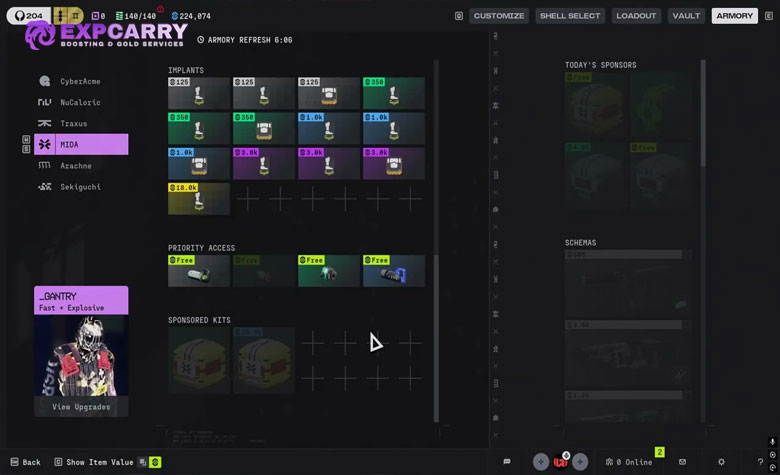
Season 2 Vault Breaker had three different kinds of value, and they should not be confused. Some progress existed only inside the PvE experiment, some purchases could be used immediately in standard modes, and the event's Codex cosmetics belonged to longer-lived account progression.
| Reward or progress | Used in Vault Breaker | Used in standard modes | Seasonal permanence |
|---|---|---|---|
| Sponsored Kit upgrades | Yes | No | Vault Breaker-specific progression |
| Vault Data | Progression currency | Spent to buy standard-mode rewards | Vault Breaker event currency; no Season 3 carryover has been announced |
| Weekly Armory gear | No direct effect on PvE kit | Yes | Subject to normal seasonal gear resets |
| Prestige gear from Armory | No direct effect on PvE kit | Yes | Subject to normal seasonal gear resets |
| Cryo Key Templates | Not a Sponsored Kit upgrade | Useful for normal Cryo progression | Normal inventory and seasonal reset rules apply |
| Vault Breaker Codex cosmetics | Cosmetic only | Account expression | Cosmetics persist across seasonal resets |
Marathon's broader seasonal rules reset gear, contract progression, faction progression, and player level while preserving achievements, cosmetics, titles, Codex progress, and some other specified progression. Bungie's official Seasons overview makes that distinction explicit. A Prestige gun purchased from the Season 2 Vault Breaker Armory could be used in the main game, but it did not have the same long-term permanence as an earned cosmetic.
Players who need standard-mode currency after risky extractions can use the verified Marathon Credits option. Vault Data was a separate event currency and could not simply replace normal Credits outside its Armory.
Solo, Duo and Trio: What Season 2 Taught Bungie
Vault Breaker allowed Solo, Duo, and Trio play when the experiment launched, but the Solo experience exposed one of its biggest balance problems. Bungie had warned that Tier 2 Vault Data would be especially difficult alone, and one week later the studio added a dedicated Solo-only queue with combat difficulty adjusted specifically for one Runner.
Solo received dedicated tuning after launch
Update 1.1.5.1 added the dedicated Solo-only queue with combat difficulty adjusted for one Runner. Bungie increased critical damage against UESC combatants and reduced UESC aggression and accuracy. Players who still wanted the original challenge could enter the Trio version with Crew Fill disabled.
The important lesson from the experiment is that Bungie was willing to tune PvE combat separately around crew size. If Season 3 launches with multiple party-size options, enemy pressure, objective timing, and reward pacing will be important details to check rather than assuming every queue uses identical tuning.
Duo was the middle ground
During Season 2, Duo reduced the navigation and combat burden without requiring a full Trio. One Runner could handle an objective while the other covered UESC pressure, and having a teammate provided more room to recover from mistakes than a Solo deployment. It also reduced the coordination requirement compared with a three-player crew.
Bungie has not yet confirmed the Season 3 queue structure, so Solo/Duo/Trio support should not be stated as a launch fact for the full PvE mode until the next reveal. Season 2 proved that all three crew sizes were supported by the experimental concept.
The Best Season 2 Vault Breaker Progression Route
The experiment is over, but its progression logic is still useful for understanding what Bungie tested. The efficient Season 2 route was not to chase the final Vault immediately. It was to use early runs to make later runs less fragile.
- Take the free Sponsored Kit. Do not risk a normal expensive Cryo loadout when the mode is built around its own kit.
- Learn one reliable path to the first Vault. Map knowledge saves more time than one premature offensive upgrade.
- Bank early Tier 1 Vault Data. Extract when the next Kit upgrade meaningfully improves future runs.
- Upgrade the weakest part of the Kit. Choose survivability if you cannot finish runs; choose weapons if UESC clear time is the bottleneck.
- Push consecutive Vaults only after the first is repeatable. Tier 2 rewards require both deeper progress and successful exfil.
- Spend on standard-mode Armory rewards after the PvE kit reaches a comfortable floor. Otherwise every external reward delays the upgrades that make future currency easier to earn.
- Use Crew size deliberately. Solo rewards independence, Duo balances safety and coordination, Trio gives the widest margin for mistakes.
Season 3 may use a different progression tree, currency, or map. The durable lesson from the Season 2 experiment is the order of priorities: stabilize the run first, increase depth second, then convert excess progression into wider-account value if the final PvE economy allows it.
Season 2 Changes That Matter for the Season 3 Version
Vault Breaker did not remain static during its short run. Bungie adjusted Solo difficulty, improved free Sponsored Kits, extended the event, and fixed reward descriptions and inventory problems. Those changes are useful evidence of the areas Bungie was actively testing.
- Dedicated Solo tuning was added. One week after launch, Bungie created a separate Solo-only option with easier UESC combat parameters.
- Free Sponsored Kits were improved later. The upgraded free kits added random Enhanced weapon mods, a stack of Enhanced Patch Kits, and a random Smoke, Heat, or Claymore grenade.
- The event was extended. The original end date was August 4, but Bungie extended Vault Breaker through August 18 and increased the available stock of some limited offers.
- Armory wording was corrected. Bungie clarified that one Key Template reward specifically granted Cryo Archive keys.
- Inventory and Sponsored Kit issues were patched. Several updates addressed incorrect loadouts and other edge cases around Sponsored Kit handling.
None of these changes proves the exact Season 3 rules. They show the areas Bungie was already iterating on: Solo fairness, baseline kit quality, reward clarity, inventory safety, and how much time players need to engage with PvE progression.
What Season 3 PvE Has Actually Confirmed
The confirmed Season 3 statement is narrower than many community summaries make it sound. Bungie says the experimental Vault Breaker was part of its work toward a full PvE mode arriving in Season 3. Separately, Bungie confirms that Season 3 begins September 22. Those two statements should not be merged into an unconfirmed claim that the PvE mode launches specifically on September 22.
That is enough to say PvE is expanding beyond the completed limited experiment. It is not enough to say the Season 3 mode is literally "Vault Breaker 2.0" with every Season 2 currency and menu intact.
Confirmed for Season 3
The following points are supported by Bungie's own announcements rather than extrapolation from the test.
- A full PvE mode is planned to arrive during Season 3.
- Season 3 begins September 22, 2026.
- Vault Breaker feedback and data were being gathered while Bungie continued work toward the full PvE mode.
- Season 3 also includes broader early-game and Perimeter changes outside the PvE mode.
Those are the stable facts available as of September 1.
Not yet confirmed for Season 3
The following details belonged to the Season 2 experiment or remain unanswered. They should not be written as final Season 3 mechanics yet.
- The exact launch date of the full PvE mode within Season 3.
- The final PvE mode name.
- Whether Cryo Archive remains the only or primary PvE map.
- Whether Vault Data returns at all.
- Whether Tier 1 and Tier 2 remain separate currencies.
- Whether Sponsored Kits remain mandatory.
- Whether Sponsored Kit upgrades use the same branches.
- Whether the Vault Breaker Armory returns.
- The Season 3 reward stock and rotation limits.
- Whether standard-mode gear can still be purchased through PvE progression.
- Whether Solo, Duo, and Trio all launch as separate PvE queues.
- Whether Solo receives different combat tuning from larger crews.
- How PvE progression interacts with the Season 3 reset and new early-game systems.
This distinction is the most important part of a current guide. Players can prepare around the Season 3 start date and understand what Bungie was testing, but there is currently no basis for planning around a returning Vault Data economy, Sponsored Kit tree, or September 22 PvE launch until Bungie confirms those details.
How to Prepare for Season 3 PvE
Season 3 begins with Marathon's normal seasonal progression reset, so preparation should focus on knowledge and account progress that Bungie says persists rather than trying to carry a giant Season 2 gear stockpile across the reset. Marathon seasons reset gear, contract progression, faction progression, and player level while preserving specified long-term progress such as achievements, cosmetics, titles, and Codex progress.
- Learn Cryo Archive routing if you skipped Vault Breaker. Cryo remains part of standard Marathon, and the Season 2 experiment showed how valuable route memory and UESC target priority can be in PvE-heavy runs.
- Practice UESC combat in standard modes. PvE still demands target selection, cover discipline, ammo management, and extraction timing.
- Keep persistent cosmetics and Codex progress in perspective. Bungie's seasonal rules say these survive resets while normal seasonal gear does not.
- Do not prepare around unconfirmed Vault Data rules. Season 3 may use a different PvE progression currency or system.
- Watch for the dedicated Season 3 PvE reveal. That is when Sponsored Kits, Armory rules, party sizes, reward transfer, and the exact launch timing should be treated as final.
The broader Marathon Runner and extraction guide is useful for standard-mode fundamentals such as shell choice, map routing, and extraction discipline. Those skills remain relevant even when PvP pressure is removed.
Players preparing a fresh account for Season 3 can also use the verified Marathon services hub for current progression, Credits, zones, equipment, coaching, and other standard-mode goals. Season 3 PvE-specific services should only be treated as available once the mode and its rules are live.
Marathon Vault Breaker FAQ
These answers separate the completed Season 2 experiment from the full PvE mode Bungie has announced for Season 3.
Is Vault Breaker still available in Marathon?
No. The Season 2 experimental Vault Breaker was extended through August 18, 2026 and has ended.
When does Marathon Season 3 start?
Season 3 begins on September 22, 2026.
Is Vault Breaker becoming permanent in Season 3?
Not exactly, at least not based on what Bungie has announced so far. Bungie has confirmed a full PvE mode for Season 3 and said Vault Breaker feedback and data were feeding into that work. It has not confirmed that Vault Breaker itself becomes permanent, keeps the same name, preserves every Season 2 rule, or launches specifically on September 22.
What was Vault Data used for?
Vault Data upgraded the special Sponsored Kit for stronger future Vault Breaker runs or purchased gear and items from the Vault Breaker Armory for standard Marathon activities.
What was the difference between Tier 1 and Tier 2 Vault Data?
Tier 1 could be found in Vaults and normally needed extraction, with a special post-run Tier 1 reward for killing a UESC Commander. Tier 2 required consecutive Vault clears in one run followed by a successful exfil.
Could Vault Breaker gear be extracted?
Normal gear found during the PvE run stayed behind. Vault Data was the key extractable event currency. Standard-mode gear could instead be bought from the event Armory.
What was a Sponsored Kit?
It was the free dedicated loadout required for Vault Breaker. Players upgraded it between runs with Vault Data through choices such as better weapon quality, survivability, implants, and cores.
Could I play Vault Breaker solo?
Yes. Solo play was supported, and Bungie later added a dedicated Solo-only queue with increased critical damage against UESC combatants and reduced enemy aggression and accuracy.
Did Vault Breaker support Duos and Trios?
Yes. The Season 2 experiment supported Duos and Trios, including matchmade and premade crews. Bungie has not yet reconfirmed the exact Season 3 PvE queue structure.
Will Vault Data return in Season 3?
Bungie has not confirmed that yet. Vault Data was specific to the Season 2 Vault Breaker experiment in the information published so far.
Will Sponsored Kits return in Season 3?
Not yet confirmed. Sponsored Kits were central to the Season 2 test, but Bungie has not published the final Season 3 PvE progression system.
What Vault Breaker rewards carried into standard modes?
Armory purchases such as weapons, gear, and Cryo-related rewards could be used in standard Marathon activities during Season 2. Sponsored Kit upgrades remained specific to Vault Breaker. The event's Codex cosmetics fall under Marathon's longer-lived cosmetic progression, which Bungie says persists across seasonal resets.
Conclusion
Season 2 Vault Breaker was a controlled test of a different Marathon loop: enter Cryo Archive with a dedicated Sponsored Kit, fight only UESC enemies, open progressively harder Vaults, extract Vault Data, and turn that progress into either stronger future PvE runs or rewards for standard modes. Tier 1 encouraged safer early banking, Tier 2 rewarded deeper consecutive Vault clears, and the Armory created a bridge between PvE progression and Marathon's normal extraction economy. Solo, Duo, and Trio support also showed why crew-size balance matters, with Bungie adding dedicated Solo difficulty tuning one week after launch.
Season 3 begins September 22, and Bungie confirms that a full PvE mode is planned to arrive during the season, but the final implementation and exact PvE launch date have not yet been published. Do not assume Vault Data, Sponsored Kits, the Event Armory, Cryo-only routing, the exact Season 2 reward limits, or a September 22 PvE launch until Bungie confirms them. The useful lesson from Vault Breaker is the progression logic it tested: stabilize early runs, bank upgrades before overextending, push deeper only when the expected reward justifies the risk, and treat PvE rewards as part of Marathon's wider seasonal economy rather than a replacement for it.