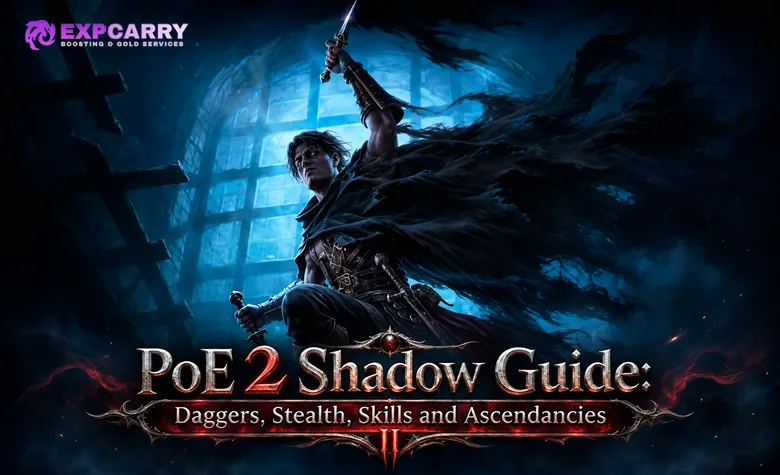
The Shadow is a new playable class coming to Path of Exile 2 with its free-to-play 1.0 release on December 11, 2026 (PST). Revealed during ExileCon 2026, the class combines daggers, Stealth, traps, shadow clones called Shades, and a new Darkness resource to create an aggressive hit-and-run playstyle. Shadow players can ambush enemies, strengthen dagger attacks while concealed, prepare trap combinations, and use Shades to multiply their melee ambush attacks. Two Ascendancy classes, Assassin and Infiltrator, will be available at launch. As of November 13, the Shadow is not playable in Early Access, so this guide covers the confirmed release features and demonstrated skills rather than presenting untested builds or unreleased Ascendancy passives as final.
Short answer: The PoE 2 Shadow is a Dexterity/Intelligence hybrid class focused on daggers, Stealth, traps, Darkness, and Shades. It launches on December 11, 2026 (PST), with Assassin and Infiltrator Ascendancies, offering dagger ambushes, trap combinations, and shadow-based attacks that reward careful positioning and well-timed kills.
What Is the Shadow Class in Path of Exile 2?
The Shadow is designed around ambushing enemies rather than standing still and trading hits. His signature mechanic, Stealth, allows him to approach monsters without immediately being detected until he enters their detection range. Attacking from Stealth provides additional effects for dagger skills, allowing the same ability to behave differently depending on how the fight begins. Successful kills can immediately reset the cooldown of his main Stealth skill while he is outside Stealth, creating a fast rhythm of entering combat, eliminating a target, and disappearing again.
Unlike a traditional rogue that relies entirely on melee attacks, the Shadow can also use traps to control an area before revealing himself. His other tools include Shades that distract enemies and repeat eligible melee ambush attacks, along with Darkness that can empower attacks made from Stealth. These systems are intended to work together, making the class attractive to players who enjoy setting up combinations rather than repeatedly using one damage skill. Grinding Gear Games introduced the class in its official ExileCon 2026 announcement and demonstrated its combat style in the Shadow reveal trailer.
| Feature | Revealed information |
|---|---|
| Release date | December 11, 2026 (PST), alongside Path of Exile 2 version 1.0 |
| Primary attributes | Dexterity and Intelligence hybrid |
| Signature weapons | Daggers and the new two-handed ranged Trap weapon type |
| Main mechanic | Stealth, with empowered attacks and detection-based gameplay |
| Additional systems | Darkness resource, Shades, Impale interactions, trap combinations |
| Starting skill | Shroud, demonstrated as the primary early Stealth skill |
| Ascendancies | Assassin and Infiltrator |
| Current availability | Announced for 1.0; not playable in the November 2026 Early Access client |
The Shadow shares the Dexterity/Intelligence side of the Passive Skill Tree with the Monk, but his revealed abilities emphasize different combat mechanics. Evasion, Energy Shield, critical damage, daggers, and traps are natural areas to investigate when planning a character. However, the 1.0 update also reworks the Passive Skill Tree and Support Gems, so old Monk routes or Path of Exile 1 Shadow builds should not be copied directly into a launch character.
How Stealth Works for the Shadow
Stealth is the foundation of the Shadow's combat system. When concealed, the character becomes difficult for monsters to detect until he approaches their visible detection zones. Entering those zones makes detection possible, with detection occurring faster at closer distances. The game highlights these areas so players can judge how close they can move before being discovered. Unlike slow stealth systems in some other games, PoE 2 does not impose a movement speed penalty while concealed, and the demonstrated version allows normal movement actions such as sprinting and dodge rolling.
The purpose of Stealth is not simply to skip enemies. It creates opportunities to choose the first target, prepare a powerful ambush, and activate special bonuses on dagger attacks. Dagger attacks from Stealth can rapidly close the distance to the target, making the mechanic useful for initiating melee combat. The Shadow is most effective when the ambush produces a quick kill, allowing him to reset Stealth and prepare another attack before the next group responds.
Shroud: Entering Stealth and Creating a Shade
Shroud is the Shadow's demonstrated starting skill and his primary early method of entering Stealth. It requires a dagger and moves the character in the chosen direction while creating a Shade at his previous location. Nearby enemies take minor damage and are Blinded, while Unique monsters can be Blinded within a larger radius. The Shade draws attention away from the Shadow, giving him an opportunity to reposition and strike from concealment.
The ExileCon skill demonstration showed an eight-second cooldown for Shroud at its introductory level, with kills resetting the cooldown while the character is outside Stealth. That reset is central to the class's speed: defeating a monster immediately after an ambush can make Shroud available again. A failed attack leaves the player needing to survive until the ability becomes available, so the Shadow should not be treated as permanently invisible or invulnerable. These were demonstrated pre-launch values, and the final release tooltip may differ.
What Breaks Stealth and How Detection Works
Stealth can end when enemies detect the character, when the character uses or triggers certain skills, when an attack connects, or when the character takes damage. Developers also explained that hits from your minions can reveal you, so adding a minion does not automatically create a safe way to attack while remaining concealed. Some abilities have special exceptions, including demonstrated Ethereal Knives interactions and traps prepared during Stealth, but these exceptions should not be generalized to every skill.
Cooldowns also do not recover normally while the character remains in Stealth, according to the ExileCon developer presentation. This prevents players from treating concealment as a completely risk-free way to wait for every ability to recharge. Monsters that have seen the Shadow enter Stealth may remain alert and gain larger detection ranges. The mechanic therefore rewards timing and positioning rather than simply pressing Shroud whenever a fight becomes dangerous.
Does Stealth Work Against Bosses?
Bosses are not completely immune to the mechanic, but they are much harder to avoid than ordinary monsters. GGG's developer presentation explained that arena bosses normally have detection covering their arenas, making Blind especially important for creating a short ambush window. Bosses can also become temporarily immune to repeated Blind applications, preventing the Shadow from maintaining uninterrupted concealment through the same interaction.
For boss encounters, Stealth should be treated as a damage setup tool rather than a permanent defensive solution. Prepare the opening attack, use available Blind opportunities, and remain ready to fight normally when the boss detects you. A Shadow that only functions while invisible may struggle against bosses that survive the first burst, making sustained damage and defensive investment important parts of the character.
Shadow Daggers and Revealed Combat Skills
Daggers are the Shadow's signature melee weapon and form the basis of his ambush gameplay. Many dagger skills receive additional properties when used from Stealth, creating a reason to alternate between preparation and direct attacks. Some abilities emphasize Poison and damage over time, while others focus on rapidly striking enemies, applying Impales, or generating Shades. The class can also use projectile-like dagger abilities to prepare damage interactions before closing into melee range.
A particularly important change is the role of Impale. The Shadow can embed blades into enemies and then interact with those embedded blades through other skills. Instead of treating every attack as an isolated source of damage, these abilities reward a sequence where one skill prepares the target and another takes advantage of that preparation. GGG demonstrated several interactions during ExileCon, but final damage values, cooldowns, and Support Gem combinations still require the 1.0 patch notes.
Key Shadow Skills Shown at ExileCon 2026
The following abilities were shown or discussed during the ExileCon presentations. They illustrate the class's planned combat directions, but this is not a final launch gem list or a ranking of the strongest skills. Several effects depend on Stealth, Darkness, Impales, or Shades, making their value difficult to judge in isolation.
| Skill | Demonstrated function | Main interaction |
|---|---|---|
| Shroud | Enter Stealth, Blind nearby enemies, and leave a Shade behind. | Initiates ambushes and resets its cooldown on kills outside Stealth. |
| Viper Strike | Attack enemies with poison-focused dagger strikes. | Stealth can enhance the poison setup and subsequent explosions. |
| Ethereal Knives | Throw spectral blades that interact with the Impale system. | Its Stealth behavior allows preparation without immediately revealing the character. |
| Blade Vortex | Extract embedded blades and create a damaging vortex around the character. | Works with Impales established by earlier attacks. |
| Pestilent Volley | Throw poison-oriented projectiles while retreating. | Combines with poisoned enemies and gas-cloud interactions. |
| Blade of the Night | Apply Engulfed in Darkness to enemies. | Prepares targets for Darkness-based abilities and resource generation. |
| Shadow Extraction | Attack enemies affected by Engulfed in Darkness and create Shades. | Turns prepared targets into additional shadow attackers. |
| Eclipse | Enter a temporary shadow realm. | Allows attacks to benefit from Stealth interactions while Darkness lasts. |
| Shrapnel Trap | Throw a trap that releases damaging fragments. | Introduces Impale interactions to trap combinations. |
The most interesting skills are those that interact with other abilities. Viper Strike becomes more attractive when Poison enables an additional effect, while Ethereal Knives and Blade Vortex provide a way to create and consume embedded blades. Darkness skills take this further by creating conditions for Shades and empowered ambushes. Players interested in the demonstrations can examine GGG's ExileCon Day 2 developer presentation, which explains the intentions behind these mechanics.
Impale, Ethereal Knives and Blade Vortex
Impale is one of the Shadow's more technical combat systems. The developers showed different Impale interactions, including upgrades associated with Poison, Lightning, and spectral or Chaos-related attacks. The basic idea is to embed blades or apply Impale effects, then use another ability to trigger additional damage or extract the embedded blades. This gives the player an incentive to combine attacks instead of relying only on one skill's direct hit damage.
Ethereal Knives can prepare enemies with spectral blades while the Shadow remains concealed, according to the demonstrated interaction. Blade Vortex then provides a way to extract embedded blades, including blades left in corpses, and create a rotating damage effect around the character. The presentation showed a version where the blades expire after delivering a number of hits rather than simply lasting for a fixed duration. That behavior creates potential synergy with builds capable of repeatedly applying Impales, although the final optimal combination cannot be determined before launch.
Explore services related to this guide, selected from our Path of Exile 2 catalog.
View All Path of Exile 2 Services


How Shadow Traps Work in Path of Exile 2
Traps are the Shadow's other signature weapon type, and their implementation differs substantially from the original Path of Exile. Rather than being only skills thrown at an enemy for immediate detonation, PoE 2 traps are designed around preparing an ambush. The developers showed traps as a separate two-handed ranged weapon type dealing attack damage, with their own abilities, cooldowns, and placement limits. Eight different trap types have been announced, with combinations involving physical Impales, Poison, Fire, and Cold effects.
The central interaction happens during Stealth. Traps prepared while concealed cannot trigger until the Shadow reveals himself, then activate in the order they were thrown. Outside Stealth, armed traps can trigger when enemies approach. This makes placement order part of the damage setup: one trap may create a condition that another trap can exploit. The official 1.0 announcement describes this sequence as a major part of the Shadow's identity rather than a minor variation on existing trap gameplay.
Example Trap Combinations: Gas, Fire and Concussive Traps
The ExileCon demonstrations included traps that interact through their effects on the battlefield. Gas can be spread, altered, and ignited, while other trap combinations can use Impales or elemental effects. The order matters because the first trap prepares a condition that the next trap changes or consumes. This rewards planning and makes the Shadow especially interesting for players who enjoy building damage sequences.
One demonstrated combination uses a Gas Trap to create a cloud, followed by a Concussive Trap that spreads the gas, and then a Fire Trap that ignites it. The sequence can be prepared from Stealth so the player does not need to expose themselves while placing each trap. When Stealth ends, the traps activate in their prepared order. The exact area, damage, and cooldown values are still subject to the final release balance.
Trap Cooldowns and Important Limitations
The Shadow cannot necessarily place unlimited traps before every encounter. Developers described cooldowns for individual trap skills and a shared placement limit across traps, meaning players must consider how many can remain active. Entering Stealth also restores one cooldown use to each trap skill in the demonstrated system. A trap-focused character therefore needs to manage charges, positioning, and activation timing instead of simply throwing every available trap repeatedly. Shrapnel Trap, shown as a basic trap attack, also illustrates how traps can support Impale-focused gameplay instead of functioning only as elemental damage sources.
The class is not restricted to using traps exclusively. A Shadow can prepare a small trap combination, reveal himself with a dagger attack, and continue fighting while the traps resolve. Conversely, players who prefer a more deliberate approach can build their strategy around carefully prepared trap sequences. Whether a dedicated trap build outperforms a dagger-focused character will depend on the final weapon, skill, and Ascendancy balance.
Darkness and Shades: The Shadow's Other Core Mechanics
The Shadow's identity extends beyond simply entering and leaving Stealth. Darkness is a new resource that supports empowered attacks, while Shades are shadow copies that can distract enemies and repeat eligible melee ambush attacks. These systems give players a way to build stronger attacks through preparation and to extend the effects of an ambush beyond one character's initial strike. They also provide alternative directions for players who enjoy the Shadow's theme but do not want to depend entirely on traps.
How Darkness Is Generated and Spent
Specific abilities, including the demonstrated Blade of the Night, can apply Engulfed in Darkness to enemies. Defeating affected enemies leaves Darkness to collect, building a resource that can empower attacks made from Stealth. Developers described Darkness as a resource intended to reward controlled preparation rather than constant attacking. The presentation also explained that Darkness shares a resource display with Rage, so players cannot accumulate and use both resources simultaneously in the demonstrated system.
The practical approach is to build Darkness before an important ambush, then spend it on a high-value attack rather than wasting the resource on an insignificant enemy. The demonstrated mechanic spends accumulated Darkness when attacking from Stealth, so target selection matters: using the strongest opening against a nearly defeated monster may be less useful than saving the setup for a dangerous Rare or boss. However, the final resource generation rate and exact damage bonuses still need to be checked in the release client.
How Shades Repeat Attacks and Distract Enemies
Shades are shadow copies that can draw monster attention and duplicate eligible melee ambush attacks. Shroud creates one when entering Stealth, while other abilities shown during ExileCon can create additional Shades through specific conditions. When the Shadow performs an appropriate melee attack from Stealth, nearby Shades can join in, allowing a carefully prepared strike to produce several attack events. Ordinary Shades do not independently move or attack, so the mechanic provides offensive value through coordinated ambushes as well as distraction.
Shadow Extraction is particularly important because it creates additional Shades from enemies affected by Engulfed in Darkness. This means a player can prepare multiple targets, generate Shades, and use them during a later attack sequence. The demonstrated Nightmare skill offers a different interaction, transforming Shades into independently attacking demonic versions after building Glory. Their durability, scaling, and final interactions with every skill will need verification once the class is playable.
Eclipse and the Shadow Realm
Eclipse was demonstrated as a more advanced Shadow ability that temporarily places the character in a shadow realm. After building the required Glory, attacks during the effect can count as though they were performed from Stealth, allowing repeated access to bonuses that would normally apply only when emerging from concealment. Shades can also join these attacks, while Darkness is drained to sustain the effect. This makes Eclipse particularly interesting for enemies that cannot be defeated with one ordinary ambush.
The skill could become an important part of Shadow bossing, where repeated kills are unavailable to reset Shroud continuously. However, its exact duration, requirements, and performance against endgame bosses cannot be established from the presentation alone, especially because the demonstrated Darkness drain increases during the effect. Players should treat it as a revealed build direction, not proof that a particular Eclipse setup will be the strongest boss build in version 1.0.
Shadow Ascendancies: Assassin and Infiltrator
The Shadow launches with two Ascendancy classes: Assassin and Infiltrator. Both names were confirmed in GGG's official Path of Exile 2 full-release announcement. However, the developers have not published complete passive trees, point allocations, or detailed final class bonuses for either one. This makes it too early to recommend a definitive best Ascendancy for mapping, bossing, Poison, traps, or Darkness-based gameplay.
Assassin: The Returning Ascendancy
Assassin returns as a familiar name from Path of Exile 1, fitting the Shadow's identity as a character who eliminates targets before they can respond. GGG's presentation associates the class with lethal ambushes and assassination, making it thematically suited to players interested in dagger attacks and decisive openings. However, the Path of Exile 1 Assassin passive tree is not evidence of which Critical Strike, Poison, or other modifiers will appear on the PoE 2 version. Those abilities must be checked after the final reveal.
Players interested in Assassin can prepare by learning the Shadow's dagger and Stealth interactions, particularly how to make opening attacks reliable. A strong ambush requires more than raw damage: accuracy, appropriate scaling, resource management, and enough defense to survive failed kills all matter. Until the actual Ascendancy nodes are released, choose Assassin for its demonstrated theme rather than a speculative list of mandatory passive bonuses.
Infiltrator: The New Shadow Ascendancy
Infiltrator is the second confirmed Shadow Ascendancy and a new addition to Path of Exile 2. The name suggests a connection to the class's stealth-oriented identity, but GGG has not yet provided a complete, authoritative breakdown of its Ascendancy nodes. It would therefore be inaccurate to promise that Infiltrator is the dedicated trap specialization, the strongest Stealth option, or an automatic choice for Darkness builds.
For now, treat Infiltrator as a separate development direction whose final strengths remain to be revealed. Players who prefer trap combinations or Shade interactions can keep those playstyles in mind without assigning them to a specific Ascendancy prematurely. A meaningful Assassin versus Infiltrator comparison will require the final passive trees, the corresponding skill gems, and practical testing after December 11.
Best Shadow Playstyles to Explore at Launch
The ExileCon demonstrations showed several approaches rather than one fixed Shadow build. Daggers, traps, and Darkness-based Shade attacks can be combined, but each emphasizes a different part of the class's mechanics. The following examples describe practical combat patterns based on revealed interactions, not finished character builds with verified damage numbers or passive-tree routes.
Dagger Ambush and Poison
A dagger-focused Shadow relies on entering Stealth, selecting a vulnerable target, and delivering a powerful opening attack. Viper Strike and other dagger skills can take advantage of special Stealth interactions, while follow-up attacks maintain pressure if the enemy survives. Against ordinary packs, the goal is to secure a kill and immediately reset Shroud before moving to the next target. Against bosses, players will need to supplement the opening burst with consistent damage and careful defense.
This approach is likely to appeal to players who prefer fast melee combat, active positioning, and frequent target switching. The main danger is becoming exposed after a failed ambush, especially against enemies that resist Poison or survive the initial damage sequence. Prioritize a reliable damage engine and defensive recovery rather than assuming that Stealth alone will keep the character safe.
Trap Ambush and Elemental Combos
A trap-oriented Shadow prepares the battlefield before directly engaging enemies. The player enters Stealth, places traps in an intentional order, and then reveals themselves to start the sequence. The advantage is that multiple effects can work together during the opening, such as spreading gas before igniting it. This can offer strong control over dangerous encounters, although traps with limited charges or poor placement may be less effective in fast-moving fights.
The approach may be more comfortable for players who enjoy planning rather than constant melee aggression. Its limitations are setup time, trap placement, and the need to trigger the intended sequence successfully. A hybrid version can combine traps with dagger attacks instead of committing the entire character to one weapon type.
Darkness, Shades and Repeated Ambush Attacks
Darkness and Shade interactions provide another possible direction. Instead of relying on a single strike, the Shadow prepares enemies with Engulfed in Darkness, generates Shades, and uses them to support empowered melee ambush attacks. Abilities such as Shadow Extraction and Eclipse create opportunities to turn one preparation sequence into repeated or multiplied damage. The complexity comes from managing the resource, keeping the Shades useful, and timing the major attacks correctly.
This playstyle may offer an alternative for players who want more sustained combat than a pure hit-and-run dagger approach. It also creates potential hybrid setups combining Poison, Impales, and Shades. Nevertheless, its actual performance against bosses and dense endgame encounters remains unknown until the final gem numbers and Ascendancy bonuses are available.
How to Prepare for Shadow Leveling and Progression
The most useful preparation for a Shadow character is understanding the core systems rather than committing to a complete passive tree before version 1.0. The new release includes a full six-Act campaign, major Support Gem changes, new and reworked equipment, and significant Passive Skill Tree adjustments. Those changes affect every class, so a leveling route built for the current Early Access environment cannot be assumed to remain optimal in December.
Shadow players should begin with a simple damage plan, then incorporate more complex combinations as the relevant abilities become available. Early dagger attacks and Shroud provide a straightforward way to learn the ambush loop, while traps and Darkness skills introduce additional setup requirements. Players who want to focus on progression rather than repeated campaign farming can review the available PoE 2 leveling options, but class-specific routes still need to be validated after release.
Attributes, Defenses and Gear Priorities
The Shadow's Dexterity/Intelligence identity makes Evasion and Energy Shield natural defensive systems to consider, but the best balance will depend on the final Passive Skill Tree and the equipment available. A dagger build should evaluate weapon damage, attack speed, accuracy, and modifiers that support its primary skills. A trap-focused character may prioritize different offensive stats, depending on how the final trap attacks scale. The key is to follow the actual skill descriptions rather than assuming every Shadow ability benefits from the same modifiers.
Defensive preparation should not be neglected just because the class has Stealth. Resistances, recovery, sufficient Life or Energy Shield, and answers to damaging ailments remain important when a boss detects the player or an ambush fails. For a character built around complicated skill interactions, a coherent starter-build setup should prioritize a reliable damage skill and appropriate defenses before investing heavily in secondary combinations.
Unlocking Shadow Ascendancy Points
Choosing Assassin or Infiltrator is only part of Ascendancy progression. Characters also need to complete the game's qualifying Ascendancy Trials to obtain the points used in their selected class tree. Existing Path of Exile 2 trials award up to eight Ascendancy Points across four progression milestones, and the chosen trial must be eligible to grant the next reward. A Shadow does not automatically receive all eight points simply by reaching a particular level.
For the current trial structure, see the PoE 2 Ascendancy Points guide. Players preparing for the Honour-based route can also review the Trial of the Sekhemas completion options. Because the class and version 1.0 have not launched yet, any changes to trial requirements or the new Shadow's Ascendancy progression must be checked against the final release rules.
Common Shadow Mistakes to Avoid
The most common problems are likely to come from misunderstanding the limitations of Stealth or treating every showcased interaction as a finished build. The developers designed the Shadow around preparation and execution, which means a powerful opening does not automatically solve the rest of a difficult encounter. Players should also distinguish confirmed mechanics from assumptions based on the original Path of Exile.
- Expecting permanent invisibility: Monsters can detect the Shadow at close range, and bosses create additional restrictions.
- Relying entirely on cooldown resets: Shroud resets through kills outside Stealth, which are harder to obtain during sustained single-target fights.
- Ignoring trap order: Trap combinations depend on which effects activate first, especially when preparing an ambush from Stealth.
- Assuming every skill preserves Stealth: Only specific demonstrated interactions allow preparation without immediately revealing the character.
- Using Darkness without a plan: Resource generation matters only when the resulting bonus supports a meaningful attack.
- Confusing Shades with permanent minions: Their demonstrated behavior is tied to specific Shadow skills and combat interactions.
- Copying Path of Exile 1 Assassin nodes: The PoE 2 Assassin tree has not been fully revealed, and its final mechanics cannot be inferred from the older game.
- Building around pre-release damage numbers: Version 1.0 includes broad balance changes, making demonstrated tooltips unsuitable for guaranteed launch calculations.
PoE 2 Shadow FAQ
These answers cover additional questions about the Shadow's release, equipment, and gameplay restrictions that matter when preparing a new character.
When can you play the Shadow in Path of Exile 2?
The Shadow is scheduled to become playable on December 11, 2026 (PST), when Path of Exile 2 enters its free-to-play 1.0 release. The class is not available in the current Early Access version.
Can the Shadow use traps without remaining in Stealth?
Yes. Stealth provides the special ability to prepare traps that wait for concealment to end, but traps are a separate weapon system rather than an ability that exists only while hidden. Their normal activation and cooldown rules depend on the individual trap skills.
Can Shadow players use other weapons?
The class is built around daggers and traps, but Path of Exile 2 generally allows classes to use compatible weapons and skills when their requirements are met. Shroud specifically requires a dagger in the demonstrated version, so a different weapon choice may prevent access to that particular Stealth setup.
Is Assassin or Infiltrator better for the Shadow?
There is no verified answer yet. GGG has confirmed both Ascendancies but has not released their complete final passive trees, and neither has been tested in the playable 1.0 version. A reliable recommendation will depend on their actual mechanics and the build you intend to play.
Conclusion
The Shadow introduces a distinctive combat style built around Stealth, daggers, traps, Darkness, and Shades. Its strongest opportunities come from combining preparation with well-timed attacks, while its main weakness is the risk of being exposed when an ambush fails. Learn the interactions demonstrated at ExileCon, keep your early build flexible, and make final Assassin, Infiltrator, and equipment decisions using the release version rather than pre-launch damage predictions.