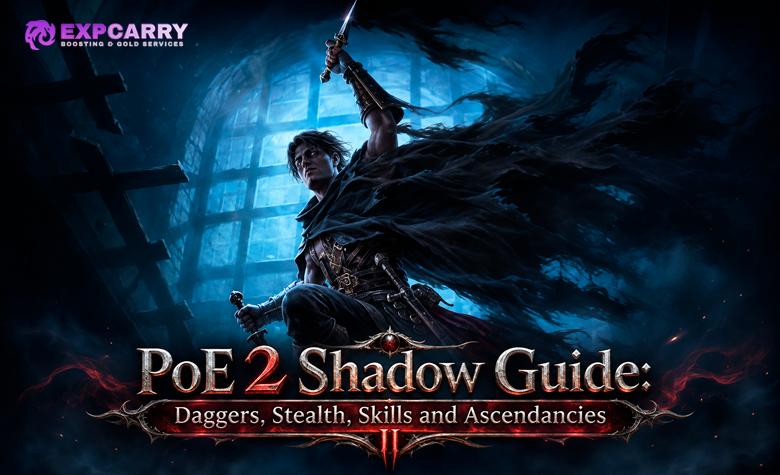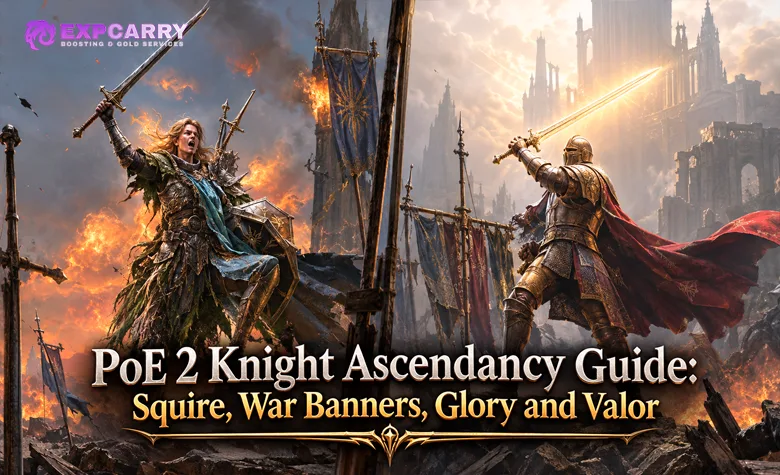
The Knight is a new Duelist Ascendancy coming to Path of Exile 2 with the free-to-play 1.0 release on December 11, 2026. Revealed at ExileCon 2026, the Knight fights alongside a customizable Squire, empowers allies with War Banners, spends Glory on powerful abilities, and uses Valour to activate additional combat effects. Unlike the base Duelist, whose signature mechanics revolve around swords and Stances, the Knight specializes in battlefield control, companion cooperation, and mounted attacks. Revealed Ascendancy passives include Esteemed Mentor, Bannerlord, Honourbound, Glorious Entrance, and Righteous Bastion. As of November 13, 2026, the Knight is not available in the Early Access 0.5.5f client. This guide covers the demonstrated mechanics and pre-release passive descriptions, not finalized launch builds or untested damage calculations.
Short answer: The PoE 2 Knight is a Duelist Ascendancy that recruits an equippable Squire, uses Glory-powered War Banners, converts Glory expenditure into Valour through Honourbound, and gains access to a mounted chariot attack. Its main strength is combining the Knight's own melee skills with a companion, banners, and defensive or offensive effects that support the same combat strategy.
How the Knight Ascendancy Works in PoE 2
The Knight takes the Duelist's sword-based combat and adds several systems that work together during a fight. Instead of choosing between attacking personally and relying on summoned allies, the Knight can fight on the front line while a Squire uses its own equipped weapon and skills. War Banners strengthen nearby allies, Glory provides access to powerful abilities, and selected Ascendancy passives turn that resource expenditure into additional combat benefits. Mounted attacks give the Knight another way to enter an encounter, disrupt enemies, and establish a favorable fighting position.
This is an important distinction from a traditional minion build. The Squire counts as a minion and can benefit from minion scaling, but the Knight is still intended to participate directly in combat rather than standing back while the companion handles every enemy. Your damage, defensive setup, positioning, and skill choices remain important, especially against bosses that can survive the Squire's attacks or move outside a banner's area. Grinding Gear Games introduced the Knight during its official ExileCon 2026 announcements, with the class arriving alongside the full six-Act campaign.
| Feature | Revealed information | Gameplay role |
|---|---|---|
| Base class | Duelist, a Strength/Dexterity hybrid | Sword-based melee combat and Stances |
| Ascendancy | Knight | Companion support, War Banners, and mounted combat |
| Squire | Equippable minion companion with melee weapons, armour, and assigned skills | Additional damage, support effects, and combat combinations |
| War Banners | Glory-powered banner abilities with additional Knight specializations | Strengthen allies and control an area of the battlefield |
| Glory | Skill-specific resource generated during combat | Banner placement and other Glory-based actions |
| Valour | Resource generated through Honourbound interactions | Additional effects connected to Honourbound Blade |
| Mounted attack | Liberator's Chariot, demonstrated as a Mounted Charge | Mobility, crowd control, and banner positioning |
| Release | December 11, 2026 (PST) | Introduced with Path of Exile 2 version 1.0 |
The Knight's defining advantage is the number of ways its mechanics can support each other. A Squire can apply an effect that benefits the Duelist's own attacks, a banner can improve both characters while they fight in its area, and Glory spent on that banner can contribute to Valour generation when the relevant Ascendancy passive is allocated. However, these interactions do not mean every Knight automatically receives all the demonstrated abilities. Individual Ascendancy skills and bonuses depend on the passives selected.
How the Knight's Squire Works
The Squire is the Knight's most distinctive feature. Rather than receiving a companion with a fixed weapon and predetermined attacks, players can equip the Squire with weapons and armour and assign melee Skill Gems through its own skill setup. This creates a second character-like loadout that can complement the Knight's abilities. The ExileCon demonstration showed the Squire fighting alongside the Duelist while using skills chosen to interact with the player's Bleed-focused attacks.
The ability to customize a companion has major implications for building a Knight. You can plan around the Squire applying a useful combat effect, attacking enemies already affected by your skills, or contributing damage while you concentrate on positioning and banner management. GGG's official Path of Exile 2 full-release overview describes the Squire as a companion capable of using melee Skill Gems, but the final 1.0 equipment rules, stat scaling, and complete list of compatible interactions have not yet been tested in the released game.
How to Equip the Squire with Weapons and Armour
The Squire has a dedicated equipment interface rather than simply inheriting all of the Knight's items. In the ExileCon presentation, players could assign it a melee weapon and armour, allowing the companion to be developed around a particular role. The demonstration used a spear, confirming that the Squire is not restricted to copying the Knight's preferred sword setup. Its ability to use different melee weapons opens opportunities for combinations involving weapon-specific skills and damage mechanics.
The practical approach is to treat the Squire's equipment as a separate part of your build. A weapon is useful only if it supports the skills assigned to the companion, while armour should help the Squire survive long enough to contribute during difficult encounters. A high-damage weapon without the required skill compatibility may offer less value than a simpler setup designed around a reliable combination.
GGG has not yet published a complete final list of the Squire's equipment slots, attribute calculations, death and resummoning rules, or precise interactions with all item modifiers. Although GGG confirmed that the Squire counts as a minion, do not assume that every item or Support Gem behaves identically on the Squire and the player character. The demonstrated customization is confirmed, but exact optimization will depend on the 1.0 client.
How to Give the Squire Skills
The Squire can use melee Skill Gems assigned through its skill interface, making its abilities another major source of customization. Instead of relying only on ordinary companion attacks, the player can choose skills that create useful interactions with the Knight's own attacks. The equipped weapon still matters because melee skills can have specific weapon requirements, and an otherwise attractive gem may not fit the companion's current equipment.
At ExileCon, GGG demonstrated a Squire equipped with a spear and using Blood Hunt and Bloodhound's Mark. Both skills supported the Duelist's Bleed-oriented combat rather than operating as unrelated sources of damage. This is the clearest demonstrated example of how to build around the Squire: give it a defined job that strengthens the overall combat sequence.
Blood Hunt and Bloodhound's Mark Combo
Blood Hunt was shown interacting with Blood Loss generated during combat. In the demonstrated setup, the Duelist created conditions involving Bleeding and accumulated Blood Loss, while the Squire used Blood Hunt to consume those effects and trigger a blood explosion. This allowed the two characters to contribute different parts of the same offensive combination instead of simply attacking the same target independently.
Bloodhound's Mark provided another layer of interaction by marking enemies and supporting Bleed- and Stun-related effects. During the presentation, the Squire used the Mark alongside Blood Hunt to help create explosions when enemies were defeated. The important point is not that these two gems are guaranteed to be the strongest Squire skills at launch, but that the companion can actively support mechanics established by the Knight.
A similar approach could become useful with other melee skill combinations, provided the final game rules support them. For example, a Knight may want the Squire to help apply a condition that the player's own attacks can exploit. However, the exact compatibility of specific ailments, Support Gems, and damage modifiers must be verified after release rather than inferred from one demonstration.
Should the Squire Deal Damage or Provide Support?
Both approaches are possible directions, but the ExileCon demonstration placed particular emphasis on cooperation. A damage-focused Squire would need appropriate equipment and minion scaling, while a support-oriented Squire could contribute effects that improve the Knight's own attacks. The best choice depends on whether the companion's independent damage is competitive with the value of an interaction that enables stronger attacks from the player character.
For example, a Knight using Bleed mechanics may benefit more from a Squire that consistently supports blood-related combinations than from one equipped with an unrelated attack. A different Knight could prioritize direct companion damage if its selected passives and equipment support that strategy. Until the final numbers are available, it is more useful to plan a clear role than to declare a universal best-in-slot Squire setup.
War Banners and the Knight's Bannerlord Passive
War Banners are another central part of the Knight's combat system. In the ExileCon demonstration, a placed War Banner improved the attack damage, attack speed, and accuracy of nearby allies, including the Squire. This makes banner placement a tactical decision: the Knight benefits from fighting within the affected area, while enemies that force the player to move can reduce the value of a poorly positioned banner. The system rewards controlling where a fight happens rather than placing a banner without considering the encounter.
The Knight can specialize its banners through Bannerlord, an Ascendancy passive associated with standards representing several cultures and empires of Wraeclast. Each option grants a different standard, changing what the banner contributes beyond its basic combat benefits. The Vaal standard was demonstrated in detail, while the remaining options were shown by name without a complete explanation of their individual effects.
All Five Revealed Bannerlord Standards
The previewed Bannerlord selection includes five cultural standards. These are alternative choices within the Bannerlord mechanic, not five separate buffs that every Knight automatically receives simultaneously. Choosing the correct option should depend on the mechanic it supports and how that mechanic interacts with the Knight's own abilities and the Squire.
| Standard | Revealed information | Planning consideration |
|---|---|---|
| Maraketh Standard | Listed as a Bannerlord option. | Its exact special effect was not detailed in the available demonstration. |
| Karui Standard | Listed as a Bannerlord option. | Do not assume its bonuses from the name alone. |
| Vaal Standard | Creates blood-covered ground that interacts with the demonstrated Cyclone setup. | Relevant to blood-based melee combinations shown at ExileCon. |
| Ezomyte Standard | Listed as a Bannerlord option. | Requires the final effect description before reliable build planning. |
| Kalguuran Standard | Listed as a Bannerlord option. | Its individual combat bonus has not been fully established. |
The names and selection structure are recorded in the pre-release Knight Ascendancy data. Those records also show a minor passive granting 25% increased Banner Skill Duration, although this value remains subject to the final release balance. The five standards should not be confused with the factions of the Conquerors of Wraeclast challenge league; their names and mechanics serve a different purpose.
Vaal Standard and the Cyclone Interaction
The Vaal standard was the most clearly demonstrated Bannerlord option. Placing the banner created blood-covered ground in the affected area, which could then interact with Cyclone. The presentation showed a blood-focused attack sequence that made use of the banner's special effect, illustrating how the standard can actively contribute to a combat combination rather than functioning only as a passive stat bonus.
This makes the Vaal option interesting for a Knight already using sword attacks and blood-related mechanics, particularly when the Squire can contribute additional effects. However, the demonstration does not establish a universal damage multiplier or guarantee that the Vaal standard will be the best option for Bleed builds. Its performance will depend on the final skill descriptions, area coverage, and interaction with other skills.
Where and When to Place War Banners
War Banners require Glory, so placement should be deliberate. A banner charged through combat and placed at the beginning of an important damage window may provide substantial benefit while the Knight and Squire remain nearby, but its value falls if the fight immediately moves outside the affected area. When possible, choose a position where the enemy is likely to remain during the next damage window. This is especially important for boss encounters with frequent movement or dangerous arena effects.
The revealed Knight mechanics also create a reason not to hoard Glory indefinitely. Spending Glory on an appropriate banner can improve the immediate fight while contributing to Valour generation through Honourbound if that passive is allocated. This gives resource expenditure a second purpose, but it does not mean every War Banner automatically grants Valour without the relevant Ascendancy interaction.
Explore services related to this guide, selected from our Path of Exile 2 catalog.
View All Path of Exile 2 Services

How Glory and Valour Work for the Knight
Glory and Valour are separate resources with different roles. Glory is tracked separately by skills that require it, including War Banners, while Valour is connected to the Knight's Honourbound mechanics. The Knight can therefore turn activity during combat into access to stronger abilities and, with the right Ascendancy passives, generate additional Valour as those abilities consume Glory. Understanding this distinction is important because the two resources should not be treated as interchangeable.
War Banners already use Glory in the current Early Access game, but the Knight adds new interactions that were demonstrated for the upcoming 1.0 release. Existing Glory-related mechanics provide background context, not proof that every new Knight skill will use identical generation requirements or costs. The final tooltips will determine the precise resource economy of each ability.
How to Generate and Spend Glory
Glory is generated through combat interactions and tracked separately for each qualifying skill before being spent to activate that skill. For the Knight, its most important demonstrated use is placing War Banners, although the Ascendancy also introduces other abilities that interact with Glory. A previewed minor passive states that skills requiring Glory generate one Glory every two seconds, providing another source of buildup alongside their normal mechanics.
The practical goal is to ensure Glory is available when an important ability is needed. A Knight that can place a banner consistently will have more opportunities to benefit from its area effects and related Ascendancy interactions. However, spending Glory at the wrong time can leave that particular skill without the necessary resource for another activation, without consuming Glory stored for other skills. The final costs, individual skill generation rules, and possible stacking limitations must be checked when version 1.0 becomes playable.
Honourbound: Turning Glory Expenditure into Valour
Honourbound is one of the most distinctive revealed Knight passives. Its previewed description grants Honourbound Blade and provides two ways to generate Valour: being near Rare or Unique monsters and spending Glory. This creates a particularly relevant interaction during boss fights, where a powerful enemy can remain within range while the Knight continues using its combat abilities.
The pre-release passive description lists the following values:
- Valour near powerful enemies: Gain 5 Valour every 2 seconds while a Rare or Unique monster is in your Presence.
- Valour from Glory expenditure: Gain 5 Valour for every 10 Glory consumed.
- Honourbound Blade: Unlocks the associated skill, demonstrated with additional waves of damage during combat.
These numbers come from the showcased Ascendancy description and should be treated as pre-release values rather than guaranteed final 1.0 balance. The exact Valour threshold, maximum resource capacity, and full damage scaling of Honourbound Blade require confirmation from the released skill tooltips.
The interaction is especially interesting because it connects the Knight's offensive and support systems. Spending Glory on a banner can strengthen the fighting area while also contributing to Valour generation, allowing the player to prepare another combat effect. Nevertheless, this does not make every Glory expenditure automatically optimal. A useful banner at the right location is still more valuable than repeatedly spending resources without regard for the encounter.
Honourbound Blade and Waves of Justice
Honourbound Blade was demonstrated as the payoff for the Valour-based system. As the Knight builds the necessary resource, attacks can produce additional waves of justice that strike enemies. This allows the Knight's normal melee combat to benefit from the resources accumulated through Honourbound, rather than treating Valour as a separate mechanic that has no connection to direct attacks.
The potential strength of this interaction depends on attack frequency, how reliably Valour can be generated, and whether the additional waves scale with the Knight's damage modifiers. Those details cannot be calculated accurately from the ExileCon footage alone. The revealed skill is a promising direction for a front-line Knight, but it is not yet a verified endgame damage setup.
Revealed Knight Ascendancy Passives
GGG demonstrated several Knight Ascendancy passives at ExileCon, providing a clearer picture of the class than its original announcement alone. These passives support different aspects of the Knight's identity: Squire customization, banner specialization, Glory and Valour interactions, mounted combat, and protection through Block. They are separate investment choices, so a character cannot assume access to every major effect without allocating the appropriate Ascendancy Points.
| Passive | Previewed effect | Main use |
|---|---|---|
| Esteemed Mentor | Grants Summon Squire. | Unlocks the customizable companion. |
| Bannerlord | Selects a cultural standard that grants an additional banner skill. | Specializes War Banner gameplay. |
| Honourbound | Grants Honourbound Blade and generates Valour near powerful enemies or from Glory expenditure. | Connects resource spending to additional combat effects. |
| Glorious Entrance | Grants Liberator's Chariot. | Unlocks the mounted charge ability. |
| Righteous Bastion | Gain Guard for 4 seconds equal to 25% of Damage Blocked. | Provides an additional defensive interaction through Block. |
The presented tree also contained smaller passives supporting Banner Duration, Glory generation, companion damage, Armour and Evasion, and Block Chance. In the pre-release records, examples include 15% increased Companion Damage, 15% increased Armour and Evasion Rating, and 8% increased Block Chance. These values are useful for understanding the directions supported by the tree, but they are not a substitute for the final Ascendancy layout.
Righteous Bastion and Guard from Blocked Damage
Righteous Bastion is the defensive notable shown for the Knight. Its previewed effect grants Guard for four seconds equal to 25% of the damage blocked. Unlike a simple passive bonus to Block Chance, it provides an additional defensive result after blocking damage. That distinction matters because a build must actually block hits to benefit from the interaction.
This makes Righteous Bastion a possible option for a Knight planning around a shield and reliable blocking. However, the full mechanics of Guard, including its interaction with other defensive systems, must be verified against the final 1.0 rules. It would be premature to promise a particular amount of damage reduction or recommend a finished shield build based only on the revealed passive.
Mounted Charge and Liberator's Chariot
The Knight's mounted attack is one of its most visually distinctive abilities. GGG demonstrated the Knight riding a spectral chariot into enemy ranks, pushing enemies aside and stunning them before planting a banner at the end of the charge. The ability combines movement, crowd control, and banner-related gameplay, making it different from a conventional melee movement skill that exists only to close distance.
The revealed Ascendancy passive Glorious Entrance grants Liberator's Chariot, the named skill associated with this mounted charge. During the ExileCon demonstration, the charge was powerful enough to affect large enemies, including Rare and Unique monsters. However, that does not establish that every boss can be interrupted or stunned under all circumstances; individual enemy mechanics and stun resistance still matter.
How Mounted Charge Fits Into Combat
Mounted Charge allows the Knight to enter a fight while disrupting enemy positioning and establishing a banner at the destination. A natural use is to approach a dangerous group, create an opening through the charge, and then fight where the banner's benefits can support the Knight and Squire. This combines offensive positioning with the class's existing area-support mechanics, making the ability potentially valuable for aggressive melee play.
The main limitation is that a charge must end in a useful location. Moving directly into a dangerous area without considering enemy attacks may leave the character exposed, even if the initial impact controls several monsters. Against bosses, the strongest use may depend on whether the encounter provides an opening to charge safely and maintain pressure afterward.
Does Mounted Charge Use Glory?
The Knight's demonstrated abilities place heavy emphasis on Glory expenditure, and the minor passive leading to Glorious Entrance specifically interacts with skills that require Glory. This connects Liberator's Chariot to the Ascendancy's Glory-focused design. However, the final skill cost, generation method, and activation requirements should be checked in the 1.0 tooltip rather than taken from older or unrelated Glory abilities.
It is also important not to confuse the chariot's banner-placement behavior with ordinary War Banner costs. The demonstration shows how the systems work together, but it does not establish every possible interaction between Glorious Entrance, Bannerlord, and Honourbound. Players should test whether those effects combine as expected before building around a specific resource loop.
Best Knight Playstyles to Explore at Launch
The Knight supports several distinct combat approaches, although no finished version 1.0 build can be ranked reliably before the class becomes playable. The most promising directions involve choosing which part of the Ascendancy should provide the main benefit and using the remaining mechanics to support it. A Squire-focused Knight may prioritize companion equipment and coordinated skills, while another character may invest more heavily in banner positioning, Honourbound, or defensive passives.
Squire-Focused Knight
A Squire-focused Knight aims to make the companion an important part of the character's combat strategy. This could involve assigning skills that complement the Knight's primary attacks or equipping the companion for more independent damage. The Blood Hunt and Bloodhound's Mark demonstration provides a practical starting concept: let the Knight and Squire perform different steps of the same offensive combination.
This approach requires attention to two equipment setups rather than one. It may offer interesting long-term scaling if the final Squire mechanics support meaningful weapon and armour investment, but it also creates additional gearing demands. Players preparing for new character progression can account for those demands through a coherent starter-build setup, while avoiding fixed 1.0 item recommendations before the release data becomes available.
Bannerlord and Frontline Support Knight
A Bannerlord-focused Knight emphasizes fighting within the area of its War Banners while taking advantage of their specialized effects. The Squire can benefit from the banner's combat bonuses, giving this setup a reason to keep both characters fighting near the same position. The Vaal standard's blood-ground interaction offers one demonstrated offensive direction, while the other standards may support different strategies once their full effects are known.
This playstyle could work well for players who enjoy influencing the battlefield rather than constantly changing targets. The main challenge is mobility: a stationary banner is less valuable when enemies repeatedly move away or the fight requires frequent repositioning. Mounted Charge may help address that problem by combining movement with banner placement, although its exact synergy with every Bannerlord option still requires release testing.
Honourbound and Glory-Spending Knight
Honourbound provides a more direct connection between resource management and the Knight's own attacks. Glory expenditure contributes to Valour, while proximity to Rare or Unique enemies provides another generation method. Honourbound Blade then offers additional offensive effects associated with that resource. This makes the mechanic interesting for prolonged encounters where the character can continue building and spending resources instead of depending entirely on killing ordinary monsters.
Players interested in this direction should focus on reliable resource generation and appropriate defense. A Knight that struggles to remain near powerful enemies may have difficulty taking full advantage of the passive's proximity-based Valour generation. At the same time, investing too heavily in offense can become risky against bosses where repeated melee engagement is dangerous. The right balance cannot be established until the skill's final scaling and defensive interactions are known.
Defensive Knight with Righteous Bastion
A defensive Knight can investigate Block, Armour, Evasion, and Righteous Bastion as complementary mechanics. Since Righteous Bastion's revealed effect depends on blocked damage, it naturally rewards a setup designed to block hits reliably. This could provide a different approach from a pure damage-focused Knight, particularly for players who prefer sustained melee engagements.
The important limitation is that Righteous Bastion does not make the character invulnerable. A shield-oriented build must still consider elemental resistances, recovery, damaging ailments, and attacks that cannot be blocked. The final Guard mechanics will determine how effectively this passive complements other defensive systems.
Knight Leveling and Ascendancy Progression
The Knight becomes available through the Duelist, so players must first create and progress a Duelist character before selecting the Ascendancy. The base class focuses on swords and Stances, while the Knight's distinctive companion and banner-related options come from Ascendancy investment. This makes it useful to learn the Duelist's ordinary attack mechanics before trying to coordinate additional systems through the Squire and Glory-based skills.
The December 11 release also introduces Acts 5 and 6, additional skill gems, and major Passive Skill Tree changes. As a result, leveling routes prepared for the current Early Access classes are not automatically reliable for the new Duelist. The broader PoE 2 Duelist guide covers swords and the base class's combat identity, while this article concentrates on the Knight's Ascendancy-specific mechanics.
How to Unlock the Knight Ascendancy
PoE 2 characters obtain Ascendancy Points by completing qualifying trials, rather than gaining them automatically with ordinary character levels. The current progression system awards up to eight points through four qualifying milestones. The Trial of the Sekhemas and Trial of Chaos provide existing routes for Ascendancy progression, although version 1.0 may modify requirements or the way the new classes access their specializations.
For current eligibility rules, the PoE 2 Ascendancy Trials guide explains how to identify trial items that can award additional points. Players preparing for the Honour-based route can also review the available Trial of the Sekhemas progression options. The new Knight's exact launch-specific progression should be confirmed in the released client rather than assumed from older classes without checking.
Which Knight Ascendancy Passives Should You Take First?
There is no verified universal passive allocation order yet. The best opening choice will depend on whether the player wants immediate access to the Squire, specializes in War Banners, or prioritizes another Knight mechanic. The ExileCon demonstration showed Esteemed Mentor as the passive granting Summon Squire, making it an obvious choice for players specifically interested in the companion. However, that does not prove it is the strongest first passive for every Duelist build.
Bannerlord, Honourbound, Glorious Entrance, and Righteous Bastion support different goals. A character built around coordinated attacks may value the Squire immediately, while another may prefer a defensive interaction or a Glory-based skill. The final node connections, exact bonuses, and skill availability must be reviewed before publishing a mandatory allocation order.
Gear and Stat Priorities for a Knight
The Knight's Strength/Dexterity identity makes Armour, Evasion, melee weapon damage, and Block natural areas to investigate, but the correct gearing strategy depends on the selected passives and primary skills. A Squire-focused character must also consider the companion's equipment, while a Bannerlord-focused setup may value effects that improve banner uptime or the player's ability to remain within their area. These are planning considerations, not a finished gear list.
During early progression, prioritize a functional melee skill, appropriate defenses, and equipment that supports your chosen combat interactions. Spending all available resources on the Squire while neglecting the Knight's own survivability can create a character that performs poorly when the companion is unable to help. Players preparing to level a new Duelist can consider character leveling progression separately from decisions about final Ascendancy gear, since 1.0 balance and equipment changes have not yet been fully tested.
Common Knight Ascendancy Mistakes to Avoid
The Knight has more interacting systems than a basic melee character, which makes it easy to misunderstand where its power comes from. The most important rule is to give each mechanic a clear purpose. A Squire with unrelated skills, poorly positioned War Banners, and inconsistent Glory spending may contribute less than a simpler setup where every ability supports the same combat plan.
- Treating the Squire as an ordinary fixed-skill minion: Its weapon, armour, and assigned melee skills are major parts of the Knight's customization.
- Equipping incompatible skills: The Squire's melee abilities must work with its actual weapon and the final skill requirements.
- Ignoring banner positioning: A banner's benefits are less valuable when the Knight and Squire cannot remain in its effective area.
- Confusing Glory with Valour: Glory is tracked separately by qualifying skills, while Valour is generated through particular Honourbound interactions.
- Assuming every Knight automatically gains all five major skills: Esteemed Mentor, Bannerlord, Honourbound, and Glorious Entrance are individual Ascendancy choices.
- Expecting every Bannerlord standard to have the Vaal effect: Only the Vaal blood-ground interaction was demonstrated in comparable detail.
- Charging into dangerous positions: Liberator's Chariot offers movement and control, but poor positioning can still leave the player exposed.
- Copying outdated pre-1.0 builds: The full release changes skills, support gems, and the Passive Skill Tree, so previous assumptions require verification.
PoE 2 Knight Ascendancy FAQ
These answers cover additional questions about Knight availability, the Squire, and the interactions between its revealed systems.
When does the Knight become playable in PoE 2?
The Knight is scheduled to launch with the Duelist on December 11, 2026 (PST), as part of Path of Exile 2 version 1.0. It is not available in the current Early Access client.
Can the Knight's Squire use different melee weapons and skills?
Yes. GGG demonstrated a customizable Squire with its own equipment and assigned melee Skill Gems. The showcased companion used a spear with Blood Hunt and Bloodhound's Mark, but full equipment and compatibility rules still require launch verification.
Does spending Glory automatically give every Knight Valour?
No. The revealed conversion is tied to the Honourbound Ascendancy passive. Its previewed description grants Valour from Glory expenditure and from the presence of Rare or Unique monsters.
Can the Knight use all five Bannerlord standards at once?
The previewed Bannerlord passive is presented as a selection between five standards, not as an automatic grant of all five. Only the Vaal standard's blood-ground interaction was demonstrated in detail.
Conclusion
The Knight is built around cooperation between the Duelist, an equipped Squire, Glory-powered War Banners, and specialized Ascendancy abilities. Start by choosing whether companion interactions, banners, or direct melee combat will be the center of your setup, then use the other mechanics to support that goal. The revealed passives provide several promising directions, but final skill scaling, Squire equipment rules, and passive priorities must be confirmed when PoE 2 version 1.0 launches.