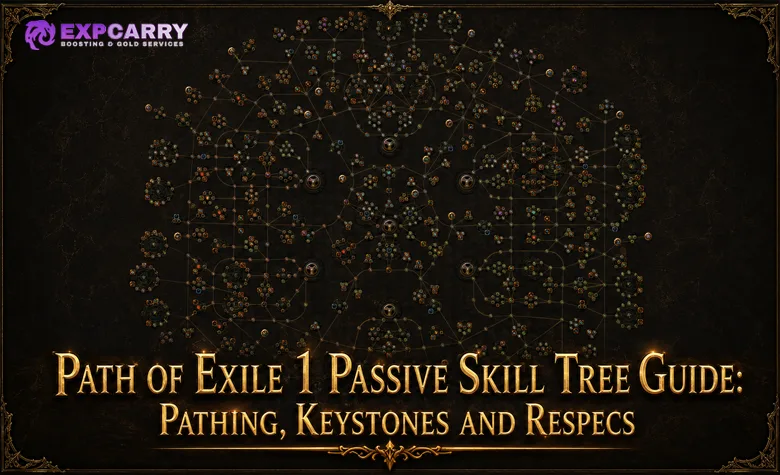
The Path of Exile passive skill tree is easiest to understand as a routing problem. A strong tree connects a limited number of valuable destinations with the fewest useful travel points while still covering damage, defence, recovery, attributes, and resource costs. The goal is not to collect every nearby Notable or force a famous Keystone into the build. Every allocated point must support the skill, equipment, and content the character is actually using.
This guide covers the character passive tree in Path of Exile 1. It explains node types, efficient pathing, Keystone evaluation, Masteries, jewels, and every normal respec method. It does not cover the separate Atlas Passive Skill Tree. Exact node positions and wording can change between leagues, so confirm a finished route on the official Path of Exile Passive Skill Tree before allocating an expensive endgame setup.
How the Path of Exile 1 Passive Skill Tree Works
All character classes share one passive tree but begin at different locations. A class starting position determines which clusters are cheap to reach, not which skills the character is allowed to use. Marauder begins near Strength, Life, Armour, and melee-oriented areas, while Witch begins near Intelligence, Energy Shield, spell, elemental, and minion clusters. Hybrid classes start between the major attribute regions, and Scion begins in the centre. Travelling far from a natural starting area is possible, but the extra points must produce more value than closer alternatives.
A character receives one passive skill point for each level after level 1, for a total of 99 from levels at level 100. Campaign quests provide 23 more passive points, and killing all three bandits in Deal with the Bandits provides one optional point instead of a bandit bonus. A level 100 character that completes every relevant quest and kills all bandits can therefore have 123 ordinary passive points. The in-game passive skill reference lists the current quest and refund totals, while the chat command /passives shows which point-granting quests the active character has completed.
| Node Type | Purpose | How to Evaluate It |
|---|---|---|
| Attribute and small Passive | Connects sections and provides an incremental stat | Count it as part of the full cost of the destination, not as a free bonus |
| Notable | Ends or anchors a cluster with a concentrated effect | Check that every important modifier applies to the main skill or defensive plan |
| Mastery | Adds one selected effect from a category after a connected Notable is allocated | Spend the extra point only when the selected option solves a real build need |
| Keystone | Changes a fundamental game rule, usually with a restriction or opportunity cost | Test the benefit, downside, equipment interactions, and total travel cost together |
| Jewel Socket | Holds a regular, Abyss, or compatible unique jewel | Compare the socket and pathing cost with the exact jewel that will occupy it |
| Large Jewel Socket | Accepts a Cluster Jewel that expands the outer edge of the tree | Price the jewel first and count every small Passive required to reach its useful Notables |
The main passive tree, Ascendancy and Bloodline allocation, and the Atlas tree are distinct systems. Bloodline Passives share the Ascendancy point pool rather than using ordinary passive points, and an Atlas refund does not change the character tree. Keeping those systems separate prevents one of the most common beginner misunderstandings when a guide shows several different trees or progression screens.
Define the Build Before Choosing a Route
Efficient pathing begins outside the tree. Decide what creates damage, which defence keeps the character alive, how skills are paid for, and which attributes the final gems and equipment require. A cluster with the correct damage type can still be wrong if it scales spells while the build attacks, scales hits while the build relies on damage over time, or requires a weapon that is not equipped.
Write a short destination list before spending points. It should identify the main skill and its relevant tags, the weapon or spell method, critical or non-critical scaling, ailment rules, primary defence, recovery method, reservation plan, and any mandatory Keystone. Treat the class and Ascendancy as constraints because their starting positions and bonuses affect the cheapest route. If the finished plan cannot explain how the character survives and sustains skills, it is not ready to become a passive tree.
Match Passives to the Actual Damage Source
Read the main skill gem and separate its tags from its damage behaviour. Attack Damage does not normally scale spells. Spell Damage does not normally scale attacks unless a specific modifier says otherwise. Projectile Damage can scale a projectile hit or projectile damage over time when the relevant rules allow it, but a visual effect travelling across the screen is not enough evidence that a skill is a projectile. Minion modifiers apply to minions, not automatically to the player, and generic elemental clusters may be less efficient than a cluster that supports the skill's weapon, ailment, or critical plan at the same time.
Conversion also changes which modifiers remain useful. Damage conversion follows a defined sequence, and bonuses to the original damage type can still matter before conversion. A build converting Physical Damage to Cold Damage should be tested as a complete chain rather than built by taking every Cold cluster in sight. Use Path of Building Community Fork or another current calculation tool to compare complete routes with the intended gems, equipment, and configuration instead of judging isolated tooltip percentages.
Set a Defence and Recovery Budget
A functional tree needs enough maximum Life or Energy Shield and at least one coherent mitigation or avoidance package. Armour, Evasion, Block, Spell Suppression, maximum resistances, endurance charges, damage conversion, and other layers solve different problems. Taking a small amount of each without meeting the conditions that make them reliable usually produces a fragile character. Choose the layers supported by the class position, Ascendancy, and equipment, then route through efficient defensive clusters near the build's offensive destinations.
Recovery must match the damage pattern. Life regeneration, leech, gain on hit, recoup, Energy Shield recharge, flask recovery, and recovery on block do not behave the same way. A build that reserves most of its Mana also needs a believable cost solution. Do not assume a late item, crafted modifier, or Eldritch Battery will fix resource problems unless that component is already included in the planned equipment set.
Plan Attributes and Reservations Before Final Damage
Strength, Dexterity, and Intelligence are not only travel stats. They determine gem and equipment requirements and provide their own base benefits. Take an attribute node when it completes a useful route or satisfies a known requirement, but avoid spending several points on attributes that gear will soon provide. The correct answer can change after an amulet, ring, or weapon upgrade, which makes excess attribute nodes good candidates for a later small respec.
Reservation efficiency, Mana costs, Life costs, and Energy Shield interactions should be checked with the complete aura and skill setup active. An extra damage aura has no value if the character cannot cast its main skill consistently. Reserve the resources in the planner, include the actual support gems, and verify that movement and guard skills remain usable during a long boss encounter.
How to Build Efficient Passive Tree Pathing
Pathing efficiency is the value gained divided by the points spent to obtain it. A powerful Notable six points away may be worse than two nearby clusters that cost the same total. Conversely, a long route can be efficient when its travel nodes satisfy attributes, connect several high-value destinations, or open an important Jewel Socket. Always evaluate the complete branch from the current connected tree to its final useful node.
Start by marking mandatory destinations, then compare the shortest connected routes between them. Add optional damage and utility only after the build reaches its defensive minimums. The official planner can highlight routes, while a calculation tool can compare the real result. If two paths produce similar damage, prefer the one that also supplies Life, Energy Shield, attributes, resistance, recovery, or future flexibility.
| Progression Stage | Main Pathing Goal | What to Delay |
|---|---|---|
| Early campaign | Immediate damage, basic Life or Energy Shield, attributes, and skill sustain | Distant Keystones, speculative Jewel Sockets, and endgame-only conditions |
| Late campaign | Reliable main-skill scaling, capped elemental resistances through gear, and a clear defence package | Luxury critical scaling, expensive Cluster Jewels, and narrow bossing bonuses |
| Early maps | Complete core Keystones, recovery, reservation, and the first proven jewel or cluster setup | Points that only work with unowned endgame items |
| High-level endgame | Optimize point efficiency around finished equipment and the intended content | Campaign convenience nodes that no longer solve an attribute, resistance, or sustain problem |
Route Through Useful Travel Nodes
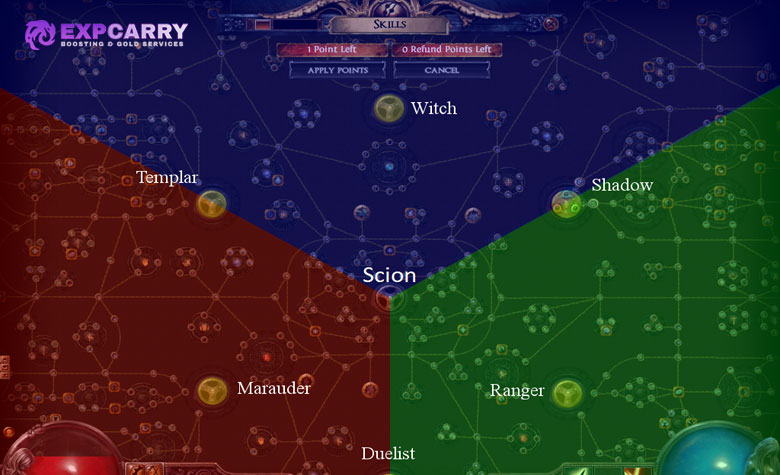
Travel points are not automatically wasted. A +10 attribute node can enable a gem level or equipment upgrade, and a small defensive Passive can complete an important mastery cluster. The waste appears when the route takes attributes the character does not need, duplicates solved stats, or reaches a destination that could be obtained more cheaply elsewhere. Compare both directions around a cluster because one side may provide a more useful set of small Passives.
Loops are occasionally justified when both sides contain valuable stats or when the second connection will later allow a clean reroute. Most finished trees do not need redundant connections. Once an alternate path is safely allocated, the weaker side of a loop can often be refunded and those points moved to a Notable, Mastery, or Jewel Socket.
Take Power in the Order the Character Needs It
A level 95 tree is a destination, not a levelling order. During the campaign, take clusters that improve current damage and survival before spending ten levels travelling toward a distant endgame payoff. If a guide supplies several tree snapshots, follow the nearest completed stage rather than drawing a straight line toward the final outer branch. A temporary efficient cluster can be correct even when the endgame tree later refunds it.
Plan transition points in advance. A critical build may level with non-critical damage until it owns enough Critical Strike Chance and multiplier. A Chaos Inoculation character normally levels with Life or a hybrid defence until its Energy Shield equipment is ready. A Cluster Jewel route should wait until the actual jewel has the right size, Passive count, and Notables. Players who want to reach a planned level breakpoint without changing the build route can use the Path of Exile leveling options as a progression reference, but the passive allocation should still be checked against the character's real equipment.
Judge Jewel Sockets by the Jewel You Own
A Jewel Socket costs at least the socket point and often additional travel points. It is efficient only when the inserted jewel beats another available use of that total budget. Do not allocate an empty socket because a finished build uses it. Regular rare jewels become stronger when several relevant modifiers apply at once, while unique jewels must be evaluated through their exact placement and conditions.
Cluster Jewels expand the tree from outer Large Jewel Sockets. Large clusters generally lead into Medium clusters, and Medium clusters can lead into Small clusters, but each added layer consumes more points. Fewer added Passives can make important Notables cheaper to reach, although the ideal layout depends on jewel size and Notable positions. Count the entrance, every required small Passive, each Notable, and any nested socket before comparing the cluster with the main tree.
Explore services related to this guide, selected from our Path of Exile catalog.
View All Path of Exile Services


How to Choose Keystones Without Breaking the Build
Keystones are rule changes, not ordinary upgrades. Their value comes from building around the restriction as deliberately as the benefit. A Keystone can invalidate critical investment, remove Evasion, redirect damage to an empty resource pool, prevent the character from dealing damage directly, or lock the build to one damage type. Read every line and test the result with active skills, reservations, flasks, minions, and equipment.
Use a four-part check before allocating any Keystone. Confirm that the build can trigger the benefit, that the downside does not disable a core mechanic, that the equipment supports the new rule, and that the total pathing cost beats other upgrades. A Keystone next to the current route can still be wrong, while a distant one may justify its cost if the entire build depends on it.
| Keystone | Build Purpose | Critical Check |
|---|---|---|
| Resolute Technique | Makes attacks unable to be evaded | The character cannot deal Critical Strikes, so critical investment becomes dead |
| Elemental Overload | Rewards occasional Critical Strikes with more Elemental Damage for the skill that triggered it | Critical Strikes do not gain their normal extra damage, so the build needs reliable triggers rather than multiplier scaling |
| Chaos Inoculation | Grants immunity to Chaos Damage | Maximum Life becomes 1, so the Energy Shield pool and recovery must already be ready |
| Mind Over Matter | Moves part of incoming damage from Life to Mana | Unreserved Mana and Mana recovery must support both damage taken and skill costs |
| Iron Reflexes | Converts Evasion Rating into Armour | The character gives up Evasion scaling from Dexterity and should recalculate both defensive layers |
| Eldritch Battery | Uses Energy Shield to protect Mana instead of Life | The build needs a different defence for Life and enough Energy Shield recovery to pay skill costs |
| Ancestral Bond | Allows one additional summoned Totem | The character cannot deal damage directly with skills, so damage must come from Totems or another valid source |
| Glancing Blows | Doubles Attack and Spell Block Chance | Blocked hits still deal 65% of their damage, making recovery on block and mitigation important |
| Unwavering Stance | Prevents Stuns | The character cannot Evade enemy attacks, so existing Evasion investment may lose its purpose |
| Precise Technique | Rewards non-critical attacks when Accuracy Rating exceeds maximum Life | The condition must remain true after Life and gear upgrades, and Critical Strikes are disabled |
Check Keystone Interactions as a Package
A build can use several Keystones, but their rules must form one coherent package. Mind Over Matter and Eldritch Battery can interact with the same resource system, yet the result depends on where Energy Shield is protecting, how Mana is reserved, and how costs are recovered. Chaos Inoculation changes the relevance of Life modifiers and Life recovery. Resolute Technique removes the value of Critical Strike Chance even if the nearby attack cluster otherwise looks efficient.
Equipment can also grant or transform Keystones. Before pathing across the tree, check whether the planned item or unique jewel already supplies the effect. The reverse is equally important: replacing that item later may silently remove a build-defining rule. Keep the source of every mandatory Keystone visible in the build plan.
Account for Current 3.29 Keystone Changes
Path of Exile 3.29 added Bitter Frost, Roiling Tempest, and Voracious Flame north of the Witch starting area. Bitter Frost uses Chill Effect to increase damage taken by affected enemies and prevents the character from dealing non-Cold Damage. Roiling Tempest raises the upper end of Lightning Damage by 25% while lowering its minimum by 50%, and it prevents non-Lightning Damage. Voracious Flame permits an additional Ignite but sets base Ignite duration to 1 second, applies 25% less Ignite Damage, and prevents non-Fire Damage.
These are clear examples of why Keystone text must be read as a complete rule. Each new option can be powerful for a specialised elemental build and destructive for a build using conversion, secondary damage types, or incompatible ailments. The official 3.29 patch notes contain the current wording and should be checked when importing a tree made for an earlier league.
Masteries, Jewels and Other Passive Tree Modifiers
Not every important decision is a Keystone. Masteries add a selected category effect after the character reaches and allocates a connected Notable in the cluster. The Mastery costs one additional passive point. Allocating a Notable through an anointment or another disconnected method does not normally unlock the cluster's Mastery because the cluster is not connected through the tree.
Choose a Mastery for its current effect, not because the build has already paid for the cluster. Mastery lists change in balance patches, and the best option can change with gear. If none of the choices solves a current problem or provides competitive damage or defence, leave the centre unallocated and spend the point elsewhere.
Separate Main-Tree Value From Jewel Value
Regular jewels can be removed or replaced without a passive refund cost, but allocating or refunding the socket still uses ordinary passive rules. Radius jewels, Timeless Jewels, and other unique jewels can change nearby Passives or allow unusual allocations, so removing the jewel may invalidate parts of the tree. Record the exact jewel, seed when relevant, and socket location in any shared build plan.
Tattoos can replace the effect of eligible allocated attribute Passives, while Runegrafts can modify allocated Masteries. These systems change the value of the affected node without changing the route itself. Do not calculate a travel node or Mastery from its default text when the finished setup plans to transform it. If that transformation is expensive or unavailable at league start, keep a functional version of the tree that works before the modifier is applied.
Use Cluster Jewels Only After Pricing the Full Branch
A Cluster Jewel should be evaluated by the exact number of points required to reach its useful Notables and sockets. Two jewels with the same listed Notables can place them differently, changing the real allocation cost. A low Passive count is often desirable, but it is not automatically best if the layout removes a useful small Passive or changes access to a socket.
Unsocketing a Cluster Jewel refunds the passive points spent on its added cluster, which makes cluster replacement more convenient than manually refunding every added node. Remove any nested jewels first if the interface requires it, keep enough inventory space for returned jewels, and verify the rebuilt branch before entering difficult content.
How Respecs Work in Path of Exile 1
Path of Exile 1 supports both small corrections and full rebuilds. The correct method depends on the number of points being changed, the character's progression, and the current value of Gold and currency. Quest refund points are ideal for early mistakes. Orbs of Regret are flexible and tradable. Respecialisation uses Gold through designated NPCs, and current versions also allow a one-click full passive tree refund for a Gold cost.
Refunding a passive returns it to the unspent ordinary passive pool. The resulting tree must remain valid: allocated nodes normally need a continuous connection to the class starting point or another explicitly permitted source. The game will not let a player remove a bridge that would leave an allocated branch disconnected. Build the replacement route first when possible, then remove the obsolete connection.
| Respec Method | What It Provides | Best Use |
|---|---|---|
| Campaign refund rewards | Up to 20 passive skill refund points from specific quests | Correcting early pathing or removing temporary levelling clusters |
| Orb of Regret | One passive skill refund point per Orb used | Targeted changes when currency is cheaper or more available than Gold |
| Gold Respecialisation | Refunds selected Passives through designated town NPCs or Faustus after he becomes available | Campaign transitions and larger edits when the displayed Gold cost is acceptable |
| Full Gold refund | Refunds the entire ordinary passive tree in one operation for a displayed Gold cost | Complete build conversions after equipment, gems, and the replacement tree are ready |
| Patch-granted full reset | An optional reset offered to affected existing characters after major tree changes | Repairing a Standard character whose old route was changed by an update |
Use Quest Refund Points and Orbs of Regret
The campaign awards 20 passive refund points when all relevant refund quests are completed. Use /passives to check missing point quests, then compare the character against the planned tree before buying currency. An Orb of Regret grants one additional ordinary passive refund point when used. Orbs are tradable and can also be obtained through normal drops and vendor currency conversion.
Open the passive tree, enter refund mode, select valid allocated nodes, and confirm the change. Work from the outer end of a branch toward the starting point. If a node cannot be selected, inspect what depends on it, including Masteries, Jewel Sockets, passives allocated through special jewels, and a second branch that uses it as the only connection.
Respec With Gold or Refund the Full Tree
Designated campaign NPCs offer Respecialisation for Gold, beginning with Bestel in Act 1. Faustus can provide the service and becomes available for the Hideout after the character meets him in Lioneye's Watch in Act 6. The displayed Gold requirement increases as more passive points are allocated, so compare the live price with the cost of Orbs of Regret instead of assuming one method is always cheaper.
Since version 3.27, the game can refund the entire ordinary passive tree in one operation for Gold. This saves the work of selecting every node but does not solve the rest of a build conversion. Buy and equip the replacement gems, gear, flasks, and jewels first, save or export the new tree, and check attribute requirements before confirming a full reset. The broader Path of Exile progression hub can help place the rebuild within current campaign, Atlas, or boss goals without treating the respec itself as a substitute for correct gear.
Reroute Without Disconnecting the Tree
For a small reroute, keep enough unspent points to allocate the new bridge before removing the old one. This temporarily creates a loop but preserves a valid connection. After the new path reaches the branch, refund the weaker side of the loop from its ends. If no points are available, first refund an optional leaf, Mastery, or temporary cluster that does not support another allocation.
A full rebuild should be prepared in the opposite order from a small correction. Save the final tree, note every required attribute, reserve enough Gold or refund points, and collect the replacement equipment. Then refund, rebuild the connected skeleton, restore defence and attributes, and add optional damage last. Do not enter a map until the tree, gems, reservations, flasks, and equipment have all been checked together.
Understand Ascendancy and Bandit Respec Costs
Ascendancy Passives are not ordinary tree nodes. Refunding one Ascendancy point costs five ordinary refund points or five times the applicable Gold cost through Respecialisation. Changing to a different Ascendancy class requires refunding all allocated Ascendancy Passives and using the Altar of Ascendancy at the end of a Labyrinth. The base character class itself cannot be changed by a passive respec.
The Deal with the Bandits reward is also separate from ordinary refund mode. Changing the chosen bandit bonus uses the appropriate vendor recipe and consumes 20 Orbs of Regret. If the planned build changes between a bandit bonus and Eramir's passive point, include that conversion in the respec budget rather than expecting the full tree refund to change the quest reward.
Common Passive Tree Mistakes and Practical Fixes
Most failed trees do not collapse because of one weak small Passive. They fail because the route scales the wrong mechanic, delays defence, assumes unavailable equipment, or spends too many points reaching isolated bonuses. Diagnose the character by category before replacing everything. Check whether damage, survival, attributes, reservation, sustain, or pathing is the actual bottleneck.
Change one connected package at a time and test it in familiar content. A damage loss after a respec may come from losing an attribute, disabling a gem, breaking a Keystone condition, removing a jewel radius, or changing reservation efficiency rather than from the new Notable itself.
| Mistake | Why It Fails | Practical Fix |
|---|---|---|
| Taking every nearby damage cluster | Points are spent without building a defence, recovery, or destination plan | Keep only clusters that scale the main damage source efficiently |
| Following only the final endgame tree | The route may depend on levels, jewels, gear, or a transition that the character lacks | Use staged snapshots and allocate current power before distant endgame branches |
| Allocating a Keystone for its upside alone | The restriction can disable Critical Strikes, Evasion, direct damage, or a damage type | Audit every skill, defence, resource, and item against the full Keystone text |
| Buying a Cluster Jewel without counting Passives | The useful Notables can cost more points than expected | Preview the exact jewel layout and compare its total branch cost with the main tree |
| Removing a bridge first | The remaining allocation would be disconnected from the starting point | Allocate the replacement connection before refunding the old path |
| Planning around unowned equipment | The live character lacks required attributes, sustain, defences, or a granted Keystone | Maintain a functional pre-upgrade tree and switch only when the item is ready |
| Using an outdated imported tree | Patches can move, replace, or rewrite Passives and Masteries | Confirm the league version and compare key nodes with the current official tree |
Final Verdict
A good Path of Exile passive tree is a connected plan, not a collection of impressive nodes. Define the main damage source, defence, recovery, attributes, reservation, and mandatory Keystones first. Connect those destinations through useful travel stats, count the full cost of every cluster and Jewel Socket, and allocate power in the order the live character needs it.
Treat every Keystone as a benefit and restriction package. Keep a staged tree for levelling, verify the current node wording after league updates, and do not rely on an item that is not yet equipped. Correct small mistakes with quest refunds, Orbs of Regret, or Gold Respecialisation, and reserve a full Gold refund for a prepared rebuild. When the new route, gear, gems, and attributes are planned together, changing a passive tree becomes controlled character development instead of an expensive guess.