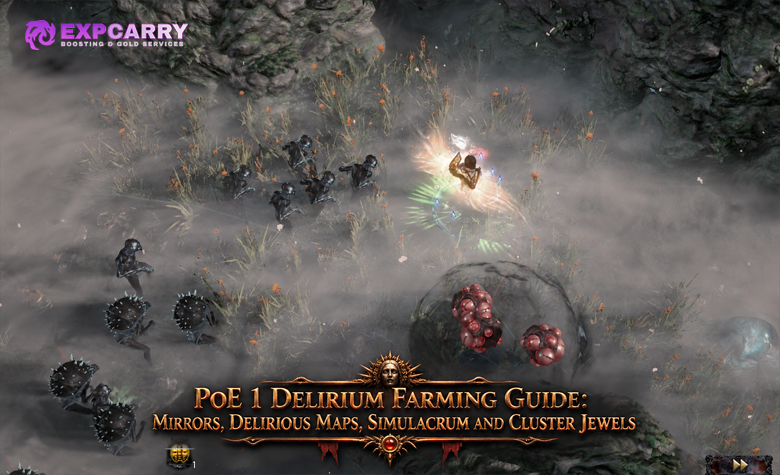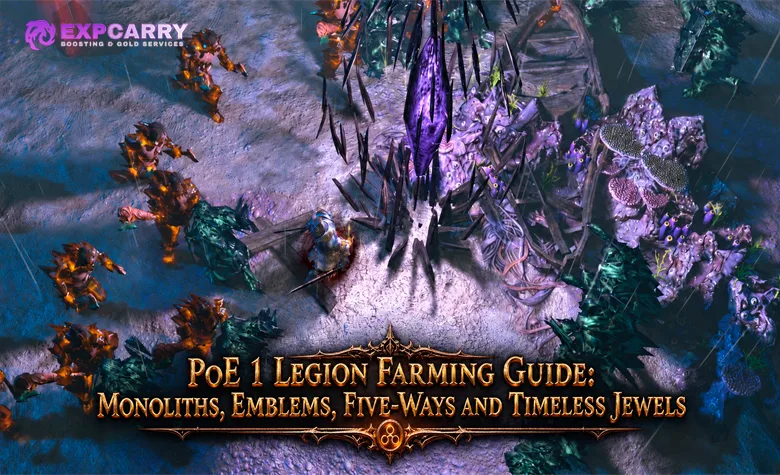
Legion farming in Path of Exile 1 connects fast Atlas mapping with one of the game's most recognizable endgame encounters, the Domain of Timeless Conflict. Players release armies from Timeless Monoliths, collect Timeless Splinters, assemble Emblems, and fight Legion Generals for valuable rewards and Timeless Jewels. Since the Legion rework in patch 3.29, the mechanic also provides Enshrouding Crystals used to create Vestigial Unique Items. Patch 3.30: Covens of Umbra changes the farming setup again, replacing Scarabs with Legion Threads and rebuilding the Atlas Passive Tree.
The current 3.30 league launched on November 13, 2026, with additional Legion Thread changes introduced in patch 3.30.0c on November 19. Old Legion strategies based on random Monolith spawns, Legion Scarabs, Incubators, or fractured-item farming are no longer reliable. The practical approach is to use maps with open layouts, invest in the current Legion Atlas passives, release high-value enemies and War Hoards, and decide whether the resulting Emblems are worth selling or running. This guide covers the complete farming cycle, including Monolith mechanics, Generals, Five-Way preparation, reward scaling, Enshrouding Crystals, and Timeless Jewel evaluation.
Short answer: Farm Legion in PoE 3.30 by adding Legion Threads to Atlas maps or using a Legion Shaped Region, then release Sergeants, Generals, and reward chests before defeating the armies. Collect 100 Splinters of one faction to form an Emblem, combine two to five different Emblems to enter the Domain of Timeless Conflict, and evaluate Timeless Jewels by their historical figure, seed, and Passive Tree socket.
PoE 3.30 Legion Farming: Threads, Atlas Drops and Reward Changes
Legion no longer appears randomly in ordinary Atlas maps. Grinding Gear Games removed the random appearance chance of ten primary league mechanics in patch 3.30.0, making Threads of Creation the standard way to add them. Legion Threads enable the encounter, while additional Threads increase the chance of stronger randomized effects. Patch 3.30.0c also introduced guaranteed extra Legion encounters at specific Thread counts. Shaped Regions provide another way to access Legion without consuming a purchased Thread on every map.
The rewards have also changed. Monsters and chests with Legion reward icons now scale their reward count with a percentage of Atlas Drops, the new stat replacing map Item Quantity. GGG also reduced the amount of Schism generated by releasing Legion monsters and chests by approximately 33%, affecting players using the Timeless Conflict Atlas keystone. The general removal of fractured-item sources from league mechanics means Legion should no longer be treated as the specialized Fractured Rare farming method described in older guides.
| Mechanic | Current behavior | Farming impact |
|---|---|---|
| Monolith access | Legion Threads or a corresponding Shaped Region. | Plan the encounter before opening a map. |
| Map investment | Threads replace Scarabs; 3, 6, and 8 Legion Threads grant 1, 2, and 3 additional encounters respectively. | Old Legion Scarab combinations are obsolete; Thread breakpoints now matter. |
| Atlas specialization | Rebuilt Legion passive clusters. | Use the current tree for Sergeants, Generals, chests, and duration. |
| Reward scaling | Reward-icon monsters and chests scale with Atlas Drops. | Map preparation can improve Legion-specific rewards. |
| Timeless Conflict keystone | Releasing enemies and chests generates approximately 33% less Schism. | More targets may need to be released before the encounter starts. |
| Fractured equipment | Many league-mechanic sources have been removed, including Legion. | Do not copy old Fractured Rare farming strategies. |
| Domain rewards | Timeless Jewels, Emblem rewards, and Vestigial Unique crafting remain relevant. | Evaluate Five-Way income separately from ordinary mapping. |
The encounter's basic structure remains the same: activate a Monolith, release as many valuable targets as possible, and defeat the armies. However, the best investment now depends on Thread cost, Atlas Drops, encounter difficulty, and current demand for Legion rewards. More expensive mapping does not automatically produce higher net profit when the character struggles to release or defeat the additional monsters.
Legion Threads and Shaped Regions: Starting the Farming Loop
A Legion Thread adds Legion content to an Atlas map through the Map Device. Under normal rules, players can apply up to eight Threads to an area, increasing the chance of powerful Legion-specific transformations as more are used. These effects can change the number or quality of encounters, the presence of Generals, or the availability of reward chests. Patch 3.30.0c additionally guarantees at least one randomized modifier with 1–3 Threads, two with 4–7 Threads, and three with 8 or more. Legion receives one additional encounter at 3 Threads, two at 6 Threads, and three at 8 Threads. The remaining effects are randomized, so spending eight Threads is not a guarantee of a particular General or reward combination.
For low-investment farming, start with one Legion Thread and a suitable open map. This allows the player to test clear speed, Monolith placement, and the value of ordinary Legion drops before consuming expensive stacks of Threads. Once the character consistently releases valuable enemies and clears the encounter, increase investment gradually and compare the extra rewards with the additional cost.
Legion Shaped Regions and Timeless Astrolabes
Legion Shaped Regions apply free Legion Threads to maps within their boundaries. Successfully completing a regional objective increases the number of free Threads granted to the other remaining affected maps, creating opportunities to run several Legion encounters without purchasing every input. A Timeless Astrolabe can also create an empowered Legion Shaped Region on the Atlas, allowing the player to organize a focused farming area.
The best use of a Shaped Region is to plan a sequence of maps that the character can complete efficiently. Clear the relevant objectives, use the resulting free Threads, and spend purchased Threads only when their additional difficulty and potential rewards justify the price. The existing PoE 3.30 Threads of Creation guide explains the broader Map Device system; Legion-specific profit depends on how well the encounters themselves are completed.
Low-Budget, Moderate and High-Investment Legion Maps
Low-budget Legion farming works best when the character already has fast area damage and can clear the Monolith without extensive preparation. Moderate investment adds more Threads and specialized Atlas passives, while high-investment strategies can incorporate additional map modifiers and Shrines. Patch 3.30.0c reduced the Toughness added by Threads, especially at higher counts, adjusted monster Rarity upward, and lowered damage scaling at high Thread counts. The strongest setup is still not necessarily the one that uses the maximum number of Threads, because difficult rare monsters and stronger Generals can reduce maps completed per hour.
The reworked Unwavering Vision Atlas keystone provides a specialized alternative. It restricts the player to a single Thread type, adds two additional Threads to affected maps, and can exceed the normal eight-Thread maximum. Its drawback gives Threads found in maps a 75% chance to be converted into Gold, so it is better suited to players deliberately specializing in one mechanic than those trying to farm several different Thread types for sale.
Best Legion Atlas Passives for Sergeants, Generals and War Hoards
The redesigned Atlas Passive Tree offers separate ways to improve Legion clear consistency, reward chests, and Splinter acquisition. The most relevant choices depend on whether the player is farming general loot, collecting Emblems, or targeting Enshrouding Crystals from Generals. Current passive descriptions can be checked in the PoEDB Legion Atlas reference, which reflects the reworked Legion clusters rather than the old Scarab-based tree.
| Passive | Effect | Farming priority |
|---|---|---|
| Prolonged Struggle | 60% increased Legion duration and 60% increased damage taken by monsters in stasis. | Useful for builds that need additional time to release valuable enemies. |
| Extra Provisions | Each Legion contains an additional War Hoard; Legion chests contain an additional random reward. | Improving chest-focused rewards. |
| Spoils of War | Legion chests can spread their rewards to nearby released monsters. | Additional rewards for builds capable of killing stronger monsters. |
| Battle-Tested | Reward-bearing Legion monsters have chances to gain additional rewards but become tougher. | Higher-investment loot farming. |
| Chain of Command | Legion encounters contain four additional Sergeants. | More valuable monsters and Splinter opportunities. |
| Leader of Men | Encounters containing a General have both Generals; Generals drop 50% more Timeless Splinters. | General and Emblem farming. |
| Timeless Conflict | Removes the normal Monolith timer and replaces it with Schism progression. | Alternative encounter control for specialized strategies. |
For a character still learning Legion, Prolonged Struggle provides a forgiving starting point because it extends the release window. Extra Provisions and Chain of Command become attractive when the character can already clear most valuable targets, while Leader of Men supports farming Generals and their specialized drops. Battle-Tested should be approached with more caution because adding rewards also increases monster durability.
Timeless Conflict Keystone and the Schism Mechanic
The Timeless Conflict Atlas keystone replaces the normal Monolith countdown with a Schism mechanic. Releasing frozen monsters and chests progresses the Schism, and the encounter begins when the required threshold is reached. This changes the timing of the release phase, allowing players to plan how much of the army is freed before the actual fight starts.
Patch 3.30 reduced Schism generated by releasing monsters and chests by approximately 33%. Players copying older setups may therefore need to release more targets before triggering the encounter. The keystone is useful when its behavior suits the build and map layout, but it should not be treated as a universal upgrade over the standard timer.
Explore services related to this guide, selected from our Path of Exile catalog.
View All Path of Exile Services

Timeless Monolith Strategy: Releasing Armies and Maximizing Rewards
A Legion encounter begins when the player activates a Timeless Monolith, revealing two opposing armies frozen in place. During the release phase, players attack frozen monsters and break reward chests out of stasis. When the release phase ends, the freed enemies become active and can be defeated for loot. Monsters that remain frozen are generally lost, making area coverage and target selection the defining skills of the mechanic.
Legion rewards builds that can damage many enemies across a large area rather than slowly eliminating isolated targets. Projectiles, explosions, chaining attacks, and other large-area clearing tools can be particularly effective when they reach multiple frozen groups. However, damage is only part of the requirement: movement speed and an open map layout determine how much of the battlefield the character can reach before the release phase ends.
Sergeants, Reward Chests and War Hoards
Sergeants are important reward-bearing Legion enemies, while War Hoards provide concentrated chest rewards. These targets deserve attention because the 3.29 rework removed Timeless Splinter drops from ordinary non-Sergeant, non-General Legion monsters. Generals now provide more Splinters on average, while Sergeants and chests have a lower chance to drop Splinters but drop larger stacks when they do. Consequently, releasing a smaller collection of valuable targets can be more rewarding than blindly prioritizing large groups of ordinary soldiers.
Some chests also release nearby monsters when broken out of stasis, making them useful for covering several targets quickly. Positioning attacks so they reach a War Hoard and its surrounding enemies can save time compared with moving through each target individually. The value of a chest depends on its rewards and the current Atlas passives, so do not ignore a nearby War Hoard merely to clear another cluster of ordinary monsters.
Legion Generals: Viper Napuatzi, Hyrri, Aukuna, Vox and Lioneye
Legion Generals are powerful unique enemies associated with the five factions. They can appear toward the rear of a Legion formation, so the player may need to move away from the Monolith to locate and release them. Their value is greater than that of ordinary monsters because they can provide substantial Timeless Splinters and have a chance to drop Enshrouding Crystals when encountered in Atlas maps.
General-focused farming requires more than enough damage to release the boss during stasis. The character must also defeat the General after the armies become active, while managing other rare monsters and any additional difficulty introduced by Threads. Leader of Men becomes especially attractive for this approach because it improves the reward potential of encounters already containing a General.
The 90% Release Mechanic and Efficient Monolith Clearing
The Legion rework in 3.29 introduced an automatic release interaction after players free nearly the entire encounter. When players have released 90% of the total monsters, as well as all chests, Sergeants, and Generals, the remaining monsters are released automatically. This reduces the need to manually reach every last ordinary monster in an encounter that has already been mostly cleared.
For efficient farming, concentrate on valuable enemies and chests first, then use wide-area damage to release as much of the remaining army as possible. Do not assume that clearing a few Sergeants automatically triggers the full release, since the mechanic also requires the 90% monster threshold and the release of all chests and Generals. A build that cannot reliably reach the relevant threshold should still prioritize high-value targets over trying to force the automatic release every time.
Legion Farming Maps: Dunes, Jungle Valley and Open Layouts
Map layout strongly affects Legion efficiency because frozen armies spread over a relatively large area. Open maps provide room to move between formations and attack enemies without walls interrupting projectiles or forcing long detours. Tight indoor layouts can prevent the character from reaching distant Generals and War Hoards before the release window expires.
Dunes and Jungle Valley are common choices in current 3.30 farming discussions because their layouts can support fast mapping and useful Legion encounters. Their effectiveness still depends on the character's movement, attack coverage, and selected Atlas strategy. The goal is not to copy a map name from a profitable video, but to find a layout where the build consistently releases the important Legion targets.
Legion and Shrine Farming with Fast-Clear Builds
Shrines can complement Legion because temporary buffs may improve movement speed, damage, or the rate at which frozen enemies are released. A current community approach associated with Fubgun focuses on clearing a map, collecting relevant Atlas rewards, and activating useful Shrines immediately before opening the Monolith. This takes advantage of the temporary buff while the player's largest area-clear requirement is active.
The sequence matters because Shrine duration is limited. Activating a useful Shrine too early can waste much of its benefit during travel or unrelated combat. If the map contains a suitable Shrine near the Monolith, taking it just before triggering the encounter can improve release coverage without requiring a different character build. The specific profitability of this combination remains dependent on the active league economy rather than a guaranteed number of Divine Orbs per hour.
Timeless Splinters and Emblems: All Five Legion Factions
Timeless Splinters are the main progression currency connecting map Legion encounters to the Domain of Timeless Conflict. Collecting 100 Splinters from the same faction produces one Timeless Emblem, which can be used with other distinct Emblems to open the Domain. Each of the five Legion factions has its own Splinter and Emblem type, and those factions also determine which Timeless Jewel can be obtained from their General in the Domain.
The five factions are the Eternal Empire, Karui, Vaal, Templars, and Maraketh. All five have distinct Emblems, Generals, and Timeless Jewel rewards, making the composition of an Emblem set relevant to the intended farm. The original official Legion overview establishes the relationship between Monoliths, Splinters, Emblems, and the Domain, while the later reworks changed several reward details.
| Faction | Emblem | General | Timeless Jewel |
|---|---|---|---|
| Eternal Empire | Timeless Eternal Emblem | General Marceus Lioneye | Elegant Hubris |
| Karui | Timeless Karui Emblem | Queen Hyrri Ngamaku | Lethal Pride |
| Vaal | Timeless Vaal Emblem | Viper Napuatzi | Glorious Vanity |
| Templars | Timeless Templar Emblem | Cardinal Sanctus Vox | Militant Faith |
| Maraketh | Timeless Maraketh Emblem | Aukuna, the Black Sekhema | Brutal Restraint |
Emblems can be traded, giving players a choice between selling the access items and using them for Domain runs. Their relative value changes as different builds, Timeless Jewels, and Enshrouding Crystal strategies become popular. A player accumulating one type of Emblem should not automatically run it in every available combination; the expected return depends on the full Emblem set and the ability to clear the resulting encounter.
Splinter Farming Priorities After the 3.29 Rework
Ordinary Legion soldiers are no longer direct Timeless Splinter sources, so focusing on them purely for Emblems is inefficient. Generals, Sergeants, and reward chests now matter more, particularly when Atlas passives provide extra Sergeants or additional reward opportunities. A General appearing in a map is not guaranteed, which makes consistent encounter volume important when farming a specific faction over many maps.
Increasing Atlas Drops may also improve the chance of additional Legion-specific drops, including Splinters. However, Atlas Drops should not be confused with the old map Item Quantity system or treated as a fixed multiplier to every reward. Players who want to compare these new scaling mechanics can use the broader PoE 3.30 Item Rarity and Atlas Drops guide, while the Legion strategy should remain focused on which monsters and chests actually generate Emblems.
Domain of Timeless Conflict: Two-Ways, Four-Ways and Five-Ways
The Domain of Timeless Conflict is the dedicated endgame encounter accessed by combining Timeless Emblems. Place at least two Emblems from different factions into the Map Device to open the area. The number of distinct Emblems used determines how many factions participate, with a full Five-Way requiring one Emblem from each of the five Legions and access to five Map Device fragment slots.
Inside the Domain, players fight the armies and their associated Generals while building rewards through repeated kills. Returning to the central Monolith during the active encounter allows defeated enemies to reappear, creating additional opportunities to earn rewards. This is the foundation of repeated Five-Way farming, but the increasing danger of revived monsters and the cost of five Emblems mean that more factions are not automatically the most profitable option for every character.
| Encounter | Required Emblems | Main purpose |
|---|---|---|
| Two-Way | Two different Timeless Emblems | Entry-level Domain farming and targeting selected factions. |
| Three-Way | Three different Timeless Emblems | Fighting an additional faction while managing moderate investment. |
| Four-Way | Four different Timeless Emblems | More factions, Generals, and reward opportunities. |
| Five-Way | All five different Timeless Emblems | Full Legion encounter with all five factions and the largest Emblem investment. |
Five-Way Access and Map Device Requirements
A Five-Way cannot be opened using duplicate Emblems from the same faction. Players need all five distinct types and the appropriate Map Device slot capacity before opening the encounter. The fifth fragment slot can be unlocked through Atlas progression by completing Maven's Invitation: The Atlas or a Nightmare Map for the first time, rather than by repeatedly farming a particular Legion faction.
For a character with insufficient Atlas progression, completing the relevant objectives should come before investing in a full collection of expensive Emblems. The existing PoE Atlas progression options concern earning missing Atlas objectives and passive points, but do not replace the need to prepare the correct Emblem set and a character capable of completing the Domain.
Five-Way Combat: General Kills, Center Resets and Revived Monsters
Once the encounter starts, clear the active armies and prioritize their Generals. Moving back through the central Monolith can revive previously defeated enemies, allowing additional kills while the encounter remains active. The player's movement route should therefore connect valuable target groups with reliable Monolith resets rather than spending too much time chasing isolated ordinary monsters.
Repeated revivals increase enemy difficulty under the Emblem modifiers introduced in 3.29. All five Emblem types provide additional experience and reward progress, but also increase enemy damage and durability. Their faction-specific effects become more dangerous with repeated revivals: Karui enemies gain critical strike bonuses, Maraketh enemies gain attack and cast speed, Templar enemies gain resistance penetration, and Vaal enemies gain extra Chaos damage. A character farming for rewards must still survive long enough to complete productive resets.
Domain Reward Crystals and the Updated Five-Way Interface
The Domain's reward interface changed in the Legion rework. The old row of reward icons was replaced by small crystals around the central structure that light up as reward progress accumulates. One illuminated crystal represents approximately three of the former reward-icon units, while additional kills can still provide progress after all 100 visible crystals have been lit.
Players should watch the current crystal display rather than searching for the old icon tracker shown in pre-3.29 guides. The change is primarily visual, but it affects how a player interprets progress during repeated waves. The most useful measure of a Five-Way remains the rewards generated by a completed encounter compared with its Emblem cost and total completion time.
Enshrouding Crystals and Vestigial Unique Crafting
The Legion rework introduced Enshrouding Crystals, adding an item-transformation system to the ordinary Monolith and Domain farming loop. These crystals can drop from Legion Generals encountered in Atlas maps and are tied to specific Unique Armour categories. Applying one to an eligible Unique makes the item Enshrouded, allowing it to participate in a transformation process inside the Domain of Timeless Conflict.
The critical distinction is where the materials come from. The five standard Enshrouding Crystals are obtained from Generals in map encounters, not from Generals inside the Domain. The Domain is where the player uses an already prepared Enshrouded item to work toward a Vestigial Unique. Confusing those two steps leads to the wrong farming strategy.
| Crystal | Associated General | Unique item type |
|---|---|---|
| Vaal Enshrouding Crystal | Viper Napuatzi | Helmets |
| Karui Enshrouding Crystal | Queen Hyrri Ngamaku | Gloves |
| Imperial Enshrouding Crystal | General Marceus Lioneye | Boots |
| Templar Enshrouding Crystal | Cardinal Sanctus Vox | Shields |
| Maraketh Enshrouding Crystal | Aukuna, the Black Sekhema | Body Armours |
Crystals of Permutation: Transforming Enshrouded Unique Items
The Domain contains four Crystals of Permutation that can hold suitable Enshrouded items. After placing an item in a crystal, the player kills enemies to generate progress toward its transformation. Once fully charged, the item gains Variant Rarity; the player can activate the crystal to produce another Unique of the corresponding item class with a Vestigial implicit derived from the original item, or continue charging it for potentially rarer outcomes.
This is not a deterministic method for obtaining one exact Unique. The target item is transformed, and its resulting value depends on the new Unique, inherited implicit, Variant Rarity, and applicable modifier values. Before preparing an expensive item, confirm that the potential outcomes justify sacrificing the original and that the character can complete enough Domain combat to charge the crystal.
Patch 3.30 also fixed a progression issue where Aukuna and Hyrri contributed twice as much charge as the other Generals. Players following older demonstrations should not expect those two bosses to provide the same disproportionate advantage in the current version. The transformation system remains useful, but its efficiency must be evaluated using the corrected charge behavior.
Afarud Enshrouding Crystal and Miraged Legion Encounters
Patch 3.30 introduces another specialized crystal source through Mirage encounters. The Afarud Enshrouding Crystal can drop from the Afarud General in a Miraged Legion encounter and is used for Unique Quivers. This is a separate acquisition route from the five standard crystals obtained through ordinary map Legion Generals.
Players specifically targeting that additional crystal need the appropriate Mirage interaction rather than simply running more ordinary Five-Ways. The existing PoE 3.30 Mirage Farming Guide covers that separate farming route, including the relevant Legion crossover. It does not change the normal requirement to obtain standard Enshrouding Crystals from map Generals.
Timeless Jewels: Lethal Pride, Brutal Restraint, Militant Faith, Elegant Hubris and Glorious Vanity
Timeless Jewels are some of Legion's most distinctive rewards because their value comes from how they alter the Passive Skill Tree. The five classic Jewels correspond to the five factions, but copies of the same Jewel type can produce very different effects depending on their historical figure, numerical seed, and socket location. A Jewel that is extremely valuable for one build may offer little benefit to another using a different Passive Tree path.
The traditional source is the Domain of Timeless Conflict, where the relevant Generals can reward their faction's Timeless Jewel. However, defeating a General does not guarantee one every time, and the number of Emblems used does not guarantee a particular desirable seed. Farming these items therefore involves both acquiring the correct faction and evaluating the actual Jewel rather than relying on its name alone.
Timeless Jewel Seeds, Historical Figures and Passive Tree Sockets
Each Timeless Jewel has a numerical seed that determines its passive modifications. The historical figure printed on the Jewel also matters because it controls the relevant keystone transformation for that type. Finally, the socket determines which Passive Tree nodes fall within its influence, meaning the same Jewel can produce different benefits when placed at different locations.
For example, Glorious Vanity can produce different keystone outcomes depending on its historical figure, while Lethal Pride and Brutal Restraint have their own modification rules. A seed's numerical size is not a measure of item quality; a larger number is not automatically better. The correct approach is to inspect the relevant modifiers and calculate their value for the actual nodes a character will allocate.
Timeless Jewel Calculator and Path of Building Evaluation
Before selling or using a Timeless Jewel, record its type, historical figure, seed, and the socket position where it will be evaluated. Use an updated Path of Building Community version or another reliable seed calculator to inspect the passive changes and determine whether they benefit the intended build. Compare the useful Notables against the passive points needed to reach them, because a strong modifier on an inaccessible node may add little practical value.
Calculators must match the current game's Passive Tree. Some popular tools still use 3.29 data, so their output should not automatically be assumed accurate for every 3.30 tree interaction. The Timeless Jewel calculation reference explains the relationship between seeds, historical figures, and socket positions, but exact values should be confirmed against a compatible current tree before making an expensive purchase.
Timeless Jewel Trading: Exact Seeds Versus Random Rolls
Timeless Jewels should not all be priced at the same value simply because they share a base type. Certain historical figures are demanded for specific keystones, while rare combinations of modified Notables can make particular seeds considerably more valuable. A generic Jewel without a useful checked combination may be far less desirable than one matching an established build.
Check comparable trade listings using the actual seed and figure rather than looking only at the cheapest Jewel of the same type. If a seed has no meaningful demand or cannot be verified, price it conservatively instead of assuming that an unusual number creates rarity. Divine Orb rerolling also changes the Jewel's identifying modifiers, so repeatedly rerolling without a clear target can consume more currency than buying the required result directly.
Legion Currency Farming: Splinters, Emblems, Crystals and Five-Way Returns
Legion has several different sources of value that should be measured separately. Atlas mapping produces Timeless Splinters, Emblems, Enshrouding Crystals, reward chest items, and ordinary currency. The Domain adds Timeless Jewels, repeated monster rewards, and the opportunity to transform Enshrouded Unique Items. The most profitable route depends on the relative trade value of those outputs and the character's ability to complete each activity efficiently.
For players who prefer liquid income, selling Splinters in bulk or complete Emblems can be more predictable than consuming them for uncertain Five-Way rewards. Enshrouding Crystals may also provide direct trade value without requiring the player to undertake item transformation. Running the Domain becomes attractive when the expected Jewel drops, raw rewards, experience, and potential Vestigial Unique outcomes justify the Emblem investment.
| Reward | Primary acquisition | Value consideration |
|---|---|---|
| Timeless Splinters | Map Legion Generals, Sergeants and chests. | Bulk value compared with complete Emblem prices. |
| Timeless Emblems | Combining 100 faction Splinters. | Sell for immediate currency or use for Domain access. |
| Enshrouding Crystals | Chance drops from Legion Generals in maps. | Demand for specific Unique Armour transformations. |
| Timeless Jewels | Domain of Timeless Conflict Generals. | Type, historical figure, seed and useful Passive Tree interactions. |
| Vestigial Unique Items | Crystals of Permutation in the Domain. | Resulting Unique and inherited implicit modifier. |
| Currency and other rewards | Reward chests, Legion enemies and Domain combat. | Actual selling price and time spent collecting loot. |
Selling Emblems Versus Running Five-Ways
The decision should be based on expected net returns rather than an assumption that Five-Ways are automatically better. Determine the sale value of the complete Emblem set, then compare it with the realistic value of rewards from successful Domain runs. Include the time required for setup, repeated Monolith resets, combat, and evaluating Timeless Jewels, since those activities can substantially affect hourly efficiency.
A character with excellent clear speed and strong survival may extract more value from running Emblems than a slower build. Conversely, an Atlas mapper who releases Legion armies efficiently but struggles in the Domain may earn more by selling the Emblems to specialized Five-Way farmers. If the goal is repeated farming time rather than a guaranteed drop, PoE hourly farming sessions can focus on suitable Legion content, but they do not guarantee particular Jewel seeds or currency totals.
Atlas Drops, Reward Icons and 3.30 Profit Calculations
Atlas Drops now matters directly to Legion because GGG made the reward count of marked monsters and chests scale with a percentage of that stat. This creates additional value in suitable map modifiers and passives, although the relationship is not equivalent to the old Item Quantity calculations. Do not assume that every ordinary Legion monster becomes a valuable Splinter source simply because Atlas Drops is high.
To evaluate a strategy, record map and Thread costs, total Splinters, Emblems, Crystals, and other realistically tradeable rewards across a fixed batch. Subtract the value of consumed resources and divide the remainder by the total time spent mapping, looting, and selling. Avoid counting an unsold Timeless Jewel at an exceptional asking price unless there is evidence that the exact seed can actually sell for that amount.
Legion Farming Builds: Clear Speed, Area Coverage and Survival
Legion strongly favors characters capable of applying damage across a wide area during a short release window. Fast movement, chaining or exploding attacks, and reliable clearing of rare monsters help turn the Monolith into a consistent source of rewards. A build that is excellent against single bosses but struggles to cover the battlefield may underperform despite having enough damage to kill every individual Legion enemy.
The requirements change inside the Domain. Repeatedly revived monsters become more dangerous, and higher-Emblem encounters introduce additional factions and modifiers. A successful Five-Way farmer needs sustained damage, enough defenses to survive dense combat, and efficient movement between enemies and the central Monolith. The best setup depends on whether the character specializes in ordinary mapping or the Domain rather than a universal class or skill ranking.
Mapping Gear Priorities for Monolith Clearing
For Atlas Legion farming, improve the weakest part of the release sequence. If distant Generals remain frozen, prioritize movement and area coverage; if many Sergeants are released but take too long to kill, improve damage against tougher enemies. Defensive upgrades matter when higher Thread counts or additional rewards create unusually durable and dangerous rares.
Do not judge a build solely by its ability to clear one perfect open Monolith. Test several encounters with different layouts and General combinations, then determine whether the extra investment consistently improves completed maps per hour. A reliable lower-investment strategy is preferable to an expensive setup that works only when the battlefield spawns favorably.
PoE 3.30 Legion Farming Route: Monoliths to Timeless Jewels
A complete Legion farming cycle begins with Atlas preparation and ends with a decision about how to use the resulting Emblems. Players who only want general mapping income can stop after collecting and selling their rewards, while those pursuing Timeless Jewels or Vestigial Unique crafting need to progress into the Domain. The following route connects those activities without assuming that every item must be consumed rather than traded.
- Prepare the Atlas: allocate Legion passives supporting the rewards you want, such as Extra Provisions, Chain of Command, or Leader of Men.
- Choose the map: select an open layout that the character clears efficiently, preferably one with convenient routes between Legion formations.
- Add Legion access: use Legion Threads or free Threads from a Legion Shaped Region.
- Locate the Timeless Monolith: prepare movement and temporary buffs before activating the encounter.
- Release valuable targets: prioritize Generals, Sergeants, War Hoards, and reward-bearing chests.
- Clear the armies: defeat the released monsters, collect Splinters and other rewards, and avoid unnecessary delays.
- Assemble Emblems: combine 100 Splinters of each desired faction into its Timeless Emblem.
- Evaluate the Emblems: compare the sale value of the set against the expected rewards from running the Domain.
- Prepare Domain access: select two to five distinct Emblems and confirm the character can handle the resulting encounter.
- Fight and reset: defeat the armies and Generals, use the central Monolith to revive enemies, and build the Domain reward progress.
- Use optional crafting: charge prepared Enshrouded items in Crystals of Permutation when pursuing Vestigial Uniques.
- Evaluate Timeless Jewels: inspect their type, figure, seed, and socket interactions before using, rerolling, or selling them.
Players can adjust the loop according to their current goals. Farming Emblems for sale does not require a character capable of completing the most difficult Five-Way encounters, while Timeless Jewel farming benefits from repeated successful Domain runs. Keeping the two activities separate makes it easier to identify which part of the strategy actually produces the strongest return.
Legion Farming Mistakes That Reduce Rewards in PoE 3.30
Several old Legion strategies remain visible in search results despite major changes across patches 3.29 and 3.30, including 3.30.0c. Following them without checking the current mechanics can waste Threads, Emblems, and valuable crafting materials. The most important errors involve outdated access methods, poor target priorities, and unrealistic assumptions about Domain rewards.
- Using old Legion Scarab setups: Scarabs were removed in 3.30, so the current farming system uses Legion Threads and the reworked Atlas passives.
- Expecting random Monoliths in Atlas maps: Legion is now a primary Thread mechanic and requires an appropriate Thread or Shaped Region.
- Prioritizing ordinary monsters for Splinters: ordinary non-Sergeant, non-General Legion monsters no longer drop Timeless Splinters directly under the reworked system.
- Ignoring reward chests: War Hoards and other marked chests can provide valuable rewards and help release nearby monsters.
- Using outdated Schism calculations: patch 3.30 reduced Schism generation, changing the behavior of Timeless Conflict strategies.
- Farming Incubators or old fractured-item rewards: Incubators are no longer obtainable and many Legion-specific fractured-item sources were removed.
- Expecting Enshrouding Crystals inside the Domain: the five standard crystals drop from Generals in map encounters, not from Domain Generals.
- Treating every Timeless Jewel as equally valuable: the figure, seed, modified nodes, and socket placement determine whether a Jewel suits a particular build.
- Running Five-Ways without checking costs: five Emblems represent a meaningful investment, and their combined sale price may exceed the actual rewards from an inefficient run.
Another common mistake is investing heavily in difficult maps before confirming that the character can release the valuable targets. High Atlas Drops and multiple Threads improve the opportunity for rewards but do not compensate for repeatedly losing Generals or failing to clear the encounter. Start with reliable results, then increase the difficulty and measure whether the additional investment is justified.
PoE Legion Farming FAQ
These answers cover the main mechanics connecting ordinary Legion mapping with the Domain of Timeless Conflict.
Do Legion Monoliths still spawn randomly in PoE 3.30? No. Legion is one of the primary mechanics that no longer appears randomly in ordinary Atlas maps. Use a Legion Thread or enter a corresponding Shaped Region to add it to the map.
How many Splinters are needed for a Timeless Emblem? You need 100 Splinters of the same Legion faction to create one Emblem. At least two different Emblems are required to open the Domain, while a Five-Way uses all five factions.
Can Timeless Jewels drop from ordinary Legion Generals in maps? The traditional Timeless Jewel farming route is the Domain of Timeless Conflict. Map Generals are particularly important for Splinters and Enshrouding Crystals, which are different rewards from the faction-specific Jewels obtained through Domain combat.
Can Legion still drop Incubators in 3.30? No. Incubators stopped being obtainable with the 3.29 Legion rework, while existing Incubators and incubated items in Standard were left unaffected. Current Legion farming focuses on its updated rewards instead.
Conclusion
Legion farming in PoE 3.30 rewards fast Monolith clearing, targeted Atlas investment, and careful decisions about selling or consuming Emblems. Threads now control access, with guaranteed additional encounters at the 3, 6, and 8 Thread breakpoints; reward-bearing Sergeants, Generals, and War Hoards are the primary priorities, and the Domain remains the main destination for Timeless Jewel farming. The updated Enshrouding Crystal system also provides a separate route to valuable Vestigial Uniques. Test each stage against your build and current market prices rather than relying on old Scarab strategies or guaranteed Five-Way profit claims.