
Flasks in Path of Exile 1 are not disposable potions. They are rechargeable equipment slots that can provide emergency recovery, movement speed, armour, evasion, resistances, ailment protection, and build-specific damage. A weak flask setup wastes charges and leaves defensive gaps. A planned setup turns the five flask slots into a reliable part of the character.
This evergreen guide explains Life, Mana, Hybrid, and Utility Flasks; quality; prefixes and suffixes; charge management; Instilling Orb automation; Enkindling Orb upgrades; and ailment coverage. It is written specifically for Path of Exile 1. The core rules were checked against the current Path of Exile 1 patch notes, including the version 3.29 Sanctum change that restores Flask Charges when you interact with the Sanctum Map between rooms, except for The Writhing Jar.
Current-system note: Harvest flask enchant crafts are no longer obtainable from the Horticrafting Bench. This guide does not use them. Instilling and Enkindling Orbs remain the normal ways to enchant eligible Utility Flasks.
How Flasks Work in Path of Exile 1
Every flask has a base type, a maximum number of charges, and a charge cost per use. Life, Mana, and Hybrid Flasks recover resources over a stated duration. Utility Flasks apply a temporary buff defined by their base type. Killing monsters is the default way to refill charges, while passives, item modifiers, Ascendancy effects, and some encounter rules can provide other sources.
The five slots should be treated as one system. A character may need immediate Life recovery, movement, physical mitigation, elemental protection, and one build-specific utility effect. Equipping five individually strong flasks without checking overlap can still produce a poor setup. Two copies of the same base Utility Flask track their own durations, but the same base effect does not stack; when identical flask suffixes affect the same stat, only the strongest active value applies. Duplicate effects can therefore spend extra charges for little or no additional benefit.
| Flask class | Primary function | Typical use | Main limitation |
|---|---|---|---|
| Life Flask | Recovers Life over time or partly or fully instantly, depending on its prefix | Emergency recovery during the campaign, mapping, and boss fights | Normal recovery ends when Life becomes full |
| Mana Flask | Recovers Mana and can bridge an incomplete sustain setup | Leveling, mana-heavy skills, no-regeneration areas, and specific endgame builds | Normal recovery ends at full Mana unless the flask has a modifier that changes this rule |
| Hybrid Flask | Recovers both Life and Mana | Niche leveling or mechanics that specifically interact with Hybrid Flasks | Usually less focused than a dedicated Life or Mana Flask |
| Utility Flask | Applies a temporary defensive, offensive, or mobility buff | Maintaining mitigation and speed while clearing, or timing a powerful window against a boss | Requires charge sustain and does not provide ordinary Life or Mana recovery |
| Unique Flask | Provides a fixed, specialized mechanic instead of normal magic affixes | Build-enabling interactions or a high-value situational effect | Cannot be rerolled like a magic flask and may have a demanding charge cost |
Life Flasks: Emergency Recovery Before Extra Utility
A Life Flask should solve the moment when incoming damage exceeds leech, regeneration, recoup, or recovery on kill. Total recovery is not the only useful number. Recovery speed determines whether the flask saves the character before the next hit lands. This is why an instant or partially instant prefix is normally preferable for a general mapping flask even when it lowers the total amount recovered.
Common recovery directions include fully instant recovery with a substantial amount penalty, partial instant recovery with the rest delivered quickly, increased recovery while on Low Life, or a larger total amount recovered more slowly. The correct choice depends on the build. A character with strong regeneration often needs a compact panic button. A build that can survive several seconds of pressure may obtain more value from a large non-instant recovery effect.
- Campaign priority: Keep upgrading the base as stronger Life Flasks become available. Compare both total recovery and recovery duration.
- Mapping priority: Use a fast recovery prefix and place a valuable defensive suffix on a flask whose shortened duration will not undermine the rest of the setup.
- Boss priority: Plan how charges will return during a long fight. A flask that works only after repeated monster kills is not dependable in an arena without adds.
- Usage discipline: Do not press a Life Flask at full Life without a specific reason. Recovery flasks normally queue instead of adding their recovery rates together, so repeated use can consume charges without giving simultaneous stacked recovery.
A character following a tested PoE 1 league starter progression may change Life Flask bases several times during the campaign. That is normal. Expensive rolling should wait until a sufficiently high item-level base can produce the desired modifier tiers.
Mana and Hybrid Flasks: Use Them Until Sustain Is Solved
A Mana Flask is valuable while leveling because skill costs rise faster than early regeneration. In many endgame builds it is eventually replaced after leech, regeneration, Mana gained on hit, reduced cost, cost efficiency, or another recovery method becomes reliable. Keeping a Mana Flask without needing it costs an entire Utility Flask slot, so it should have a specific job.
The Enduring prefix, available on Mana and Hybrid Flasks, is the main exception to the normal full-Mana rule. It allows the Mana recovery effect to continue after unreserved Mana becomes full, applies a substantial recovery penalty, and prevents that flask effect from queuing. This is useful when a build spends Mana continuously or has a very small unreserved pool. It does not make the character immune to map modifiers, resource drains, or an unsustainable skill cost. Test the setup while attacking continuously, not while standing in the hideout.
Hybrid Flasks recover both resources but are rarely the default endgame answer. They can still be correct when a mechanic explicitly rewards a Hybrid Flask, when both pools fluctuate, or while leveling before specialized recovery is available. Do not assume that a higher-tier base is automatically better for every purpose. A shorter duration can mean a faster recovery rate, while a larger total can arrive too slowly for the intended use.
Explore services related to this guide, selected from our Path of Exile catalog.
View All Path of Exile Services


Utility Flasks and What Each Slot Should Solve
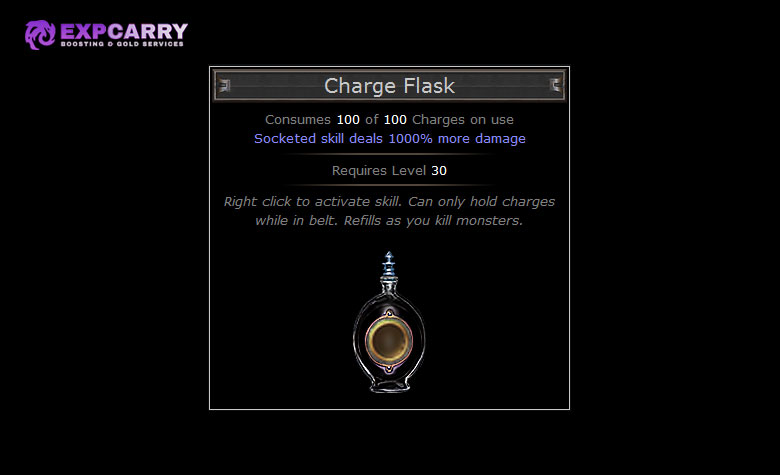
Utility Flasks should match the defenses and damage model already present on the character. Granite adds Armour, while Basalt grants more Armour and taunts nearby enemies on use. Jade supports evasion, and Quartz provides Phasing plus Spell Suppression. Ruby, Sapphire, and Topaz Flasks currently grant Resistance and maximum Resistance for Fire, Cold, and Lightning respectively. Amethyst helps with Chaos Resistance, while Bismuth helps stabilize elemental resistances. Quicksilver is the universal movement option.
Other bases serve specialized goals. Diamond supports critical strike builds, Silver supplies Onslaught, Sulphur creates Consecrated Ground and supports damage, Stibnite strengthens evasion and creates a Smoke Cloud, Aquamarine reduces the effect of Freeze and creates Chilled Ground, Gold improves item rarity, and Iron restores Ward on use. Corundum is another defensive option for stun-focused setups. The best five-flask setup is therefore an answer to a build sheet, not a universal list.
| Character need | Common base direction | Question to verify |
|---|---|---|
| Faster traversal and safer repositioning | Quicksilver Flask | Does the flask have enough duration and charges for the actual mapping pace? |
| Armour against physical hits | Granite Flask, with Basalt as a possible additional layer | Does the character already scale armour, or would another defense produce more value? |
| Avoiding attacks | Jade Flask | Is evasion already supported by gear, passives, or an aura? |
| Phasing and extra spell defense | Quartz Flask | Does its Spell Suppression help reach the intended cap without wasting excess chance? |
| Specific elemental pressure | Ruby, Sapphire, or Topaz Flask | Is the dangerous content dominated by Fire, Cold, or Lightning Damage? |
| Chaos resistance | Amethyst Flask | Will the build remain safe when the flask is down? |
| Critical strike consistency | Diamond Flask | Does Path of Building show a meaningful gain after all other critical modifiers? |
| Temporary resistance correction | Bismuth Flask | Are resistances still acceptable against bosses or after charges run out? |
Temporary resistance from a flask is useful during progression, but it should not hide a fragile endgame character. Mapping can create near-continuous uptime through kills; a boss phase may not. If a resistance is required to survive every hit, solve it permanently on gear, passives, jewels, or another dependable layer.
Flask Quality and Glassblower's Baubles
Quality improves the core function of a flask. On Life, Mana, and Hybrid Flasks it increases the amount recovered. On Utility Flasks it increases effect duration. More duration usually improves effective uptime because the buff lasts longer without increasing the charge cost of each use.
Since version 3.25, a Glassblower's Bauble improves a non-unique flask according to item level rather than rarity. It can apply 20 quality to a very low-level flask in one use, while higher item-level flasks gain less quality per Bauble. The old advice to scour a flask and apply quality while it is normal is obsolete: normal and magic non-unique flasks of the same item level receive the same amount. Ordinary Bauble use stops at 20 quality. Flasks from certain reward modifiers can drop with up to 30 quality, and since version 3.24 a Vaal Orb can corrupt a flask and change its quality by up to 10 points, allowing a maximum of 40 quality in the relevant cases. Corruption also prevents later modification with ordinary currency, so finish normal crafting and enchantment decisions first. The item-level quality rules are documented in the official Path of Exile 1 version 3.25 item changes.
- Choose the correct base type and check its item level.
- Apply enough Glassblower's Baubles to reach 20 quality. The amount required depends on item level, not normal or magic rarity.
- If the existing magic affixes are unwanted, use an Orb of Scouring to return the flask to normal rarity.
- Use an Orb of Transmutation if the flask is normal and needs to become magic.
- Roll the required prefix and suffix with Orbs of Alteration and an Orb of Augmentation when one affix is missing.
- Add the Instilling or Enkindling enchantment only after the functional flask is ready.
Quality does not fix a wrong base, a low modifier tier, or poor charge economy. It is a cheap multiplier on a correct flask, not a substitute for choosing the correct effect.
Prefixes, Suffixes, Item Level, and Enchantments
A normal flask has its base properties but no explicit affixes. A magic flask can have one prefix and one suffix. Flasks do not become rare items through normal rarity crafting, so there is no four- or six-affix flask target. A Utility Flask can also carry one enchantment from Instilling or Enkindling currency. This enchantment is separate from its prefix and suffix, but the two orb families compete for the same enchantment slot.
Item level determines which modifier tiers can roll. A correct base found too early may be suitable for the campaign but unable to roll the strongest endgame tier. Hold Alt while inspecting the item to check item level and advanced modifier details. The visible name of a modifier is less important than its actual values and tradeoffs.
| Modifier layer | What it usually controls | Common examples |
|---|---|---|
| Base type | The default recovery or Utility Flask buff | Life recovery, movement speed, armour, evasion, elemental protection, or critical support |
| Prefix | Recovery behavior or charge, duration, and effect economy | Instant Life recovery, increased duration, reduced charges used, charges gained when hit, or increased effect with a drawback |
| Suffix | Ailment defense or an additional global buff during flask effect | Bleeding protection, reduced curse effect, movement speed, armour, evasion, critical support, or resistances |
| Quality | Base recovery amount or Utility Flask duration | More Life or Mana recovered, or a longer utility effect |
| Enchantment | Automatic use or a stronger manually timed effect | Instilling trigger or Enkindling improvement |
Duplicate suffixes are a common waste. If two active flasks grant the same increased Armour suffix buff, only one instance of that buff applies. Spread useful suffixes across the belt and combine them with different base effects.
Best Prefix Priorities for Recovery and Uptime
Prefixes should be selected by the failure the flask needs to prevent. Life Flasks prioritize recovery timing. Utility Flasks prioritize uptime, effect, or charge behavior. A prefix with the largest tooltip number is not automatically the best because increased effect can shorten duration, increased recovery can slow the recovery rate, and extra maximum charges may provide fewer uses than reduced charges spent.
| Goal | Prefix direction | Best environment | Tradeoff to check |
|---|---|---|---|
| Emergency Life recovery | Instant or partially instant recovery | General mapping and reaction to large hits | Lower total recovery |
| Recovery at dangerous Life levels | Increased recovery while on Low Life | Characters that can react before the next hit | Weaker value when used too early |
| Long utility duration | Increased duration | Mapping and stable automation loops | May be weaker than charge efficiency in boss encounters |
| More uses from the same pool | Reduced charges used | Bossing and low-density encounters | Must cross an integer breakpoint to create an extra use |
| Refill under repeated hits | Gain charges when hit | Characters that are hit often and can survive those hits | Unreliable for evasion builds or avoidable one-shot mechanics |
| Maximum temporary power | Increased effect with reduced duration | Short burst windows or permanent-flask mechanics | Shorter uptime and faster charge pressure |
For reduced charges used, calculate uses rather than comparing percentages. Divide maximum charges by the final charge cost and round down. A small numerical improvement is valuable only when it creates another full activation or helps the flask refill before the next trigger.
Suffix Priorities and Ailment Coverage
Ailment suffixes work differently by flask class. On Utility Flasks, the dedicated Poison, Freeze and Chill, Shock, Bleeding and Corrupted Blood, and Ignite suffixes can grant immunity for the flask effect, with a flask-duration penalty on those immunity variants. Recovery flasks instead have reactive suffixes that grant timed protection when the flask is used while the matching ailment is already affecting you; Warding on a recovery flask removes Curses on use. Utility Flask curse protection is normally reduced effect of Curses rather than blanket curse immunity. These distinctions matter when automation activates a flask too early or charge generation stops during a boss phase.
| Threat | What a flask can provide | Important limit |
|---|---|---|
| Freeze and Chill | Utility Flask immunity during effect, or reactive timed protection from a recovery flask when used while Chilled or Frozen | Protection ends with the flask; permanent freeze protection may come from the Pantheon or the build |
| Shock | Utility Flask immunity or reduced Shock effect during effect, or reactive timed protection from a recovery flask when used while Shocked | A flask that is empty cannot protect against the next hit that shocks |
| Ignite | Utility Flask Ignite immunity during effect with removal of Burning on use, or reactive timed protection from a recovery flask when used while Ignited | Ignite protection does not automatically make every form of burning ground harmless |
| Bleeding and Corrupted Blood | Utility Flask immunity to both during effect, or reactive timed protection from a recovery flask when used while Bleeding or affected by Corrupted Blood | Corrupted Blood is a separate debuff even though the flask suffix covers both; permanent immunity can be safer for specific bosses |
| Poison | Utility Flask Poison immunity during effect, or reactive timed protection from a recovery flask when used while Poisoned | Chaos Resistance and recovery are still needed for other Chaos Damage over Time |
| Curses | Reduced effect of Curses during a Utility Flask effect; Warding on a recovery flask removes Curses on use | One roll is not automatically complete curse immunity, and flask downtime restores the full curse effect |
Start with the threats that disable movement or kill the character before recovery can react. Freeze is often an early priority, followed by Bleeding and Corrupted Blood, Shock, Ignite, Poison, or curse mitigation according to the content and permanent defenses already present. Scorch, Brittle, and Sap are also elemental ailments, but the standard Utility Flask immunity suffixes above do not provide dedicated coverage for them; broader elemental-ailment avoidance or immunity may be required. Do not use temporary flask protection to solve every problem. Cover some threats permanently, then use flask suffixes for the remaining gaps.
When a build's ailment plan is unclear, compare the flask belt with the character's Pantheon, jewels, boots, shield, passives, and Ascendancy. A build-specific PoE 1 setup is more useful than copying a generic list because two characters using the same skill can have completely different immunity and charge needs.
Instilling Orb Automation
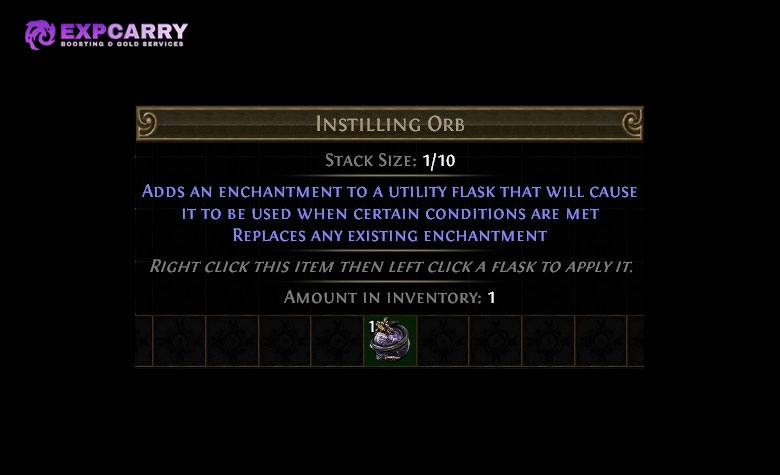
An Instilling Orb adds an enchantment to an eligible Utility Flask that automatically uses it when a stated condition is met. It cannot be applied to Life, Mana, or Hybrid Flasks, and it cannot modify a corrupted flask. Instilling provides conditional automatic use, while Enkindling improves a Utility Flask but prevents it from gaining charges during its effect.
Directly using an Instilling Orb rolls a random trigger. The Crafting Bench can apply a selected Instilling trigger for a listed currency cost, which is preferable when the exact behavior matters. The bench option uses ordinary Instilling currency; it is not a Harvest enchant.
| Trigger style | Best use | Risk |
|---|---|---|
| Used when charges reach full | Fast mapping with steady kill-based charge generation | May spend charges before a rare monster, boss, or dangerous pack |
| Reused at the end of flask effect | Builds with enough charge generation to sustain a continuous loop | The loop fails as soon as the flask lacks enough charges at the end |
| Used when an adjacent flask is used | Linking several Utility Flasks to one deliberate manual activation | Belt order matters, and one button can consume several charge pools at once |
| Reaction to a listed condition | Triggering protection when a supported ailment or combat event occurs | The flask still needs enough charges at the moment the condition occurs |
Automation does not create charges, reduce the charge cost, or guarantee uptime. It simply sends the use command when the condition occurs. Test the enchant in three places: an ordinary map, a boss without adds, and a long phase with no targets. If it works only in dense packs, it is mapping automation rather than universal sustain.
Enkindling Orb Upgrades and Their Cost
An Enkindling Orb adds a Utility Flask enchantment that improves one aspect of the flask while preventing it from gaining charges during its effect. Current enchantment directions are increased effect, increased duration, increased Charge Recovery, reduced charges used, or increased maximum charges. The exact roll should be judged against the base flask, prefix, passive tree, belt modifiers, and encounter length.
Instilling and Enkindling enchantments are mutually exclusive because a flask has one enchantment slot. Applying one replaces the other. Enkindling is therefore not automatic flask use. It is a trade between more power per activation and less natural charge recovery while the buff is active.
- Increased effect: Strong for a carefully timed defensive or offensive window, but it does not improve every binary modifier in the same way.
- Increased duration: Extends the window and may improve effective uptime, but charges still cannot be gained during the active effect.
- Increased Charge Recovery: Improves valid charge-recovery sources while the flask is not active, but the Enkindling restriction still prevents charge gain during its effect.
- Reduced charges used or increased maximum charges: Either can create additional stored activations; calculate the final whole-number use count instead of comparing percentages alone.
Enkindling is attractive for manually timed boss flasks and for mechanics that apply eligible magic Utility Flasks without ordinary charge use. It is less suitable when the build depends on automated use and has barely enough charges to maintain the effect. Do the arithmetic before replacing a working Instilling enchant.
Charge Sustain: Mapping Uptime Is Not Boss Uptime
Flask uptime can be modeled with four values: charge cost, maximum charges, effect duration, and charge gain over time. Mapping adds frequent kill-based charge income. Bossing often removes that income. Increased duration reduces how often a flask must be used, while reduced charges used lowers the cost of each activation. Increased maximum charges may store another use, and charge recovery modifiers improve valid sources of charge gain.
Do not describe a flask as permanent after testing it only in a dense map. A true sustain test includes time spent moving between packs, invulnerable boss phases, failed attacks, and mechanics that stop the character from hitting. Instilling automation can make an unsustainable flask appear reliable until it empties at the worst time.
- Record the final charge cost shown on the flask.
- Divide maximum charges by that cost to find stored uses.
- Compare effect duration with the time needed to regain one activation.
- Repeat the calculation with no charges from kills.
- Check whether an Enkindling enchant blocks charge gain during the exact window being measured.
Some skills consume charges from specific flasks as part of their own mechanics. In those builds, the flask is both equipment and a resource pool. Reserve enough charges for the skill and do not automate that flask without verifying the interaction.
Campaign, Early Maps, and Endgame Upgrade Order
During the campaign, replace weak recovery bases, keep a Quicksilver Flask, and solve immediate ailments. Do not spend a large currency budget perfecting a low item-level flask that will be replaced two acts later. Quality is still efficient on a base that will remain useful for a meaningful part of progression.
| Stage | Recommended priorities | What can wait |
|---|---|---|
| Acts 1 to 4 | Current Life Flask base, Mana sustain if needed, Quicksilver, and basic freeze or bleed response | Perfect modifier tiers and expensive enchant rolling |
| Acts 5 to 10 | Fast Life recovery, updated utility bases, corrected resistances, and coverage for dangerous ailments | Unique flasks that do not enable the build |
| White and Yellow Maps | 20 quality, correct magic prefix and suffix pairs, non-duplicated buffs, and initial Instilling automation | Maximum item-level perfection when a functional cheaper tier is available |
| Red Maps | High item-level bases, tested boss sustain, complete ailment plan, and optimized automation triggers | Luxury unique flasks that weaken defensive uptime |
| Pinnacle and specialized content | Encounter-specific elemental flasks, manual Enkindling windows, and permanent coverage for threats that cannot depend on charges | One universal belt for every encounter |
The endgame order should be function first, quality second, affix tiers third, automation fourth, and luxury optimization last. Buying a high-value unique before fixing a missing anti-freeze or emergency Life Flask often makes the character weaker. If a specific rare or unique flask is part of a larger gear transition, compare the complete PoE 1 item progression rather than evaluating the flask in isolation.
Unique Flasks and When They Are Worth a Slot
A unique flask should either enable a mechanic, solve several constraints at once, or provide more value than a well-rolled magic Utility Flask. Its orange name does not guarantee that it is stronger. Magic flasks offer a base effect, a tailored prefix, a tailored suffix, quality, and a chosen enchantment. Replacing that package can remove movement speed, ailment coverage, armour, evasion, or charge efficiency.
Check the unique flask's required level, charge cost, maximum charges, duration, roll ranges, and conditional wording. Some unique effects apply only during the flask effect, only after a particular event, or only while another condition remains true. A short burst flask can be excellent for a boss damage window and poor for a long mapping session.
Eligible uncorrupted unique Utility Flasks can receive Instilling or Enkindling enchantments, but their charge economy may differ sharply from a magic flask. Corrupted flasks cannot be modified by ordinary currency. If you plan to corrupt a flask for a possible quality change, complete its ordinary crafting and enchantment decisions before using the Vaal Orb.
Removed Harvest Flask Enchants and Legacy Items
Old guides may recommend Horticrafting Bench options that added temporary or specialized flask enchantments. Those recipes are outdated. In the official Path of Exile 1 version 3.28 patch notes, GGG removed all crafts that enchant flasks from the Horticrafting Bench. Existing flasks with those enchantments were left unchanged.
This creates a clear distinction:
- In a current challenge league, do not plan around a Harvest flask enchant craft.
- In Standard, an older flask may retain a legacy Harvest enchantment, but that does not make the craft obtainable.
- Instilling Orb triggers and Enkindling Orb improvements remain the current, repeatable enchantment systems for eligible Utility Flasks.
- The Crafting Bench options for selected Instilling triggers are separate from the removed Horticrafting recipes.
An evergreen build guide should describe the flask that a player can actually reproduce. Legacy Standard items can be acknowledged, but they should never be presented as the baseline for a league build or a new character.
Common Flask Mistakes and How to Fix Them
| Mistake | Why it fails | Correction |
|---|---|---|
| Automating Life or Mana Flasks with Instilling | Instilling and Enkindling Orbs apply only to Utility Flasks | Use Life and Mana recovery manually and automate eligible utility slots |
| Using duplicate base flasks or suffix buffs | The repeated effect may not stack, while both flasks still consume charges | Spread different base effects and suffixes across the belt |
| Treating reduced curse effect as curse immunity | Partial reduction still allows the remaining curse effect to apply | Combine several valid sources only when the build needs full mitigation |
| Assuming automation guarantees uptime | A trigger cannot use an empty flask | Calculate charges and test without kill-based refills |
| Using Enkindling on every Utility Flask | The flask cannot gain charges during its effect and loses Instilling automation | Reserve Enkindling for a tested burst or special continuous-flask setup |
| Rolling a low item-level base indefinitely | The strongest modifier tiers may be unavailable | Acquire the correct endgame item level before expensive crafting |
| Relying on flask resistances to remain capped | Boss downtime can expose an uncapped character | Cap essential resistances permanently and use flasks as additional protection |
| Following an old Harvest enchant guide | The Horticrafting Bench recipes were removed | Use current Instilling or Enkindling systems instead |
Final Flask Checklist
- Every flask has a defined job that is not already covered more reliably elsewhere.
- The Life Flask recovers quickly enough to survive the next hit.
- The Mana Flask remains only if continuous skill use proves that it is needed.
- Utility bases support the character's real armour, evasion, suppression, resistance, movement, or damage plan.
- Non-unique flasks are normally raised to 20 quality with the required number of Baubles for their item level; rarity does not change the amount gained. Higher quality requires special drop or corruption outcomes rather than ordinary Bauble use.
- The item level allows the required prefix and suffix tiers.
- No base effect or suffix buff is duplicated without a tested reason.
- Ailment protection covers Freeze, Shock, Ignite, Bleeding, Corrupted Blood, and Poison through a deliberate mix of permanent and flask-based defenses.
- Instilling triggers have enough charges to fire when required.
- Enkindling is used only when its power is worth losing charge gain during effect and automatic use.
- Boss sustain has been tested without relying on monster kills.
- No removed Harvest flask enchant is required by the build.
Conclusion
A strong Path of Exile 1 flask belt begins with roles, not item names. Life and Mana Flasks manage recovery, Utility Flasks extend the build's defenses and damage, quality improves their base function, and one prefix plus one suffix defines how each magic flask behaves. Instilling Orbs automate eligible Utility Flasks, while Enkindling Orbs provide a stronger activation at the cost of charge gain during the flask effect and the ability to use an Instilling trigger on the same flask.
The reliable upgrade path is to choose the correct base, verify item level, apply quality, roll a purposeful prefix and suffix, remove duplicate effects, and then test the enchantment in both maps and boss fights. Permanent defenses should cover threats that cannot safely depend on charges. With removed Harvest enchants excluded, this approach produces a reproducible, current, and maintainable flask setup for campaign progression and endgame content.