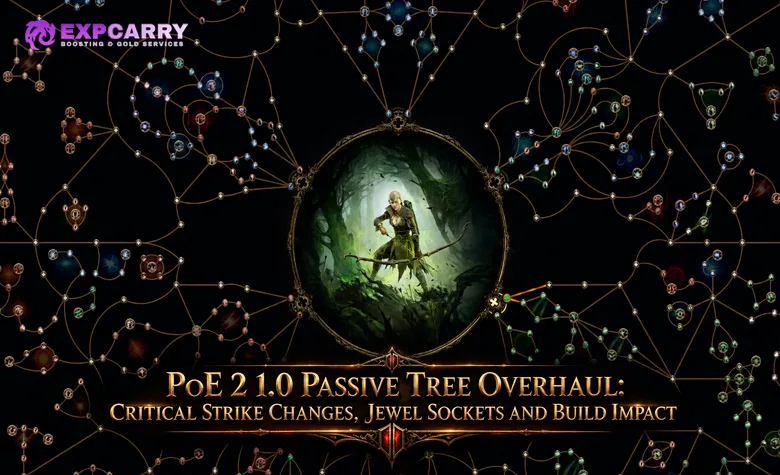
Path of Exile 2 version 1.0 will rebuild the Passive Skill Tree when the full game launches on December 11, 2026 (PST). Grinding Gear Games has announced hundreds of new passive stats, moved Jewel Sockets into clusters, and revealed a sweeping Support Gem rebalance. Developers also described a major change to Critical Strike Chance: instead of stacking it through ordinary passive nodes, critical builds will rely much more heavily on their equipment. These systems affect far more than one class or Ascendancy. A character that looks complete in the current Early Access version may require a different tree, different jewels, and a revised skill setup at launch.
As of November 16, the 1.0 tree is still a preview rather than a fully published set of final nodes and numerical values. The live game remains on the 0.5.5f Early Access branch, and the announced changes should not be treated as active LIVE mechanics. This guide separates GGG's published announcements from developer interview details and explains which existing build decisions are most likely to need another look.
Short answer: PoE 2 1.0 moves Jewel Sockets into meaningful passive clusters, reworks hundreds of passive stats and Support Gems, and shifts Critical Strike Chance away from ordinary passive-tree investment toward gear. Crit-heavy and jewel-stacking builds need the closest review, but final routes, damage rankings, and exact breakpoints cannot be confirmed before the released tree and patch notes.
What Is Changing in the PoE 2 1.0 Passive Skill Tree?
GGG describes the 1.0 tree as a major redesign, not a small group of adjusted Notables. Its official full-release overview confirms hundreds of new stats and the relocation of all Jewel Sockets into clusters. The objective is to make players choose passive areas because those areas help their builds, rather than treating the tree as a route between as many Jewel Sockets as possible.
The critical-strike change comes from a separate post-keynote developer interview, not from the text of that release overview. This distinction matters: the overall direction has been discussed publicly, but the final numerical balance, individual replacement nodes, and complete tree layout remain unpublished.
| System | Early Access approach | Announced 1.0 direction | Build consequence |
|---|---|---|---|
| Passive clusters | Current clusters and paths support existing build routes. | Hundreds of additional stats and substantial layout changes. | Old routes and point costs need recalculation. |
| Jewel Sockets | Many sockets sit along the tree's connecting highways. | All sockets move into passive clusters. | Socket value must be judged alongside cluster value. |
| Critical Strike Chance | Can be increased through passive nodes, jewels, gear, and other mechanics. | Developers describe removing ordinary passive-tree crit chance and emphasizing gear. | Existing crit setups cannot assume the same chance after respec. |
| Critical damage | Often paired with high crit-chance investment. | Discussed as a continuing role for the passive tree. | Damage bonuses become less valuable without enough actual crit chance. |
| Support Gems | Current skills depend on their present support behavior and restrictions. | Broad rebalancing, including more flexible interactions for selected supports. | Old gem packages require individual compatibility checks. |
| Unique Items | Existing item modifiers can define entire builds. | More than 40 new Uniques and over 70 reworked ones. | Build-enabling gear may gain or lose important interactions. |
This concerns the character's Passive Skill Tree, not the separate Atlas Passive Tree used for endgame mapping. They are both changing in 1.0, but they have different point systems and purposes. For the fundamentals of Small Passives, Notables, Keystones, weapon-set points, and current respec rules, the existing PoE 2 Passive Skill Tree guide remains a separate reference for the live version.
PoE 2 1.0 Jewel Sockets: Why Cluster Placement Changes Builds
Jewel Sockets are one of the clearest mechanical changes announced at ExileCon. GGG has shown a move away from sockets on major connecting paths toward sockets embedded in clusters. The keynote preview discussed roughly 60 sockets across the redesigned tree, compared with 18 on the current highway-style layout. These are counts from the presentation, not a promise that every build can or should allocate that many jewels.
The New Cost of Reaching a Jewel Socket
In Early Access, a long route may incidentally collect sockets while moving between useful sections of the tree. In 1.0, reaching a socket will more often mean choosing the cluster around it. A good cluster can make its socket efficient; an otherwise irrelevant cluster may make the same jewel a poor use of passive points.
Compare the entire investment rather than only the final socket point. Count the connecting passives, any required nodes inside the cluster, the socket allocation, and what the character would give up elsewhere. Then compare the jewel's actual modifiers with the damage, defence, or utility available from spending the same points in another cluster.
For example, a projectile build may benefit from a nearby projectile cluster and its socket together. Detouring into unrelated minion passives solely to fit another rare jewel is a different decision. The exact paths in this example are illustrative, not confirmed 1.0 node locations.
What Happens to Radius and Unique Jewels?
Radius-dependent jewels deserve special attention because their value depends on the passives surrounding the socket, not just on how many sockets a tree contains. Moving a socket can change which nodes fall inside its radius and whether the intended interaction is accessible at all. Unique jewels with location-sensitive effects therefore need to be checked against the released tree rather than placed by following an old screenshot.
The same caution applies to jewels that support a particular attribute, ailment, weapon, or critical-damage package. A jewel may retain its general purpose while becoming less attractive if the cluster around its new socket contributes little to the rest of the build. GGG has not provided a complete final list of socket positions, radius interactions, or modified jewel affixes.
Are Critical Strike Jewels Being Nerfed?
Developers discussed reducing the excessive critical power available from jewels during the post-keynote interview. That is a distinct change from relocating sockets: more sockets shown in the tree does not necessarily mean a higher total critical chance or a stronger jewel-stacking build. The final affix ranges, affected modifiers, and relationship to Unique Jewels still require confirmation.
The interview also described a five-modifier jewel interaction as a bug already corrected in GGG's internal build. This should not be confused with a confirmed removal of all valuable rare jewels. Players should not plan a 1.0 setup around reproducing that particular unintended crafting result, but they also should not assume every existing multi-modifier jewel becomes unusable.
PoE 2 1.0 Critical Strike Changes: Chance from Gear, Damage from Passives
The critical-strike redesign is a major reason older damage trees may stop working as expected. In a post-ExileCon interview with Jonathan Rogers and Mark Roberts, the developers described removing Critical Strike Chance from the ordinary Passive Skill Tree and shifting that investment toward equipment. Their goal is to make a critical hit a meaningful event rather than allowing too many builds to approach guaranteed critical strikes through similar passive choices.
This information comes from spoken developer discussion, not final 1.0 patch notes. The precise wording of new passive nodes, the gear modifiers available at launch, and any exceptions for special class or skill systems must still be checked. Removing passive-tree crit chance also does not mean removing critical hits from the game.
Critical Strike Chance and Critical Damage Are Different Investments
Critical Strike Chance determines how often a hit can be critical; critical damage determines how rewarding those hits are when they happen. The developers' stated direction separates the two more sharply: gear helps establish how reliably the character crits, while passive investment can continue to improve the result of a crit.
That makes buying critical damage before securing adequate chance a more obvious mistake. A character might have excellent critical damage modifiers but still feel inconsistent if the attack or spell only crits occasionally. Conversely, chasing chance through an expensive weapon may not be worthwhile if the rest of the build has weak damage, poor recovery, or too little defence to survive.
When comparing two weapons, do not look only at their displayed critical chance. Compare the complete skill setup, weapon damage or spell-relevant properties, attack or cast speed, and how much other gear is needed to make the crit package function. Final rankings cannot be established using pre-release dagger examples alone.
Will Daggers and Traps Have Better Critical Strike Chance?
The interview highlighted daggers and traps as more crit-oriented gameplay options. Developers discussed dagger examples reaching roughly 25% base critical chance in some configurations. That figure is an illustrative preview, not a verified base value for every dagger and not a guarantee about a completed character's final chance.
This is especially relevant to the new Shadow, which arrives with dagger and trap gameplay. However, players using spells, crossbows, Quarterstaves, or other weapons should not conclude that their builds are automatically excluded from critical scaling. Their access to critical chance will depend on the released equipment, skills, and applicable class interactions.
Is 60% the New Critical Strike Chance Cap?
No hard universal cap has been confirmed in the published release materials. The developers discussed characters being able to reach around 60% critical chance rather than the near-100% results familiar from some Early Access setups. That is a design target or illustrative expectation from an interview, not a final rule establishing that all builds are mechanically capped at exactly 60%.
The distinction is important for build guides. Do not publish a 60% cap as an itemized game rule, promise that every class can reach it, or calculate a final best-in-slot setup from that number. Only the final character calculations and patch notes can settle those questions.
What Happens to Cast on Critical and Other Crit-Triggered Builds?
Builds that depend on landing critical strikes to trigger another effect deserve more scrutiny than builds that simply gain extra damage from occasional crits. If a trigger setup fires less consistently, it may lose both damage and the smooth combat rhythm the old build relied on. Changes to Support Gems, Spirit requirements, and trigger behavior can compound that problem.
However, a lower theoretical chance does not prove that Cast on Critical or another trigger mechanic will be unplayable. The released gem values, trigger conditions, gear options, and encounter pace still matter. A practical 1.0 test should measure reliable activations during ordinary clearing and single-target fights, not merely highlight one strong critical hit.
Explore services related to this guide, selected from our Path of Exile 2 catalog.
View All Path of Exile 2 Services


Which Existing PoE 2 Builds Are Most Affected by the 1.0 Overhaul?
The severity of the impact depends on what made the old character strong. Some builds concentrate their power in a narrow chain of critical chance, jewels, and triggers; others get most of their damage from skills, ailments, minions, or equipment and may need a simpler pathing revision. None can be accurately classified as dead or best-in-slot before the full 1.0 data is available.
| Existing approach | Main risk | First compatibility check |
|---|---|---|
| Near-guaranteed critical-hit setups | Loss of passive-tree critical chance. | How much chance remains from final gear and other applicable systems. |
| Cast on Critical or similar triggers | Less frequent activations and changed support behavior. | Trigger reliability against bosses and ordinary packs. |
| Rare jewel stacking | Different socket routes and reduced value of selected crit modifiers. | Total point cost per useful jewel and each revised affix. |
| Radius-dependent Unique Jewels | Changed nearby passives and socket positions. | Whether the jewel reaches the intended nodes. |
| Hybrid Attack and Spell setups | Support scaling or compatibility changes. | Which support effects apply to each damage source. |
| Minion, ailment, and non-crit builds | Changed clusters, support interactions, and reworked gear. | Damage tags, defensive nodes, and core support package. |
| New Shadow or Duelist launch builds | Unfinished starter trees and untested endgame combinations. | Final class start, skill unlocks, and complete passive connections. |
Jewel-Stacking Characters Lose Their Old Routes
A build that travels across the tree collecting jewels must now justify each cluster it enters. This can reduce the appeal of paths where almost every intermediate node existed only to reach another socket. The strongest response is not necessarily to abandon jewels; it is to select the jewel-and-cluster packages that provide useful combined value.
Existing collections should be sorted by role: damage, defence, attributes, specific mechanic, and radius interaction. Do not sell or replace them merely because their old socket location disappears. The final layout may provide a good new home for a jewel even when its original position is gone.
Crit Damage Builds Need a Reliable Chance Source
A spellcaster or attack build that previously combined passive crit chance with substantial critical damage may have to rebuild its equipment priorities. In particular, a crit multiplier is not a substitute for the chance to land the critical hit. Evaluate sustained damage and trigger consistency before assuming the same passive damage route remains optimal.
The exact outcome is build-specific. A well-geared character may retain a practical critical playstyle, while another setup may gain more from strengthening non-critical damage or its primary ailment. Those are choices to test, not confirmed winners of the 1.0 balance pass.
Non-Critical Builds Are Not Automatically Unchanged
Even characters that ignore Critical Strike Chance can be affected by new passive connections, different Keystone availability, altered Support Gems, and reworked Unique Items. A minion build may gain useful cluster options but lose efficiency on its old route. An ailment build may need to re-evaluate how a support now scales its damage. Defensive characters still need to inspect changed Life, Energy Shield, Armour, Evasion, or recovery investment when those nodes are updated.
Players following a particular Infernalist, Blood Mage, or Acolyte setup can also review the PoE 2 1.0 Ascendancy reworks separately. Those class-specific changes add another layer to the general tree overhaul and should not be mistaken for a finished cross-class ranking.
PoE 2 1.0 Support Gem Rework: Which Old Combinations May Change?
GGG has announced a broad Support Gem rebalance alongside the Passive Skill Tree overhaul. The official ExileCon keynote demonstrated a number of design changes intended to improve underused supports and give more combinations a practical purpose. This is not simply a global damage buff: different supports may change function, deal a different kind of damage, or become more appropriate for particular skills.
Supports That Adapt to Attacks and Spells
The showcase presented selected supports whose secondary effects can use Attack or Spell damage according to the supported main skill. Living Lightning was discussed as an example of an effect moving away from fixed minion-damage behavior toward a damage type matching the supported skill. That can make the support relevant to a broader range of scaling packages.
The important word is selected. It would be incorrect to claim that all Support Gems automatically become interchangeable between every Attack, Spell, and Minion build. Read the actual support tags, supported skill restrictions, damage source, and final gem wording before choosing a passive cluster to scale the effect.
Chain, Elemental Penetration, and Brutality Changes
Other showcased changes include removing Chain's first-hit damage penalty, combining the separate elemental Penetration supports into an Elemental Penetration option, and redesigning Brutality to add extra Physical damage. These previews suggest that old support choices may become less restrictive, but they do not establish final gem levels, values, or every compatibility exception.
A projectile skill that previously avoided Chain because of its single-target trade-off is worth retesting. A multi-element setup may benefit from consolidated Penetration, while a Physical build needs to examine what the new Brutality actually adds after other damage conversions and modifiers are applied. None of those examples proves that the previewed support will be best for every corresponding build.
Why Passive Tree Planning Must Follow the Final Gem Setup
The effective damage source of a supported skill matters when choosing passives. If a support-generated effect now scales as Attack damage, investing in Spell-only bonuses for that effect may be wasted. Conversely, a spell setup should not assume that an older Minion-focused support route still applies.
Identify the main damage skill first, then the actual tags and damage sources of its support effects, and only then select clusters. A clean passive tree cannot repair a support package that has stopped scaling with the chosen damage method.
New Passive Stats, Keystones, and 1.0 Class Starting Areas
The rework goes beyond moving existing circles on the tree. The presentation showed new stats and specialist effects built around previously underserved mechanics. For example, the showcased Cataclysm notable interacts with Molten Fissures and Aftershocks, while Tawhoa's Overgrowth supports a more specialized totem interaction. These examples illustrate the direction of the redesign, not a complete map of where the nodes sit or which builds can reach them efficiently.
That matters because a new cluster can be more valuable than a familiar damage multiplier if it makes an otherwise awkward mechanic practical. It also creates opportunities for players who previously had no good passive route for their chosen skill. However, attractive showcase effects can change during balance testing, and their final positions, prerequisites, and numerical strengths remain subject to release data.
How Shadow and Duelist Affect Tree Planning
Version 1.0 introduces the Shadow and Duelist alongside major changes to existing classes. Their weapon and skill identities create additional demand for relevant clusters, particularly daggers, traps, and swords. But players should not paste an older Monk or Mercenary tree into a new class solely because the attributes or starting region appear similar.
The GGG ExileCon 2026 announcement confirms the December 11 (PST) full release and the two new classes. The final passive connections, early skill availability, Ascendancy options, and leveling breakpoints should be taken from the release client rather than from isolated presentation screenshots.
How Unique Item Reworks Change Passive Priorities
GGG is adding more than 40 Unique Items and reworking over 70 existing ones. Some can introduce new skill interactions or change the scaling provided by equipment. A passive route that was efficient with an old Unique may become weaker if its build-defining property changes, while a new item may justify investing in a previously unattractive cluster.
Check the new item version before changing the entire tree. The relevant comparison is not whether a Unique has more lines of text, but whether the combined skill, supports, passives, and equipment produce a usable build with enough defence and recovery.
How to Rebuild a PoE 2 Character for 1.0 Without Wasting Points
Preparation is useful now, but a finished 1.0 passive tree is not. The sensible approach is to record the build's dependencies in the current version, then replace obsolete assumptions once the new tree is available. GGG's November 11 0.5.5f restart fixes concern issues in the current Early Access game, not deployment of the announced 1.0 passive changes.
- Save the existing setup: record the main skill, Support Gems, passive allocation, current critical chance, important jewels, weapon, and defensive values.
- Separate required mechanics from optional damage: identify what enables the build and what merely increases its numbers.
- Audit critical dependence: count how much of the build's chance currently comes from passive nodes and which triggers require frequent critical hits.
- Rank jewels by function: keep track of radius effects, irreplaceable attributes, defences, and critical modifiers instead of assuming each old socket survives.
- Choose the revised main skill and supports first: confirm their tags and damage type before committing to a new cluster route.
- Calculate complete cluster costs: include travel nodes, any required internal passives, the socket, and the value of the jewel placed there.
- Restore defences and sustain: reserve points for survival, attributes, Spirit and resource costs before optimizing peak damage.
- Test in real content: compare clearing, single-target damage, trigger frequency, and survivability after the actual 1.0 patch is live.
For an extensive change involving weapons, gems, and equipment together, a PoE 2 starter build configuration is relevant to the character setup itself; it does not supply unreleased 1.0 node values or guarantee a pre-launch build's performance.
Recommended Rebuild Order for a Crit-and-Jewel Character
Begin with a main skill that works without perfect critical uptime. Establish the necessary equipment and resource budget, then determine how much Critical Strike Chance the released items actually provide. Only after that should you allocate critical-damage passives or select jewels for additional scaling.
Next, compare each candidate socket cluster against the same point investment in damage, defence, or utility. Keep clusters whose passives help even before the jewel is installed; treat a socket hidden behind unrelated nodes as a luxury until its payoff has been demonstrated.
| When | Useful action | Decision to avoid |
|---|---|---|
| Before final patch notes | Document current dependencies and keep flexible equipment options. | Publishing a finished 1.0 tree or buying gear for unconfirmed breakpoints. |
| After the complete tree is published | Recalculate routes, socket positions, Keystone effects, and attribute needs. | Reusing old passive links without checking connections. |
| After gem and item notes | Confirm support tags, jewel modifiers, and critical sources. | Assuming preview values are final. |
| At launch on December 11 (PST) | Verify the live client and test a functional starter setup. | Committing all currency to an untested meta prediction. |
| During early endgame | Measure actual bossing, clear speed, sustain, and socket efficiency. | Ranking builds solely from a high-damage showcase. |
Should You Level a New Character or Rebuild an Existing One?
Those are different objectives. A returning Early Access character may be useful for examining changed mechanics in its existing environment, while entering the new Conquerors of Wraeclast Challenge League requires a fresh league character. Do not assume that owning high-level Early Access gear allows it to enter the new league economy.
Fresh characters should prioritize a reliable leveling skill, attributes, recovery, and nearby useful clusters before attempting a jewel-heavy endgame route. The available PoE 2 leveling progression service addresses character levels, but it cannot replace selecting a legal 1.0 tree or validating the new support interactions.
Ascendancy Points are a separate layer of progression from ordinary passive points. Under the current Early Access system, the Trial of Chaos is one route toward them; Trial of Chaos completion assistance concerns that existing objective rather than access to unreleased 1.0 nodes. Check final trial and respec rules before using an old Ascendancy progression plan.
Will Existing PoE 2 Characters Receive a Free Passive Respec?
Past major changes provide precedent but not a confirmed 1.0 promise. For example, GGG granted existing Early Access characters a free passive-tree refund when the 0.5.0 content update substantially changed the tree. The specific 1.0 refund policy, which points might be automatically returned, and the final cost of additional changes have not been established in the reviewed full-release announcement.
Before spending Gold on extensive refunds, load the character after the update and inspect its available points and the active respec interface. Avoid following a pre-release guide that claims a guaranteed complete reset without an official 1.0 statement.
Common Mistakes When Preparing for the PoE 2 1.0 Passive Tree Overhaul
The biggest preparation mistake is treating all pre-release information as if it already applies to LIVE characters. The 1.0 reveal gives strong design direction, but complete individual-node values and reliable build comparisons still depend on the released patch.
Treating 60% Crit Chance as a Confirmed Hard Cap
The interview's approximate target is not an official universal maximum. Do not build a damage calculator or publish class-specific gear requirements around that exact figure until the released mechanics confirm what is achievable.
Assuming More Sockets Means More Free Jewel Power
A tree showing many socket locations does not give one character all of them. Clusters cost points, and some jewel modifiers are also being revised. The useful metric is the value of reachable sockets in an actual completed route.
Keeping an Old Support Setup Without Checking Damage Types
Selected supports may behave differently in 1.0, including the damage categories of their secondary effects. Old passive investments can lose value if they no longer scale the supported skill as expected.
Declaring Every Critical Build Dead Before Launch
Critical strikes remain part of the announced combat design. Their itemization and consistency are changing, but the final results will depend on individual weapons, skills, jewels, and encounter testing, not on one removed group of passive modifiers.
Copying ExileCon Tree Screenshots as Final Builds
Presentation screenshots reveal examples, not a complete verified endgame route. The launch client may have different passive connections, costs, or balance. Build planners and guides must be checked against final data.
PoE 2 1.0 Passive Tree Overhaul FAQ
These questions cover the practical uncertainties around critical scaling, jewels, and the December full release.
Is Critical Strike Chance being removed from PoE 2 entirely? No. Developers discussed removing ordinary passive-tree sources and placing more emphasis on equipment. Critical hits remain part of the game, while the final item and skill values need confirmation.
Will every Jewel Socket be inside a cluster in PoE 2 1.0? That is GGG's announced redesign. The precise final positions, total socket availability for any one build, and radius interactions need to be checked in the published 1.0 tree.
Are all Support Gems being reworked in the same way? No. GGG announced a broad rebalance and showed specific examples of new behavior. It has not said that every Support Gem becomes universally compatible with all skills or shares the same damage rules.
Can existing Early Access build guides be used at the 1.0 launch? They can explain the underlying playstyle, but old passive routes, critical requirements, jewels, supports, and equipment interactions must be rechecked before they can count as validated 1.0 builds.
Conclusion
PoE 2 1.0 changes the logic behind passive allocation: choose useful clusters rather than chasing sockets, establish critical chance through the released equipment system before stacking critical damage, and rebuild support combinations around their final behavior. Keep existing build records as references, but treat completed 1.0 trees and damage rankings as provisional until GGG publishes the final notes and the December 11 client is playable.