
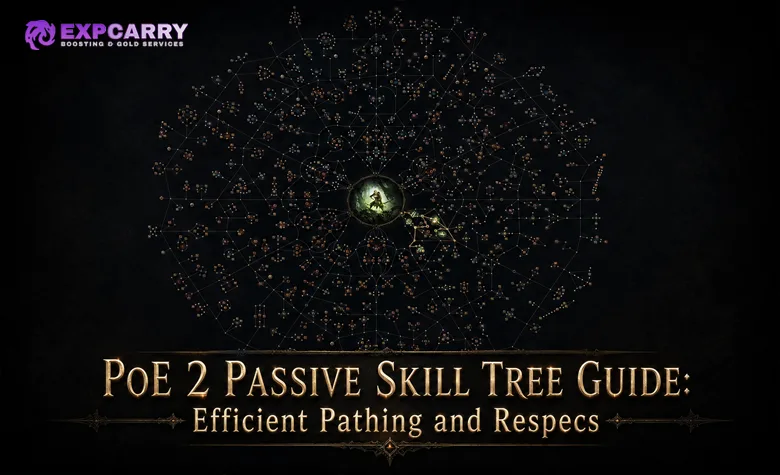
The best Path of Exile 2 passive tree is not the route with the most Notables. It is the shortest connected path that gives your build enough damage, defence, attributes, recovery, and resource stability for the content you are playing. Efficient pathing begins with a destination list: choose the clusters your build actually needs, connect them with useful travel nodes, and ignore distant bonuses that do not solve a current problem.
Before spending points, define the main skill, weapon type, damage mechanic, defensive layer, and resource plan. A Lightning attack build, for example, does not benefit equally from every Lightning cluster: some nodes scale spells, ailments, critical hits, or a weapon type the character does not use. The searchable official PoE 2 Passive Skill Tree is the safest place to inspect current wording and test connections before changing the live character.
How the PoE 2 Passive Skill Tree Works
Every class uses the same large passive tree but enters it from a different starting position. The starting area influences which mechanics are cheap to reach; it does not permanently lock a character into one damage type or defence. A nearby cluster may be efficient for one class and wasteful for another because the second character must spend more points reaching it.
Small Passives provide modest bonuses and often act as the route into a cluster. Notables are larger nodes with stronger or more specialised effects. Keystones change a fundamental rule and usually include a serious restriction or opportunity cost. Jewel Sockets gain value only when the jewel placed inside provides more than the points spent reaching and allocating the socket.
| Node type | Primary purpose | How to evaluate it |
|---|---|---|
| Attribute node | Provides Strength, Dexterity, or Intelligence while connecting sections | Choose attributes that satisfy current gem and equipment requirements |
| Small Passive | Builds a route and supplies incremental stats | Count it as part of the complete cost of the destination |
| Notable | Provides a concentrated offensive, defensive, or utility benefit | Check whether every important line applies to the build |
| Keystone | Changes a core rule of the character | Prove that the build can exploit the benefit and survive the drawback |
| Jewel Socket | Turns an equipped jewel into part of the passive tree | Include the route, socket point, jewel price, and opportunity cost |
Attribute travel nodes in PoE 2 can offer a choice when allocated. Take the attribute needed for current gems and gear rather than automatically matching the colour associated with the class. Changing that selection later requires the node to be refunded and allocated again, so verify every dependent gem and item before removing the old attribute.
The passive tree is changed regularly by balance updates. Clusters can move, connections can disappear, and the effects of Notables or Keystones can be rewritten. Content update 0.5.0 added and reworked multiple defensive clusters and changed major Keystones, so a route copied from an older screenshot may no longer connect or solve the same problem. Check the official Path of Exile 2 patch notes before importing an older build.
Build an Efficient Route Before Spending Points
Plan backward from outcomes, not outward from the class start. Select a small number of priority destinations and then find the route that reaches them with the least dead travel. A practical plan normally needs one reliable damage package, one primary defence package, enough recovery or sustain to keep using skills, and only the attributes required by the intended gems and equipment.
- Write down the main skill and confirm whether it is an Attack, Spell, Minion, Totem, or another supported category.
- Identify the damage method: hits, critical hits, ailments, damage over time, minion damage, or a deliberate combination.
- Choose the main defensive model, such as Armour, Evasion, Energy Shield, Block, Deflection, Life recovery, or a planned hybrid.
- Mark two or three nearby clusters that directly improve those mechanics.
- Connect the marked clusters while minimising nodes that provide no immediate or planned value.
- Reserve several future points for requirements, recovery, resistance pressure, or weaknesses discovered during progression.
A cluster must be judged by its total point cost. If a Notable requires four travel points and one allocation point, compare its effect with every alternative available for those five points. A smaller nearby cluster may produce a better character even when its final Notable looks less impressive in isolation.
Useful travel is not wasted pathing. An attribute node that enables a gem, a defensive node on the route to a damage cluster, or a regeneration node that removes Mana problems contributes to the build. Dead pathing consists of points that neither support the finished setup nor solve a temporary progression requirement.
| Planning question | Efficient answer | Warning sign |
|---|---|---|
| What does the next cluster improve? | A mechanic used by the main skill or primary defence | The bonus only looks generally powerful |
| How many points does it really cost? | Travel nodes plus every required node inside the cluster | Only the final Notable is being compared |
| When will the benefit matter? | Immediately or during the next planned gear transition | The route depends on an uncertain endgame item |
| Can equipment solve the same problem? | Use the cheaper source after comparing both options | Rare passive points fix a stat that one gear modifier could cover |
| Does every modifier apply? | The main skill satisfies the node's weapon, damage, and condition tags | Part of the Notable has no effect on the build |
Do not plan a leveling tree as a reduced copy of the final tree. Campaign characters need immediate damage, affordable attributes, and dependable recovery. An endgame setup may rely on equipment, jewels, or interactions that are unavailable while leveling. Temporary clusters are useful when they make progression stable, but they should remain near the main route so removing them later requires only a small respec.
If a build needs a distant Keystone or cluster, compare complete routes instead of drawing one direct line across the tree. The shortest geometric route is not always the most efficient. A slightly longer path can pass through relevant Life, damage, attribute, or defensive nodes and therefore deliver more total value at the same character level.
How to Choose Keystones Without Breaking the Build
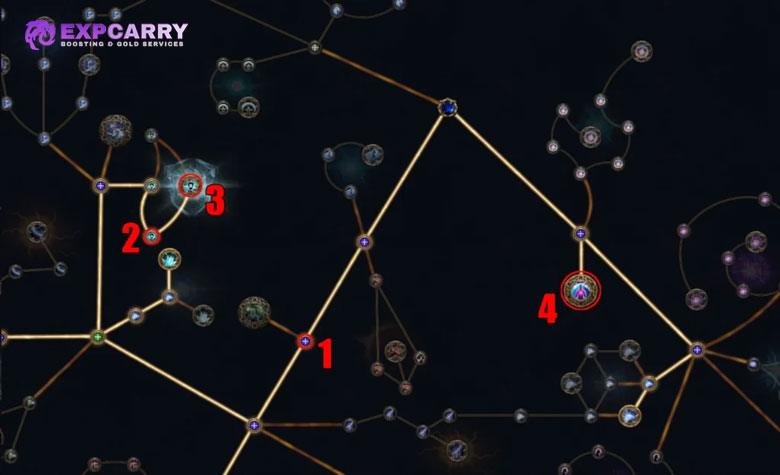
A Keystone is not an automatic upgrade. It changes the rules under which other passives, gear, and skills operate, so its drawback must be included in the plan before allocation. Read every line literally and check its current wording in the tree. A familiar Keystone name does not guarantee that its effect still matches an older guide.
Start by asking what the Keystone enables that the character cannot obtain efficiently elsewhere. Then list the systems it disables or makes more expensive. Vaal Pact must be evaluated as a complete recovery model rather than a standalone leech bonus. Ancestral Bond changes Totem limits, placement, and Spirit reservation, so it belongs in a build prepared to support those costs. Giant's Blood enables a different weapon arrangement but substantially increases the attribute investment required by eligible weapons.
- Allocate a Keystone only when its benefit supports the build's main engine.
- Calculate the entire route cost in addition to the Keystone's own point.
- Check whether the drawback removes a recovery, defence, or damage mechanic already in use.
- Confirm that required attributes, Spirit, equipment, and skill conditions still fit.
- Test the Keystone before purchasing expensive gear built around it.
The correct question is not whether a Keystone is strong, but whether the complete character becomes stronger after paying for its route and restrictions. If the build functions without it, compare the same number of points invested in ordinary clusters. Several efficient Notables can outperform a dramatic Keystone that requires a long detour.
Be particularly careful when a build guide predates a major passive-tree revision. The official 0.4.0 patch notes added more than 250 passive skills, while later updates changed more clusters and Keystone effects. Matching the build name is not enough: the tree version, node wording, and actual connections must also match.
Explore services related to this guide, selected from our Path of Exile 2 catalog.
View All Path of Exile 2 Services


Weapon Set Skill Points and Conditional Pathing
Weapon Set Skill Points allow part of the passive tree to change with the active weapon set. They are not extra passive points and do not create two free trees. The system lets an available regular Passive Skill Point be used as a paired allocation: one version for weapon set one and another for weapon set two. Both versions use the same underlying point budget but can occupy different valid nodes.
The shared tree and each specialised branch must remain connected for the weapon set in which they are active. Allocate a node normally when its effect should apply all the time. Use the weapon-set allocation controls only when the two equipment sets genuinely need different passives, and verify both point counters before confirming the route.
Good candidates include weapon-specific damage, Block nodes for a set carrying a Shield, or utility that supports a dedicated bossing weapon. Maximum Life, general recovery, and attributes required by shared gems normally belong in the permanent tree because losing them during a swap can disable equipment or make the character unexpectedly fragile.
Automatic weapon swapping works only when the skill and weapon configuration are set correctly. If a skill can use both sets, the game may not select the intended specialisation. Assign the required weapon set for each important skill in the Skills Panel, then test the result instead of assuming that the correct passive branch will activate automatically.
| Good weapon-set allocation | Poor weapon-set allocation |
|---|---|
| Weapon-specific damage used by only one set | Maximum Life required in every situation |
| Block nodes for a set that equips a Shield | Attributes needed to keep shared gems active |
| Conditional utility for a dedicated bossing setup | A connecting node that leaves the other set without a valid route |
| Projectile or melee bonuses tied to separate skill packages | Recovery needed regardless of which weapon is active |
Never make a weapon swap remove an attribute required by the skill performing that swap. Check equipment requirements, Spirit sources, persistent skills, and defensive values in both configurations. A second set with higher tooltip damage is not useful if it disables a core buff or leaves the character unable to use its intended skill.
How Respecs Work and When to Use Them
Passive points can be refunded through The Hooded One after his respec service is unlocked during the campaign. Refunds cost Gold, with higher-level characters generally paying more per point than low-level characters. You can remove an endpoint or a connected branch, but the remaining tree must still form a valid route from the character's starting point. Dependent nodes must be removed before the connection supporting them.
Respec in small batches whenever possible. First replace the lost function with gear or a new cluster, then refund the obsolete branch, and finally allocate the saved points. This prevents the character from temporarily losing attributes, damage, or defences needed to equip items and clear content.
- Record the current Strength, Dexterity, Intelligence, resistances, Life, and resource values.
- Preview the destination and verify that enough unspent or refundable points exist.
- Check which gems or items depend on attributes supplied by the old path.
- Allocate the new connecting route before removing the old one when possible.
- Refund the far end of the obsolete branch first and work back toward the shared tree.
- Retest damage, sustain, persistent skills, and both weapon sets before spending more Gold.
A full rebuild is most expensive when performed without a transition plan. If the new setup changes the main weapon, damage type, defence, and attributes simultaneously, prepare the required equipment and gems first. Players who need a complete setup instead of several disconnected corrections can use a PoE 2 Starter Build with compatible skills, equipment, and passive-tree priorities.
Temporary leveling nodes are not mistakes when they save time or prevent deaths. They become wasteful only when they remain allocated after their job has ended. Review the tree after major gear upgrades, the campaign-to-endgame transition, a change of main skill, or an update that modifies cluster locations and effects.
Passive Tree Mistakes That Waste the Most Points
The most common failure is collecting attractive Notables without calculating the path between them. Another is investing only in damage while expecting gear to repair every defensive and resource problem. A functional tree distributes points according to actual bottlenecks, not according to the number of offensive keywords visible on the screen.
- Do not cross a large section of the tree for one ordinary Notable.
- Do not scale multiple damage methods unless the build intentionally uses all of them.
- Do not take critical damage before the build has a reliable critical-hit foundation.
- Do not select ailment bonuses for a hit build that cannot apply the relevant ailment consistently.
- Do not use passive points for surplus attributes that equipment can provide cheaply.
- Do not copy an old tree without checking current node effects and connections.
- Do not place universal defences inside a weapon-set-only branch.
- Do not refund attribute nodes before checking every equipped gem and item.
Evaluate the finished route at several point totals instead of only at maximum level. The early version should reach nearby power quickly, the middle version should establish defence and sustain, and the later version can afford distant clusters, Jewel Sockets, or specialised scaling. If a plan feels weak for many levels while travelling toward one payoff, its order or route is probably wrong.
Every allocated branch must answer a real build requirement. Keep the shortest route that delivers the necessary damage, survival, recovery, attributes, and weapon specialisation. Remove paths that exist only because a nearby node looked powerful, and use respecs as controlled corrections instead of rebuilding the character blindly.