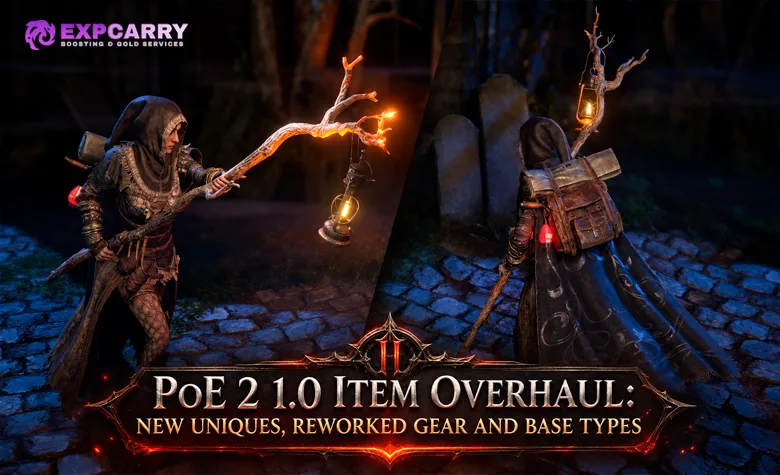
Path of Exile 2 version 1.0 introduces one of the game's largest equipment overhauls when the full release arrives on December 11, 2026 (PST). Grinding Gear Games has announced over 40 new Unique Items, more than 70 reworked existing Uniques, and over 200 new equipment base types. The changes go beyond improved damage and defensive modifiers. Previously underused items are gaining built-in skills, new combat interactions, and different reasons to occupy valuable equipment slots. At ExileCon 2026, GGG demonstrated redesigned versions of Keelhaul, Radiant Grief, Edyrn's Tusks, and Apron of Emiran alongside new items such as Ashcaller, Siegebreaker, and Windripper.
The overhaul also changes how players should evaluate ordinary equipment. New sword, dagger, armour, and trap bases introduce additional implicit properties, while the redesigned Passive Skill Tree and Support Gems will influence which combinations are worth building around. As of November 16, version 1.0 has not launched, and the complete final item database, modifier values, drop rates, and balance notes are unavailable. This guide compares the actual items revealed at ExileCon, explains their possible build applications, and separates demonstrated properties from combinations that still require testing.
Short answer: PoE 2 1.0 adds over 40 new Uniques, reworks more than 70 existing ones, and introduces over 200 equipment base types. The biggest change is that more items provide distinctive skills or mechanical interactions rather than ordinary stat bonuses, but their final strength, acquisition methods, and best build combinations cannot be established before launch.
What Changes in the PoE 2 1.0 Item Overhaul?
GGG's new equipment direction focuses on making Unique Items change the way a character plays. A Unique weapon, helmet, or belt should provide a reason to build around its effect rather than simply offer slightly better damage or defence than ordinary equipment.
The official Path of Exile 2 full-release announcement confirms more than 40 new Uniques and over 70 redesigned existing items, with improvements involving modifiers, skills, and visuals. During the ExileCon keynote, GGG also demonstrated how equipment bases themselves can contribute special effects to a character.
| Equipment category | Announced changes | Why they matter |
|---|---|---|
| New Unique Items | Over 40 new Uniques with distinctive modifiers and skills. | New damage engines, companions, and equipment combinations. |
| Existing Unique Items | More than 70 reworked items with revised mechanics, modifiers, or appearances. | Previously weak or specialized equipment may support entirely different builds. |
| Equipment base types | Over 200 new bases announced during the keynote. | More meaningful weapon and armour choices before explicit modifiers are considered. |
| Built-in equipment skills | Selected Uniques grant active or triggered abilities. | Additional mechanics can become part of a character's main combat setup. |
| Weapon categories | New sword, dagger, and trap equipment associated with the Duelist and Shadow. | New weapon properties and skill interactions affect character progression. |
| Support Gems and passive scaling | Broad rebalancing alongside the item overhaul. | Existing gear combinations may require different passives and supports. |
These figures describe the announced scope of the update, not a fully published item list. The 40-plus new Uniques should not be confused with the more than 70 reworks. Likewise, the addition of hundreds of base types does not mean every new base provides a skill, an additional socket, or a superior damage profile.
The distinction also matters for existing equipment. A revised Unique can become more interesting without automatically becoming stronger than every Rare in the same slot. Its value depends on whether the new effect improves the intended build enough to justify giving up other modifiers.
PoE 2 1.0 Reworked Unique Items: Old and New Properties Compared
The most useful part of the ExileCon demonstration was the comparison between existing Unique Items and their redesigned versions. Several examples showed that GGG is not merely increasing numerical values. Instead, it is changing what the equipment actually does during combat.
The official ExileCon 2026 keynote recording presents the Unique Item changes during the equipment segment. The comparisons below use the properties shown on stage. Numerical values reflect individual preview item rolls and should not be mistaken for guaranteed final values on every dropped copy.
| Unique Item | Earlier functionality | Revealed 1.0 functionality | Build impact |
|---|---|---|---|
| Keelhaul | Flask recovery, charge regeneration, and Charm utility. | Grants Geyser, triggered by flask use, with much faster charge regeneration and reduced flask recovery rate. | Flask use becomes part of an offensive combat loop. |
| Edyrn's Tusks | Armour, Physical Thorns, Bleeding chance, and reduced slowing effects. | Possession by the Spirit of the Boar, spirit boars that attack enemies, and protection against Heavy Stun while sprinting. | Changes from a defensive and Bleeding-oriented item into companion-assisted combat equipment. |
| Radiant Grief | Nearby enemies Ignite as though affected by a fixed amount of Fire damage. | Grants Radiance, a scalable burning skill with support compatibility. | Creates more possibilities for an Ignite-focused character. |
| Apron of Emiran | Bleeding inflicted by the character is Aggravated. | Retains the Aggravated Bleeding identity and adds Guillotine. | Adds a separate damaging skill to a Bleeding-oriented setup. |
Nightfall was also displayed as an example of the equipment-skill philosophy. Its existing Soaring Midnight skill shows how a Unique can supply a recognizable combat mechanic. Its inclusion in the presentation does not by itself establish that Nightfall received a new 1.0 rework.
Keelhaul: Flask Regeneration Becomes an Offensive Mechanic
Keelhaul is one of the clearest demonstrations of the new philosophy. The existing Linen Belt already focused on flask recovery and charge regeneration. The redesigned version grants a level 19 Geyser skill in the showcased tooltip, producing eruptions of Cold damage when the character uses a flask.
That changes the belt's purpose. Rather than equipping Keelhaul only to maintain flask resources, a player can potentially use flask activation as part of a damage setup. The character receives offensive activity from a resource-management action that would otherwise be primarily defensive or supportive.
The showcased version also involves substantial trade-offs. Flask charges regenerate much faster, but Life and Mana flask recovery rates receive penalties. This means frequent flask activation becomes easier to support while the recovery from each flask must be evaluated more carefully.
| Property | Earlier showcased version | 1.0 preview |
|---|---|---|
| Granted skill | No Geyser skill. | Level 19 Geyser. |
| Charm slots | Variable, 1–3. | Variable, 1–3; the revealed example has 1. |
| Life flask charge regeneration | 0.25 charges per second | 1.7 charges per second |
| Mana flask charge regeneration | 0.25 charges per second | 1.72 charges per second |
| Life flask recovery rate | 16% increased | 50% reduced |
| Mana flask recovery rate | 19% increased | 50% reduced |
These are the displayed item values, not confirmed fixed rolls for the released Unique. The final strength of Geyser depends on its Cold damage, targeting, trigger restrictions, and scaling. The preview does not establish that players can generate unlimited geysers or sustain flask use without additional investment.
A flask-focused character should compare the benefit of triggering Geyser against reduced recovery and the loss of alternative belt modifiers. The build only becomes practical if flask resources and survivability remain reliable during prolonged encounters.
Edyrn's Tusks: Spirit Boars Replace Earlier Combat Modifiers
Edyrn's Tusks receives a different type of rework. The earlier Iron Cuirass combined Armour and Physical Thorns with a chance to inflict Bleeding and reduced slowing potency from debuffs. The version shown at ExileCon replaces the old Bleeding and slowing-related effects with new mechanics.
The redesigned armour makes the character possessed by the Spirit of the Boar, generating spirit boars that attack nearby enemies. It also prevents Heavy Stun while sprinting. The displayed increased Armour modifier changes from 129% to 149%, although those values represent the specific examples shown rather than confirmed fixed rolls.
This gives the item a potential role beyond ordinary protection. Spirit boars might contribute damage while the player moves or attacks, but their exact scaling, duration, targeting, and relationship to minion-related modifiers still require testing.
Players should not assume that every build benefits equally from these companions. A character with strong minion investment may find interesting combinations, while another build could lose more from the removed Bleeding interaction than it gains from the new effect.
Radiant Grief: Fixed Burning Becomes the Scalable Radiance Skill
Radiant Grief previously caused nearby enemies to Ignite as though dealt 200 base Fire damage. That made its effect distinctive but limited its potential when the rest of a character's damage had scaled far beyond the fixed burning value.
The redesigned Lace Hood grants level 19 Radiance in the preview. Instead of relying on the original fixed-damage interaction, Radiance functions as a skill that can benefit from compatible supports. The presentation also showed nearby enemies burning and exploding, giving the mechanic possible applications in clearing groups.
The displayed rework adds 45 maximum Life, increases Fire Resistance from 22% to 25% on the compared copies, and allows changes to Light Radius to apply to Ignite Magnitude. Evasion differs slightly between the showcased versions. Those individual numerical values may change before the released item becomes available.
The important build opportunity is the new scaling model. A character can potentially invest in applicable Fire, Ignite, Light Radius, and skill-related modifiers to improve Radiance rather than treating the helmet as a small fixed source of incidental damage.
However, the complete support compatibility, Ignite calculations, and explosion conditions are not yet established. A visually impressive pack-clearing demonstration does not prove that Radiant Grief will provide enough sustained damage against an isolated endgame boss.
Apron of Emiran: Aggravated Bleeding and Guillotine
Apron of Emiran keeps its connection to Aggravated Bleeding but gains a new damaging ability. The version shown at ExileCon grants level 4 Guillotine, summoning falling blades that inflict damage and interact with Bleeding.
The previewed Hermit Garb also displays Evasion, Energy Shield, maximum Life, and Dexterity modifiers. Unlike Keelhaul, GGG did not show a complete old-versus-new comparison for every numerical property of this item, so an exact full stat difference cannot yet be established.
Guillotine creates an additional way for Bleeding-focused characters to attack enemies. Its usefulness will depend on whether it complements the player's existing main skill, how its damage is calculated, and whether the additional ability justifies the armour slot.
That is particularly relevant to the new Duelist, whose announced sword skills include additional Bleeding interactions. The combination is worth examining, but no completed Guillotine Duelist build has been validated on the 1.0 LIVE client.
New Unique Items Revealed for PoE 2 1.0
The new Unique lineup expands the available build mechanics rather than focusing on one equipment category. GGG showcased weapons, armour, and accessories built around Fire damage, elemental projectiles, summoned allies, and other specialized effects.
Only a portion of the more than 40 announced items has been shown in sufficient detail for meaningful analysis. The following examples are identifiable from official presentation footage, but their final values and acquisition sources have not been fully documented.
| Unique | Equipment base | Revealed mechanic | Potential build direction |
|---|---|---|---|
| Ashcaller | Searing Wand | Fire Infusion interactions, Ancestrally Boosted Fire spells, Burning Effigy, and Spirits of Ngamahu. | Fire spellcasting with additional ancestral effects. |
| Siegebreaker | Ornate Belt | Bunkerbuster sends a reviving minion toward a target and detonates it. | Minion sacrifice and Life-scaling damage. |
| Windripper | Greatbow | Perfect Squall creates squalls that interact with elemental ground effects and Whirlwinds. | Elemental bow attacks and area control. |
| Oro's Sacrifice | Twilight Longsword | Infernal Step, Fire damage, Sacrificial Flame interactions, and Ignite. | Fire-based sword combat. |
| The Wanderer | Leather Vest | Experience bonuses, reduced armour movement penalties, and a restriction on Item Rarity increases. | Character progression with a deliberate loot-related trade-off. |
Ashcaller: Fire Infusions and Ancestrally Boosted Spells
Ashcaller is a new Searing Wand with unusual Fire-related mechanics. The showcased item grants level 12 Burning Effigy and level 12 Spirits of Ngamahu. It also provides increased Fire damage and interactions that empower Fire spells after gaining a Fire Infusion.
According to the displayed modifiers, the next three Fire spells after gaining a Fire Infusion become Ancestrally Boosted. The effect is strengthened by summoned Spirits of Ngamahu, connecting spellcasting with another source of ancestral power.
This makes Ashcaller interesting for Fire-focused casters who can generate the required Infusions and benefit from the resulting empowered spells. Its value will depend on how frequently those conditions can be satisfied during ordinary gameplay and demanding encounters.
The showcase does not establish that every Fire spell will scale equally well or that the ancestral effects can be maintained permanently. The released skill descriptions and final interaction rules must determine whether Ashcaller supports a primary damage build or works better as a complementary weapon.
Siegebreaker: Bunkerbuster and Exploding Minions
Siegebreaker is a new Ornate Belt built around minion-related mechanics. Its main feature is Bunkerbuster, a skill that sends the nearest reviving minion toward a selected location and detonates it.
The level 14 Bunkerbuster preview combines Physical damage with additional Fire damage based on the minion's maximum Life. Siegebreaker also provides maximum Life, Strength, minion Life, minion regeneration, and a reduction to minion revival time when Bunkerbuster is cast.
The potential build interaction is clear: a character with suitable reviving minions could convert part of its minion investment into an offensive explosion. However, the ability must be evaluated around the actual revival rules and whether enough eligible minions are available.
This is not confirmation that every summoned creature can be detonated or that Bunkerbuster works without a reviving minion. Infernalist players may find the idea especially interesting because version 1.0 expands demonic companion gameplay, but compatibility with individual Infernalist summons is not yet established.
The existing PoE 2 Ascendancy Reworks guide examines those class changes separately. A minion-focused item and a minion-focused Ascendancy are not automatically compatible merely because their descriptions mention companions.
Windripper: Perfect Squall and Elemental Tornadoes
Windripper is a new Greatbow that grants Perfect Squall. The showcased skill creates a large squall projectile that divides into smaller squalls, which can gain elemental damage from ground surfaces and interact with Whirlwinds.
The previewed bow also contains Physical damage increases, additional Lightning and Cold damage, Attack Speed, and elemental ailment interactions. The showcased modifiers include effects related to penetrating the resistance of Shocked or Chilled enemies.
This creates several possible scaling directions. A bow character might combine elemental damage and ailment application with squall behavior, potentially creating an alternative to conventional projectile-only clearing.
The key questions are how Perfect Squall acquires elemental effects, how its damage scales, which supports apply, and whether the resulting squalls remain effective against a single moving target.
Those mechanics cannot yet be translated into a reliable damage ranking. A powerful visual effect does not establish that the bow outperforms existing endgame weapons, particularly when their final 1.0 stats are also subject to adjustment.
Oro's Sacrifice: Fire Sword Gameplay and Sacrificial Flame
Oro's Sacrifice was showcased during the second day of ExileCon as a new Unique for Path of Exile 2. It uses the Twilight Longsword base and grants Infernal Step.
The displayed item deals Fire damage instead of Physical damage and includes increased Attack Speed. Hits with the weapon Ignite enemies on Full Life, while additional modifiers interact with Sacrificial Flame and Frenzy Charge generation.
These mechanics suggest a sword build centered on Fire damage and maintaining the relevant resource rather than simply converting an ordinary Physical sword setup into Fire damage.
However, the precise timing of Sacrificial Flame generation, practical Ignite performance, and compatibility with the full Duelist skill roster remain unresolved. Its individual stage-preview damage values should not be used as a final weapon ranking.
The Wanderer: Experience Gain with an Item Rarity Restriction
The Wanderer is a new Leather Vest shown during ExileCon's second day. Its unusual property is an increased experience gain modifier that becomes less beneficial as the player gains levels.
The showcased version provides 20% increased Experience gain alongside 1% reduced Experience gained per five player levels. It also ignores movement penalties from Armour but prevents the character from increasing the Rarity of Items found.
This is a progression-oriented trade-off rather than a conventional endgame damage effect. A player may value additional leveling efficiency while accepting restrictions on Item Rarity, but the actual benefit depends on character level and how the modifiers combine.
The item should not be described as providing a permanent flat 20% increase to all experience. It also should not be considered an automatic best choice for farming valuable items, since its displayed restriction directly affects Item Rarity.
Explore services related to this guide, selected from our Path of Exile 2 catalog.
View All Path of Exile 2 Services

PoE 2 1.0 New Base Types: Swords, Daggers, Traps, and Armour
One of the less obvious but potentially more widespread changes is the addition of over 200 equipment base types. During the keynote, GGG demonstrated that certain bases will carry special properties capable of changing gameplay even before the player evaluates their random explicit modifiers.
This makes the base item itself a more important build decision. Two Rare weapons with similar damage may provide different utility if their base properties affect sockets, skills, or combat mechanics.
Twilight Longsword and Bejewelled Weapons
The Twilight Longsword is associated with the Bejewelled property. GGG demonstrated the idea of swords containing Jewel Sockets, creating another possible way for equipment to interact with character customization.
The important difference is that a Jewel Socket on equipment should not be assumed to follow every rule of an ordinary passive-tree socket. Its actual restrictions, supported jewel types, capacity, and interactions with other socket systems need to be verified in the released client.
This is potentially valuable for builds that depend on specific jewel modifiers, but it does not guarantee that every sword can hold additional jewels or that a Bejewelled weapon is automatically better than one with stronger base damage.
Chieftain Sword: Ancestrally Boosted Buried Blades
The Chieftain Sword is another showcased base with a specific skill interaction. Its demonstrated property allows Buried Blades to become Ancestrally Boosted, tying the weapon base to a particular offensive mechanic.
This could encourage a Duelist to choose the base because of its interaction with a chosen skill rather than because it has the highest displayed Physical damage.
However, it is not confirmation that every sword skill benefits from the same effect. A character using other attacks must determine whether the base provides anything meaningful to that setup.
Revered Vestments: Curse Immunity from an Armour Base
Revered Vestments were demonstrated with a new 1.0 property granting immunity to curses. Unlike a modifier that adds ordinary damage or defence, curse immunity can potentially replace another source of protection within a completed character setup.
That creates an important equipment trade-off. A character may be able to obtain the desired protection from its armour base and use other available slots or passive points for different purposes.
The final value still depends on the armour's defensive statistics, requirements, rarity, and compatible modifiers. The presentation does not establish that every build should abandon other methods of handling curses or that the new base supplies equivalent protection against unrelated debuffs.
Gladiator Armour: Generating Glory When Hit
Gladiator Armour was shown with an implicit property that generates Glory when the wearer is hit. This creates a connection between defensive equipment and abilities that use Glory as a resource.
For a character already built around spending Glory, the base might offer another way to generate the resource during combat. That could be useful when the character is exposed to enemy attacks or plays close to dangerous targets.
However, taking damage to generate a resource is not automatically an efficient strategy. The generated amount, qualifying hit conditions, and interaction with defensive mitigation must be confirmed before building around it.
New Dagger and Trap Bases for the Shadow
Version 1.0 also introduces equipment categories supporting the new Shadow class. Previewed dagger bases include Phantom Kris, Parrying Dagger, and Moon Dagger, while trap-related bases include Brazier Trap, Spike Trap, and Bladed Trap.
The Shadow's gameplay involves stealth, traps, and dagger attacks, so these new bases are relevant to its character progression. Different implicit properties may make particular bases more appropriate for specific skill combinations.
However, merely appearing in a presentation does not establish a base's final damage, critical chance, speed, item level, or endgame ranking. Those values must be checked against the completed 1.0 item database.
| Base type | Revealed property or purpose | Possible build consideration |
|---|---|---|
| Twilight Longsword | Bejewelled interaction with Jewel Sockets. | Compare jewel utility with other weapon bases. |
| Chieftain Sword | Buried Blades receives Ancestrally Boosted functionality. | Relevant to suitable sword skill setups. |
| Revered Vestments | Curse immunity in the 1.0 preview. | Can affect defensive equipment planning. |
| Gladiator Armour | Generates Glory when hit. | Potential resource generation for Glory-based gameplay. |
| Phantom Kris and other Daggers | New dagger options for Shadow gameplay. | Final weapon properties and implicit effects require testing. |
| Brazier Trap and other Trap bases | New trap equipment category. | Supports new Shadow-related equipment and skill choices. |
How the PoE 2 1.0 Item Overhaul Affects Different Builds
The most important question is not which new Unique has the most impressive tooltip. It is whether that item provides an interaction the character can scale without sacrificing essential damage, recovery, or defensive equipment.
For players comparing complete gear configurations, the PoE 2 starter build configuration service covers the relationship between equipment, skills, and passive allocations. The final 1.0 item values still need to be available before any particular new Unique combination can be treated as tested.
Fire Spell and Ignite Builds
Ashcaller and Radiant Grief create two different directions for Fire-focused characters. Ashcaller emphasizes Fire Infusions and Ancestrally Boosted spells, while Radiant Grief turns a fixed burning interaction into a support-compatible skill.
A character could potentially investigate both systems, but their combined value depends on which modifiers apply to each granted ability. A Fire damage increase does not automatically improve every secondary effect in the same way.
Fire spellcasters should first determine whether the new item grants a useful main skill, provides supplementary damage, or merely adds another mechanic that consumes equipment space without improving the build's central damage engine.
Minion Builds and Companion Interactions
Siegebreaker and Edyrn's Tusks are particularly relevant to players interested in minion-related gameplay. One converts a reviving minion into an explosion, while the other generates spirit boars that attack nearby enemies.
These are different mechanics. A companion that attacks automatically should not be assumed to work with Bunkerbuster, and a minion-related damage bonus should not automatically be considered applicable to every spirit generated by equipment.
Version 1.0 also reworks several Ascendancies, so minion characters need to examine both their equipment and the revised class mechanics. The strongest combination will depend on compatibility, minion availability, resource costs, and performance against bosses.
Bleeding and Sword Builds
Apron of Emiran's Guillotine ability creates a possible secondary damage source for Bleeding builds, while the new Duelist introduces additional sword skills involving Bleeding and related effects.
A character should evaluate whether Guillotine benefits from the same modifiers as its primary attack and whether its damage contribution justifies losing another armour slot.
The same principle applies to specialized sword bases. A weapon that empowers one selected skill may be excellent for that skill but less attractive to a character using a different attack combination.
Bow Builds and Elemental Ailments
Windripper introduces a new elemental squall mechanic alongside attack and ailment-related modifiers. This makes it worth examining for bow characters that can apply elemental effects consistently.
However, the new bow must still compete with existing Rare and Unique weapons. The relevant comparison includes sustained single-target damage, clearing reliability, speed, and how many additional item slots or passive points the elemental setup requires.
Players should not use the showcased squall behavior to declare an existing bow build obsolete. The released damage values and final support interactions may substantially change the comparison.
Defensive Builds and Special Armour Implicits
Revered Vestments and Gladiator Armour demonstrate how armour bases can change decisions beyond raw Armour, Evasion, or Energy Shield. Curse immunity may solve a specific defensive requirement, while Glory generation can support a resource-based combat system.
These benefits must still be weighed against ordinary defensive statistics. A valuable implicit cannot compensate for every missing resistance, attribute, or recovery requirement.
A character's entire gear set matters more than an isolated item effect. The best base is the one that helps the completed build meet its requirements while enabling the intended combat mechanics.
How New Base Types Affect Crafting and Item Upgrades
The introduction of new equipment bases changes which items are worth collecting and crafting. In Path of Exile 2, the base determines fundamental properties such as weapon damage, attack behavior, defensive statistics, requirements, and inherent modifiers. A powerful Rare built on the wrong base may lose to a less expensive item with a more useful implicit.
The official Path of Exile 2 equipment overview describes the existing system of equipment bases and Skill Gems. Version 1.0 expands those foundations, but the final crafting restrictions and interactions for each new base remain subject to the release rules.
Why Implicit and Explicit Modifiers Must Be Evaluated Separately
An implicit property belongs to the equipment base or another applicable item system, while explicit modifiers provide additional stats or effects according to the item's rules.
That distinction matters for the revealed equipment. Curse immunity on the previewed Revered Vestments or the Bejewelled interaction on Twilight Longsword may make the base desirable before the player considers which additional modifiers it can roll.
The correct comparison involves the complete item: its base properties, available explicit modifiers, requirements, sockets, and compatibility with the chosen skill.
What Happens to Existing Unique Runeforging?
Early Access already contains Verisium Runeforging, which can upgrade eligible low-level Unique weapons and armour or modify selected defensive properties. That existing system should not be confused with the announced rework of more than 70 Unique Items.
Changing a Unique's underlying mechanics in version 1.0 and upgrading its base through Runeforging are different operations. GGG has not established how every redesigned Unique will interact with the existing Runeforging rules after launch.
The PoE 2 Runeforging guide explains the existing equipment-upgrade system separately.
Does Conquerors of Wraeclast Reforging Work on New Uniques?
The Conquerors of Wraeclast Challenge League introduces a separate Reforging mechanic associated with castle treasury rewards. GGG demonstrated materials such as Crimson Iron that replace selected unwanted modifiers with random fractured results.
This creates another potential method for improving equipment, but the presentation does not establish that the process can be used on every Unique Item or special base. A new Unique and a new Reforging material being released in the same update does not automatically make them compatible.
The existing PoE 2 Reforging guide explains the announced modifier-replacement mechanic separately.
Should Players Replace Their Old PoE 2 Gear in Version 1.0?
Replacing existing gear before the complete patch notes would be premature. The announcement identifies major equipment changes but does not provide a final list of every altered Unique, modified base, or numerical adjustment.
For returning players, the first step is to identify which equipment pieces enable the current build. An ordinary damage upgrade is easier to replace than a Unique whose effect makes an entire skill combination function.
Will Existing Unique Items Automatically Receive Their New Properties?
GGG has not provided a complete public policy explaining how every existing item instance will be handled during the transition. The showcase demonstrates redesigned item properties but does not settle whether all previously obtained copies update, retain legacy modifiers, or require a particular action.
Players should therefore avoid assuming that an old Keelhaul or Radiant Grief will automatically become identical to a newly dropped 1.0 version. The final item migration rules and actual post-update tooltips must determine that.
Which Items Are Worth Keeping Before Launch?
Equipment that enables a distinctive interaction deserves attention, but that does not mean every existing Unique should be stockpiled. The final effect may change, and some items could remain less efficient than comparable Rares.
- Keep track of build-defining Uniques: identify items whose mechanics are essential to your current setup.
- Record current item values: save the important modifiers and properties before the update.
- Separate essential modifiers from replaceable stats: ordinary damage or resistance values may be easier to recover elsewhere.
- Review new base implicits: determine whether a specialized property would solve a problem in the build.
- Wait for final item notes: do not treat previewed rolls or incomplete community item lists as final.
- Test equipment after launch: compare damage, resource sustain, movement, and survival rather than relying only on tooltip numbers.
Players starting the new Challenge League will begin with fresh league characters and equipment rather than transferring their Early Access inventories into that economy. Current PoE 2 campaign progression options are separate from any transfer of existing equipment into the new league.
Can New Rare Bases Outperform Reworked Uniques?
Yes, that remains a possible outcome, but it must be evaluated item by item. A specialized Unique may provide an exceptional mechanic while sacrificing ordinary defensive or offensive modifiers. A Rare on a strong new base may offer a more balanced combination of useful properties.
For example, curse immunity from an armour base might allow a Rare item to handle a specific defensive requirement without relying on a Unique. Conversely, an ability such as Radiance or Bunkerbuster may be impossible to reproduce with an ordinary Rare item.
Neither category is automatically superior. The comparison must account for the full equipment setup and the particular mechanic the character intends to scale.
Recommended Equipment Progression for PoE 2 1.0
The new itemization system gives players more options, but it does not remove the need for a functional leveling setup. A character still needs reliable damage, appropriate attributes, defensive layers, and resource sustain before investing heavily in unusual Unique interactions.
| Progression stage | Equipment priority | What to avoid |
|---|---|---|
| Early campaign | Reliable weapon damage, basic defences, and attribute requirements. | Chasing a Unique that has no confirmed accessible source. |
| Middle campaign | Evaluate useful new base implicits alongside ordinary modifiers. | Equipping specialized items that break the main skill setup. |
| Campaign completion | Establish sufficient recovery, resistances, and consistent damage. | Replacing functional gear solely because a new item looks interesting. |
| Early endgame | Compare Rare bases with available build-enabling Uniques. | Spending expensive crafting resources before confirming final base properties. |
| Build specialization | Test Unique skills, support compatibility, and passive scaling. | Assuming previewed item combinations are already optimized. |
| Advanced endgame | Optimize the complete equipment set around verified combat performance. | Ranking gear using isolated tooltip values without encounter testing. |
A fresh character may obtain useful new equipment naturally while progressing through the campaign. However, GGG has not published the complete level requirements and acquisition sources for every new Unique. The right approach is to use effective available gear until a specialized item can be obtained and tested.
For players prioritizing character progression before completing a specialized equipment setup, PoE 2 leveling progression is available as a separate option.
Common Mistakes When Preparing for the PoE 2 1.0 Item Overhaul
The largest source of confusion is treating equipment shown during a developer presentation as though its final version has already been fully documented. The examples reveal important mechanics, but final itemization depends on released values and actual combat interactions.
Assuming All 110-Plus Items Are Completely New Drops
GGG announced more than 40 new Uniques and over 70 reworks. The combined total describes new and redesigned equipment, not more than 110 entirely new item identities.
Treating ExileCon Item Rolls as Fixed Final Values
The displayed numbers belong to particular preview items. Some modifiers can vary between copies, and balance changes may occur before release. Do not build a final damage calculator around one screenshot.
Assuming Every Unique Skill Uses the Same Scaling
Geyser, Radiance, Bunkerbuster, and Perfect Squall are different mechanics. Their tags, triggers, resource requirements, and applicable modifiers must be checked individually.
Assuming Every New Weapon Has Extra Jewel Sockets
The Bejewelled property was shown on a specific sword base. It does not establish a universal socket increase for every sword, dagger, or other new weapon.
Assuming Reforging Works on All New Unique Items
The announced Reforging mechanic has its own eligibility rules, which have not been fully published. Its existence does not guarantee compatibility with Unique Items, corrupted equipment, or every special base.
Declaring a New Unique Best-in-Slot Before Launch
An item that grants an impressive skill may still have demanding resource costs, poor single-target performance, or insufficient defensive stats. Only completed builds tested with the released rules can establish a reliable ranking.
PoE 2 1.0 Item Overhaul FAQ
These answers cover the most important questions about the announced Unique Item and equipment changes.
How many new Unique Items are coming in PoE 2 1.0? GGG has announced more than 40 new Unique Items and over 70 redesigned existing Uniques. The complete final item list has not yet been published.
Will the new Unique Items drop only in Conquerors of Wraeclast? The announced Unique overhaul belongs to the broader 1.0 release. Players should not assume every new item is exclusive to Conquerors encounters. Exact drop sources and restrictions still need confirmation.
Which existing Uniques are confirmed for a 1.0 rework? The ExileCon showcase demonstrated changes to Keelhaul, Edyrn's Tusks, Radiant Grief, and Apron of Emiran. Additional changes were previewed elsewhere, but a complete final rework list and all modifier values remain unavailable.
Can existing Early Access Unique Items become the new versions? GGG has not published complete item migration rules for the 1.0 overhaul. Previously obtained copies should not be assumed to receive every new modifier automatically until the final policy and released item behavior are confirmed.
Conclusion
PoE 2 1.0 changes equipment from a collection of numerical upgrades into a wider set of build-defining mechanics. Reworked Uniques such as Keelhaul, Radiant Grief, Edyrn's Tusks, and Apron of Emiran demonstrate how existing items can gain new combat roles, while Ashcaller, Siegebreaker, Windripper, and other new equipment expand the possible combinations. The introduction of specialized base types makes ordinary gear selection more important as well. Players should evaluate each revealed interaction against their actual build requirements and reserve final equipment decisions for the released item values and mechanics on December 11.