
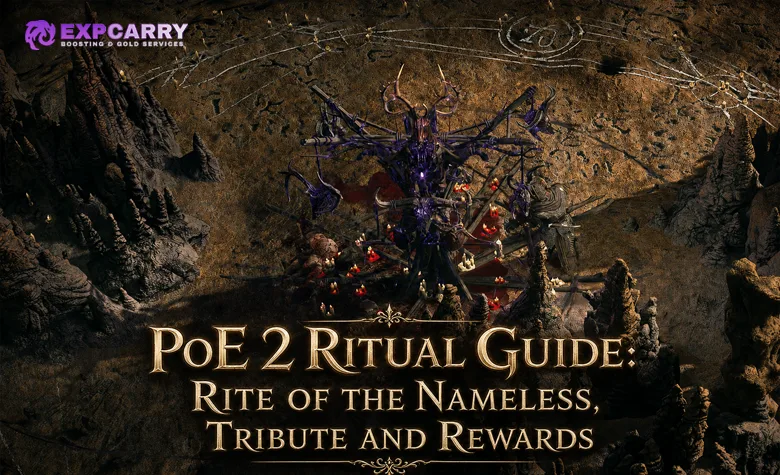
Path of Exile 2 turns Ritual into a layered mapping loop built around enclosed altar fights, a map-specific Tribute budget, focused Favours, and a progression chain leading from the King in the Mists to the Rite of the Nameless and The Bodach. The mechanic rewards characters that can control dense packs in limited space, but the most important decisions happen after the fighting: which reward to buy, what to defer, whether a reroll is justified, and how much Tribute to offer toward the next boss access item.
The current system is not the same Ritual route described by older pre-overhaul guides. Endgame Favours are focused on Omens and Unique items, unused Tribute can advance an Audience with the King, and defeating the King now starts a connected series of Rite maps. This guide explains the complete current route, including Caer Tarth, reward selection, the five-map Rite, quest and repeat effigy pieces, and final Ritual pinnacle access.
PoE 2 Ritual Quick Answer
Find Caer Tarth west of the Atlas starting area and complete the nearby maps containing Ritual to earn points for the dedicated Ritual Atlas Passive Tree. Clear every altar, spend Tribute on worthwhile Omens or Uniques, defer an expensive target when needed, and offer the remainder to the King before leaving. Filling the Tribute to the King bar grants An Audience with the King, which reveals a route to the Crux of Nothingness on the Atlas. Defeat the King in the Mists, take the Head of the King to the effigy in Caer Tarth, complete the five-map Rite of the Nameless, attach its five effigy pieces, and enter the final encounter with The Bodach.
| Stage | Required action | Main result |
|---|---|---|
| Caer Tarth maps | Complete nearby Ritual maps and their altars | Ritual Atlas points, Tribute, Favours, and storyline progress |
| Tribute to the King | Offer unspent Tribute after handling Favours | Progress toward An Audience with the King |
| Crux of Nothingness | Use the Atlas route revealed by An Audience with the King | King in the Mists encounter |
| King in the Mists | Complete the boss fight and its maze | Head of the King and boss rewards |
| Rite of the Nameless | Select and finish the connected Rite maps | Five effigy pieces and Foretold rewards |
| Caer Tarth effigy | Attach the complete set of quest pieces or five repeat keys | Access to The Bodach |
The official Return of the Ancients patch notes establish this route and confirm the base five-map Rite. Treat any guide that still sends An Audience with the King to the Realmgate, asks for Petition Splinters, or presents the King as the last step of Ritual as an outdated route.
How Ritual Encounters Work
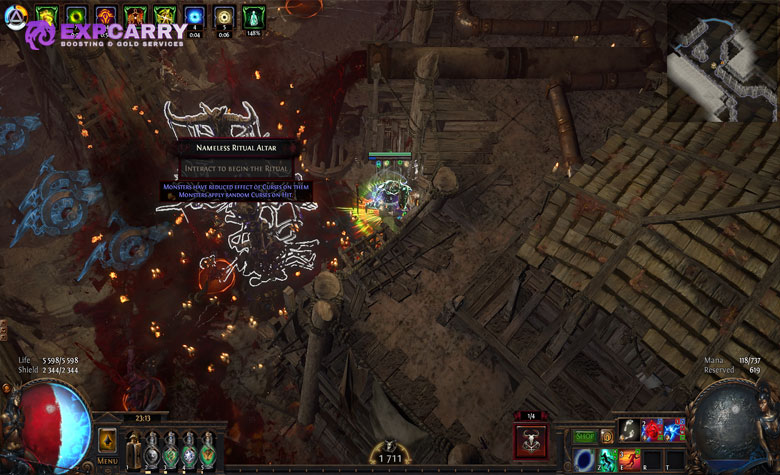
A Ritual map contains several altars surrounded by marked circles. Kill enough monsters around an altar to make it usable, activate it, and defeat the enemies resurrected inside the enclosed arena. The altar itself adds pressure through its Ritual variation, so the fight tests positioning and recovery as well as clear speed. Leaving the circle is not the solution; the encounter must be completed or failed inside its boundary.
Monsters associated with Ritual can return at later altars in the same area, making later encounters denser and usually more valuable. Tribute is earned by killing revived enemies, with tougher and rarer targets generally contributing more. The exact total changes with the map, monsters, modifiers, tablets, and Atlas choices, so a fixed Tribute promise is not reliable.
Find every altar efficiently
After an altar is completed, a visible stream of locusts points toward the next incomplete altar. Follow that direction instead of searching the full map without guidance. The current navigation cue is particularly useful in branching layouts where a missed side path would otherwise leave one Ritual undiscovered.
Do not open the Favours panel in an unsafe location. The reward interface does not stop surrounding monsters, ground effects, or other map threats. Finish the immediate fight, move to a protected position, and then evaluate the offers. A death while comparing items can waste portals and jeopardize a map that was otherwise under control.
Build for a confined arena
Ritual values reliable area damage, crowd control, recovery while surrounded, and the ability to keep dealing damage while repositioning. A build that clears long corridors quickly can still struggle when enemies appear from several directions inside a small circle. Chaos resistance is useful because Ritual hazards and Wildwood enemies can add Chaos pressure, but it does not replace Armour, Evasion, Energy Shield, Block, Deflection, or recovery appropriate to the character.
Read Waystone modifiers before committing. Reduced recovery, additional projectiles, extra monster speed, dangerous critical modifiers, and overlapping damage conversions can turn an ordinary altar into a portal drain. Progression maps should be rolled for completion first. Additional reward scaling only matters if every altar and the map boss can still be killed.
Tribute, Favours, Deferral and Rerolls
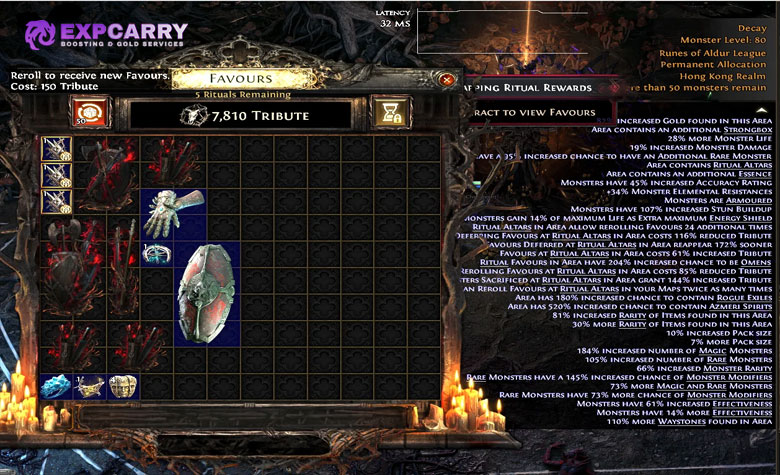
Tribute is the temporary purchasing resource earned within the current Ritual area. It buys Favours, pays deferral costs, and funds reward rerolls. In current endgame Ritual, the normal Favour pool is focused: offers are Omens or Unique items rather than a broad mixture of ordinary equipment and currency. This makes every screen easier to read, but it does not make every offer equally valuable.
Tribute does not function as a permanent account currency to hoard for a later map. Before leaving, decide how much to spend and then offer any true remainder toward the King. The practical order is inspect, buy, defer, consider a reroll, inspect again, and only then sacrifice what is left.
| Tribute action | Best use | Main risk |
|---|---|---|
| Buy | Claim a useful or valuable Omen or Unique immediately | Spending too early can remove the budget needed for a stronger offer |
| Defer | Keep an unaffordable target in the future pool at a lower remaining price | The item must be recognized and maintained when it reappears |
| Reroll | Replace a weak screen when enough Tribute remains for the new offers | Paying for a reroll can leave no budget to buy what appears |
| Offer Tribute | Convert the final unused balance into King access progress | Offering before checking Favours permanently gives up purchasing power |
How to choose Ritual rewards
Start with character impact rather than a fixed market ranking. A Unique that immediately completes a build interaction can be worth more to the player than a theoretically expensive item that must be sold. For Omens, read the trigger and effect carefully, confirm that the current character or crafting project can use it, and compare the displayed Tribute cost with the opportunity to advance the Audience bar.
For trade evaluation, check the exact item, rolls, variant, and current league economy before buying. Unique names alone are not enough because base versions, modifier ranges, and build demand change. An Omen may also be valuable for a narrow crafting operation even when it is not popular with the average mapping build. Evergreen reward selection therefore uses live price and build checks rather than a permanent tier list.
When to defer and when to reroll
Deferral is the correct tool when a strong Favour costs more Tribute than remains. Paying the displayed deferral fee allows the item to return in a later Ritual at a reduced remaining cost. When it reappears, reassess it and defer again if the purchase is still impossible. Ignoring a deferred item repeatedly can eventually remove it from the pool, so do not begin a long deferral chain for something the player no longer wants.
Use a reroll only after protecting any valuable offer already visible. The current interface shows the reroll cost and available count, while Ritual Atlas passives and tablets can modify the economy. Always retain enough Tribute to buy or defer a desirable result after rerolling. A new screen has no value if the entire balance was consumed to reveal it.
Explore services related to this guide, selected from our Path of Exile 2 catalog.
View All Path of Exile 2 Services


How to Earn An Audience with the King
Once purchases, deferrals, and rerolls are finished, use the Offer Tribute to the King control for the remaining balance. The offered amount fills the persistent Tribute to the King bar across Ritual maps. When that bar is complete, it grants An Audience with the King, the map fragment required for the next stage.
The current route does not use the old Realmgate interaction. Keep An Audience with the King in the main inventory and inspect the Atlas for matching markers. A marker becomes usable when the nearby Atlas route has been cleared; choosing it consumes the fragment and reveals the Crux of Nothingness containing the King in the Mists.
Balance rewards against Audience progress
Offering every point while ignoring good Favours is inefficient, but spending all Tribute on marginal rewards can delay the storyline indefinitely. Use a simple threshold: buy or defer outcomes that materially improve the build or have verified value, then direct the rest to the Audience bar. Weak Uniques should not automatically outrank deterministic boss progress merely because the reward screen displays them.
Dedicated Ritual Atlas choices can improve this balance by making spent Tribute contribute some Audience progress, improving deferral economics, or supporting rerolls. Players still building a broader endgame plan can compare their next objective through the PoE 2 progression options, but Ritual decisions remain character-specific: the correct allocation depends on whether the goal is Favours, King access, Rite rewards, or repeat boss attempts.
Caer Tarth and Ritual Atlas Progression
Caer Tarth is the Ritual hub west of the Atlas starting location. Its surrounding maps contain Ritual encounters and award points for the dedicated Ritual Atlas Passive Tree when completed. Speak with Aoife, follow the live quest tracker, and clear the regional cluster rather than expecting ordinary Ritual maps elsewhere on the Atlas to replace every storyline objective.
The Atlas tree should first make normal Ritual maps consistent, then support the desired reward layer. Early progression benefits from better deferral, efficient rerolls, reliable Audience advancement, and manageable revived-monster scaling. Rite length, Foretold modifiers, Queen encounters, and maximum-risk Tribute scaling are later specializations.
| Goal | Useful specialization direction | Readiness check |
|---|---|---|
| Storyline progress | Audience progress and reliable altar completion | Can finish all altars without losing the map |
| Omen and Unique farming | More Favour choice, deferral support, and efficient rerolls | Can generate enough Tribute to act on better screens |
| High Tribute maps | More rewarding revived monsters with accepted difficulty | Recovery and crowd control remain stable in later altars |
| Rite specialization | Foretold rewards and additional Rite opportunities or length | Can defeat several accumulated map bosses in one Ritual |
| Queen encounters | Chance for the Queen's Ritual and its Idol rewards | Can handle an optional boss without sacrificing map completion |
Use live node wording
Ritual has several multi-choice or highly specialized passives. Current examples include Patient Devotion for deferral support, Prayer and Pledge for Audience progress from Tribute spending, Magnanimous Offerings for reroll value, and Ongoing Chants for a longer Rite. These names explain the present tree, but exact values should always be read in the live client before allocating around a fixed calculation.
A longer Rite is not an automatic upgrade. Adding another map also adds another accumulated boss and another opportunity for dangerous modifiers. Allocate this direction only when the build can finish the base chain consistently. A shorter completed Rite is more valuable than a theoretically richer sequence that fails before producing a full effigy set.
King in the Mists Access and Preparation
An Audience with the King reveals the Crux of Nothingness on the Atlas. This is the endgame King encounter, not the Act 1 version fought in Freythorn. The campaign boss grants its own campaign reward, while the Crux boss belongs to Ritual endgame progression and drops the Head of the King needed at Caer Tarth.
The fight includes an arena encounter and a maze transition. The maze is not a safe intermission: the current version includes Followers of the King that attack while the player searches for the route back. The official 0.5.3 notes added these followers, so guides that describe an empty maze omit a current source of pressure.
King in the Mists readiness
Enter with capped elemental resistances, meaningful Chaos resistance, dependable recovery, and enough single-target damage to shorten exposure to overlapping mechanics. Preserve mobility for ground hazards and maze movement rather than spending every movement option on damage. The access item represents many Ritual maps of offered Tribute, so test the build against difficult map bosses before committing it.
Players evaluating assistance for this exact checkpoint can compare a contextual King in the Mists completion option. Whether the encounter is completed independently or with help, the progression objective is the same: secure the Head of the King, retain it, and return to Aoife and the effigy in Caer Tarth.
King rewards and the Head of the King
The Head of the King is the critical storyline drop and should not be confused with An Audience with the King. The Audience reveals the Crux; the Head starts the Rite. The King can also reward Ritual Omens and boss-restricted Uniques such as Beetlebite, Ingenuity, The Burden of Shadows, Pragmatism, and From Nothing. A Ritualistic Reliquary Key is a separate possible reward and does not replace the Head.
Do not assign permanent drop rates or a guaranteed rare Unique to the fight. Availability does not mean equal probability, and market demand changes with builds and balance updates. For first completion, the Head is more important than the trade value of the optional loot because it unlocks the entire second half of the Ritual storyline.
How to Start the Rite of the Nameless
Bring the Head of the King to Caer Tarth and attach it to the effigy. The Atlas then presents a connected sequence of maps for the Rite of the Nameless. The base Rite contains five maps. Each choice after the first adds a modifier that affects later difficulty, rewards, or both, so the chain should be planned as one continuous escalation rather than five independent maps.
The official Ritual overview describes the Rite as an encounter that grows in power until the map boss is defeated, carries the player's choices into later maps, and ends with the completed effigy opening the prison. This is the route to The Bodach, not to the optional Queen in the Mists.
Choose Rite maps by boss and modifier
Inspect the offered map, its boss, layout, and Foretold effect before selecting it. Foretold Bounty places a specified reward into the first Ritual offer, while Foretold Proliferation applies a stated modifier to the other Rite maps after its map is completed. A valuable Bounty can justify a harder choice only if the build can still reach and finish its final altar.
Avoid stacking bosses that all punish the same weakness. Several bosses with large persistent areas, fast gap closers, or long invulnerability windows can become far more dangerous when revived together. Select open or familiar arenas when possible, use conservative Waystone modifiers, and treat each new map as an addition to the final multi-boss encounter.
How the Five-Map Rite Chain Works
Every Rite map contains a Ritual that incorporates its map boss. Completing it advances the chain and adds that boss to the accumulated pool. In later Rite maps, monsters and bosses from earlier steps return. Unique map bosses appear in the final Ritual of each Rite map, causing the last encounters to become substantially more demanding than an ordinary altar.
The selected maps do not have to be completed in their original selection order, but the run order still matters because defeated bosses and completed Foretold Proliferation effects influence the remaining stages. Protect portals, clear dangerous monsters around the altar, prepare flasks and charms before activation, and verify that the current boss has been defeated where required. Failing late in the sequence wastes far more progression than abandoning an unsafe optional modifier before the chain is chosen.
| Rite step | What changes | Practical priority |
|---|---|---|
| First map | Begins the boss and monster pool | Choose a familiar boss and establish a safe baseline |
| Second map | Adds another Foretold effect and accumulated enemies | Confirm recovery remains stable before escalating further |
| Middle maps | Boss combinations and propagated modifiers become important | Prioritize completion over the most attractive isolated reward |
| Final base map | Completes the standard five-map sequence | Prepare for the full accumulated boss set |
| Extended Rite | A live Atlas specialization may add another map | Use only after consistent base Rite clears |
Rite Tribute and rerolls
Rite encounters preserve their own reward logic. Completing Rituals during the chain can improve reroll access for later Rite offers, while Tribute earned in the Rite is used for its Favours rather than being offered toward another Audience. This distinction prevents a common mistake: the Rite is the spend-and-complete stage, not another efficient place to fill the King bar.
Claim a promised Foretold Bounty when it is genuinely useful, but do not spend the entire Tribute balance before checking every available offer. As in ordinary Ritual, secure important deferrals before rerolling. The difference is that failing the chain can also cost the effigy component and propagated rewards expected from the current stage.
Effigy Pieces and Final Boss Access
Each completed Rite stage awards an element needed at the effigy in Caer Tarth. The first storyline completion and repeatable farming use different item presentation. This distinction matters because a player searching trade for the five named quest pieces will not find a normal repeat access route.
| Access version | Required effigy pieces | Use |
|---|---|---|
| Quest version | Tangled Torso, Mossy Arm, Frayed Cloth, Brittle Arm, and Ragged Cloth | Attach the five distinct quest pieces to the Caer Tarth effigy |
| Repeatable version | Five Call of the Shadows items | Attach the complete repeat set to the same effigy |
After all required pieces are attached, perform the final Rite at Caer Tarth to open The Bodach encounter. The quest version provides the deterministic storyline path, while repeat access is the harder farming route. Do not consume, discard, or misplace a component before the full set is ready.
Prepare before attaching the final set
The Bodach is the Ritual pinnacle boss and should be treated as a standalone bossing check. Confirm single-target damage, recovery, movement, defenses, and visual clarity before opening the encounter. Remove map-only assumptions from the setup: bonuses that depend on continuous ordinary pack kills may not support the character during a prolonged pinnacle fight.
This guide covers access rather than a full Bodach move-by-move strategy. The important progression rule is exact: King access leads to the Head, the Head opens the Rite, the Rite supplies five effigy pieces, and the completed effigy opens The Bodach. The Queen in the Mists is an optional Atlas-tree encounter and is not the final boss access item.
Ritual Rewards and What to Keep
Ritual rewards come from several layers rather than one chest: altar Favours, deferred offers, Foretold Bounties, the King in the Mists, the optional Queen, Rite completion, and The Bodach. Evaluate each layer by immediate build value, verified trade demand, and progression importance. Access pieces should normally be protected until their purpose is complete.
| Reward layer | Possible value | Evergreen decision rule |
|---|---|---|
| Endgame Favours | Omens and Unique items | Check exact use, rolls, and live value before spending Tribute |
| Foretold Bounty | A specified Rite reward placed into the offer | Balance the promised item against map and boss risk |
| King in the Mists | Head of the King, Omens, boss Uniques, and a possible reliquary key | Preserve the Head until the Rite has been started |
| Queen in the Mists | Corrupted Idol rewards | Treat the Queen as optional specialization, not mandatory progression |
| Rite completion | Quest effigy pieces or Call of the Shadows for repeat access | Complete the full set before evaluating it as disposable value |
| The Bodach | Boss-restricted Uniques, Lineage Supports, and Ancient Augments | Compare the exact drop with the current build and economy |
Bodach reward categories
The current Bodach reward pool includes restricted Uniques such as Vestige of Darkness, Forgotten Warden, Sylvan's Effigy, Liminal Coil, and Periphery. The encounter can also provide Ritual-related Lineage Supports and Ancient Augments. These rewards serve very different builds, so no single item is permanently the best outcome.
Do not publish or follow fixed profit numbers for Bodach, King, Omens, or Rite Bounties. Access costs and demand move with the league economy. Track the time required to fill the Audience bar, the completion rate of the Rite, the value of sacrificed Favours, and the success rate of the final boss. Profit is the value of completed outcomes after failed chains and consumed access are counted.
Best Ritual Farming Strategy
A stable Ritual loop completes every altar in maps the build can clear quickly, preserves high-value Favours through deferral, and converts true leftovers into Audience progress. Specialize in one main output before adding every possible risk layer. Omen farming, King access, Rite Bounties, Queen Idols, and Bodach attempts use related content but demand different Atlas choices and build strengths.
Open layouts reduce the time spent searching and give more room around circles, while familiar bosses reduce Rite risk. Ritual Tablets can add altars to chosen maps, and Atlas passives can improve Favours, Tribute, deferral, rerolls, or special encounters. Always calculate around completed maps rather than maximum theoretical monster count.
Track the whole progression loop
Record Tribute earned, Tribute spent, Tribute offered, valuable deferrals, maps needed per Audience, King completions, Rite failures, and completed effigy sets. This reveals the actual bottleneck. A character may need more altar clear speed, better boss survival, improved reward evaluation, or a safer Rite selection strategy rather than simply more map quantity.
Players comparing the time required for repeated altar runs can also examine a contextual PoE 2 hourly farming option beside their own route. Define the target clearly as Ritual Atlas progress, Tribute offering, an Audience route, or Rite preparation. These are different deliverables, and vague farming time does not guarantee the component the player actually needs.
Escalate only after consistent completion
Begin with ordinary Caer Tarth maps and a reward-oriented tree. Add stronger revived-monster scaling only when later altars remain controlled. Attempt the King when map bosses no longer expose a single-target weakness, and extend the Rite only after the standard five-map chain is repeatable.
The best Ritual strategy is not the highest Tribute total shown in one successful map. It is the setup that repeatedly turns maps into useful Favours, Audience progress, full Rite chains, and finished boss encounters. One failed late Rite can erase the apparent gain from several overly aggressive map choices.
Common Ritual Mistakes
Most Ritual losses come from incorrect order of operations or from following an obsolete access route. Use the following checklist before leaving a Ritual map or spending a boss key:
- Opening the Favours panel while monsters or ground effects can still kill the character.
- Offering Tribute before inspecting, buying, or deferring a valuable reward.
- Paying for a reroll without leaving enough Tribute to act on the new screen.
- Leaving the map with unused Tribute instead of offering the true remainder.
- Expecting ordinary Tribute to carry as spendable currency into the next map.
- Using an old Realmgate or Petition Splinter route for An Audience with the King.
- Keeping An Audience in an inventory location that does not expose its Atlas markers.
- Confusing the Act 1 King in Freythorn with the endgame King in the Crux of Nothingness.
- Discarding the Head of the King before using it at the Caer Tarth effigy.
- Selecting Rite maps only for Bounties without checking their bosses and propagated modifiers.
- Assuming the five named quest pieces and five Call of the Shadows use the same access format.
- Treating the Queen in the Mists as the Ritual pinnacle instead of the optional Idol encounter.
- Extending the Rite before the build can finish its normal five-map sequence.
If progression appears stuck, inspect the quest tracker, the main inventory, the Audience bar, the Atlas around accessible markers, and the effigy in Caer Tarth. Most apparent blockers are a missed interaction or a confused item role rather than a need to repeat the entire storyline from the beginning.
Final Verdict
PoE 2 Ritual is a complete endgame progression route built on disciplined reward choices. Clear every altar, follow the locusts, spend Tribute on meaningful Omens and Uniques, defer unaffordable targets, and offer the remainder toward An Audience with the King. Use the Audience on the current Atlas route, defeat the King in the Mists, and return the Head of the King to Caer Tarth.
For the Rite of the Nameless, choose five connected maps by survivability as well as reward, prepare for accumulated bosses, and collect the full effigy set. The first quest uses five distinct body pieces; repeat access uses five Call of the Shadows. Attach the correct set to reach The Bodach, and judge the entire mechanic by completed rewards and boss access rather than one large Tribute number.