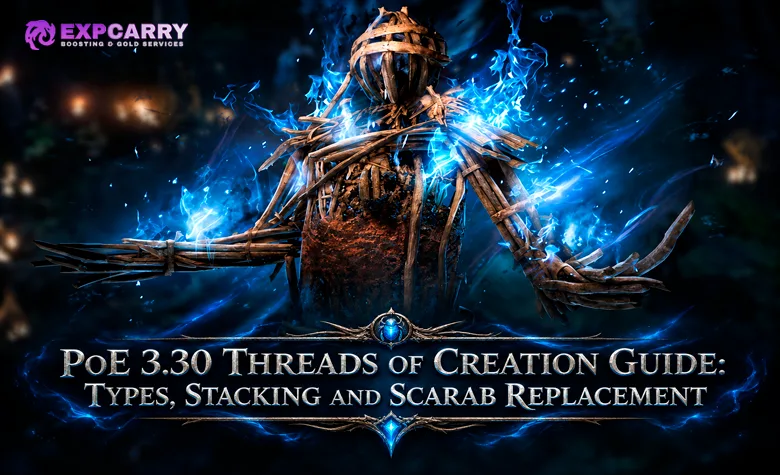
Threads of Creation replace Scarabs in Path of Exile 3.30, changing how players add league mechanics and invest in Atlas maps. Instead of assembling a set of different Scarabs, you spend Threads for the mechanic you want, stacking up to eight of one type under the normal rules. More Threads make that content tougher and increase the chance of powerful randomized effects. Ten Thread types cover Abyss, Bestiary, Betrayal, Blight, Breach, Expedition, Incursion, Legion, Ritual and Ultimatum. Shaped Regions can supply free Threads, while the revised Atlas tree handles many bonuses previously tied to individual Scarabs. This guide is based on GGG's published 3.30.0 notes: Covens of Umbra is scheduled to launch on November 13, 2026 (PST), as stated in the official ExileCon 2026 announcement, so the new economy and optimal farming combinations have not yet been tested on live 3.30 servers.
Short answer: Select a map and configure the chosen Threads in the Map Device, which can automatically draw the required Threads from your stash, then spend more of one type to strengthen its encounter, up to eight normally; you can also combine different mechanics when additional Thread slots are available. Scarabs are removed in 3.30, with old copies converting to corresponding Threads or Frayed Threads, while Shaped Regions and the new Atlas passives provide further ways to improve maps.
What Replaces Scarabs in PoE 3.30?
Threads are consumable map inputs, but they are not a one-for-one recreation of every Scarab modifier. Each Thread names a primary league mechanic. The Thread makes that mechanic available in the map, and additional Threads increase its difficulty, monster rarity and chances of special effects. The specific bonuses that used to be carried by many different Scarabs have instead been moved partly or entirely into the reworked Atlas Passive Tree.
That changes the old preparation routine. A five-Scarab recipe from patch 3.29 is not a valid 3.30 setup just because the underlying mechanic still exists. You now choose the mechanic with its Thread, decide how deeply to invest in it and match the Atlas passives to that plan. GGG lists the conversion and new item rules in the official 3.30.0 patch notes.
The ten primary mechanics also stop spawning randomly in map areas. You need to deliberately enable them through Threads or receive them through a corresponding Shaped Region. Other content, such as Delirium Mirrors and Beyond, follows separate spawn or map-modifier rules; it has not been given an eleventh Thread type.
All 10 Threads of Creation Types
Each Thread is named after the content it enables. The table identifies the encounter you are choosing, rather than promising a particular quantity of rewards. Actual profits will depend on the new Atlas tree, map modifiers, how many Threads you spend and the post-launch market.
| Thread | Mechanic added to the map | Planning consideration |
|---|---|---|
| Abyss Thread | Abyss | Plan for combat around Abyss encounters and their related rewards. |
| Bestiary Thread | Bestiary | Choose this when your build and Atlas are set up for beast encounters. |
| Betrayal Thread | Immortal Syndicate / Betrayal | Useful for Syndicate progression and the rewards from its reworked system. |
| Blight Thread | Blight | Prepare for tower defense rather than pure map-clear speed. |
| Breach Thread | Breach | Favors builds able to clear monsters rapidly within encounter space. |
| Expedition Thread | Expedition | Check remnant modifiers against your build before detonating. |
| Incursion Thread | Incursion | Plan for timed incursions and Temple progression. |
| Legion Thread | Legion | Clear speed and your ability to release targets remain important. |
| Ritual Thread | Ritual | Thread count matters for Blood-Filled Vessel slot access. |
| Ultimatum Thread | Ultimatum | Requires a build that can survive stacking trial modifiers. |
There are no separate Delirium, Harvest, Heist or Strongbox Threads in the announced list. Those mechanics still matter for Atlas farming, but do not confuse their 3.30 changes with a corresponding Thread item. The official Covens of Umbra expansion overview introduces the system as part of the broader endgame overhaul.
How to Use Threads in the Map Device
The Map Device is where you decide which primary league mechanics to force into your map. The demonstrated system provides up to three Thread slots as you progress through the Atlas, with up to eight Threads of a chosen type used for its normal maximum investment. Treat the number of Thread types and the number of Threads spent on one type as different limits.
- Prepare a map: select a map tier and modifiers your build can complete without risking the whole investment.
- Choose a Thread type: pick the mechanic you actually want to run, such as Breach or Expedition.
- Set the Thread quantity: spend a smaller amount for a cheaper map or increase the count for harder encounters and a higher chance of special effects.
- Add other mechanics if available: use additional unlocked Thread slots for different content rather than assuming all your investment must go into one mechanic.
- Check the Atlas region: a matching Shaped Region can contribute free Threads before you decide how many more to commit.
- Open and finish the map: include consumed Threads and other map inputs in your farming costs, even if you found them yourself.
Do not confuse a stack's inventory size with the number actually consumed by one map. The important number is the Thread quantity applied through the Map Device, which can retain your configuration and draw the required Threads from your stash. If your Atlas is still incomplete, Atlas progression is a separate concern from choosing a Thread setup; merely possessing Threads does not award Atlas Passive Points.
Explore services related to this guide, selected from our Path of Exile catalog.
View All Path of Exile Services
How Thread Stacking and Bonus Effects Work
Stacking is the main replacement for old Scarab combinations. More Threads of the same type increase the intensity of that mechanic and raise the chance of randomized transformative effects specific to it. The rules do not say that every extra Thread guarantees one additional encounter or that a fully stacked map always rolls every possible special effect.
Normal Limit: Eight Threads per Mechanic
Under the standard system, up to eight Threads can be spent on one mechanic. One or two Threads are a lower-commitment way to run that content; pushing toward eight is an investment in tougher encounters and better chances of their special modifications. There is no officially published universal percentage gain per additional Thread, so a precise "best value at five Threads" claim would be premature before live testing.
For example, putting multiple Breach Threads into the same map focuses investment on Breach. Choosing Breach and Expedition Threads in separate slots instead provides two different mechanics. Neither setup is automatically more profitable: it depends on Atlas passives, time to complete each encounter, build strengths, Thread prices and the actual rewards.
Unwavering Vision: Two Extra Threads Beyond the Cap
The reworked Unwavering Vision Atlas Keystone changes this trade-off. It allows only one type of Thread to be applied to your maps, gives maps with Threads two additional Threads beyond the normal eight-thread cap, and has a 75% chance for Threads found in your maps to be converted to Gold. This creates a potential ten-Thread focus on a single mechanic, but it is not a free upgrade for players who want several different mechanics or who farm Threads to sell.
Take Unwavering Vision only when you deliberately want a single-mechanic strategy and accept the loss of Thread drops. Do not allocate it just because ten is a larger number than eight.
Ritual Thread Stacks Unlock Vessel Slots
Ritual is a particularly clear example of Thread quantity changing available options, not only encounter difficulty. In 3.30, Blood-Filled Vessels can be added only to maps with Ritual Threads. Maps with at least four Ritual Threads unlock two Blood-Filled Vessel slots, while eight Ritual Threads unlock three slots. If a Ritual plan relies on Vessels, count Threads first and do not prepare the old Vessel setup independently of the new system.
Free Threads From Shaped Regions and Astrolabes
Shaped Regions are an important source of map investment that does not require spending Threads from your inventory. The 3.30 Atlas starts with ten types of Shaped Region, corresponding to the ten Thread types. Maps affected by a region gain free Threads of that region's mechanic.
Completing the Shaped Region objective in one affected map increases the free Thread count by one in the other maps still affected by that region. This creates a route-building decision: completing objectives can strengthen subsequent maps in the same region, so the order you run them matters. It does not mean every map on your entire Atlas gains a permanent extra Thread.
Astrolabes can create a Shaped Region of a specified type around an Atlas map, replacing existing regions of that type. Astrolabe-created regions start with a higher base free Thread count. When fewer than ten Shaped Regions remain, the Atlas also offers a button to regenerate all Shaped Regions. These rules are in GGG's endgame changes, not a community farming estimate.
When planning a batch, compare the free Thread type in a region with the Atlas passives you already have. A strong free Expedition region is more useful to an Expedition-focused setup than to a character whose Atlas investment is almost entirely in Blight. In trade leagues, consider whether to save your own Threads for maps where the region does not provide the same mechanic.
How to Get Threads and What Happens to Old Scarabs
Most sources that previously granted Scarabs are being adapted to award Threads. This gives players several ways to build supplies without relying on one specific mechanic. It also changes which items and rewards are worth checking while mapping.
- Old Scarabs: existing Scarabs convert into a Thread corresponding to their content or into a Frayed Thread. Existing Veiled Scarabs convert into Frayed Threads.
- Frayed Thread: use it to obtain a random Thread, or vendor it for a random Thread. It is a conversion currency, not an eleventh primary mechanic.
- Eater of Worlds altars: relevant modifiers can award Breach, Legion, Blight, Ritual or Incursion Threads from Eldritch monsters or map bosses.
- Searing Exarch altars: the corresponding modifier pool can award Abyss, Expedition, Betrayal, Bestiary or Ultimatum Threads.
- Strongboxes: modifiers that previously granted one to four Scarabs of a particular type instead grant two to five Threads of a type. Operative's Strongboxes have been removed.
- Tormented Heretics: monsters touched by them have a chance to drop Threads, while monsters possessed by them drop additional Threads.
- Betrayal: Rin's Research reward becomes a trapped stash with different Threads and stack sizes; Rin's Fortification reward becomes chests containing Threads.
- Heist: reward chests that previously gave Fragments now give Threads; compatible Heist equipment that doubled Fragments instead doubles Threads.
Several familiar modifiers and storage tools also change name or function. Maven's Chisel of Scarabs becomes Maven's Chisel of Threads and improves Thread quantity found on the map. Skittering Delirium Orb becomes Threaded Delirium Orb and grants Thread rewards. The Fragment Stash Tab receives a Threads section, and the former Scarab section is hidden when empty.
The conversion matters particularly in Standard, where players may have stored Scarabs from previous leagues. Do not assume an old high-priced Scarab remains a special one-off modifier after conversion. Check the resulting Thread type and the new Atlas tree before deciding whether to use or trade it.
Atlas Passives and Mechanics Without Threads
Threads handle access and investment in the ten primary mechanics; Atlas passives handle much of their specialization. Patch 3.30 rebuilds the Atlas Passive Tree, replaces Scarab-related clusters with Thread-related ones and moves many old Scarab effects into the core tree. The number of obtainable Atlas Passive Points also increases to 150.
That means the strongest preparation is not automatically eight Threads of whatever you find. First choose a mechanic, then inspect the passive clusters that affect it, and only then decide how many Threads to spend. A character still completing boss-related milestones can treat Voidstone progression and Atlas Passive Point acquisition as distinct from Thread farming: both influence endgame access, but neither is a Thread item.
The ten primary mechanics no longer appear randomly in maps, but that rule should not be extended to all content. GGG has different Atlas handling for secondary mechanics such as Essence, Harvest, Strongboxes and Torment, and for tertiary mechanics such as Beyond, Delirium Mirrors, Mirage and the Viridian Wildwood. Those are not missing Thread types. Similarly, old Memory Threads are renamed Memory Traces; they are a separate system from Threads of Creation.
Practical Thread Setup for Early and High-Investment Maps
Without a live 3.30 trade economy or measured drop rates, a fixed Divine-Orbs-per-hour tier list would be guesswork. The useful approach is to start with an affordable setup, understand how the region and passives change it, and increase Thread spending only when the character clears reliably.
| Approach | Thread plan | What to check |
|---|---|---|
| Early mapping | One mechanic with a small Thread count, ideally helped by a matching Shaped Region. | Comfortable clears, basic reward consistency and low wasted inputs. |
| Specialized farming | Increase the Thread count of the mechanic supported by your Atlas passives. | Clear time, special-effect frequency and actual sale value of rewards. |
| Mixed-mechanic mapping | Apply different Thread types in available slots. | Whether extra encounters add more profit than the time they cost. |
| Maximum single focus | Eight of one Thread normally, or the extra two from Unwavering Vision. | Survival, reward variance, opportunity cost and the Keystone's Gold conversion drawback. |
Test the exact map setup over a repeatable batch. Record Thread costs at their current trade value, including self-found supplies; add other consumed map inputs; count unsold rare items conservatively; and divide net returns by the full time spent preparing and clearing. Currency spent buying Threads is part of the investment, not an invisible cost. Players who use Chaos Orb supplies for mapping budgets should still compare the currency cost with realistic returns instead of assuming a more expensive Thread stack must be better.
The existing PoE Atlas farming guide explains budget-based testing, but its 3.29 Scarab recipes are historical after the 3.30 change. Do not carry over five-Scarab shopping lists, old Scarab drop values or claimed profit-per-hour results to a Thread-based league.
Thread Farming Mistakes to Avoid
Most wasted map investment comes from treating Threads as merely renamed Scarabs. The important differences are the eight-Thread investment scale, free regional contributions, the new Atlas passive layout and limits on combining content.
- Expecting every primary mechanic to spawn by chance: the ten Thread mechanics no longer have normal random map spawns, so use a Thread or the matching region.
- Assuming eight Threads guarantees the best effects: extra Threads raise probabilities, but the transformative effects remain randomized.
- Ignoring free regional Threads: check the Shaped Region before spending inventory Threads on the same content.
- Taking Unwavering Vision for a mixed strategy: its one-type restriction and 75% Gold conversion chance are major trade-offs.
- Copying a 3.29 Scarab farm: old Scarab combinations, reward sources and Atlas passives no longer transfer directly.
- Comparing gross loot without map costs: higher monster rarity and more difficult encounters do not guarantee higher profit per hour.
Threads of Creation FAQ
These answers cover important setup questions that can be missed when moving from Scarabs to the new Map Device system.
How many Threads can you use on one map in PoE 3.30?
Normally, up to eight Threads can be spent on an individual mechanic. The Map Device supports multiple mechanic choices as Atlas progression unlocks the relevant slots. Unwavering Vision adds two Threads beyond the normal cap but restricts you to one type.
Can Breach, Legion or Expedition spawn without spending a Thread?
They no longer spawn randomly in ordinary map areas. A corresponding Shaped Region can provide free Threads, so a map may contain one of these mechanics without spending a Thread from your inventory.
What does a Frayed Thread do?
It gives a random Thread when used or sold to a vendor. It is not a separate map mechanic and should not be confused with Memory Traces.
Can I still use Blood-Filled Vessels without Ritual Threads?
No. The 3.30 rules require Ritual Threads on the map. Four or more Ritual Threads allow two Vessel slots, while eight allow three.
Conclusion
Prepare 3.30 maps by choosing the mechanic first, matching it with Atlas passives and available Shaped Region bonuses, then spending only as many Threads as the build and budget can support. The normal eight-Thread cap is a scaling option, not a mandatory target, and Unwavering Vision is a specialized exception. Start with reliable clears, measure real costs after launch and replace old Scarab routines with tested Thread setups.