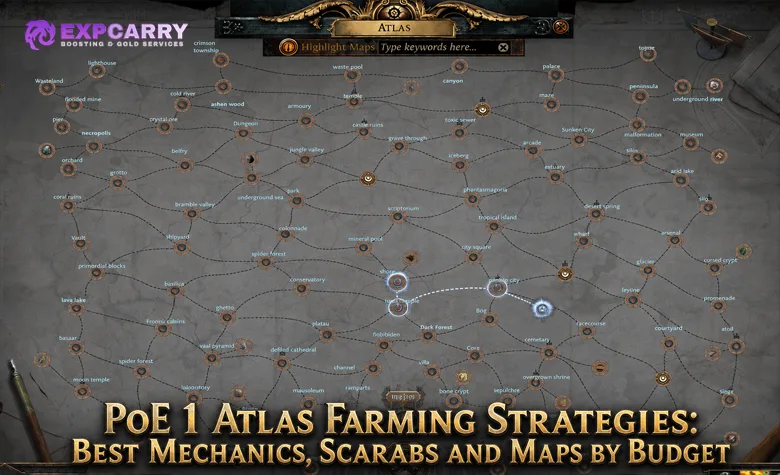
PoE 1 Atlas farming in 3.29 is less about finding one secret strategy and more about matching the mechanic to your build, map speed, and the price of the Scarabs you are buying today. Several older high-investment routes were weakened before or during Curse of the Allflame, while Abyss was rebuilt and then buffed again, Breach lost part of its density scaling, Scrying Orbs changed how Divination Card maps are selected, and the league economy created new demand for Scarabs, Essences, Harvest juice, Charts, and crafting materials. That is why a 3.28 spreadsheet can still look familiar while producing completely different profit in 3.29.
The practical answer is to choose a budget band, buy enough supplies for a fixed batch, run maps without changing the strategy halfway through, and calculate profit from what can actually be sold. For the current 3.29 economy, Essence and low-cost Harvest are practical entry farms, Ultimatum and Stacked Deck farming are documented mid-investment options, and fast Abyss plus Searing Exarch altar farming has shown a high ceiling in player testing. These are routes to match to your build rather than a fixed tier list. The exact Divine Orbs per hour will move with the market, so this page uses dated route setups and transparent test methodology instead of promising a permanent number.
PoE 1 Atlas Farming in 3.29: Current Economy Snapshot
Curse of the Allflame launched with major Atlas changes that directly affect farming. The official 3.29.0 patch notes reworked Abyss, added new Abyss Scarabs and Atlas clusters, added Atlas support and Scarabs for Mercenaries, weakened several Breach density passives, introduced Scrying Orbs, and rotated the Atlas map pool. Those changes are why this guide treats 3.29 as a new farming state rather than a continuation of Mirage.
This 3.29 snapshot is built for the September 1, 2026 trade environment, with 3.29.3 already live, and uses documented community tests from late July through the end of August as comparison points. Those tests are evidence that the routes can work, not a promise that the same Scarab prices or Divine-per-hour results still apply to your next batch.
The strategies covered here fall into five useful buckets. The budget labels below are operational rather than fixed market prices: Scarab prices can move enough in one day to shift a strategy from low to mid investment. Use the bands to decide how much variance your bankroll can absorb, then price the actual inputs before buying a batch.
| Strategy | Budget | Core setup | Best map style | Build requirement | 3.29 role |
|---|---|---|---|---|---|
| Essence | Low | Essence Scarabs + Essence Scarab of Ascent + Essence Scarab of Stability | Linear maps such as Silo or Strand | Decent single-target damage | Reliable sellable crafting materials |
| Harvest rush | Low | Harvest Scarab, optional cheap fragment | Fast boss access such as City Square | Safe T16 clear, no extreme DPS needed | Low setup cost and liquid juice |
| Ultimatum | Mid | 2 Bribing, 1 Inscription, 2 Kalguuran | Compact map such as Jungle Valley | High recovery and strong defenses | Consistent encounter-value farm |
| Stacked Decks | Mid | 4 Divination Scarabs of the Cloister | Fast clear with minimal backtracking | High clear speed | Simple bulk-sale output |
| Abyss + Red Altars | High | 2 Horned Scarabs of Nemeses, 2 Scarabs of Adversaries, 1 Scarab of Monstrous Lineage | Jungle Valley-style fast full clears | Very fast T16 clear and altar tolerance | High ceiling from density, Scarabs and altar spikes |
The key observation is that the best high-end strategy is not automatically the best strategy for a weaker character. If a 40-second encounter becomes a three-minute fight or a map requires two extra portals, the expensive setup loses its advantage. Profit per map and profit per hour are different metrics.
Budget Rules Before You Choose a Farming Strategy
A farming budget should be defined by how many failed maps you can absorb, not by one arbitrary Chaos Orb threshold. The safest rule is to buy a complete 20-map batch without spending the currency reserved for character upgrades, then keep enough liquid currency to buy the next batch if the first returns are temporarily below average.
- Low investment: the strategy still works with cheap or partial Scarab sets and does not rely on rare map preparation.
- Mid investment: buy a complete Scarab package for every map and prepare the map layout around the mechanic.
- High investment: premium Scarabs, map rolling, chisels, Delirium, influence, or rarity scaling are part of the expected return.
If buying the next 20 maps requires selling gear from your character, the strategy is above your bankroll. A lower-profit farm that you can run continuously is better than a theoretically stronger farm that stops after six maps because the input cost emptied the stash.
Players who still lack Atlas points or the map access needed for a full farming tree can use a focused PoE Atlas progression option for the missing objectives. For self-play, the existing PoE 1 Atlas Passive Tree guide explains how to separate progression, bossing, and farming across the three Atlas loadouts.
Best Low-Investment Atlas Farming Strategies
Low-investment farming should produce liquid rewards without requiring a premium map-preparation package. Essence and Harvest fit that role in 3.29 because both can start with cheap inputs, scale gradually, and generate crafting materials that are consistently traded.
Low-Investment Strategy 1: Essence Farming
Essence remains one of the easiest farms to understand because most of the value is visible and easy to price. You are not waiting for a rare jackpot item to make the batch profitable. The main requirement is enough single-target damage to kill heavily modified Essence monsters without turning every map into a boss fight.
Recommended 3.29 Essence Scarabs
For a five-slot setup, the common 3.29 community route is three base Essence Scarabs, one Essence Scarab of Ascent, and one Essence Scarab of Stability. If your Map Device has fewer available slots or the market makes the full set too expensive, prioritize Ascent and fill the remaining slots with base Essence Scarabs.
- 3x Essence Scarab for more Essence encounters.
- 1x Essence Scarab of Ascent so Essences found in the area are one tier higher.
- 1x Essence Scarab of Stability so corrupting an Essence can only upgrade or transform it.
A more expensive variant replaces part of the cheap package with Scarabs of Adversaries plus Essence Scarab of Calcification. Do not move to that version until the character kills stacked Essence rares comfortably, because the extra map cost is wasted if the encounter slows the run dramatically.
Best maps for Essence
Silo and Strand are strong examples because their layouts make it difficult to miss a frozen Essence monster and do not require much backtracking. A compact or linear layout matters more than the theoretical Divination Card pool because Essence profit comes from encounters completed per hour.
At higher map tiers, especially once Voidstones and Eldritch influence are online, you also gain influence progress, higher-tier map drops, and access to Atlas Anomalies from maps affected by a Voidstone, plus other endgame rewards if the build handles them comfortably. A weaker build can begin lower and move upward once kill time becomes stable. The mechanic does not become good only at Tier 16.
What to sell
Price Essences in bulk rather than one at a time. Corruption outcomes such as Insanity, Horror, Delirium, and Hysteria can create a meaningful part of the batch value, so track the Essences you corrupt instead of valuing every purple Essence as if it will convert successfully.
Low-Investment Strategy 2: Harvest Rush
Harvest is a useful low-budget farm because the input cost can remain small while the output is liquid. Lifeforce is used continuously by crafters, so the strategy does not depend on identifying rare items or waiting for one unique buyer. The main variable is how quickly you reach and clear the Sacred Grove.
Simple 3.29 Harvest setup
A current low-cost route uses a Harvest Scarab and, optionally, an inexpensive Sacrifice Fragment for its Map Item Quantity bonus, then puts most Atlas points into Harvest reward scaling plus whichever influence or boss package is already useful to the character. A late-August community test used high-quantity eight-mod Tier 16 City Square maps, killed the bosses first, rushed the Grove, and ignored low-value detours.
That test reported a very high return for its hour, but it should not be copied as a guaranteed rate. Lifeforce prices, plot quality, map quantity, player speed, and altar value all affect the result. The useful part is the route design: boss, Grove, exit. Do not spend another minute clearing the opposite corner of the map if the strategy is supposed to be Harvest rushing.
Build requirement
Harvest does not require extreme screen-wide clear, but it does punish weak defenses when map modifier effect and difficult seed monsters stack together. Use eight-mod maps only if the build can actually run their modifiers. A safe rare map with slightly lower quantity produces more profit than an eight-mod map that causes repeated deaths or skipped plots.
If the goal is simply to farm currency for a build upgrade rather than learn one specific mechanic, a PoE hourly farming option can be used for an agreed progression target. For self-play, Harvest is one of the better mechanics for learning the difference between gross revenue and real profit because both the inputs and outputs are easy to record.
Best Mid-Investment Atlas Farming Strategies
Mid-investment routes ask you to buy the full Scarab package before the batch begins, but they should still survive a few weak maps without threatening the bankroll. Ultimatum favors defensive characters, while Stacked Deck farming rewards speed and simple bulk liquidation.
Mid-Investment Strategy 1: Ultimatum on Jungle Valley
Ultimatum is a good mid-budget choice for characters that are much tankier than they are fast. The encounter rewards surviving escalating modifiers inside a confined arena, so raw movement speed matters less than recovery, mitigation, ailment handling, and the ability to keep dealing damage while mechanics overlap.
Scarab setup
One documented 3.29 community test used two Ultimatum Scarabs of Bribing, one Ultimatum Scarab of Inscription, and two Kalguuran Scarabs. The tester ran white Tier 16 Jungle Valley maps to keep the encounter safer and reported roughly 5.3 Divine Orbs of profit per hour after approximately 1.2 Divine Orbs of hourly input cost at that test's market prices.
- 2x Ultimatum Scarab of Bribing.
- 1x Ultimatum Scarab of Inscription.
- 2x Kalguuran Scarab.
That number is a sample, not a forecast. Its value is that the input package and test duration are known. Re-price the five Scarabs before copying it, because a strategy posted publicly can become worse simply because thousands of players start buying the same inputs.
Who should run it
Choose Ultimatum if the build has strong recovery, capped defenses, reliable damage while moving, and no major weakness to the trial modifiers you accept. Avoid it on a fast but fragile bow build just because the reported profit looks attractive. Every failed late-round encounter destroys the advantage of the mid-investment setup.
Mid-Investment Strategy 2: Stacked Deck Farming
Stacked Deck farming is attractive because the primary output is easy to count and bulk-sell. It also rewards fast clearing more than boss damage, making it a natural alternative for builds that destroy packs but do not want to fight heavily modified rares or stand inside Ultimatum circles.
Cloister Scarab setup
A documented early-3.29 test used four Divination Scarabs of the Cloister per map across a 20-map batch. The logged test reported approximately 11 Divine Orbs of hourly revenue against about 5.9 Divine Orbs of hourly cost, leaving roughly 5.2 Divine Orbs per hour at the prices used in that test.
The important warning is input inflation. Cloister Scarabs can re-price rapidly when the strategy becomes popular, so never use the old profit number with today's Scarab price. Calculate the map cost first, then compare the expected Stacked Deck output at the current bulk sale rate.
Best map style
Use fast, compact layouts with minimal doors, dead ends, or long boss phases. Stacked Deck farming rewards maps per hour. If your build has excellent clear but spends 90 seconds navigating an awkward layout, change the map before changing the build.
Explore services related to this guide, selected from our Path of Exile catalog.
View All Path of Exile Services


Best High-Investment Strategy: Abyss and Searing Exarch Altars
The clearest high-investment 3.29 mapping example combines monster density, Scarab returns, and Searing Exarch altar spikes. Abyss is useful here because the rework produces large numbers of monsters without the old crack-chasing pattern, while the altar package turns those additional packs into more chances at high-value Scarab and currency modifiers.
This is also where the 3.29 follow-up matters. The official 3.29.1 patch notes increased the quality and quantity of Abyss chest rewards, especially Currency and Scarabs, added three reward chests after Abyssal Depths bosses, and shortened the old Lich immunity sequence. Patch 3.29.2 then improved Abyss Scarab of Crystals so every non-final Abyss Pit creates an Abyssal Crystal when it closes.
Current fast-mapping Scarab setup
A late-3.29 player test used two Horned Scarabs of Nemeses, two Scarabs of Adversaries, and one Scarab of Monstrous Lineage. The maps were rolled for at least 80% increased Scarabs, given one Maven’s Chisel of Scarabs and one Delirium Orb for more monsters, then cleared at roughly 20 maps per 60-70 minutes.
- 2x Horned Scarab of Nemeses.
- 2x Scarab of Adversaries.
- 1x Scarab of Monstrous Lineage.
- 1x Maven’s Chisel of Scarabs on each prepared map.
- 1x Delirium Orb to add monsters.
- Map target: at least 80% increased Scarabs, with useful secondary "more" modifiers when possible.
The player reported approximately 35-45 Divine Orbs of revenue from 20 maps against 10-15 Divine Orbs of cost, which produced a claimed 20-30 Divine Orbs per hour at that clear speed. Roughly half the reported profit came from Searing Exarch altar value rather than Abyss itself. That distinction is critical: copying only the Abyss points and ignoring altar speed does not reproduce the strategy.
Why Jungle Valley works
Jungle Valley is useful because it supports rapid pack clearing and good altar routing. The player behind the test specifically used the map for the strategy and described finding Abyss early as a way to generate more Exarch packs while moving through the map.
This strategy is not recommended for a build that takes four or five minutes per map. The reported economics assumed around 20 maps per hour. If your character needs twice as long, the same per-map profit can become a mediocre hourly farm while still exposing you to the same premium input cost.
High-rarity Abyss variant
A separate 3.29.1 community setup used two Horned Scarabs of Nemeses, one Scarab of Wisps, one Abyss Scarab of Multitudes, and one Abyss Scarab of Crystals on high-rarity, high-pack-size maps with a Lightless Astrolabe and substantial item rarity on gear. That route is a higher-variance unique-item hunt rather than the safer Scarab-and-altar model above.
Do not treat a Mageblood screenshot or one Tier 0 drop as an expected return. The reason to use the rarity version is because your build and bankroll can tolerate a long dry streak, not because a rare unique appeared in somebody else's test.
Choose the Map, Atlas Tree and Strategy for Your Build
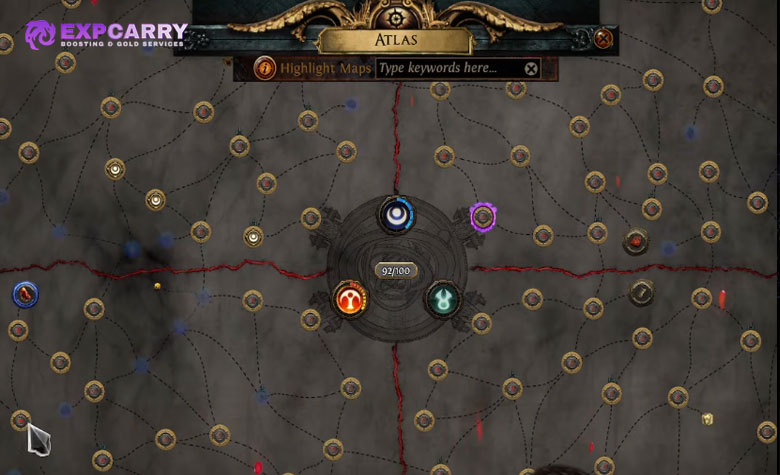
A farming route only works when three pieces agree: the map layout must suit the mechanic, the Atlas tree must concentrate enough points into the reward source, and the character must clear that content at the speed assumed by the investment. Treat these as one decision rather than three independent optimizations.
Best Maps for 3.29 Farming by Mechanic
Map choice should reduce the time your chosen mechanic wastes. The 3.29 Atlas rotated the map pool, explicitly bringing back maps such as Toxic Sewer while removing a different set of previous Atlas locations. Current maps such as Silo, Strand, City Square, and Jungle Valley are still useful because of their layouts, but they should not all be described as maps that returned in 3.29. Do not keep running a famous 3.28 map simply because an old guide named it.
- Jungle Valley: strong for fast Exarch altar, Ultimatum, and dense mapping strategies.
- City Square: useful for boss-first routes and quick Harvest access when the Grove appears.
- Silo: linear layout that makes Essence monsters difficult to miss.
- Strand: simple linear route for Essence, Legion-style clear, and low-backtracking farms.
- Toxic Sewer: compact layout that suits RF and other builds that thrive in narrow dense maps.
Divination Card farming is more flexible in 3.29 because Scrying Orbs can transfer one map's Divination Card pool to another Atlas map. The 3.29 Atlas tree added Altered Prophecy, whose notable gives completed Tier 14+ maps a 4% chance to drop a Scrying Orb. That means a good layout no longer has to be abandoned only because its native card pool is weak.
The PoE mapping guide covers the current generic Map-item system, Voidstones, Nightmare Maps, and sustain rules. Those systems matter because an efficient farm must replace its maps rather than buying every map at a premium.
How to Build the Atlas Tree for Any Farming Strategy
The farming tree should concentrate on one primary mechanic, one compatible secondary reward layer, and the map or influence package that improves both. Splitting points among five mechanics produces more variety but usually weaker economics because each encounter appears without enough scaling.
Use the official Path of Exile Atlas Skill Tree to search the live node text before copying any 3.29 route. Search for the mechanic name, then compare the point cost of reaching its important notables with the points spent on map modifier effect, Scarabs, influence, boss rewards, and sustain.
Tree One: stable income
Use one tree for low-investment mapping such as Essence or Harvest plus map sustain and influence. This is the tree you can run when Scarab prices spike or the character is not ready for dangerous high-investment maps.
Tree Two: boss and invitation value
Keep boss-map, Maven, guardian, or invitation routing on a separate loadout. A boss tree wastes too many points if it is also expected to be a perfect Essence or Abyss tree.
Tree Three: high-investment project
Reserve the third loadout for the expensive strategy: Abyss plus Exarch, Divination Card farming, Rogue Exile/Mercenary projects, or another market-dependent setup. This lets you stop buying overpriced Scarabs and switch farms without paying to rebuild the entire Atlas every day.
Build Requirements Matter More Than the Farming Tier List
A strategy is only profitable when the build clears the mechanic at the speed assumed by the setup. Before buying 20 maps of Scarabs, test two or three maps with cheaper inputs and measure the actual bottleneck.
| Build profile | Best mechanics | Avoid until upgraded | Main performance metric |
|---|---|---|---|
| Low single-target, strong clear | Stacked Decks, light Harvest, fast altars | Heavy Essence, late Ultimatum | Maps per hour |
| Strong single-target, average clear | Essence, boss rush, controlled Harvest | Density farms that require 20 maps/hour | Encounter kill time |
| Tanky sustain build | Ultimatum, Harvest, dangerous rare maps | Speed-only strategies if movement is slow | Failure rate |
| Fast endgame mapper | Abyss + Exarch, Cloister, density strategies | Slow menu-heavy mechanics | Portal-to-portal time |
| Magic-find / rarity build | High-rarity Abyss and unique-focused projects | Mechanics whose rewards ignore rarity | Large-sample realized value |
Do not spend another 20 Divine Orbs making a bossing build slightly stronger if the farm is limited by looting and map loading. Conversely, do not chase movement speed when Essence rares are taking 45 seconds each. Upgrade the stat that improves the farm's actual time bottleneck.
How to Calculate Profit and Re-Price Scarab Strategies
Economic farming pages become outdated when they preserve one profit number but ignore input inflation. Use a fixed-batch ledger for every route and treat Scarabs as live market inputs whose opportunity cost can turn a previously excellent strategy into a bad buy.
How to Calculate Real Profit Per Hour
The only trustworthy farming number is one you can reproduce from a batch. Use at least 20 maps for low-variance farms and more for strategies whose value depends on rare drops. A one-map jackpot is not a farming rate.
- Price the complete input batch before starting. Include maps, Scarabs, chisels, Delirium Orbs, fragments, map rolling, and Map Device costs.
- Start a timer when the first map opens. Stop only when the last map is looted and you are ready to open the next batch.
- Record stackable outputs at realistic bulk prices. Scarabs, Essences, Lifeforce, currency, Stacked Decks, fragments, maps, and invitations are easy to value.
- Value rare items conservatively. A rare item that has not sold is not the same as liquid currency.
- Separate gross revenue from profit. Profit equals revenue minus all inputs.
- Divide by total session time. Include normal looting and stash time if those actions are part of the strategy.
- Repeat the batch. Compare three 20-map samples before calling a strategy stable.
The formula is simple: Profit per hour = (realistic sell value - total input cost) / total hours. The difficult part is realistic sell value. If an item is listed for 40 Chaos but only moves at 25 Chaos in bulk, use 25. If you have 300 low-value Scarabs that you refuse to sell, they are inventory value, not realized profit.
Example of a transparent 20-map ledger
Suppose a 20-map high-investment batch costs 12 Divine Orbs after maps, Scarabs, rolling, chisels, and Delirium. The stash value after the batch is 39 Divine Orbs, but 3 Divine Orbs are speculative rares that have not sold. Count 36 Divine Orbs of liquid or realistically saleable revenue until those rares sell.
36 revenue - 12 cost = 24 Divine Orbs profit. If the batch took 75 minutes, divide 24 by 1.25 hours: 19.2 Divine Orbs per hour. If the same strategy takes your build two hours, the rate falls to 12 Divine Orbs per hour without any change in drops.
Scarabs: When a Good Strategy Becomes a Bad Buy
Scarabs are not merely inputs; they are part of the live economy. A public strategy often becomes less profitable after publication because more players buy its Scarabs and sell its outputs. The map itself did not change. The margin changed.
Before buying a large batch, compare the price of the full five-Scarab set with the median output of your last batch. If input cost rises faster than output prices, reduce the expensive Scarab, move to a cheaper variant, or switch Atlas loadouts entirely.
- Do not buy 100 maps of supplies before testing 20.
- Do not value self-found Scarabs at zero. Using a Scarab has an opportunity cost because you could sell it.
- Do not keep a premium Scarab because a guide says it is mandatory. Recalculate its marginal value at today's price.
- Sell Scarabs when the buyer has the better strategy. Sometimes supplying high-investment farmers is the best low-investment farm.
This is one reason current 3.29 players report that even casual mapping can make money by selling the Scarabs demanded by high-end routes. You do not have to consume every valuable Scarab that drops.
What Not to Copy Blindly From Older Farming Guides
Several familiar farming recommendations are outdated or at least repriced in 3.29. The mechanic may still work, but the old expected profit does not survive changes to pack size, rewards, Atlas nodes, or Scarab demand.
Breach is no longer the automatic high-investment answer
Patch 3.29 reduced Swelling Ranks from 20% to 10% increased Breach Monster Pack Size and reduced other Magic/Rare monster scaling in the Breach Atlas clusters. Breach can still be good for fast clear builds and specific goals, but old Mirage-era high-juice numbers should not be carried forward.
Abyss should not be judged by its launch-day state
Abyss received a full mechanical rework in 3.29 and significant reward buffs in 3.29.1. A guide written on July 24 can already be meaningfully outdated if it evaluated Abyss before the chest and Depth changes.
Old Divination Card map logic is incomplete
Scrying Orbs let players move a map's card pool onto another Atlas map. The correct question is now "which layout do I want to run and which card pool can I Scry onto it?" rather than only "which map naturally drops the card?"
Do not confuse PoE 1 farming with PoE 2
This page is specifically for Path of Exile 1. Scarabs, the PoE 1 Atlas Passive Tree, Voidstones, Searing Exarch altars, Essences, Harvest, Ultimatum, and the 3.29 Curse of the Allflame economy should not be mixed with Path of Exile 2 endgame systems.
How This Page Should Update for PoE 1 3.30
The URL should remain evergreen. When 3.30 launches, the update should replace the patch-specific economy snapshot rather than publishing another competing "best Atlas farm" page. Farming search intent does not change because the league number changes; the profitable inputs do.
- Re-check the 3.30 Atlas and Scarab patch notes. Remove any setup whose mechanic or Scarab changed.
- Re-price every five-Scarab package. Do not carry September 3.29 costs into a fresh economy.
- Run new 20-map samples. Replace the current community snapshots with 3.30 batches.
- Re-rank maps. Atlas rotation can remove or reintroduce important layouts.
- Re-check Scrying and Divination Card pools. Card location changes can alter the best mapping layout.
- Preserve the profit formula. Batch accounting, bankroll rules, build matching, and realized-profit math remain valid.
The existing PoE 1 3.30 endgame and loot rework tracker is the separate page for future 3.30 endgame and loot changes. Until 3.30 is live, do not abandon a profitable 3.29 strategy because a future reward source might change.
If a character needs liquid currency for mapping supplies rather than another gear change, the PoE Chaos Orb option is directly related to map and Scarab purchasing. For self-farming, keep enough Chaos liquid that one market swing does not force you to stop the batch midway.
PoE 1 Atlas Farming FAQ
These answers focus on the farming questions players are asking during 3.29 and on the rules that will remain useful when the economy changes.
What is the best Atlas farming strategy in PoE 1 3.29?
There is no single best strategy for every build. Essence and low-cost Harvest are strong low-investment choices, Ultimatum and Stacked Decks fit mid investment, and fast Abyss plus Searing Exarch altar farming currently has a high reported ceiling for strong mappers.
What is the best low-budget farm in PoE 3.29?
Essence is the easiest recommendation if your build has enough single-target damage. Harvest is another strong option if you want liquid crafting currency and can rush the Sacred Grove quickly.
What Scarabs should I use for Essence farming?
A common five-slot setup is three Essence Scarabs, one Essence Scarab of Ascent, and one Essence Scarab of Stability. If you have fewer slots or a smaller budget, prioritize Ascent and base Essence Scarabs.
What is a good mid-budget farming strategy?
Ultimatum works well for tanky builds, while four Divination Scarabs of the Cloister can support a straightforward Stacked Deck farm for fast-clear builds.
What is the best high-investment map farm in 3.29?
A late-3.29 community test using Abyss density, Searing Exarch altars, two Horned Scarabs of Nemeses, two Scarabs of Adversaries, one Scarab of Monstrous Lineage, a Maven’s Chisel of Scarabs, and a Delirium Orb reported 20-30 Divine Orbs per hour at roughly 20 maps per hour. Treat that as a tested snapshot, not a guaranteed rate.
Which maps are best for farming?
Jungle Valley is strong for fast altar and Ultimatum routes, City Square suits boss-first Harvest rushing, and Silo or Strand are easy linear choices for Essence. The best map is the layout your build clears with the least backtracking.
Is Breach still good in 3.29?
It is still playable, but 3.29 reduced multiple Breach density values, so older high-investment Mirage-era profit claims are not reliable. Compare its current Scarab cost and your actual clear speed before committing.
Is Abyss worth farming in 3.29?
Yes, especially after the 3.29.1 reward improvements to Abyss chests and Depths. It is strongest for builds that can exploit the added density without slowing down.
How many maps should I test before judging a strategy?
Use at least 20 for stable-output farms and more for high-variance unique or Divination Card farms. Three separate 20-map batches are much more informative than one lucky hour.
Should self-found Scarabs count as zero cost?
No. They have an opportunity cost because you could sell them. Count the current realistic sale value when calculating whether consuming them was profitable.
How do I calculate Divine Orbs per hour?
Subtract total map and Scarab inputs from realistic sellable revenue, then divide by the full session time. Do not count unsold rare items at optimistic listing prices.
Will this guide get a new URL for 3.30?
No. The strategy page should keep its evergreen URL and replace the 3.29 economy snapshot, Scarab packages, map rankings, and test results when 3.30 changes the market.
Conclusion
PoE 1 Atlas farming in 3.29 rewards specialization more than copying the highest Divine-per-hour screenshot. Start with Essence or Harvest if the bankroll is small, move into Ultimatum or Stacked Decks when the character and supply budget are stable, and use high-investment Abyss plus Searing Exarch altars only when the build can maintain the fast mapping speed that makes the setup work. Jungle Valley, City Square, Silo, Strand, and Toxic Sewer are useful because their layouts match specific mechanics, not because one map is universally best.
The durable farming skill is accounting. Buy a fixed batch, record every input, value only rewards you can realistically sell, measure total session time, and repeat the test before changing strategies. Scarab prices and loot values will move throughout 3.29 and will move again in 3.30, but the method does not change: choose a farm your build can execute, calculate its real margin, and switch when the market makes another use of your time or Scarabs more valuable.