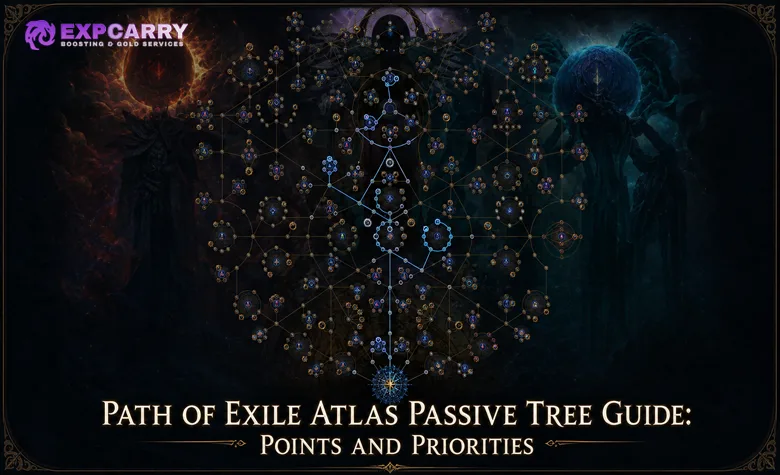
The Path of Exile Atlas Passive Tree determines what appears in your maps, how often selected mechanics occur, and how strongly those encounters are rewarded. A good first tree is not a collection of the most profitable-looking notables. It is a progression tool that must first keep maps dropping, help the character reach higher tiers, and only then concentrate points into a farming strategy.
In the current Atlas, a character can earn up to 138 Atlas Passive Points. The first 100 come from bonus objectives on regular maps, while the remaining points are tied to unique maps, Nightmare Maps, Maven Invitations, and major endgame bosses. Because the late points require much stronger encounters, a practical tree should work at 60 to 100 points and improve as the final objectives are completed.
Patch status: This guide was checked against Path of Exile 3.29 on August 23, 2026. It reflects the major Atlas rework introduced in 3.28, including generic Map items, the removal of Favoured Maps and Kirac Atlas Missions, plus the 3.29 Atlas changes such as Altered Prophecy, Scrying Orbs, reworked Abyss clusters, and Atlas support for Mercenaries. Always inspect the live node text before copying an older tree because a familiar notable can receive a new value or mechanic.
Path of Exile Atlas Passive Tree Overview
The Atlas tree affects maps opened by the player whose Map Device is used. It does not add power directly to the character in the way the regular passive tree does. Instead, it changes map sustain, encounter frequency, monster density, rewards, bosses, Scarabs, and the risk created by map modifiers.
| Atlas Goal | What to Prioritize | Why It Matters |
|---|---|---|
| Reach higher map tiers | Map tier, increased Maps found, and map drop passives | Keeps enough Map items dropping while progression moves into higher tiers |
| Complete bonus objectives | Atlas routing, correct map rarity, and Kirac's shop | Regular map objectives provide the largest share of Atlas points |
| Build an early economy | One or two reliable mechanics with low entry cost | Concentrated investment produces more useful rewards than scattered nodes |
| Farm red maps | Influence, Scarab support, map modifiers, and selected league mechanics | Turns progression into a repeatable strategy |
| Farm bosses | Witnessing, special map drops, invitations, and boss rewards | Supports access to late Atlas points and repeatable boss encounters |
| Change strategies | Separate Atlas loadouts, Gold respecs, and Orbs of Unmaking | Avoids forcing mapping, bossing, and special projects into one tree |
The official Path of Exile Atlas Skill Tree is the safest place to confirm current node wording and build a route. Use its search function to highlight a mechanic, then count the travel points needed to reach the important notables rather than judging a cluster in isolation.
How to Earn All 138 Atlas Passive Points
Atlas points do not come from character levels. Most are awarded when an Atlas objective is completed for the first time in the league, so repeating a completed map does not award another point. The current total is divided among regular maps, selected unique maps, Nightmare Maps, Maven encounters, and endgame bosses.
| Point Source | Maximum Points | Completion Rule |
|---|---|---|
| Regular map bonus objectives | 100 | Complete each eligible map at the rarity required by its tier |
| Unique maps | 10 | Complete 10 different qualifying unique maps on the Atlas |
| Nightmare Maps | 5 | Complete each of the five Nightmare Maps for its first-time Atlas point |
| Maven Atlas Invitations | 5 | Complete the 3, 4, 5, 6, and 10-boss Atlas Invitations through Kirac |
| Special Maven Invitations | 6 | Complete The Formed, The Twisted, The Elderslayers, The Forgotten, The Remembered, and The Feared |
| Pinnacle and quest bosses | 12 | Earn first-kill Atlas Books from The Infinite Hunger, The Black Star, The Eater of Worlds, The Searing Exarch, The Maven, Uber Elder, and the three Incarnations |
The regular map objectives are the foundation because they are numerous and can be earned while naturally moving through the Atlas. The other 38 points should be treated as progressive upgrades, not as a requirement before a farming tree can function. Many effective strategies are already complete at roughly 100 to 115 points.
If the point total appears wrong, enter /atlaspassives in chat. The command separates the main categories and makes it easier to identify whether the missing point belongs to a map objective, an invitation, or a boss. Also inspect the Atlas carefully for an incomplete map before assuming that the reward failed.
Atlas Bonus Objective Requirements

Simply killing a map boss is not always enough. The Map item must meet the bonus condition associated with its tier when the boss is defeated. Preparing Map items correctly before opening them prevents wasted completions and reduces the amount of backtracking needed later.
| Map Tier | Required Map State | Safe Preparation |
|---|---|---|
| Tier 1 to Tier 5 | Magic or higher | Use an Orb of Transmutation and check the modifiers |
| Tier 6 to Tier 10 | Rare or higher | Use an Orb of Alchemy, then reroll modifiers the build cannot run |
| Tier 11 to Tier 16 | Rare and corrupted | Make the map Rare, verify its modifiers, then use a Vaal Orb |
Corruption can change a red-tier Map item, add modifiers, or produce a result the build cannot complete. Keep spare Tier 11 to Tier 16 Map items when possible and do not corrupt the only usable item for an important objective until the character can handle several possible outcomes. A completed map and a completed bonus objective are separate states, so confirm the visual objective marker rather than relying on memory.
Since 3.28, regular Map items are generic by tier rather than tied to one specific Atlas area. Select an uncompleted map location on the Atlas, then use a Map item of the required tier to open it. Kirac no longer offers Atlas Missions, but his shop sells a wider range of map-related items and can be rerolled with Gold. Three Map items of the same tier can still be sold to a vendor for one Map item one tier higher, so duplicates remain useful for progression.
Explore services related to this guide, selected from our Path of Exile catalog.
View All Path of Exile Services


Best First Atlas Passive Priorities
The first tree should solve access before profit. A player who spends the opening points on several distant league mechanics can create exciting maps but still become trapped in low tiers. Early routing should take efficient map progression nodes first, then add content that the build can clear without expensive Scarabs or dangerous map modifiers.
- Take map tier passives first: Shaping the Mountains, Shaping the Skies, and Shaping the World remain standard progression targets when their current paths are efficient. Their tier-up effects improve low- and mid-tier map drops and help accelerate access to red maps.
- Add general map-drop support: Use nearby small passives that increase Maps found while the Atlas is still incomplete. The old small passives for additional connected maps were changed in 3.28.
- Use Shrines for temporary power: Shrine clusters improve clear speed and survivability without asking the character to defeat a separate difficult encounter.
- Select one low-investment mechanic: Strongboxes, Essences, Harvest, Expedition, or another mechanic the build handles well can provide the first consistent reward layer.
- Add a second compatible mechanic: Only expand after map sustain feels stable and the first mechanic has enough points to function properly.
This order is a framework rather than a fixed number-by-number route. Travel efficiency, build strength, available Scarabs, point total, and the current tree layout all change the exact path. The important rule is that every early detour must justify the points it consumes.
When missing maps or unfinished objectives make progression repetitive, a focused PoE Atlas completion option can be considered for only the blocked objectives. The rest of the tree should still be planned around the content the character will run after those points are earned.
Atlas Point Priorities by Progression Stage
A useful Atlas tree changes purpose as more points become available. The early version opens the Atlas, the middle version establishes an economy, and the finished version converts maps, Scarabs, and player time into a specialized farming loop.
| Available Points | Main Priority | What to Avoid |
|---|---|---|
| 0 to 30 | Map tier progression, increased Maps found, and short efficient routes | Long travel paths and high-risk keystones |
| 30 to 60 | Finish core map support and establish one reliable mechanic | Splitting points among four or five incomplete mechanics |
| 60 to 90 | Add a second compatible mechanic, Shrines, influence, or Scarab support | Scaling difficulty beyond the build's defenses and damage |
| 90 to 110 | Complete the main farming package and remove obsolete progression points | Keeping early sustain nodes that no longer solve a real problem |
| 110 to 138 | Add premium reward, boss, quantity, or map modifier clusters | Assuming every final point has equal value for every strategy |
Do not refund all map progression nodes the moment the first Tier 16 Map item drops. Remove them gradually after map supply, Voidstones, bonus-objective completion, and the intended farming loop are stable. If removing a cluster immediately creates a map shortage, the tree was changed too early.
The final 20 to 30 points usually improve efficiency rather than define the strategy. They can complete an influence branch, add Scarab generation, strengthen map bosses, or raise the reward ceiling through map modifier effect. A character does not need 138 points before it can farm effectively.
How to Choose the Right Atlas Mechanics

The best mechanic is one that matches the build, map layout, budget, and preferred level of interaction. Reward value alone is not enough. A mechanic that takes too long, causes repeated deaths, or produces items the player does not want to trade can be worse than a simpler alternative.
| Build or Goal | Suitable Mechanics | Reason |
|---|---|---|
| New or undergeared character | Shrines, Strongboxes, moderate Harvest, and controlled Essences | Simple access and adjustable encounter difficulty |
| Fast clearing build | Legion, Breach, Delirium, and dense influenced maps | Wide coverage and mobility convert extra monsters into efficient clears |
| Strong single-target build | Essences, Bestiary targets, map bosses, and invitations | Damage is concentrated into fewer valuable enemies |
| Damage over time or mobile build | Expedition, Ritual, Harvest, and arena encounters | The build can continue dealing damage while repositioning |
| Solo Self-Found progression | Essence, Harvest, Expedition, Betrayal, and map sustain | Rewards support crafting and character development without trade |
| Boss-focused character | Maven witnessing, guardian maps, conqueror maps, invitations, and boss reward nodes | Creates access to encounters that match the character's strongest damage profile |
Mechanics should also complement each other operationally. Legion and Breach reward fast open-layout clearing. Expedition and Harvest add pauses but can produce controlled, tradable reward types. Strongboxes and Shrines fit into many routes because they require little setup. A tree with conflicting rhythms can be profitable on paper and still feel slow in practice.
Before specializing, run the mechanic several times without full investment. Measure clear time, deaths, reward sorting, and the effort required to buy or sell materials. If the character is the limiting factor rather than the Atlas, a PoE build planned around specific endgame content can align defenses, damage, and clear style with the intended farming loop.
Map Sustain and Atlas Progression
Map sustain is the ability to replace the Map items being consumed while continuing to move toward useful tiers and layouts. It depends on more than one passive cluster. Bonus-objective completion, which grants +1% Map Item Quantity for every four completed bonus objectives, map boss kills, passives that increase Maps found, Voidstones, Scarabs, and correct map rolling all contribute.
During early progression, use suitable-tier Map items to complete uncompleted Atlas locations before repeatedly farming finished ones. Kill the map boss, because skipping it can prevent the objective from being awarded and sacrifices an important reward source. Kirac no longer grants Atlas Missions; instead, check his shop for useful map-related items and reroll the inventory with Gold when progression stalls.
Once red maps are sustainable, map modifier effect becomes a possible reward multiplier, but it also magnifies dangerous modifiers. Increased effect can turn a manageable resistance penalty, recovery restriction, critical modifier, or added damage combination into a map the build cannot safely run. Add these passives only after identifying the modifiers that are already close to the character's limit.
Voidstones reshape long-term sustain by raising the minimum Map Tier in their Atlas quadrants to 16, causing maps in those quadrants to drop one tier higher, and converting Tier 15 and lower map drops there to Gold. Each Voidstone also grants a global Atlas bonus and enables Nightmare Maps to drop, while maps affected by a Voidstone can lead to Atlas Anomalies. Players who can progress maps comfortably but are blocked by the required boss fights can use a targeted Voidstone completion as an alternative to rebuilding the entire Atlas strategy around one encounter.
Three Atlas Trees and When to Use Them
Path of Exile provides three Atlas Passive Tree loadouts. The second loadout unlocks after 50 bonus objectives and the third after 100. Each loadout spends the same earned point total independently, so switching loadouts does not require refunding the currently selected tree.
| Loadout | Recommended Role | Typical Investment |
|---|---|---|
| Tree One | General mapping and steady income | Map sustain, influence, Shrines, and two compatible mechanics |
| Tree Two | Boss maps and Maven invitations | Witnessing, special map drops, invitations, and boss rewards |
| Tree Three | Special project or high-investment farming | One heavily scaled mechanic, Scarabs, quantity, and map modifier effect |
Select the intended loadout at the Map Device before opening the map. The tree that is active when the map is created controls the area. Changing the selected loadout after portals exist does not rebuild the already opened map with different passives.
Separate loadouts are particularly valuable for expensive Scarab sets, boss rotations, and unusual objectives. A general mapper should not permanently carry invitation-only nodes, while a boss tree does not need every small passive used to improve ordinary league encounters.
How to Respec Atlas Passive Points
Orbs of Unmaking grant Atlas refund points, and Kirac can also respecialize Atlas passives for Gold. One refund point removes one allocated Atlas passive, but connected pathing rules still apply. A passive cannot be removed if doing so would disconnect another allocated node from the starting point.
Respec from the outside of a branch toward the center, removing notables and their dependent small nodes before deleting the travel path. When moving a large section, calculate the complete cost first. A half-finished respec can leave the new mechanic underinvested while the old mechanic no longer functions.
The official Path of Exile Trade site can be used to compare the current cost of Orbs of Unmaking, Map items, and Scarabs before changing strategies. Kirac also sells Orbs of Unmaking for Orbs of Regret, while Atlas respecialisation can be paid directly with Gold. Prices vary by league and date, so this guide does not assign a fixed trade-currency cost to a respec.
Use the additional Atlas loadouts for recurring strategies and save refund currency for revisions within a loadout. Respeccing is most valuable when the expected gain comes from a complete new loop, not when two points are moved because one map had poor rewards.
Current Atlas Changes in Path of Exile 3.29
Patch 3.29 added the Altered Prophecy cluster. Its notable gives completed Tier 14 or higher maps a 4% chance to drop a Scrying Orb, while the preceding small passives improve Divination Card drops. A Scrying Orb records the map where it dropped and can apply that map area's Divination Card pool to another map on the Atlas.
Abyss clusters were reworked alongside the new Abyss encounter structure, Legion received additional endgame and Atlas revisions, and Mercenaries gained Atlas Passive Tree support after becoming core content. Patch 3.29 also introduced Atlas Anomalies after maps affected by a Voidstone; these Anomalies are not affected by the Atlas Passive Tree and cannot be augmented with Fragments. A route copied from 3.28 can therefore still connect correctly while allocating points whose effects no longer match the older explanation.
The official Path of Exile 3.29 patch notes list the Atlas changes and current league-wide revisions. Check this page together with the live tree when a strategy depends on one exact value, reward source, or encounter rule.
Do not allocate Altered Prophecy merely because Scrying Orbs are new. The cluster is most useful when the character already completes Tier 14 or higher maps consistently and has a Divination Card farming plan. Early map access remains more important than a late reward that cannot trigger in low tiers.
Common Atlas Passive Tree Mistakes
- Taking profit nodes before map sustain: A strong mechanic cannot compensate for being unable to reach or replace higher-tier maps.
- Spreading points across too many mechanics: Partial clusters create extra encounters without the notables that make their rewards meaningful.
- Copying an old Atlas guide: The current Atlas allows up to 138 points, while 3.28 also removed Favoured Maps, Kirac Atlas Missions, and location-specific regular Map items. Older routes and progression advice can therefore be wrong even when the tree still looks familiar.
- Forgetting objective rarity: White, yellow, and red map tiers have different bonus requirements.
- Scaling content the build cannot clear: More Essences, Delirium, modifier effect, or boss rewards are losses if they cause failed maps.
- Ignoring travel cost: A distant notable can require enough small passives to make a nearer, slightly weaker cluster more efficient.
- Using the wrong loadout: The active tree is applied when the map is opened, not when the boss dies.
- Removing sustain too early: One small stock of Tier 16 maps is not proof that the long-term loop is stable.
- Buying inputs without a full strategy: Scarabs, Fragments, map rolling, and the Atlas tree must support the same mechanic and reward plan.
- Trusting old node text: Patch changes can keep a familiar node name while changing its numbers or purpose.
A reliable check is to describe the tree in one sentence. For example, a tree may sustain Tier 16 maps while farming red altars, Strongboxes, and Harvest with moderate investment. If the sentence needs six unrelated mechanics and several exceptions, the plan is probably too scattered.
Final Atlas Passive Tree Recommendations
Build the Atlas tree in layers. Use the opening points for map tier progression and general map-drop support, add Shrines or one manageable mechanic, and delay expensive or dangerous specialization until red maps are stable. Complete regular bonus objectives as the primary source of points, then collect the remaining points through unique maps, Nightmare Maps, Maven Invitations, and boss objectives as the character becomes stronger.
A finished Atlas is not defined by using all 138 points. It is defined by a clear loop in which the selected maps, passive nodes, Scarabs, map modifiers, and character build support the same goal. Keep separate loadouts for general mapping, bosses, and special farming projects, and use refund points only when a complete change has been planned.
Before opening a batch of maps, confirm the active loadout, check the map modifiers, verify that the required Scarabs are present, and identify the reward you are targeting. That routine prevents most Atlas mistakes and turns passive points from a collection of bonuses into a consistent endgame strategy.