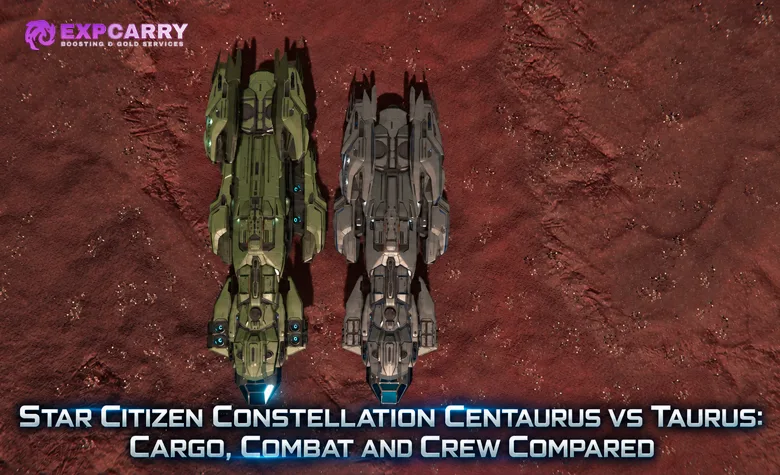
The RSI Constellation Mk V Centaurus looks like an obvious upgrade from the Mk IV Taurus: more cargo capacity, stronger defenses, larger turrets and a docked fighter. However, Taurus owners should consider what they actually do between takeoff and landing. In Star Citizen Alpha 4.10.2 LIVE, the Centaurus carries 240 SCU compared with the Taurus's 174 SCU, but both ships give the pilot four Size 5 weapons. The Centaurus becomes significantly more dangerous when additional players operate its turrets, while the Taurus retains a dedicated cargo tractor turret and a smaller, more manageable hull. For a solo pilot running regular freight contracts, the Taurus remains an excellent daily ship. For a group combining cargo, combat and vehicle transport, the Centaurus offers a more substantial change in capability.
Short answer: Keep the Taurus if you mostly fly alone and value efficient loading, maneuverability and strong pilot-controlled weapons. Upgrade to the Centaurus if you regularly have two to four players aboard, need 240 SCU or large-vehicle transport, and will actually use its additional turrets and Skylark.
Centaurus vs Taurus: Key Specifications
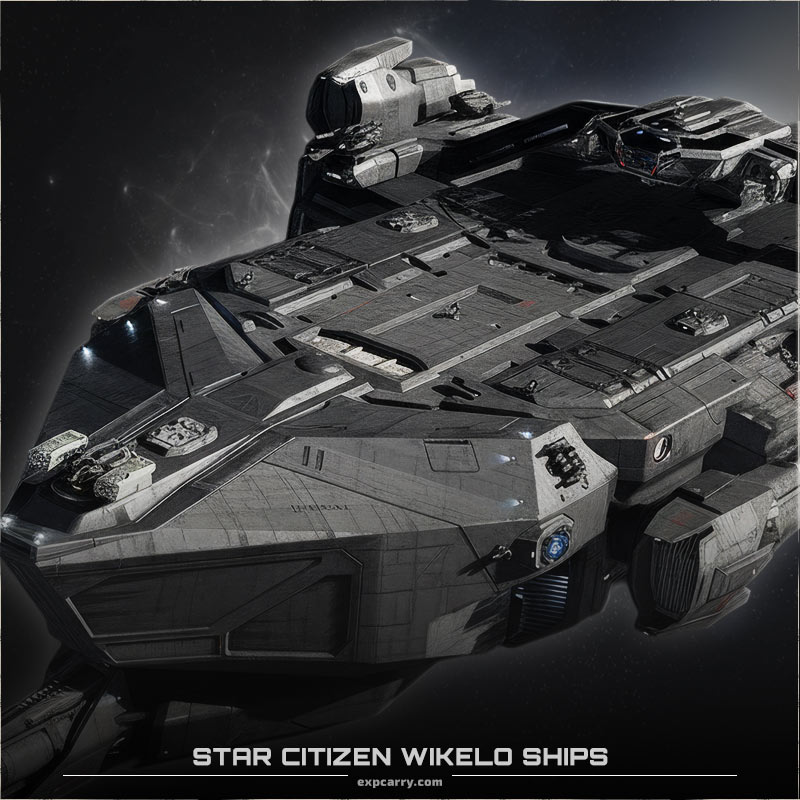
The main distinction is not simply that the Centaurus is newer. The Taurus is a cargo-focused Mk IV Constellation, whereas the Mk V Centaurus combines freight capacity with a heavier multicrew combat configuration. Both are flight-ready in the current LIVE environment, but they approach the same general-purpose role differently. The figures below reflect the current official RSI Ship Matrix and the developer's published Centaurus design details.
| Specification | Constellation Taurus | Constellation Centaurus |
|---|---|---|
| Cargo capacity | 174 SCU | 240 SCU |
| Pilot-controlled guns | 4 × Size 5 | 4 × Size 5 |
| Crew-operated guns | 1 manned turret with 2 × Size 3 | 2 remote turrets with 4 × Size 3 each |
| Cargo tractor turret | Yes, dedicated lower turret | No equivalent built-in cargo tractor turret |
| Ready missiles | 24 × Size 2 | 32 × Size 2, with internal racks for in-flight reloading |
| Shield generators | 1 × Size 3 | 2 × Size 3 |
| Docked snub fighter | None | RSI Skylark |
| SCM speed | 180 m/s | 170 m/s |
| NAV speed | 950 m/s | 1,075 m/s |
| Length | 69 m | 82.5 m |
| Beam | 28.6 m | 47.5 m |
| Listed crew capacity | 4 | 4 |
The Centaurus has better headline numbers in cargo capacity, shields, missiles and crew weapons, but its size creates practical costs. It is longer and substantially wider, which affects approach angles, landing clearance and the space needed to turn around obstacles. Its lower SCM speed and reduced maneuverability also matter in situations where a pilot must reposition quickly. The Taurus gives up some capabilities in exchange for a simpler freight workflow and a less demanding footprint.
Cargo Capacity: Is 240 SCU Worth More Than 174 SCU?
The Centaurus gains 66 SCU of nominal cargo capacity, an increase of approximately 38% over the Taurus. That is a meaningful difference when a contract, trade route or collection of freight orders can fill the extra space. It does not automatically translate into 38% more profit per hour, because loading, unloading, travel time, cargo availability and mission requirements remain part of the calculation. A larger grid is valuable only when you can regularly use it.
Both ships use ventral cargo elevators, but the Centaurus provides a larger internal cargo area designed to accommodate more substantial payloads. Its capacity can make mixed cargo and vehicle operations easier to organize. The Taurus is more specialized around routine freight handling, with a cargo arrangement designed for transporting goods and getting them back out efficiently. RSI's official cargo guide identifies the Taurus as a 174-SCU cargo option, which remains a useful benchmark when comparing freight ships.
Why the Taurus Can Be Easier to Load
The Taurus has a dedicated lower tractor-beam turret, allowing an operator to manipulate cargo without relying exclusively on handheld equipment. A solo owner must still move between the pilot's position and the cargo workstation, but the tool is already integrated into the ship. With two players, one can manage the cargo tractor while the other handles positioning, logistics or security. This is particularly useful when making frequent stops rather than completing a single large transfer.
The Taurus also has a QuikHitch cargo-release system and a reinforced security hold in its advertised design. These features support its identity as a dedicated freighter, although players should verify the current behavior of cargo-release and scanning-related mechanics in the LIVE build rather than assuming every advertised benefit is fully implemented. The reliable distinction is its dedicated cargo tractor and smaller hull, not a guarantee that unloading is instantaneous or that particular cargo can never be scanned.
When the Centaurus Cargo Hold Is Better
The Centaurus is particularly attractive when the cargo itself is physically difficult to accommodate in a smaller ship. CIG confirms that its enlarged hold can transport the Tumbril Nova tank, giving it a major advantage for missions built around substantial ground vehicles. That capability matters independently of the SCU figure: a vehicle's shape, clearance and placement can be more restrictive than its apparent volume. A Nova occupying the hold also reduces the room available for ordinary freight, so the full 240 SCU should not be treated as additional usable cargo alongside every large vehicle.
The main compromise is the absence of the Taurus's dedicated tractor-beam turret. Centaurus crews should plan around handheld tractor tools or suitable external loading equipment, especially when dealing with numerous containers. The larger elevator and hold provide more capacity, but a bigger load can still take longer to arrange. If you are comparing ship investment with the aUEC needed for cargo operations, account for the credits tied up in freight and the time spent completing each route, not just the maximum amount the ship can carry.
Pilot Weapons, Turrets and Combat Survivability
The most important combat fact for a Taurus owner is straightforward: both ships provide four Size 5 pilot-controlled weapons. Moving to the Centaurus does not give the pilot additional main guns. Its combat advantage comes from crew-operated weapons, increased defensive hardware, a larger missile loadout and reinforced armor. These improvements can be substantial in organized engagements, but they are not all available to a player flying alone.
Pilot Firepower vs Crew Firepower
The Taurus carries one manned combat turret with two Size 3 weapons. Its other turret position is dedicated to cargo handling. The Centaurus replaces that division of labor with two remote combat turrets, each mounting four Size 3 weapons. When both positions are occupied, the ship can bring eight additional Size 3 guns into combat beyond the pilot's four Size 5 weapons. The remote stations are controlled by separate crew members from the bridge.
That does not mean a fully crewed Centaurus will always deliver its theoretical maximum firepower to a single target. Turret firing arcs, target position, available power, weapon choice and crew accuracy affect actual damage. With only one person aboard, the extra turret guns do not increase what the pilot can fire from the main seat. With a second player, however, one quad-Size-3 turret represents a more meaningful combat station than the Taurus's dual-Size-3 turret.
Shields, Armor and Missiles
The Centaurus carries two Size 3 shield generators compared with the Taurus's single Size 3 generator. CIG also describes reinforced armor and greater overall armor integrity for the Mk V. These are genuine defensive advantages, although the larger ship presents a bigger target and is slower to accelerate or turn. It may withstand more punishment while also finding it harder to avoid incoming fire, especially against smaller and more agile opponents.
The Centaurus carries 32 ready-to-fire Size 2 missiles, compared with 24 on the Taurus. It also has internal storage racks for spare missiles, allowing the crew to reload its launchers during flight when replacement missiles are available aboard. That storage does not mean another 32 missiles are automatically available for immediate firing; someone must load the replacements into the launchers. The developer explains these details in the official Centaurus Q&A.
Component selection remains relevant on either ship. Two shield slots create a different configuration from one shield slot, but generator models, power distribution and damage state still affect combat performance. When evaluating compatible Star Citizen ship components, check the actual slots and ship configuration instead of assuming that a newer hull automatically makes every installed component optimal.
Handling: Better NAV Speed Does Not Mean Better Dogfighting
The Centaurus has a higher listed NAV speed, but the Taurus has a higher SCM speed and better turning characteristics. CIG explicitly states that the Mk V uses a heavier handling profile and needs more space to reposition. Those differences are easy to overlook when comparing weapon mounts on paper. In practice, a solo pilot may find the Taurus more comfortable for tracking targets, correcting approaches and escaping awkward positions around stations or terrain.
Neither Constellation should be evaluated as if it were a light fighter. The Centaurus is most effective when its pilot manages range and orientation while crewmates cover additional angles. The Taurus relies more heavily on the pilot's own positioning and its smaller profile. A stronger shield configuration does not remove the need to avoid unfavorable engagements.
Explore services related to this guide, selected from our Star Citizen catalog.
View All Star Citizen Services
Solo, Duo or Full Crew: Which Ship Benefits You Most?
The Centaurus's value changes sharply with crew availability. Both ships list four crew positions, but the Centaurus provides more separate jobs that directly contribute to combat. That creates an opportunity for a coordinated group and an efficiency problem for someone who usually logs in alone. The relevant question is not how many people can fit inside the ship, but how many are regularly available and willing to operate its systems.
Solo Player: Taurus Is Usually the Better Daily Driver
A solo Taurus pilot gets four Size 5 guns, 174 SCU, a dedicated cargo tractor and a comparatively manageable ship. The Centaurus provides the same pilot guns, more cargo space, more missiles and stronger shields, but its two remote combat turrets sit unused without other operators. Its larger size also makes tight landing areas and quick maneuvering less convenient. The result is a ship with greater maximum capability but lower utilization of that capability.
There are valid solo reasons to switch. If your usual freight operations exceed 174 SCU, you regularly need the Centaurus's large-vehicle clearance, or you place a high value on additional shielding, the Mk V may suit your routine. However, buying it solely to increase solo gun damage would be a mistake. Pilots who struggle with large-ship approaches or combat positioning may also benefit from practical Star Citizen flight coaching before deciding whether the limitation is the ship or their handling technique.
Two Players: Decide Between Cargo Handling and One Powerful Turret
A duo gets a clear choice. In the Taurus, the second player can operate the combat turret when threatened or use the lower tractor station during loading operations. That flexibility is valuable for freight-focused sessions in which most of the work happens outside combat. The pair can run cargo efficiently while retaining an additional defensive gun position when necessary.
In the Centaurus, the second player can occupy one remote quad-Size-3 turret, making the ship much more threatening during encounters than it is with only the pilot aboard. The same player could instead help with loading, missile resupply or other ship tasks, but cannot fill all those roles simultaneously. For a duo that frequently alternates between fighting and transporting cargo, the Centaurus becomes attractive. For a duo primarily moving freight between stops, the Taurus's dedicated loading equipment may be more useful than four turret guns.
Three or Four Players: Centaurus Gains a Clearer Identity
With three players, the Centaurus can field a pilot and operators for both quad-Size-3 remote turrets. This is the crew configuration that most clearly separates its combat output from the Taurus. A fourth player can handle logistical tasks, support engineering or operate the docked Skylark when the mission calls for an independent fighter. The crew still needs to decide who will stop firing to reload missiles, manage equipment or handle cargo.
The Skylark is a genuine part of the Centaurus package, as confirmed by RSI's included-vessels support article. It carries three Size 2 guns and two five-missile Size 1 racks, offering a separate craft for scouting, pursuit or tactical support. However, it does not turn the Centaurus into a complete fighter-service platform: the mothership cannot refuel, rearm or repair the Skylark through the recently introduced mothership servicing feature. It also cannot dock a P-52 Merlin or P-72 Archimedes in the Skylark's place.
Daily Use: Freight Routes, Bounties and Ground-Vehicle Missions
The best ship on a specification sheet is not necessarily the ship that completes your usual activities with the least friction. Taurus owners should consider how often they fill the entire hold, whether they fight while carrying valuable cargo, and how many people typically join their session. A mixed mission profile can justify a more capable hull, but repeated short tasks often favor easier handling and faster setup.
| Activity | Practical choice | Reason |
|---|---|---|
| Solo cargo hauling with frequent stops | Taurus | Built-in tractor turret, smaller footprint and ample capacity for many routine loads |
| Large-volume freight runs | Centaurus if the extra space is consistently used | 66 additional SCU per full load, subject to physical cargo placement and route economics |
| Solo bounty missions | Taurus for handling; Centaurus for additional protection | Same four pilot guns, with different maneuverability and defenses |
| Two-player combat and mixed missions | Centaurus | One crewmate can operate a quad-Size-3 remote turret |
| Three-player combat operations | Centaurus | Pilot and both remote turret positions can be active simultaneously |
| Large ground-vehicle transport | Centaurus | Enlarged hold officially supports vehicles including the Tumbril Nova |
| Compact, general-purpose daily travel | Taurus | Smaller dimensions and stronger maneuverability reduce handling demands |
Cargo profitability deserves particular attention. The Centaurus can move more freight in one fully utilized trip, but that advantage matters less when contracts are smaller than either hold, a route runs out of desirable commodities, or loading consumes a large share of the session. The Taurus can be the more productive ship for a player who values dependable, repeatable workflows over maximum capacity. Conversely, a coordinated crew transporting substantial freight and a large vehicle may benefit from the Centaurus in ways that a simple SCU-per-minute calculation misses.
Combat presents a similar distinction. A solo Centaurus has better defenses and a larger ready missile supply, but the pilot's four Size 5 guns remain unchanged. A crewed Centaurus gains additional firing positions that can engage threats while the pilot maintains course or protects cargo. That makes it a stronger choice for groups entering dangerous areas deliberately, provided the crew can coordinate turret coverage and manage the ship's heavier handling.
Should You Upgrade From a Taurus to a Centaurus?
A Taurus-to-Centaurus upgrade makes sense when it changes the missions you can perform or improves the experience of people who regularly play together. The Centaurus is not a straight replacement for every Taurus advantage, because it sacrifices a cargo-focused tool and easier handling to gain a larger, more combat-oriented hull. Before committing to a pledge upgrade, review your actual playtime distribution rather than counting features you might use someday.
The Centaurus is worth considering if:
- You regularly fill the Taurus's 174-SCU hold and can make practical use of another 66 SCU.
- You want to transport large ground vehicles such as the Tumbril Nova.
- You normally fly with at least one other player who actively uses a remote combat turret.
- You often have three or four players available for turret operation, logistics and Skylark missions.
- You value the additional Size 3 shield generator, reinforced armor and larger missile supply enough to accept heavier handling.
Keep the Taurus if:
- Most of your sessions are solo cargo runs, deliveries or general-purpose travel.
- Your normal jobs rarely require more than 174 SCU.
- The dedicated tractor-beam turret is important to your loading routine.
- You prefer faster turns, a smaller landing footprint and less demanding ship positioning.
- You are upgrading mainly because you expect more pilot-controlled firepower; both ships already have four Size 5 pilot guns.
If the decision involves a real-money ship upgrade, check the current RSI upgrade tool, your existing pledge's insurance and package contents, and the actual checkout difference. Store prices and available upgrade paths can change, so an older price comparison is not a reliable basis for today's decision. If possible, fly a Centaurus with a crew and then repeat the same freight or combat activity in your Taurus. The comparison is most useful when you test the tasks you perform regularly rather than a one-off showcase mission.
Centaurus vs Taurus FAQ
These questions cover several practical details that can affect the decision even after comparing cargo and combat statistics.
Can a solo Centaurus pilot control the two quad-Size-3 turrets?
No. The pilot controls the four Size 5 main weapons, while the remote turrets are separate crew stations. Do not count their eight Size 3 guns as additional solo pilot firepower.
Does the Centaurus have the Taurus's built-in cargo tractor turret?
No. The Taurus retains a dedicated cargo tractor station, while Centaurus crews must plan their loading workflow around other cargo-handling tools. More cargo capacity does not mean the Centaurus is automatically faster to load.
Can a Merlin or Archimedes dock with the Centaurus?
No. CIG confirms that the Mk V Centaurus docking arrangement is currently compatible with the RSI Skylark only. The P-52 Merlin and P-72 Archimedes use different docking geometry.
Does the Skylark need to be purchased separately for a Centaurus owner?
No. RSI lists the Skylark as an included vessel for the Centaurus. Included craft are currently handled through the game's loaner system and may not appear as separate items in the original pledge listing.
Final Verdict: Taurus for Solo Efficiency, Centaurus for Crewed Versatility
The Taurus remains the more practical choice for many solo players because it combines 174 SCU, four Size 5 pilot guns, integrated cargo handling and a manageable hull. The Centaurus is a worthwhile step up when its additional 66 SCU, larger vehicle clearance, stronger defenses and two quad-Size-3 turrets serve missions you actually run. If you routinely fly with a small group, the Centaurus can offer a substantially richer multicrew experience. If you usually fly alone, keeping the Taurus is often the smarter decision.