
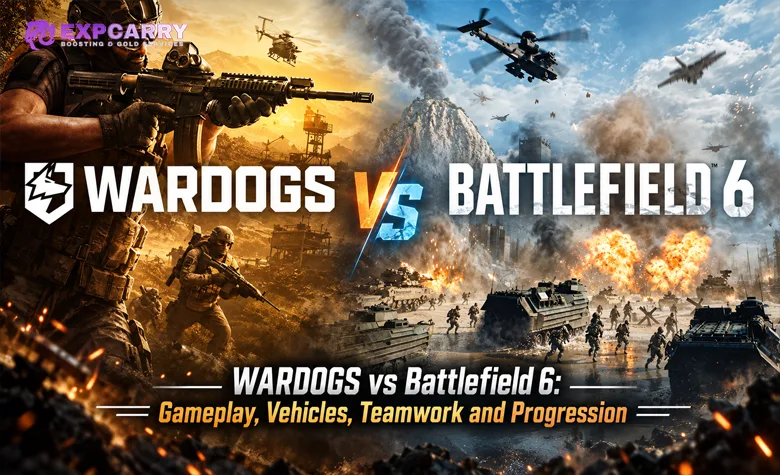
WARDOGS vs Battlefield 6 comes down to what you want from a large-scale multiplayer FPS. Battlefield 6 makes objectives, squad spawns, class tools and vehicle pushes the center of each match. WARDOGS adds persistent cash and paid equipment: the gear you deploy with costs money, while reviving, transporting teammates and playing the objective can earn that money back. That makes survival and support work part of the long-term decision-making rather than just the current scoreboard.
Battlefield 6 is the easier fit for friends who want accessible combined-arms combat, multiple multiplayer modes and crossplay. WARDOGS offers a different proposition for a PC group: flexible loadouts, three competing teams and an economy that makes transport, medical work and logistics financially useful. WARDOGS launched in Steam Early Access on September 10, 2026, so its progression grind and still-evolving server tools are as important to the comparison as the firefights themselves.
WARDOGS vs Battlefield 6: Gameplay and Core Differences
The closest comparison is WARDOGS vs Battlefield 6 Conquest. Both let infantry and vehicles shape a large battle, but they organize that battle differently. WARDOGS concentrates three teams around a randomized Control Zone. Conquest spreads two teams across multiple objectives, giving squads more opportunities to redirect pressure by attacking or defending somewhere else.
| Comparison | WARDOGS | Battlefield 6 multiplayer |
|---|---|---|
| Core objective | Up to 100 players across three teams; control of the Control Zone generates points | Conquest objectives and team lives, Breakthrough sectors, Escalation objectives, Rush M-COMs and smaller modes |
| Deployment choices | Purchase a loadout with persistent cash; equipment, inventory and vehicles shape your role | Select an unlocked class loadout without paying to replace the same unlocked equipment after every death |
| Team contribution | Reviving, healing, transport, logistics, building and objective play can generate cash | Assault, Engineer, Support and Recon provide distinct squad tools for attacking, repairing, resupplying, spotting and reviving |
| Vehicle appeal | Purchased ground vehicles and helicopters support both combat and logistics | Tanks, IFVs, anti-air vehicles, transports, helicopters and jets, depending on the map and mode |
| Progression pressure | Career and role requirements sit alongside unlock costs and the recurring cost of deployments | Career Rank, weapon and vehicle Hardware XP, Assignments and seasonal unlock paths |
| Friends on different platforms | PC Early Access; consoles planned for 2028 | Crossplay between PC, PlayStation 5 and Xbox Series X|S |
The official WARDOGS FAQ explains the scoring rule: every 30 seconds, the team with the most players inside the Control Zone earns one point, and the first team to reach 100 wins. Eliminations still matter because they remove enemy players from the fight, but a sniper outside the zone does not add a body to the scoring population. Moving several teammates into the zone can therefore influence the result even when the driver or pilot never fires a shot.
Battlefield 6 Conquest connects objective control to pressure on the enemy team's lives, while deaths that are not reversed by revives also reduce that resource. Breakthrough concentrates the battle into successive attacking and defending sectors, while Escalation adds another large-map objective format. That range is a significant Battlefield advantage: the same game can provide a distributed vehicle battle, a concentrated sector assault or a smaller infantry-focused fight.
WARDOGS vs Battlefield 6: Maps, Combat Pace and Gunplay
WARDOGS has a slower decision cycle without making every gunfight slow. Before deploying, players decide what to buy and carry, then need a practical route into the fighting. Weight, backpack space, ammunition types and projectile behavior make equipment selection part of the combat problem. Carrying tools for several jobs increases flexibility, but it also requires more preparation than selecting a familiar Battlefield 6 loadout.
WARDOGS places a randomized 2x2 km Control Zone inside its much larger 256 km² battlefield. Three competing teams make that space less predictable: a position facing one opponent can become exposed when the third team arrives from another direction. Winning one exchange does not guarantee a safe route forward, which rewards players who read terrain, plan rotations and know when to disengage as much as players with strong mechanical aim.
Battlefield 6 usually gives movement a clearer immediate destination: another Conquest objective, the next Breakthrough sector, an Escalation objective or a squadmate who can provide a new spawn position. Its smaller modes also remove much of the travel and vehicle coordination. Players who mainly want repeated close-range gunfights can therefore choose a playlist that delivers them instead of committing to the largest available battlefield.
Battlefield 6 should not be judged only by its tighter maps. In PC Gamer's Railway to Golmud hands-on, a 64-player match had substantially more room for vehicles, long sightlines and fights away from the busiest central areas. Map selection changes this comparison considerably: large-map Conquest on Railway to Golmud is much closer to the WARDOGS experience than an infantry-heavy playlist.
Weapon freedom also works differently. WARDOGS lets equipment purchases and carried gear define what a player can do. Battlefield 6 supports Open Weapons, where every class can equip any weapon type, and Closed Weapons, where classes are restricted to their class-specific weapon categories. Class gadgets, signature traits and Field Specs still preserve class identity, so equipping an assault rifle does not turn an Engineer or Recon player into Assault.
For a player moving from Battlefield, the main adjustment is learning to plan the approach before committing an expensive kit. WARDOGS coaching can focus on route selection, positioning and choosing equipment for a specific battlefield role. The useful comparison is not which game's guns are universally better: Battlefield 6 gives players more control over encounter type and playlist, while WARDOGS asks them to manage more of the preparation and economy surrounding each fight.
WARDOGS vs Battlefield 6: Vehicles, Helicopters and Destruction
Battlefield 6 currently has the clearer advantage in vehicle variety. Its live roster includes main battle tanks, infantry fighting vehicles, anti-air vehicles, transports, multiple helicopter types and jets. Availability depends on the map and mode, so vehicle-focused players still need to choose the right playlist. WARDOGS supports ground vehicles and helicopters, but its current Early Access battlefield does not match Battlefield 6's full range of air and armored vehicle roles.
Battlefield 6 vehicles also give passengers distinct reasons to stay aboard. Main battle tanks accommodate four players, infantry fighting vehicles five, and attack helicopters pair a pilot with a gunner. Several vehicles also act as squad spawn points. A surviving vehicle can therefore maintain pressure through both its weapons and the infantry arriving around it, even though losing that vehicle does not subtract money from a persistent personal wallet.
WARDOGS puts more of the vehicle decision in the player's hands through its cash economy. Transport is valuable as an ongoing role because moving friendly players toward the objective can earn money while also adding bodies to the scoring area. A successful helicopter run and the passengers' successful push are therefore economically and tactically connected. Returning for another pickup can be a useful contribution even if the pilot never competes with infantry players for kills.
The drawback is that unlocking and purchasing a vehicle is not the same as being ready to operate it effectively. A player working toward a specific machine can use WARDOGS vehicle unlock assistance, but practical vehicle play still requires route knowledge, suitable landing areas, positioning and escape planning. Battlefield 6's Multiplayer Initiation and appropriate Portal experiences provide lower-pressure ways to practice vehicle handling before taking an important vehicle slot in a live match.
Building gives WARDOGS another clear distinction. Forward Operating Bases and fortifications let players invest directly in the position their team fights from, while destruction can threaten defenses that players deliberately constructed. Battlefield 6 also uses Tactical Destruction to reshape cover and buildings, but its standard class system does not reproduce the same purchased FOB and construction loop. WARDOGS gives builders a more direct strategic role; Battlefield keeps more of its battlefield infrastructure tied to existing objectives and spawn systems.
Both games punish armor that operates without infantry support. Battlefield 6 makes those relationships especially easy to understand through its classes: Engineers specialize in vehicle repair and anti-vehicle tools, Support keeps teammates supplied and alive, Recon provides information, and Assault helps create pressure around objectives. The important question is not simply which tank has the stronger gun, but whether the crew and nearby infantry can sustain the vehicle while denying the enemy's counters.
Explore services related to this guide, selected from our Wardogs catalog.
View All Wardogs Services
WARDOGS vs Battlefield 6: Death, Respawns and Persistent Cash
Death is one of the sharpest differences between WARDOGS and Battlefield 6. In WARDOGS, losing an equipped life can mean spending more cash to replace the weapons, equipment or vehicle you brought. Cash carries between matches, so repeated expensive losses can reduce the loadouts you are comfortable funding later. In standard Battlefield 6 multiplayer, dying does not make you repurchase an unlocked rifle, optic or class gadget.
WARDOGS also makes the revive itself part of the economy. A downed player can offer additional money to encourage a medic to prioritize the rescue. Sean Martin's September 11 hands-on with the revive payment system describes players responding to those offers in live Early Access matches. It is a practical example of the game's broader design: helping another player can carry an immediate personal financial incentive.
That arrangement can create memorable cooperation, but it does not make every revive sensible. A downed player exposed to the same position that caused the casualty is still dangerous to reach. The useful question is whether the body can be recovered with cover, smoke or support. Expensive equipment makes survival more valuable, but money already spent should not turn an unwinnable rescue into a good tactical decision.
Battlefield 6 puts more of the death penalty on team resources and battlefield position. Non-Support classes can revive their own squadmates, while Support is the dedicated medical class, revives teammates faster and can use the Defibrillator for faster revives. Players can also drag downed teammates while reviving them. In Conquest, a successful revive can preserve a life for the team while keeping a squad close to the objective instead of forcing another deployment.
This makes Battlefield 6 more forgiving when experimenting with weapons, classes or routes. Trying another approach after a death does not require rebuilding a personal budget. WARDOGS gives successful survival greater economic continuity, but that same continuity makes repeated expensive failures harder to ignore. Neither system makes reckless deaths harmless: WARDOGS emphasizes replacement cost, while Battlefield emphasizes team lives, lost positions and broken squad pressure.
WARDOGS vs Battlefield 6: Progression, Classes and Teamwork
WARDOGS separates battlefield jobs from a rigid class selection. Medical equipment lets you help casualties, construction tools let you build, and larger carrying capacity can support several tasks in one loadout. Role and Career progression still matter, however. Flexible equipment does not mean a new account immediately has access to every weapon, tool or vehicle.
WARDOGS launch progression is also substantially slower than its beta progression. BULKHEAD's September 9 Season 1 changelog, available in the official WARDOGS announcements, moved the Heavy Tank to Driver level 35 and Artillery to Career level 90, while increasing the Forward Operating Base vendor price from $2,500 to $7,500. These are current launch values, but WARDOGS is in Early Access and later balance updates can change them.
That creates several layers of progression pressure: a player needs to reach the relevant requirement, afford an unlock where applicable and still have enough cash to deploy the equipment they want to use. Someone can remain effective with a relatively cheap infantry kit while being far from an expensive vehicle goal. Conversely, reaching the required progression level does not eliminate the economic decisions attached to using high-value equipment.
Battlefield 6 separates progression into Career XP, Hardware XP and Battle Pass XP. Career Ranks provide many foundational unlocks through rank 50, while Hardware XP develops individual weapons and vehicles. Assignments, Challenges and seasonal paths can add separate requirements. Reaching Career Rank 50 therefore does not mean that every weapon, attachment or later seasonal item is automatically unlocked.
Battlefield 6 progression has friction of its own. Some hardware is tied to Assignments or Challenges, while individual weapons and vehicles have their own progression for attachments and upgrades. Catch-Up Hardware Challenges can provide routes to missed functional seasonal content. The major difference from WARDOGS is that once standard Battlefield equipment is unlocked, using it repeatedly does not require another personal cash payment every time you deploy.
For WARDOGS players pursuing a specialist role, WARDOGS role leveling assistance can focus on the relevant progression track. For ordinary team play, the more important distinction is between a long-term unlock goal and what the team needs immediately. Working toward a Heavy Tank does not prevent a player from contributing through cheaper transport, medical equipment, construction or simply adding another body to the Control Zone.
The teamwork tradeoff follows directly from those systems. WARDOGS lets players create their own division of labor through equipment, but a flexible squad can still forget an important capability. Battlefield 6 makes responsibilities easier to recognize through Assault, Engineer, Support and Recon. Support can resupply and revive, Engineer can repair vehicles and attack enemy armor, Recon supplies battlefield information, and Assault specializes in frontline pressure. Clear class identities reduce how much coordination strangers need before becoming useful to each other.
WARDOGS provides a stronger direct economic incentive for helping strangers, while Battlefield 6 provides a clearer standardized toolkit for doing it. Cash can encourage a player to become a dedicated medic, driver or transport pilot because those jobs help fund future deployments. Battlefield's class system makes the same kinds of support easier to recognize at a glance. Which model works better for a group depends on whether its players enjoy creating their own roles or prefer familiar responsibilities built into the class system.
WARDOGS vs Battlefield 6: Crossplay, Friends and Solo Play
For a group split between PC and consoles, Battlefield 6 is currently the practical choice. Crossplay supports PC, PlayStation 5 and Xbox Series X|S. WARDOGS is currently available in PC Early Access, with consoles planned for 2028 and limited controller support in the present version. A future console release does not solve the problem for friends who want to play together across platforms now.
EA's Battlefield 6 crossplay instructions explain that crossplay is enabled by default and EA Connect can be used to find friends by EA or platform ID and invite them to a party. Battlefield's standard squad structure gives a four-player group a straightforward unit to organize around. On consoles, disabling crossplay limits play to people using the same platform, so cross-platform friends need crossplay enabled.
WARDOGS relies more heavily on servers and team availability than Battlefield 6's cross-platform party flow. A PC group needs to find a server with enough space for everyone and coordinate so friends can fight together rather than simply joining separate sides of the same battle. Local voice communication and community servers add social possibilities once players are inside, but the server-browser structure currently requires more setup from a regular group.
Those server tools are still changing during Early Access. Patch 0.11 is scheduled for September 14 at 08:00 UTC, with approximately one hour of downtime. BULKHEAD says the update is intended to improve the server-browser experience and make community servers easier to surface. Community servers will also receive a 5% End of Match cash bonus for one week after the patch. As of September 13, these changes are announced but not yet live.
Solo players face a more interesting choice than simply picking whichever game requires less coordination. Battlefield 6 lets a solo player choose an objective format and contribute through recognizable class tools without a premade squad. WARDOGS lets a solo player build an entire session around transporting, reviving, building or supporting strangers. Its drop-in, drop-out design also supports short sessions, although buying a loadout and reaching a useful position can consume more of that time than jumping into a smaller Battlefield mode.
For a reliable weekly session, Battlefield 6 has substantial advantages in platform support, party flow and mode selection. For PC friends who enjoy community servers, persistent cash and the social interactions around a large battle, WARDOGS offers a different reason to return. That experience should become easier as Early Access server tools improve, but announced improvements should not be confused with features that are already live.
WARDOGS vs Battlefield 6 FAQ
The main buying questions are less about which shooter is universally better and more about the kind of commitment each game expects. WARDOGS and Battlefield 6 overlap in combined-arms combat, but their economy, progression, class structure, platforms and consequences for death create substantially different multiplayer experiences.
Is WARDOGS an extraction shooter?
No. WARDOGS is built around a three-team Control Zone battle, not extracting with loot to determine victory. Persistent cash and paid equipment add financial risk to each life, but the match is won by controlling the objective and reaching the required score.
Does Battlefield 6 have a cost for dying?
Standard Battlefield 6 multiplayer does not make you repurchase an unlocked loadout after every death. Death still matters because it can reduce team lives in modes such as Conquest, remove your squad from an important position and interrupt pressure on an objective.
Can WARDOGS be played casually?
Yes. WARDOGS supports drop-in, drop-out play, and useful contributions do not require an expensive vehicle or top-tier loadout. It is less frictionless than Battlefield 6 if your definition of casual play means minimal preparation, immediate matchmaking and no persistent equipment budget to consider.
WARDOGS or Battlefield 6: which is better for helicopter players?
Battlefield 6 has a broader established aircraft roster and dedicated combat helicopter roles. WARDOGS is especially interesting for players who want helicopter transport and logistics to function as repeatable, economically rewarded team jobs rather than simply as ways to reach the next firefight.
WARDOGS vs Battlefield 6: Which Game Should You Play?
Battlefield 6 is the easier recommendation for a mixed-platform group looking for a repeatable multiplayer shooter. Crossplay, four-player squads, recognizable classes and multiple objective modes give friends more ways to choose the kind of fight they want. Large-map Conquest and maps such as Railway to Golmud also preserve the vehicle-heavy, maneuver-focused side of Battlefield. Its biggest advantage is how quickly a group can move between different styles of action without rebuilding its plans around a persistent equipment budget.
WARDOGS is more compelling when the work surrounding a firefight is part of the attraction. Persistent cash, transport, construction, revives, logistics and flexible equipment give players a direct stake in how the battle is sustained. The tradeoff is slower specialist progression and the rougher edges of a game that has only just entered Early Access. Choose WARDOGS if your PC group wants those responsibilities, economic consequences and social encounters; choose Battlefield 6 if crossplay, established class roles and easy access to varied multiplayer fights are the priority.